Myocardial Infarction (Heart Attack): Symptoms, Tests, Treatment and Recovery
The essentials
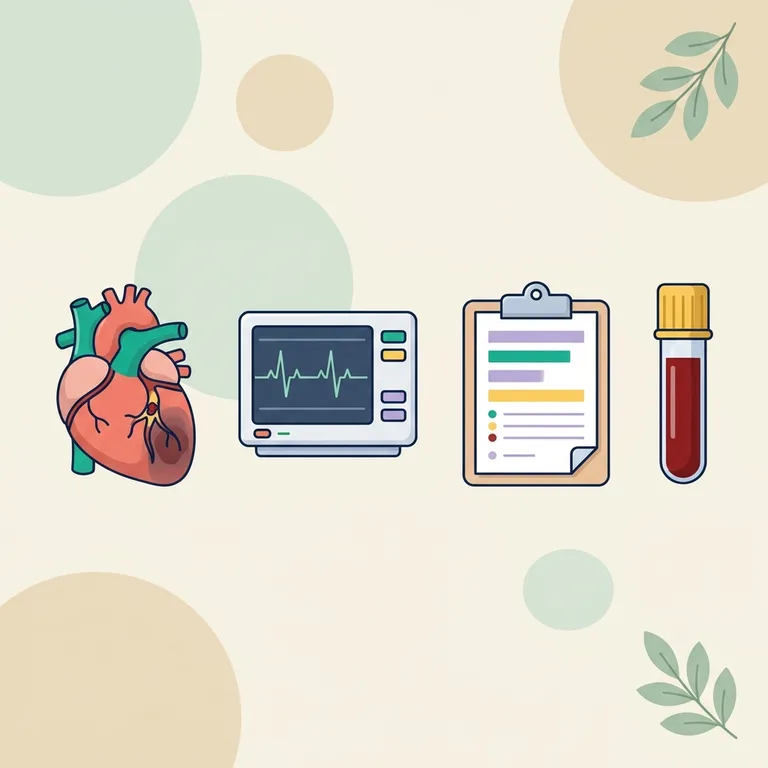
A myocardial infarction, or heart attack, happens when blood flow to part of the heart muscle is suddenly blocked. Chest pain or pressure is the most common sign, but women, older adults and people with diabetes may mainly feel short of breath, very tired or sick to the stomach. Call 911 at once and do not drive yourself. The diagnosis rests on an ECG and repeated troponin blood tests.
What is a myocardial infarction, at a glance?
- What it is: "myocardial" means heart muscle and "infarction" means tissue death from lack of blood. If blood flow is not restored quickly, the blocked part of the heart muscle dies[1].
- How common: more than 800,000 people in the United States have a heart attack each year[1], about one every 40 seconds[5].
- Main cause: coronary artery disease[4].
- Not cardiac arrest: in cardiac arrest the heart suddenly stops beating; a heart attack can trigger it[1].
- Key tests: an electrocardiogram (ECG or EKG), then troponin blood tests repeated over a few hours[7][8].
What are the symptoms of a heart attack?
Symptoms can begin slowly or suddenly, be mild or severe, and come and go over several hours[2]:
- chest pain, pressure, heaviness or squeezing in the center or left side of the chest, often lasting more than 20 minutes[7];
- pain in one or both arms, the back, shoulders, neck, jaw or above the belly button;
- shortness of breath, a cold sweat, nausea or vomiting;
- light-headedness, dizziness, unusual tiredness, or a fast or irregular heartbeat[2].
In women, chest pain is also the most common symptom, but pain in the shoulder, back or arm, shortness of breath, unusual tiredness and weakness, an upset stomach or anxiety are more frequent, with or without chest pain[3]. Women often wait longer before calling for help[3]. Older adults and people with diabetes may have little or no chest pain, and some heart attacks are "silent", found later on an ECG[2][7].
Angina or heart attack? Stable angina comes with effort and eases within minutes with rest or medicine; heart attack pain does not. If you are not sure, call 911[2].
What should you do if you think you are having a heart attack?
When to see a doctor
- Emergency: call 911 right away, even if you are not sure it is a heart attack. Do not drive yourself or let someone drive you: the ambulance team can start tests and treatment on the way[2]. Do not wait to see if symptoms go away. Chew an aspirin only if the 911 operator or a doctor tells you to and you are not allergic to it; never delay the call to take one[6]. If the person collapses and does not breathe normally, start CPR and use an AED if available[6].
- Within 24 hours for new chest discomfort with effort that eases with rest, angina that comes more often, or new unexplained breathlessness, especially if you have diabetes or a past heart attack. If in doubt, call 911.
- At your next appointment to review cholesterol, blood pressure, blood sugar and medicines after a heart attack.
Every minute matters: the risk of sudden death is highest in the first hours[7].
What causes a heart attack, and who is at risk?
Most heart attacks start with plaque made of fat, cholesterol and calcium in a coronary artery. When the plaque breaks open, a clot forms and blocks the artery[4].
- Common Plaque rupture and clot, linked to high cholesterol, high blood pressure, smoking, diabetes, obesity, inactivity, age and family history[4].
- Possible Too little oxygen for the heart's needs without a new clot (type 2 myocardial infarction), for example with severe anemia, a very fast rhythm or a serious infection[10].
- Possible A heart attack without blocked arteries (MINOCA), more common in women and younger people: artery spasm (smoking, cocaine) or a clot traveling to the heart[4].
- Rare A tear inside a heart artery (SCAD), mostly in women under 50 or around pregnancy[4].
How is a heart attack diagnosed? The ECG and troponin tests
Doctors diagnose a myocardial infarction when troponin rises or falls over time with at least one value above the upper reference limit, together with signs of a lack of blood to the heart: typical symptoms, new ECG changes or new damage seen on imaging[10].
- STEMI: a raised "ST segment" on the ECG usually means a fully blocked artery, to be opened as fast as possible without waiting for blood results.
- NSTEMI: no ST elevation, sometimes a normal ECG; the diagnosis depends on troponin[7][11]. If troponin stays normal despite symptoms, it is unstable angina, also an emergency.
How do you read repeated troponin results?
Troponin leaks from dying heart cells. What matters is the change between samples, taken at arrival and again a few hours later (often 1 to 2 hours with high-sensitivity tests)[8][11]:
- Normal, and still normal hours after symptoms began: a heart attack is unlikely[8].
- High and clearly rising or falling: acute heart damage; with symptoms or ECG changes, a heart attack[10].
- High but stable: more often long-standing damage, as in chronic kidney disease[10].
A first normal result does not rule out a heart attack: troponin starts to rise 2 to 3 hours after it begins and can keep rising for about 24 hours[8]. Limits differ between tests and sometimes between men and women[10]. CK-MB and myoglobin are now rarely needed.
| Test | Result | Reference range | Flag |
|---|---|---|---|
| Troponin T, high-sensitivity, 0 h | 21 ng/L | <14 ng/L | H |
| Troponin T, high-sensitivity, 2 h | 68 ng/L | <14 ng/L | H |
| eGFR | 78 mL/min/1.73 m² | >60 mL/min/1.73 m² | |
| LDL cholesterol | 142 mg/dL | <100 mg/dL | H |
- Two troponin lines: the value more than triples in two hours. This rise, with the symptoms, points to a heart attack.
- eGFR: kidney function, checked before medicines and angiogram dye.
- LDL cholesterol: guides cholesterol treatment after discharge.
- Reference range: these are examples; the ranges on your own report are the ones that count.
Back home with a hospital report full of troponin, kidney and cholesterol lines? BloodSense explains your complete report in plain words, so you know what to ask at your follow-up visit.
Explain my test resultsA coronary angiogram shows which artery is blocked and an echocardiogram how well the heart pumps; a BNP test may be added if heart failure is suspected[7].
What follow-up blood tests are needed after a heart attack?
- Lipid panel: repeated 4 to 12 weeks after a statin is started or changed; if LDL stays at 70 mg/dL or more, another cholesterol medicine is considered[11][12].
- Kidney function and potassium: after starting or changing medicines such as ACE inhibitors.
- Blood sugar: fasting glucose or A1C, because diabetes raises the risk.
- Complete blood count: if bleeding or anemia is suspected on blood-thinning medicines.
How is a heart attack treated?
- Opening the artery: angioplasty with a stent, ideally within 90 minutes of arrival at the hospital, or clot-dissolving medicine; sometimes bypass surgery[7].
- Emergency medicines: aspirin or another antiplatelet medicine, nitroglycerin for pain, and heart monitoring[7].
- Long-term medicines: antiplatelet medicines (often two for up to a year after a stent), a statin, and often a beta blocker and an ACE inhibitor[9][11]. Never stop them on your own[7].
What is recovery like, and how can you prevent another heart attack?
Most people survive and return to active lives, often to usual activities within a few weeks[9]. Complications include heart failure and irregular rhythms[9]. Sadness or anxiety is common at first; tell your doctor if it lasts[7].
- Join cardiac rehabilitation: supervised exercise, education and counseling[9].
- Stop smoking, eat heart-healthy, stay active and take your medicines daily[9].
- Keep blood pressure, LDL cholesterol and blood sugar on target.
- A second heart attack may feel different from the first: call 911 if in doubt[9].
Questions to ask your doctor
- Was it a STEMI, an NSTEMI or a type 2 heart attack, and why?
- How well is my heart pumping now?
- What LDL cholesterol, blood pressure and blood sugar targets should I aim for?
- When should my blood tests be repeated?
- Can you refer me to cardiac rehabilitation?
Frequently asked questions
Can a heart attack happen with a normal ECG?
Yes, especially an NSTEMI. That is why troponin and the ECG are repeated[7].
Does a high troponin always mean a heart attack?
No. It can also rise with rhythm problems, myocarditis, a pulmonary embolism, sepsis or after a marathon[8]. This is called myocardial injury[10].
Can young people have a heart attack?
Yes, though less often. SCAD, artery spasm and cocaine use are more frequent causes in younger people[4].
When can I have sex again after a heart attack?
Most people slowly return to normal activities, including sex. Ask your doctor what is safe for you[9].
Related articles
- Troponin levelsReading the main heart attack test
- Coronary artery diseaseThe disease behind most heart attacks
- AnginaChest pain from narrowed arteries
- Lipid panelThe cholesterol test to repeat
- Congestive heart failureA possible complication
- National Heart, Lung, and Blood Institute. Heart attack: what is a heart attack? Updated March 24, 2022. nhlbi.nih.gov (accessed October 28, 2026)
- National Heart, Lung, and Blood Institute. Heart attack symptoms. Updated March 24, 2022. nhlbi.nih.gov (accessed October 28, 2026)
- National Heart, Lung, and Blood Institute. Heart attacks in women. Updated March 24, 2022. nhlbi.nih.gov (accessed October 28, 2026)
- National Heart, Lung, and Blood Institute. Heart attack: causes and risk factors. Updated March 24, 2022. nhlbi.nih.gov (accessed October 28, 2026)
- Centers for Disease Control and Prevention. Heart attack symptoms, risk, and recovery. October 24, 2024. cdc.gov (accessed October 28, 2026)
- MedlinePlus Medical Encyclopedia. Heart attack first aid. Reviewed October 7, 2024. US National Library of Medicine. medlineplus.gov (accessed October 28, 2026)
- MedlinePlus Medical Encyclopedia. Heart attack. Reviewed July 14, 2024. US National Library of Medicine. medlineplus.gov (accessed October 28, 2026)
- MedlinePlus. Troponin test. US National Library of Medicine. medlineplus.gov (accessed October 28, 2026)
- National Heart, Lung, and Blood Institute. Heart attack: recovery. nhlbi.nih.gov (accessed October 28, 2026)
- Thygesen K, Alpert JS, Jaffe AS, et al. Fourth universal definition of myocardial infarction (2018). Circulation. 2018;138(20):e618-e651. doi:10.1161/CIR.0000000000000617 (accessed October 28, 2026)
- Rao SV, O'Donoghue ML, Ruel M, et al. 2025 ACC/AHA/ACEP/NAEMSP/SCAI guideline for the management of patients with acute coronary syndromes. Circulation. 2025;151(13):e771-e862. doi:10.1161/CIR.0000000000001309 (accessed October 28, 2026)
- Grundy SM, Stone NJ, Bailey AL, et al. 2018 AHA/ACC/AACVPR/AAPA/ABC/ACPM/ADA/AGS/APhA/ASPC/NLA/PCNA guideline on the management of blood cholesterol. Circulation. 2019;139(25):e1082-e1143. doi:10.1161/CIR.0000000000000625 (accessed October 28, 2026)
This page is general information and does not replace a doctor's advice. If you think someone is having a heart attack, call 911 immediately.