Norovirus: Symptoms, How Long It Is Contagious, Tests and Treatment
The essentials
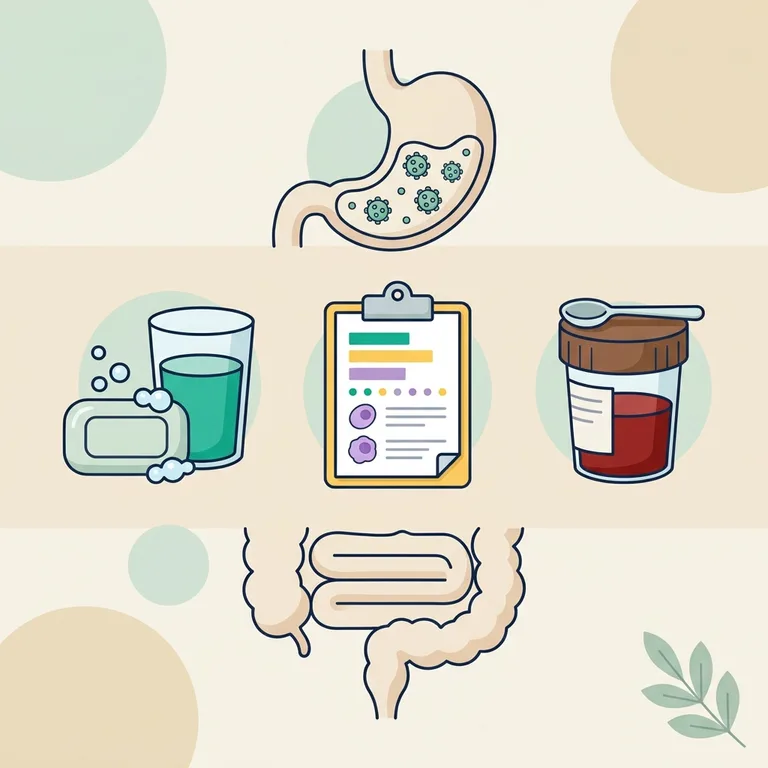
Norovirus is the "stomach bug" behind most outbreaks of sudden vomiting and diarrhea. Symptoms start 12 to 48 hours after exposure and usually last 1 to 3 days. There is no specific medicine: the main risk is dehydration, especially in young children and older adults. You stay contagious for days after you feel better, and hand sanitizer does not work well against it: soap and water do.
What is norovirus, at a glance?
- What it is: a very contagious virus and the leading cause of vomiting, diarrhea and foodborne illness in the United States[1]. It is one cause of gastroenteritis, often called "stomach flu", although it is not related to influenza.
- How common: in the United States, it causes on average 19 to 21 million illnesses, 465,000 emergency visits, 109,000 hospital stays and 900 deaths each year, mostly in older adults[2]. Worldwide, about 685 million cases a year, including 200 million in children under 5[2].
- Why it spreads so easily: fewer than 100 virus particles can cause infection, and the virus survives well on surfaces[5].
- Key test: a stool PCR (RT-qPCR) or a multiplex stool panel, when a test is needed at all[4].
What are the symptoms of norovirus?
Symptoms usually begin 12 to 48 hours after exposure[1]:
- most often diarrhea, vomiting, nausea and stomach pain;
- sometimes fever, headache and body aches.
Most people get better within 1 to 3 days[1]. The danger is losing more fluid than you take in. Signs of dehydration include passing less urine, a dry mouth and throat, and feeling dizzy when you stand up; in children, crying with few or no tears and unusual sleepiness or fussiness[1].
When should I see a doctor for norovirus?
When to see a doctor
- Emergency: call 911 for confusion or unusual drowsiness, fainting, no urine for many hours with an inability to keep any fluid down, or blood in the vomit or stool with feeling very unwell[3].
- Within 24 hours for a baby or young child who drinks little or has fewer wet diapers, an older adult who cannot keep fluids down, a pregnant woman, or anyone with a weakened immune system[1][3].
- At your next appointment if diarrhea lasts more than several days, or if it keeps coming back[3].
How do you catch norovirus, and who is at risk?
Norovirus spreads through direct contact with a sick person, contaminated food or drink, and touching contaminated surfaces and then your mouth[1]. Outbreaks are common in cruise ships, nursing homes, schools, daycare centers and restaurants.
- Anyone can get it, and many times in a lifetime, because there are many types of norovirus and protection against one type may not cover the others[1].
- Higher risk of severe illness: children under 5, older adults and people with a weakened immune system[1].
- Long-lasting infection: in transplant recipients and other immunocompromised people, norovirus can cause chronic diarrhea lasting months[6].
How is norovirus diagnosed? The tests and how to read them
Most people do not need a test: the diagnosis is based on the typical sudden vomiting and diarrhea, often in several people at once. Stool tests are used mainly in outbreaks, in hospital, in people with a weak immune system, or when symptoms last[3].
- Stool RT-qPCR: the preferred test; whole stool is the best sample[4]. A "detected" result for norovirus genogroup I or II confirms the infection.
- Multiplex stool panels: one test that looks for many germs at once, with a sensitivity for norovirus close to RT-qPCR[4].
- Rapid antigen tests: they miss many cases (sensitivity 50% to 75%), so a negative result does not rule norovirus out[4].
- Stool culture: it does not find viruses, but it checks for bacteria when the picture is unusual[3].
Blood tests do not detect norovirus, but in hospital they measure the effects of fluid loss: the basic metabolic panel shows sodium, potassium, bicarbonate and kidney function.
| Test | Result | Reference range | Flag |
|---|---|---|---|
| Norovirus GI/GII, stool PCR | Detected (GII) | Not detected | A |
| Potassium | 3.2 mEq/L | 3.5-5.0 mEq/L | L |
| Bicarbonate (CO2) | 19 mmol/L | 22-29 mmol/L | L |
| BUN/creatinine ratio | 28 | 10-20 | H |
- PCR "Detected": the virus's genetic material was found in the stool; GII is the group behind most outbreaks.
- Low potassium and bicarbonate: salts and base are lost with diarrhea and vomiting.
- High BUN-to-creatinine ratio: a pattern often seen with dehydration.
- Reference range: the ranges here are examples; the ones printed on your own report are the ones that count.
Stool panel, chemistry and blood count after a hospital visit? BloodSense explains each line of your complete report in plain words, so you can see what returned to normal and what to discuss with your doctor.
Explain my test resultsWhat follow-up is needed after norovirus?
Most people need no follow-up once eating and drinking are back to normal. When blood tests were abnormal, the doctor may repeat potassium, sodium and kidney function after rehydration. In people with a weakened immune system and lasting diarrhea, repeated stool PCR helps follow the infection[6].
How is norovirus treated?
- Fluids first: drink plenty of liquids to replace what you lose. Oral rehydration solutions sold in pharmacies are most helpful for mild dehydration; sports drinks can help but may not replace important minerals[1].
- No specific medicine: antibiotics do not help, because they act on bacteria, not viruses[1].
- Severe dehydration: treatment in hospital with intravenous fluids[1].
- Medicines for vomiting or diarrhea: only on medical advice, especially for children.
How can I avoid catching or spreading norovirus?
- Wash hands with soap and water; hand sanitizer does not work well against norovirus[7].
- Do not prepare food for others or care for others until at least 48 hours after your symptoms stop[7].
- Clean soiled surfaces with a chlorine bleach solution of 1,000 to 5,000 ppm (5 to 25 tablespoons of household bleach per gallon of water), left on for at least 5 minutes[7].
- Wash soiled laundry without shaking it, with detergent and hot water on the longest cycle, then machine-dry on high heat[7].
- Cook oysters and other shellfish to at least 145°F, and throw away food that may be contaminated[7].
- Remember that you can still spread the virus for 2 weeks or more after you feel better[1].
Questions to ask your doctor
- Do I or my child need a stool test, or can we treat this at home?
- How much should we drink, and which oral rehydration solution should we use?
- Which signs of dehydration mean we should come back?
- When can I go back to work, school or daycare?
- Should my potassium or kidney function be checked again?
Frequently asked questions
How long is norovirus contagious?
You are most contagious while sick and in the first days after, but you can spread the virus for 2 weeks or more after you feel better[1]. That is why hand washing must continue.
Can you get norovirus twice?
Yes. There are many types, and protection after an infection is partial and of unknown duration[1].
Is norovirus the same as food poisoning?
Norovirus is the leading cause of foodborne illness in the United States[1], but "food poisoning" can also come from bacteria such as Salmonella, which a stool culture can find.
How is norovirus different from rotavirus?
Both cause vomiting and diarrhea. Rotavirus mostly affects young children and has a vaccine; it is checked with a rotavirus antigen test.
Related articles
- GastroenteritisAll the causes of vomiting and diarrhea
- DehydrationThe main danger of norovirus
- Multiplex stool panelsHow one stool test checks many germs
- Viral antigen testsWhy a negative rapid test can miss norovirus
- Potassium blood testOften low after vomiting and diarrhea
- Basic metabolic panelThe blood test that checks salts and kidneys
- Centers for Disease Control and Prevention. About norovirus. April 24, 2024. cdc.gov (accessed October 27, 2026)
- Centers for Disease Control and Prevention. Norovirus facts and stats. May 8, 2024. cdc.gov (accessed October 27, 2026)
- MedlinePlus Medical Encyclopedia. Viral gastroenteritis (stomach flu). Reviewed April 27, 2026. US National Library of Medicine. medlineplus.gov (accessed October 27, 2026)
- Centers for Disease Control and Prevention. Laboratory testing for norovirus. April 24, 2024. cdc.gov (accessed October 27, 2026)
- Robilotti E, Deresinski S, Pinsky BA. Norovirus. Clin Microbiol Rev. 2015;28(1):134-164. doi:10.1128/CMR.00075-14 (accessed October 27, 2026)
- Bok K, Green KY. Norovirus gastroenteritis in immunocompromised patients. N Engl J Med. 2012;367(22):2126-2132. doi:10.1056/NEJMra1207742 (accessed October 27, 2026)
- Centers for Disease Control and Prevention. Preventing norovirus. January 13, 2025. cdc.gov (accessed October 27, 2026)
This page is general information. It does not replace the advice of a doctor, who assesses dehydration and decides on tests and treatment.