STI Testing: Which Tests to Get and How to Read the Results
The essentials
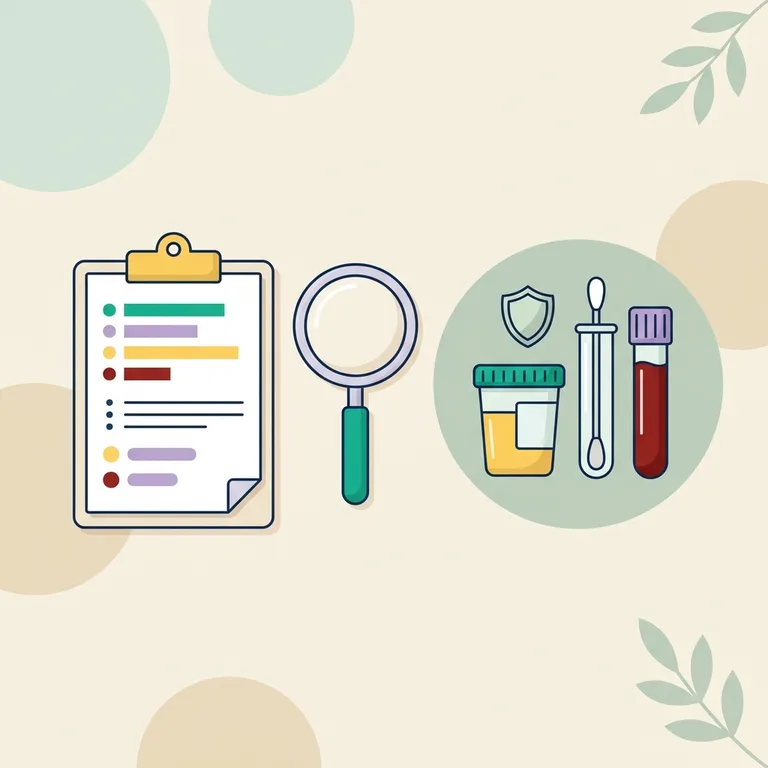
Most sexually transmitted infections (STIs) cause no symptoms, so testing is the only way to know. A full check usually combines a urine test or swabs (chlamydia, gonorrhea, trichomonas) with a blood test (HIV, syphilis, hepatitis B and C). Which tests you need depends on your age, your partners and the type of sex you have, and a test taken too soon after exposure can miss an infection.
When are symptoms an emergency?
When to see a doctor
- Emergency: call 911 or go to the emergency department for severe lower belly pain with fever or vomiting, sudden severe pain and swelling of a testicle, or pain in pregnancy with bleeding.
- Within 72 hours after a possible exposure to HIV (condom broke, sexual assault, partner with HIV): ask an emergency department or clinic about post-exposure treatment (PEP), which works best when started as early as possible[3].
- Within a few days for discharge, burning when you urinate, a genital sore or ulcer, a new rash on palms or soles, or if a partner tells you they have an STI.
- At your next appointment for routine screening, a new partner, or a test before stopping condoms.
Why do people get tested for STIs?
STIs are very common: more than 1 million curable STIs are acquired every day worldwide, most of them without symptoms[1]. In 2020 the World Health Organization estimated 374 million new cases of four curable STIs: chlamydia (129 million), gonorrhea (82 million), syphilis (7.1 million) and trichomoniasis (156 million)[1].
Genital symptoms are not always caused by an STI. Common, non-sexual causes come first:
- Common Vaginal yeast infection (candidiasis) or bacterial vaginosis: itching or discharge, not usually sexually transmitted.
- Common Urinary tract infection: burning and frequent urination; a urinalysis helps tell it apart.
- Common Chlamydia and gonorrhea: discharge, burning, pelvic pain, or nothing at all.
- Possible Trichomoniasis and genital herpes: discharge, or painful blisters and sores.
- Possible Syphilis: a painless sore, then sometimes a rash; it can be silent for years.
- Rare but serious Untreated infection spreading: pelvic inflammatory disease, which can affect fertility.
Which STI tests should I get?
Tests can use blood, urine, or swabs from the vagina, throat or rectum[2]. The usual tests are[3]:
| Infection | Test and sample | Usually recommended for |
|---|---|---|
| Chlamydia, gonorrhea | Nucleic acid amplification test (NAAT) on urine or a swab; throat and rectal swabs depending on sex practices | Sexually active women under 25; older women at increased risk; men who have sex with men at least yearly[4][5] |
| HIV | Blood test (antigen/antibody), lab or rapid finger-stick | Everyone aged 13 to 64 at least once; more often if at risk[6] |
| Syphilis | Blood test: a treponemal test and a non-treponemal test such as the RPR | People at increased risk; all pregnant women[4][7] |
| Hepatitis B | Blood test: HBsAg, anti-HBc, anti-HBs | All adults at least once[9] |
| Hepatitis C | Blood test: HCV antibody, then RNA if positive | All adults at least once[8] |
| Trichomoniasis | NAAT on a vaginal swab or urine | Women in high-prevalence settings or at high risk; women with HIV[4] |
| Herpes | Swab of a sore (NAAT); blood tests only in selected cases | Not recommended as routine screening[4] |
There is no routine blood test for HPV: it is checked in women with cervical screening.
How do I read my STI test results?
- "Not detected" or "negative": no infection was found in that sample, at that time. It does not cover an exposure that is too recent, or a site that was not tested (for example the throat).
- "Detected" or "positive" on a NAAT for chlamydia, gonorrhea or trichomonas: the infection is present and needs treatment. Partners should be tested and treated, and the CDC recommends retesting about 3 months after treatment for chlamydia and gonorrhea[4].
- HIV "reactive": a first positive result is always confirmed with another test before a diagnosis is made[3].
- Syphilis: both test types are read together. A positive treponemal test can stay positive for life after a treated infection; the RPR level (titer, such as 1:32) helps tell an active infection from an old one and is used to follow treatment[3].
- Hepatitis B and C: the combination of markers tells apart a current infection, a past infection or vaccination; see our pages on each disease.
Window periods. An HIV test can be negative early after exposure. HIV can usually be detected 10 to 33 days after exposure with a NAT, 18 to 45 days with a lab antigen/antibody test, 18 to 90 days with a rapid finger-stick antigen/antibody test, and 23 to 90 days with an antibody test[6]. If you were tested early, ask when to repeat the test.
Several STI results on one report, with terms like "reactive", "titer" or "anti-HBc"? BloodSense explains each line of your complete report in plain words, so you can prepare your questions for your doctor.
Explain my test resultsWhat should I note before my appointment?
- The date of the possible exposure, to check the window period.
- Your symptoms and when they started.
- The type of sex (vaginal, oral, anal) so the right sites are tested.
- Whether you are or could be pregnant.
- Your vaccination status for hepatitis B and HPV, and any earlier STI and its treatment.
- For a urine test: avoid urinating for about an hour before, if the clinic asks you to.
Frequently asked questions
Does a routine blood test check for STIs?
No. A standard blood count or chemistry panel does not include STI tests. HIV, syphilis and hepatitis must be requested, and chlamydia and gonorrhea need urine or swabs.
How long after sex should I get tested?
It depends on the infection and the test. For HIV, the lab antigen/antibody test usually detects infection 18 to 45 days after exposure[6]. Get tested at once if you have symptoms, and repeat later if your doctor advises.
Are home STI tests reliable?
FDA-approved self-collection options exist for HIV, syphilis, chlamydia and gonorrhea[2]. A positive self-test must be confirmed and treated by a professional.
Should my partner be tested too?
Yes, if you test positive for a curable STI: partners need testing and treatment so the infection is not passed back to you[4].
Related articles
- ChlamydiaThe most frequently reported bacterial STI
- GonorrheaSymptoms, testing and treatment
- HIV test resultsHow to read an HIV blood test
- RPR testThe syphilis blood test and its titer
- HerpesSores, testing and treatment
- Hepatitis BThe markers that show infection or immunity
- World Health Organization. Sexually transmitted infections (STIs): fact sheet. September 10, 2025. who.int (accessed October 27, 2026)
- Centers for Disease Control and Prevention. Getting tested for STIs. March 17, 2026. cdc.gov (accessed October 27, 2026)
- Workowski KA, Bachmann LH, Chan PA, et al. Sexually transmitted infections treatment guidelines, 2021. MMWR Recomm Rep. 2021;70(4):1-187. doi:10.15585/mmwr.rr7004a1 (accessed October 27, 2026)
- Centers for Disease Control and Prevention. STI screening recommendations. Reviewed March 22, 2024. cdc.gov (accessed October 27, 2026)
- US Preventive Services Task Force. Screening for chlamydia and gonorrhea: US Preventive Services Task Force recommendation statement. JAMA. 2021;326(10):949-956. doi:10.1001/jama.2021.14081 (accessed October 27, 2026)
- Centers for Disease Control and Prevention. Getting tested for HIV. September 15, 2026. cdc.gov (accessed October 27, 2026)
- US Preventive Services Task Force. Screening for syphilis infection in nonpregnant adolescents and adults: US Preventive Services Task Force reaffirmation recommendation statement. JAMA. 2022;328(12):1243-1249. doi:10.1001/jama.2022.15322 (accessed October 27, 2026)
- Schillie S, Wester C, Osborne M, Wesolowski L, Ryerson AB. CDC recommendations for hepatitis C screening among adults: United States, 2020. MMWR Recomm Rep. 2020;69(2):1-17. doi:10.15585/mmwr.rr6902a1 (accessed October 27, 2026)
- Conners EE, Panagiotakopoulos L, Hofmeister MG, et al. Screening and testing for hepatitis B virus infection: CDC recommendations, United States, 2023. MMWR Recomm Rep. 2023;72(1):1-25. doi:10.15585/mmwr.rr7201a1 (accessed October 27, 2026)
This page is general information. It does not replace the advice of a doctor or sexual health clinic, who interprets your results with your history and exposures.