






Coronary Artery Disease: Symptoms, Causes, Treatments
Coronary artery disease happens when the arteries that supply blood to the heart muscle become narrowed by a buildup of fatty plaque, slowly limiting the oxygen-rich blood the heart needs to work well. It is the most common form of heart disease and one of the leading causes of death in the United States, but it is also one of the most preventable and treatable. Many people live for years with narrowed arteries and no symptoms, while others notice warning signs such as chest discomfort long before a heart attack happens. This guide explains what coronary artery disease is, its symptoms, causes, how it is diagnosed with blood tests and heart imaging, the treatments available, and the latest research.
What is coronary artery disease?
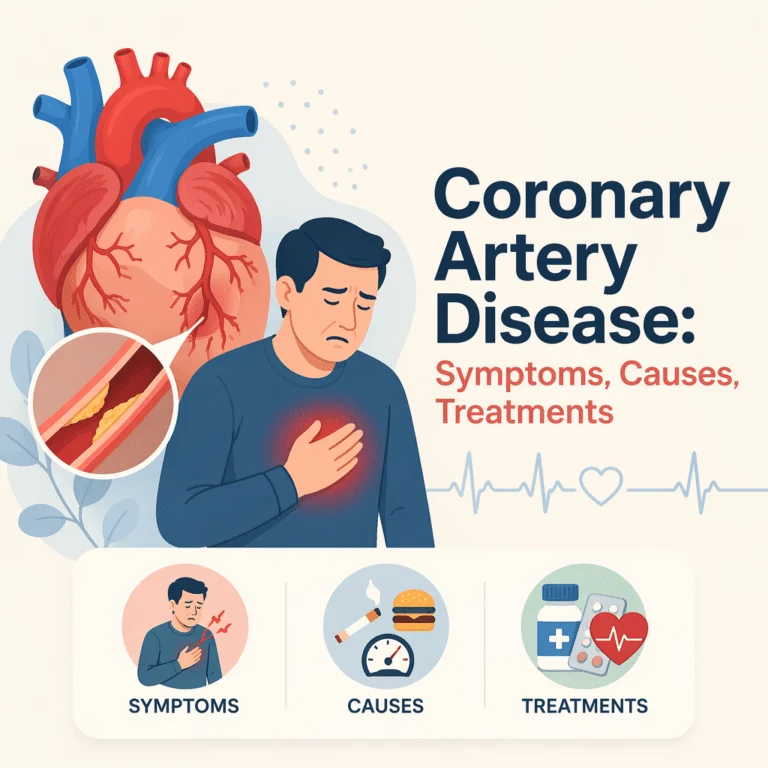
Coronary artery disease, often called CAD or coronary heart disease, develops when the coronary arteries, which feed the heart muscle, narrow due to a buildup of cholesterol, fat, and other substances known as plaque. As plaque accumulates, less oxygen-rich blood reaches the heart, especially during exercise or stress. If a plaque ruptures, a blood clot can form suddenly and block the artery, cutting off blood flow and causing a heart attack.
Coronary artery disease is the most common type of heart disease, and heart disease remains the leading cause of death in the United States for men, women, and most racial and ethnic groups. Roughly 1 in 20 adults age 20 and older lives with the condition, and cardiovascular disease caused about 1 in 3 deaths nationwide in 2023, or one death every 34 seconds. Because it develops gradually and can stay silent for years, understanding it early helps protect the heart.
Symptoms of coronary artery disease
The hallmark symptom of coronary artery disease is angina: chest pressure, squeezing, tightness, or a heavy weight on the chest, often brought on by exertion and relieved by rest. Shortness of breath and fatigue can accompany it or appear alone. In its early stages, the disease often causes no symptoms, and for many people the first sign is a heart attack.
Because a heart attack can happen with little warning, it helps to know the signs: chest pressure, squeezing, or fullness lasting more than a few minutes or coming and going, pain in the arms, back, neck, jaw, or stomach, shortness of breath, a cold sweat, nausea, and lightheadedness. Anyone with these symptoms should call 911 immediately rather than wait to see if they pass, since faster treatment saves heart muscle. Women more often have atypical symptoms during a heart attack, such as brief or sharp pain in the neck, jaw, arm, or back, nausea, or fatigue, rather than classic chest pressure, which can delay diagnosis.
What causes coronary artery disease and its risk factors
Coronary artery disease develops when injury to the artery lining lets cholesterol and other substances build up in the artery wall over many years, a process called atherosclerosis. Two of the most powerful modifiable factors are high LDL cholesterol and high blood pressure: managing the artery-clogging effects of high cholesterol and the added strain of high blood pressure can slow or even stall the disease. Smoking, diabetes, obesity, inactivity, and a diet high in saturated fat, sodium, and added sugar add to the risk too.
Some risk factors cannot be changed. Risk rises with age, and a family history of early heart disease, especially in a parent or sibling, raises the odds significantly. Chronic low-grade inflammation and a genetically inherited high lipoprotein(a) level also add to risk independent of cholesterol — one reason doctors now look beyond a standard cholesterol panel when estimating cardiovascular risk.
How coronary artery disease is diagnosed
Because coronary artery disease stems from the plaque buildup of atherosclerosis, diagnosis blends blood tests that capture cardiovascular risk with imaging that can see narrowing directly. Most adults start with a symptom and family history review, a fasting lipid panel, and a blood pressure and blood sugar check, then add further markers or imaging if risk appears elevated.
| Blood marker | What it indicates |
|---|---|
| LDL cholesterol | Main driver of plaque buildup; target varies by overall cardiovascular risk |
| HDL cholesterol | Helps clear cholesterol from artery walls; higher levels are generally protective |
| Triglycerides and non-HDL cholesterol | Capture additional fat-carrying particles that add to atherogenic risk |
| Apolipoprotein B | Counts artery-clogging particles directly; clarifies risk when LDL alone is not enough |
| Lipoprotein(a) | Genetically set particle checked once in adulthood; high levels raise lifetime risk independent of LDL |
| High-sensitivity CRP | Reflects vessel inflammation; refines risk when other results are borderline |
| HbA1c | Reflects average blood sugar; screens for diabetes, a major driver of coronary artery disease |
| High-sensitivity troponin | Signals heart muscle injury; diagnoses a heart attack, not a screening test |
A fasting lipid panel anchors cholesterol testing. Understanding the LDL cholesterol number, the HDL cholesterol number, the triglyceride level, and the total cholesterol reading, which combines with HDL into non-HDL cholesterol, puts a result in context. How aggressively LDL should be lowered depends on overall risk: guidance sets a target under 100 mg/dL for borderline or intermediate risk, under 70 mg/dL for high risk, and under 55 mg/dL for very high risk or established disease. When risk stays unclear, checking the apolipoprotein B level can clarify how many artery-clogging particles are circulating even with LDL controlled, and every adult should have the lipoprotein(a) level checked once, since it is genetically set and stable from a young age; roughly 125 to 150 nmol/L or above is elevated, and 250 nmol/L or above roughly doubles lifetime risk versus a low level.
Two more tests add detail. Checking the high-sensitivity CRP level can reveal low-grade vessel inflammation, a risk factor independent of cholesterol. Screening the HbA1c level shows average blood sugar over recent months and catches the prediabetes or diabetes that raises coronary artery disease risk. A different test measures the high-sensitivity troponin level to diagnose a heart attack already underway, not to screen people who feel well.
Blood tests are complemented by tests that look at the heart directly. A resting electrocardiogram records electrical activity, a stress test looks for changes under exertion, and an echocardiogram checks pumping function and valves by ultrasound. A coronary CT angiogram visualizes the arteries and calculates a coronary artery calcium score that ranges from zero, reflecting very low near-term risk, to above 400, reflecting extensive plaque. When a blockage is strongly suspected, cardiac catheterization threads a thin tube to the heart to map it directly, often leading straight into a stent. Newer risk calculators, such as the American Heart Association’s PREVENT equations, weigh age, sex, cholesterol, and blood pressure over 10 years and a lifetime, replacing an older model that overestimated risk by 40 to 50 percent.
Treatment options for coronary artery disease
Treatment for coronary artery disease combines heart-healthy lifestyle changes with medications and, when needed, procedures that restore blood flow. Nearly everyone benefits from not smoking, regular activity, a diet built around vegetables, fruit, whole grains, and lean protein, and reaching a healthy weight, since these steps slow plaque buildup and support the rest of treatment.
| Approach | Role |
|---|---|
| Statins | First-line drugs that lower LDL cholesterol and help stabilize plaque |
| Ezetimibe | Added to a statin, or used alone if statins are not tolerated, for extra LDL lowering |
| PCSK9 inhibitors and inclisiran | Injectable options with large additional LDL reductions for higher-risk patients |
| Antiplatelet therapy | Aspirin or similar drugs that help prevent clots that trigger a heart attack |
| Blood pressure and diabetes control | Reduces strain on the arteries and slows disease progression |
| Stents or bypass surgery | Reopens or reroutes around a blocked artery to restore blood flow |
Medications are typically layered by how much additional LDL lowering is needed. Statins are the starting point for most people, with ezetimibe added when a statin alone falls short. Higher-risk patients may add PCSK9 inhibitors, given by injection every few weeks, or inclisiran, given twice yearly, for substantially more LDL lowering. Antiplatelet therapy reduces the chance a plaque rupture leads to a clot, and tightly managing blood pressure and blood sugar offers further protection. When a blockage is severe, a stent placed during catheterization, or bypass surgery, can restore blood flow, though both work best alongside, not instead of, medication and lifestyle change.
Living with coronary artery disease and long-term outlook
A diagnosis of coronary artery disease does not mean life must be limited. With consistent treatment, most people significantly lower their heart attack risk and continue working, exercising, and enjoying everyday activities. Staying attentive to warning signs, keeping up with follow-up appointments, and taking medications as prescribed help keep the disease from quietly progressing.
Long-term outlook depends heavily on how well the major risk factors stay controlled. Keeping cholesterol, blood pressure, and blood sugar at target levels, staying active, eating a heart-healthy diet, and never smoking all continue to matter for years, not just at the start. Because coronary artery disease can quietly worsen even when someone feels well, most people benefit from periodic clinician check-ins to reassess risk and adjust treatment as new options emerge.
Latest scientific advances in coronary artery disease research
According to PubMed-indexed research, a 2026 secondary analysis of the FOURIER trial asked whether aggressively lowering lipoprotein(a) alongside LDL cholesterol with the PCSK9 inhibitor evolocumab carries hidden safety risk. Among more than 25,000 participants with established atherosclerotic disease on a statin, lower baseline lipoprotein(a) was linked to more diabetes but no increase in stroke, bleeding, cognitive problems, cancer, or irregular heart rhythm, and evolocumab’s lipoprotein(a)-lowering effect did not raise diabetes risk even at the highest levels (Gencer et al., 2026). What this means for you: lowering lipoprotein(a) alongside LDL cholesterol appears safe from a diabetes standpoint, supporting further drug development for this genetic particle. Separately, a 2025 study applied semaglutide’s SELECT trial benefit to a large imaging cohort and found a coronary calcium score of 300 or higher carried more than double the cardiovascular risk of a score of zero, meaning far fewer high-score people would need treatment to prevent one event (Razavi et al., 2025). What this means for you: a coronary calcium score can help identify who benefits most from newer heart-protective medications.
Inflammation is also getting renewed attention. A 2026 clinical consensus statement from European cardiology societies confirmed inflammation drives both the buildup and sudden rupture of arterial plaque, and formally endorsed treating residual inflammatory risk, including with low-dose colchicine, in selected patients with established coronary artery disease, while noting anti-inflammatory trial results overall have been mixed (Roubille et al., 2026). What this means for you: if your cholesterol is already well controlled but risk still feels high, treating leftover inflammation is now a recognized extra avenue to raise with your doctor, alongside the usual focus on cholesterol and blood pressure.
Glossary of key coronary artery disease terms
| Term | Definition |
|---|---|
| Atherosclerosis | The gradual buildup of fatty plaque inside artery walls that narrows blood flow. |
| Plaque | A deposit of cholesterol, fat, and other substances that accumulates inside an artery wall. |
| Angina | Chest discomfort caused by reduced blood flow to the heart muscle, often brought on by exertion. |
| Myocardial infarction | The medical term for a heart attack, when blocked blood flow damages heart muscle. |
| Revascularization | A procedure, such as a stent or bypass surgery, that reopens or reroutes blood flow around a blocked artery. |
| Statin | A medication that lowers LDL cholesterol and helps stabilize plaque within the artery walls. |
| Coronary artery calcium score | An imaging result that estimates how much calcified plaque has built up in the coronary arteries. |
Frequently asked questions about coronary artery disease
What is coronary artery disease and how does it happen?
Coronary artery disease is a narrowing of the heart’s arteries from a buildup of cholesterol-containing plaque. As plaque accumulates, less oxygen-rich blood reaches the heart, and if it ruptures, a clot can block the artery and cause a heart attack. It develops over decades, tied to cholesterol, blood pressure, and lifestyle.
What are the earliest warning signs of coronary artery disease?
Coronary artery disease often causes no symptoms early on. When they appear, the most common is angina: chest pressure, squeezing, or tightness brought on by exertion and relieved by rest, sometimes with shortness of breath or fatigue. Because early disease can be silent, blood tests and risk assessment matter before symptoms start.
What’s the difference between coronary artery disease and a heart attack?
Coronary artery disease is the underlying, gradual narrowing of the heart’s arteries by plaque, which can exist for years without symptoms. A heart attack is sudden: a plaque ruptures, a clot blocks the artery, and blood flow to the heart stops. In short, one is the ongoing condition, the other its most serious complication.
What blood tests diagnose coronary artery disease and heart attack risk?
A fasting lipid panel measuring LDL, HDL, triglycerides, and total cholesterol is the starting point, often followed by apolipoprotein B or lipoprotein(a) testing for clarity. High-sensitivity CRP can flag inflammation, and HbA1c screens for diabetes. High-sensitivity troponin is different: it diagnoses a heart attack already underway, not screens for future risk.
Can coronary artery disease be reversed, or is there a cure?
There is no outright cure, but progression can often be slowed, stopped, or partly reversed with aggressive cholesterol and blood pressure treatment, lifestyle changes, and statins, which some research shows can even shrink plaque modestly. For most people, the realistic goal is stopping the disease from advancing, not eliminating it.
How is coronary artery disease treated — do I need a stent or surgery?
Most people are treated first with lifestyle changes and medications, including statins, antiplatelet drugs, and blood pressure and diabetes control. A stent or bypass surgery is generally reserved for significant blockages or symptoms unresponsive to medication, and even then, ongoing medication and lifestyle changes stay essential to protect the rest of the arteries.
Sources
- Centers for Disease Control and Prevention — About Coronary Artery Disease — CDC, 2024 — cdc.gov
- MedlinePlus, National Library of Medicine — Coronary Artery Disease — MedlinePlus, 2024 — medlineplus.gov
- Mayo Clinic — Coronary Artery Disease: Symptoms and Causes — Mayo Clinic, 2024 — mayoclinic.org
- Gencer B, Giugliano RP, Ran X, et al. — Safety of low lipoprotein(a) levels: the FOURIER trial — European Heart Journal, 2026 — doi.org/10.1093/eurheartj/ehag398
- Razavi AC, Cao Zhang AM, Dardari ZA, et al. — Allocation of Semaglutide According to Coronary Artery Calcium and BMI: Applying the SELECT Trial to MESA — JACC: Cardiovascular Imaging, 2025 — doi.org/10.1016/j.jcmg.2024.10.004
- Roubille F, Kharlamov JA, Lenz M, et al. — Inflammation in coronary syndromes in clinical practice: a clinical consensus statement of the ESC Association for Acute CardioVascular Care and ESC Working Groups/Councils — European Heart Journal: Acute Cardiovascular Care, 2026 — doi.org/10.1093/ehjacc/zuag086
Further reading
- Get practical guidance on interpreting a report in this guide to how to interpret flags and reference ranges on a lab report.
Understand your lab results with BloodSense
Coronary artery disease risk is rarely captured by a single number. A lipid panel, an apolipoprotein B or lipoprotein(a) result, a high-sensitivity CRP level, and an HbA1c reading each add a piece to the picture, and the right LDL target depends on a person’s broader risk profile, not one fixed cutoff. Seeing these values together, and watching how they change after a new statin or diet change, is far more useful than reading one line alone.
BloodSense translates a full panel of cholesterol and cardiovascular markers into plain language, showing where each result falls and what it may mean for your heart, so you can track changes over time and have an informed conversation with your care team.