Perimenopause: First Signs, Age, How Long It Lasts and Hormone Tests
The essentials
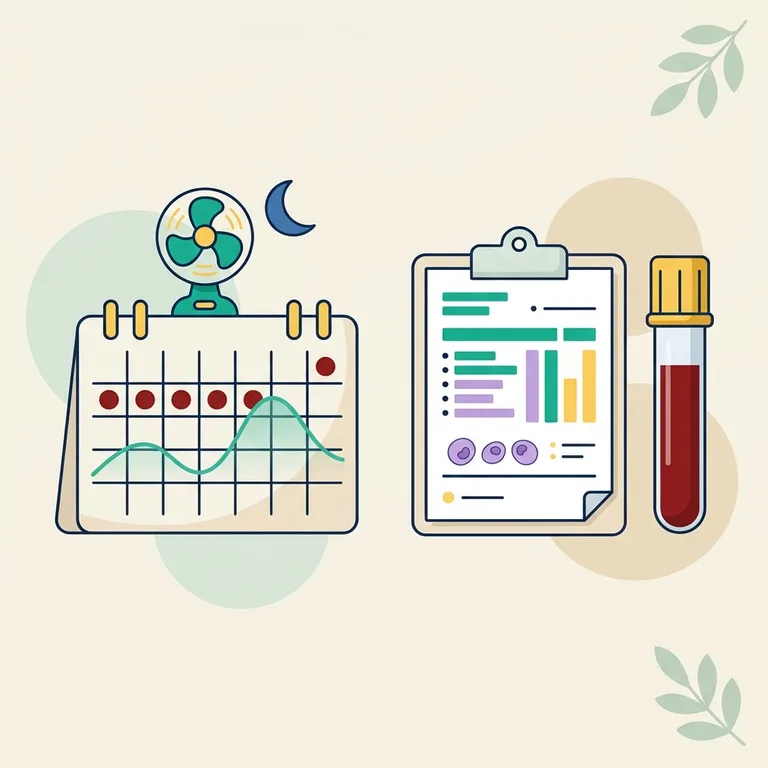
Perimenopause is the transition before the final period, when hormones swing up and down. It usually starts in the mid-to-late 40s and lasts about 4 years, sometimes up to 10. The first sign is most often a change in your cycle. After 45, blood tests are rarely needed to recognize it, but some help rule out other causes, and pregnancy is still possible.
What is perimenopause, at a glance?
- What it is: the years before menopause, which is confirmed only after 12 months in a row without a period. It is a normal life stage, not an illness.
- When it starts: usually in the mid-to-late 40s, sometimes in the mid-to-late 30s[1].
- How long it lasts: about 4 years on average, up to 10 years; in the United States, the average age at menopause is 52[1].
- Tests: hormone tests are not usually needed; age, symptoms and period changes are enough[1].
What are the first signs of perimenopause?
The first sign is usually a change in your cycle. Cycles may first become a little shorter; later their length varies by 7 days or more, periods are skipped, and flow can be heavier or lighter[2]. Other symptoms:
- Common hot flashes and night sweats, most likely in the later part of the transition[3];
- Common poor sleep (see insomnia), irritability, anxiety and "brain fog";
- Possible vaginal dryness, lower sex drive, breast tenderness, headaches, joint aches;
- Possible depression: perimenopause is a window of vulnerability, especially after a previous episode[10].
In a large US study, frequent hot flashes lasted a median of 7.4 years in total, and 4.5 years after the final period[4].
When should I see a doctor during perimenopause?
When to see a doctor
- Emergency: call 911 for very heavy bleeding with dizziness or fainting, sudden severe lower belly pain if you might be pregnant, or thoughts of harming yourself.
- Within 24 to 48 hours if you soak a pad or tampon every hour for 2 to 3 hours, pass large clots, or bleed for more than 7 days[8].
- At your next appointment for bleeding between periods or after sex, symptoms that disturb sleep, work or mood, or periods that stop before age 40[1].
What causes perimenopause, and what are its stages?
With age, the ovaries hold fewer egg follicles, so ovulation becomes irregular. The pituitary gland raises follicle-stimulating hormone (FSH) to push them: FSH is the first hormone to change, while cycles are still regular. Estrogen and progesterone then become erratic[5]. The STRAW+10 system describes the stages mainly by your cycles[3]:
| Stage | Your cycles | Tests |
|---|---|---|
| Early transition | Cycle length differs by 7 days or more, again within 10 cycles | FSH higher but variable; AMH low |
| Late transition (1 to 3 years) | 60 days or more without a period | FSH often above 25 IU/L; hot flashes likely |
| Menopause | 12 months without a period | FSH high, estradiol low |
Removing both ovaries, chemotherapy or pelvic radiation can cause sudden menopause. After a hysterectomy that keeps the ovaries, the transition continues without periods to follow.
How is perimenopause diagnosed? The tests and how to read them
At 45 or older, testing usually isn't needed: a high FSH is a normal sign of perimenopause. Hormone tests help under 40, before 45, or when the cause of symptoms is unclear[9]. Most tests are ordered to rule out another cause.
FSH and estradiol: why one result can mislead
Hormones rise and fall from one cycle to the next[5]. A FSH blood test can be in the postmenopausal range one month and normal the next, and an estradiol test can be low, normal or even high, sometimes in the same sample as a high FSH. That is why the test may be timed in your cycle and repeated[9]. LH adds little. Hormonal birth control changes these results.
AMH: an estimate of time, not a diagnosis
Anti-Müllerian hormone (AMH) reflects the follicles left. In a large US study, an AMH below 10 pg/mL (sensitive assay) meant a 51% to 79% chance of the final period within 12 months, depending on age; above 100 pg/mL, a 90% to 97% chance of no final period within 12 months. AMH predicted timing better than FSH[6]. US labs usually report ng/mL (10 pg/mL = 0.01 ng/mL). AMH gives no date and does not tell you whether you can still get pregnant.
Tests that look for another cause
- TSH: a thyroid problem causes fatigue, palpitations, mood and cycle changes, so thyroid tests are part of the check-up for abnormal bleeding[8].
- Complete blood count and ferritin: heavy periods can cause anemia[8]; a low ferritin shows empty iron stores, often before hemoglobin drops (see iron deficiency).
- hCG pregnancy test: a missed period can still mean pregnancy[8]. After 40, the pituitary can make a little hCG: non-pregnant women aged 41 to 55 had up to 7.7 IU/L, and pregnancy is unlikely with hCG between 5 and 14 IU/L and FSH above 20 IU/L[7]. Your doctor interprets a weak positive.
- Prolactin may be added when the bleeding pattern is unusual[8].
| Test | Result | Reference range | Flag |
|---|---|---|---|
| FSH | 38.2 mIU/mL | Follicular phase 3.5-12.5 | H |
| Estradiol | 214 pg/mL | Follicular phase 12-166 | H |
| TSH | 2.1 mIU/L | 0.4-4.0 | |
| Hemoglobin | 10.9 g/dL | 12.0-15.5 | L |
| Ferritin | 8 ng/mL | 15-150 | L |
| hCG, quantitative | <2 mIU/mL | Not pregnant: <5 |
- High FSH and high estradiol together: a typical perimenopausal swing, not proof of menopause; the next sample may look different.
- Normal TSH: the thyroid is unlikely to explain the symptoms.
- Low hemoglobin and ferritin: iron-deficiency anemia, likely from heavy periods. This is the line that calls for action.
- hCG below 5: not pregnant; contraception is still needed if you want to avoid pregnancy.
- Reference range: FSH and estradiol ranges depend on the cycle phase; the ranges on your own report are the ones that count.
FSH, estradiol, TSH and ferritin on the same report? BloodSense explains each line of your complete report in plain words, so you can see what reflects perimenopause and what to discuss with your doctor.
Explain my test resultsHome urine FSH kits only detect a high FSH and should not be used to judge whether you can get pregnant[9].
What follow-up is needed during perimenopause?
- Hormones: no repeated FSH or estradiol tests are needed in a typical perimenopause.
- Anemia: blood count and ferritin are rechecked after iron treatment, and the cause of heavy bleeding is looked for.
- Heart and bones: a good time to check blood pressure, a lipid panel and blood sugar, and to discuss osteoporosis risk.
- Mood: a screening questionnaire helps tell perimenopausal symptoms from depression[10].
How is perimenopause treated?
Treatment is optional and targets the symptoms that bother you (overview, without doses):
- Hormone therapy: the most effective treatment for hot flashes and vaginal dryness; under 60 or within 10 years of menopause, without contraindications, benefits generally outweigh risks[11]. Hormonal contraception is another option that also prevents pregnancy.
- Non-hormonal options: cognitive behavioral therapy, clinical hypnosis, SSRI or SNRI antidepressants, gabapentin, fezolinetant, oxybutynin; herbal supplements are not recommended[12].
- Depression: antidepressants and psychotherapy first; estrogen may help mood when hot flashes are present[10].
- Heavy periods: iron if you are anemic, and treatment of the bleeding.
More on treatments in menopause symptoms and management.
Can you get pregnant during perimenopause?
Yes: ovulation can still happen when periods are irregular[1]. Use birth control until menopause is confirmed, one year after your final period[2]; a blood test cannot tell you when to stop. Day to day:
- Keep a diary of periods, flow, hot flashes and sleep for your doctor.
- Dress in layers and keep the bedroom cool.
- Stay active, with muscle-strengthening exercise; limit alcohol; do not smoke.
- Get enough calcium and vitamin D, and iron-rich foods if periods are heavy.
Questions to ask your doctor
- Do my cycle changes fit perimenopause, or should we look for another cause?
- Do I need blood tests, and on which day of my cycle?
- Are my heavy periods causing anemia?
- Which birth control suits me now, and when can I stop it?
- Is hormone therapy or a non-hormonal option right for me?
Frequently asked questions
Can perimenopause start at 35?
Some women notice changes in their mid-to-late 30s[1], but other causes are checked first. If periods stop before 40, the doctor looks for primary ovarian insufficiency with repeated FSH tests.
Can a blood test tell me when my last period will be?
Not precisely. AMH best estimates whether the final period is likely within a year or two, but gives no date[6].
Is perimenopause the same as PCOS or a thyroid problem?
No, but they can look alike. Polycystic ovary syndrome also causes irregular periods, and hypothyroidism causes fatigue and mood changes; TSH and the overall picture help tell them apart.
Does taking the pill hide perimenopause?
Yes. Combined pills create regular bleeding and change FSH and estradiol, so neither your cycle nor a hormone test shows where you are in the transition.
Related articles
- MenopauseSymptoms, stages and treatments after the final period
- FSH blood testThe hormone that rises first in perimenopause
- Estradiol blood testWhy it can be high, normal or low in perimenopause
- FerritinCheck your iron stores after heavy periods
- AnemiaFatigue that may come from blood loss, not hormones
- TSH testRule out a thyroid problem with similar symptoms
- Office on Women's Health, US Department of Health and Human Services. Menopause basics. Updated October 19, 2026. womenshealth.gov (accessed October 28, 2026)
- The Menopause Society. Perimenopause. menopause.org (accessed October 28, 2026)
- Harlow SD, Gass M, Hall JE, et al. Executive summary of the Stages of Reproductive Aging Workshop + 10: addressing the unfinished agenda of staging reproductive aging. J Clin Endocrinol Metab. 2012;97(4):1159-1168. doi:10.1210/jc.2011-3362 (accessed October 28, 2026)
- Avis NE, Crawford SL, Greendale G, et al. Duration of menopausal vasomotor symptoms over the menopause transition. JAMA Intern Med. 2015;175(4):531-539. doi:10.1001/jamainternmed.2014.8063 (accessed October 28, 2026)
- Hale GE, Burger HG. Hormonal changes and biomarkers in late reproductive age, menopausal transition and menopause. Best Pract Res Clin Obstet Gynaecol. 2009;23(1):7-23. doi:10.1016/j.bpobgyn.2008.10.001 (accessed October 28, 2026)
- Finkelstein JS, Lee H, Karlamangla A, et al. Antimullerian hormone and impending menopause in late reproductive age: the Study of Women's Health Across the Nation. J Clin Endocrinol Metab. 2020;105(4):e1862-e1871. doi:10.1210/clinem/dgz283 (accessed October 28, 2026)
- Snyder JA, Haymond S, Parvin CA, Gronowski AM, Grenache DG. Diagnostic considerations in the measurement of human chorionic gonadotropin in aging women. Clin Chem. 2005;51(10):1830-1835. doi:10.1373/clinchem.2005.053595 (accessed October 28, 2026)
- MedlinePlus Medical Encyclopedia. Abnormal uterine bleeding. Reviewed October 15, 2024. US National Library of Medicine. medlineplus.gov (accessed October 28, 2026)
- MedlinePlus. Follicle-stimulating hormone (FSH) levels test. Updated December 4, 2023. US National Library of Medicine. medlineplus.gov (accessed October 28, 2026)
- Maki PM, Kornstein SG, Joffe H, et al. Guidelines for the evaluation and treatment of perimenopausal depression: summary and recommendations. Menopause. 2018;25(10):1069-1085. doi:10.1097/GME.0000000000001174 (accessed October 28, 2026)
- The 2022 hormone therapy position statement of The North American Menopause Society. Menopause. 2022;29(7):767-794. doi:10.1097/GME.0000000000002028 (accessed October 28, 2026)
- The 2023 nonhormone therapy position statement of The North American Menopause Society. Menopause. 2023;30(6):573-590. doi:10.1097/GME.0000000000002200 (accessed October 28, 2026)
This page is general information. It does not replace the advice of a doctor, who interprets your hormone results with your age, cycle and symptoms and decides on tests and treatment.