Iron Deficiency: Symptoms, Causes and Blood Tests That Confirm It
The essentials
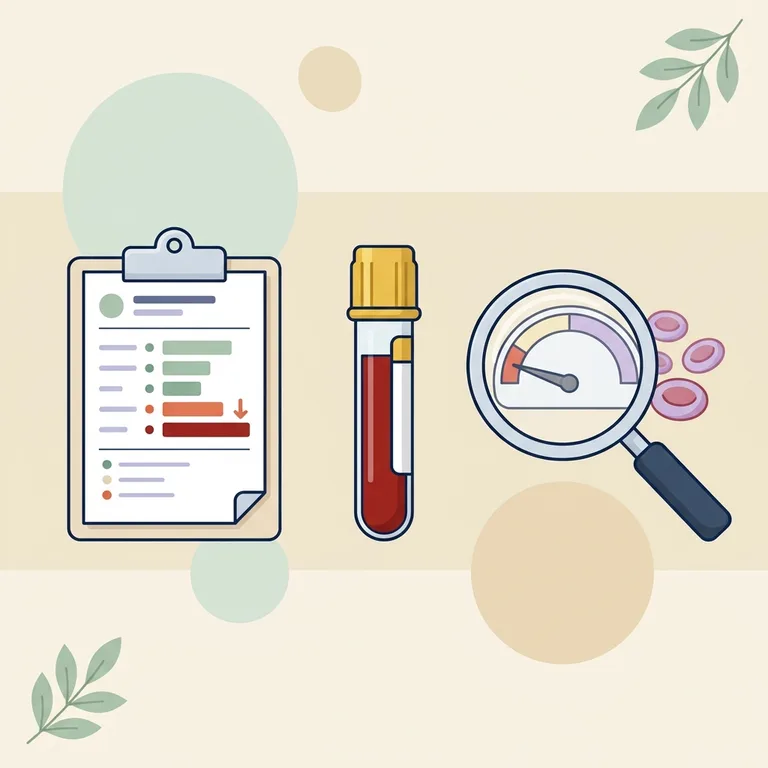
Iron deficiency means your iron stores are running low. It often starts before anemia: hemoglobin can be normal while ferritin, the stored-iron marker, is already low. Tiredness and breathlessness on effort are common signs. Heavy periods, pregnancy, diet and hidden bleeding are the usual causes, and the cause should be found before treatment.
How do I know if I have iron deficiency on my blood test?
A complete blood count checks for anemia, and ferritin shows how much iron you have stored[1][4]. Problems can occur before hemoglobin falls[6]. Here is a fictitious US report showing iron deficiency without anemia.
| Test | Result | Reference range | Flag |
|---|---|---|---|
| Hemoglobin | 12.4 g/dL | 12.0-15.5 g/dL | - |
| MCV (mean corpuscular volume) | 82 fL | 80-100 fL | - |
| Ferritin | 22 ng/mL | 11-307 ng/mL | - |
| Transferrin saturation | 14% | 20-50% | L |
- Hemoglobin and MCV: normal, so no anemia yet.
- Ferritin: inside this laboratory's range, so it carries no flag. Yet the American Society of Hematology (ASH) now diagnoses iron deficiency in adults at 30 ng/mL or lower[1].
- Flag L: transferrin saturation, the share of the iron carrier that holds iron, is below the range. Your laboratory's ranges apply.
Not sure whether a ferritin without a flag is really fine? BloodSense reads your whole report, line by line, and helps you prepare questions for your doctor.
Get my iron results explainedThe 2026 ASH guideline sets ferritin thresholds that apply with or without anemia[2][1]:
| Group | Iron deficiency if ferritin is | Source |
|---|---|---|
| Children aged 9 months to 4 years | 20 ng/mL or lower | ASH[1] |
| Adults, including menstruating or pregnant people | 30 ng/mL or lower | ASH[1] |
| Heavy menstrual bleeding, pregnancy with anemia | 50 ng/mL or lower | ASH[1] |
| Adults with inflammation (cancer, inflammatory bowel disease, infection) | under 100 ng/mL, or transferrin saturation under 20% | ASH[1] |
For each marker, see the ferritin blood test, transferrin saturation and the full iron panel.
When should I see a doctor about low iron?
When to see a doctor
- Emergency: call 911 for chest pain, fainting, severe shortness of breath, vomiting blood, or black, tar-like stools with dizziness. These can signal major bleeding.
- Within 24 to 48 hours if you see blood or a black tar-like look in your stool[3] or feel breathless or dizzy with light effort.
- At your next appointment if you have lasting tiredness, a low ferritin or a low transferrin saturation, even with normal hemoglobin.
Ask before starting iron tablets on your own: experts say an underlying cause should be sought in everyone with iron deficiency[6].
What are the symptoms of iron deficiency?
Mild iron deficiency anemia may cause no symptoms[3][5]. Signs come on slowly. The ASH lists[1]:
- unexplained fatigue, lack of energy or weakness;
- shortness of breath, rapid heartbeat or headache on effort; pale skin, feeling cold;
- brittle nails, hair loss, a sore or smooth tongue;
- craving ice or clay (pica), poor sleep and restless legs.
Some signs point to the cause: dark tar-colored stools, heavy periods or upper belly pain from an ulcer[3].
What causes iron deficiency?
- Common Heavy or frequent periods. In a US national survey, 38.6% of females aged 12 to 21 had iron deficiency (ferritin under 25 µg/L), but only 6.3% had iron deficiency anemia[7].
- Common Pregnancy and breastfeeding, which raise iron needs[3]. The recommended intake rises from 18 mg a day for women aged 19 to 50 to 27 mg during pregnancy; it is 8 mg for adult men[9].
- Common Low intake, for example a strict vegetarian diet without enough iron-containing foods[3]. Iron from plants is harder to absorb than iron from meat or fish[9].
- Possible Hidden bleeding from the gut: ulcers, long-term aspirin or ibuprofen use, polyps or cancer[3]. Frequent blood donation, nosebleeds and blood loss from the kidneys or bladder also count[1].
- Possible Poor absorption: celiac disease, Crohn disease, gastric bypass surgery, or heavy use of antacids[3].
- Rare Red cells breaking down inside the blood vessels (intravascular hemolysis), which loses iron in the urine[1].
Can iron tests be misleading?
Yes, in both directions. Ferritin rises with inflammation, infection, surgery, liver disease, obesity, alcohol use and some cancers[4]. A "normal" ferritin can therefore hide iron deficiency, which is why the ASH uses a higher cut-off (under 100 ng/mL) or transferrin saturation in people with inflammation[1].
Serum iron on its own is a poor guide; ferritin is the most accurate test for iron deficiency, as long as nothing falsely raises it[10]. Before your blood draw, check these points:
- Ask whether you need to fast; for ferritin, some providers ask for about 12 hours and a morning draw[4].
- Mention recent iron tablets, an infection, surgery or a flare of a chronic illness.
What will the doctor check next?
Next comes the search for the cause: celiac screening should be considered routinely, and men and postmenopausal women with iron deficiency anemia need a gut exam for bleeding[6]. The doctor may order:
- a complete blood count with hemoglobin, MCV and a reticulocyte count[3];
- serum iron, TIBC and ferritin[3];
- a fecal occult blood test, an upper endoscopy or a colonoscopy, or tests of the urinary tract or uterus[3].
Experts advise oral iron once a day at most, or every other day if better tolerated, with vitamin C; iron through a vein is used when tablets fail, are not tolerated or cannot be absorbed[8].
Questions to ask your doctor
- Is my ferritin above or below the new 30 ng/mL threshold, and does inflammation change how we read it?
- Do I have iron deficiency only, or also anemia?
- What do you think is causing it, and do I need a celiac test or a gut exam?
Frequently asked questions
Can you have iron deficiency with normal hemoglobin?
Yes. Stores run out first; problems can occur before anemia[6].
Is iron deficiency the same as anemia?
No. Anemia is a low hemoglobin with many causes. See anemia: symptoms and causes.
Can coffee or tea cause low iron?
Black tea reduces iron absorption[5][9], so drink it between meals; vitamin C helps[9].
Why does iron make my stool dark?
Oral iron darkens stool and often causes constipation[10]. Tar-like stool with dizziness is different: see black stool causes.
Related tests and guides
- Serum iron testWhy one value is not enough.
- Ferritin blood testLow and high ferritin explained.
- Iron panelHow the four iron markers are read together.
- Transferrin testThe iron carrier protein.
- AnemiaAll the causes of a low hemoglobin.
References
- American Society of Hematology. Iron-deficiency anemia. hematology.org (accessed October 26, 2026)
- Powers JM, Lim MY, Achebe MO, et al. American Society of Hematology 2026 guidelines for diagnosis of iron deficiency. Blood Adv. 2026. doi:10.1182/bloodadvances.2025015950 (accessed October 26, 2026)
- MedlinePlus Medical Encyclopedia. Iron deficiency anemia. medlineplus.gov (accessed October 26, 2026)
- MedlinePlus Lab Tests. Ferritin blood test. medlineplus.gov (accessed October 26, 2026)
- National Heart, Lung, and Blood Institute. Iron-deficiency anemia. nhlbi.nih.gov (accessed October 26, 2026)
- Pasricha SR, Tye-Din J, Muckenthaler MU, Swinkels DW. Iron deficiency. Lancet. 2021;397(10270):233-48. doi:10.1016/S0140-6736(20)32594-0 (accessed October 26, 2026)
- Weyand AC, Chaitoff A, Freed GL, et al. Prevalence of iron deficiency and iron-deficiency anemia in US females aged 12-21 years, 2003-2020. JAMA. 2023;329(24):2191-3. doi:10.1001/jama.2023.8020 (accessed October 26, 2026)
- DeLoughery TG, Jackson CS, Ko CW, Rockey DC. AGA clinical practice update on management of iron deficiency anemia: expert review. Clin Gastroenterol Hepatol. 2024;22(8):1575-83. doi:10.1016/j.cgh.2024.03.046 (accessed October 26, 2026)
- MedlinePlus Medical Encyclopedia. Iron in diet. medlineplus.gov (accessed October 26, 2026)
- Merck Manual Consumer Version. Common causes of iron deficiency anemia. 2025. merckmanuals.com (accessed October 26, 2026)
This article is general health information. It does not replace a medical examination, diagnosis or treatment. If you have chest pain, fainting or black, tar-like stools, seek care without waiting.