






A serum iron test measures how much iron is circulating in your bloodstream at the exact moment the sample is drawn. That single sentence explains both its usefulness and its biggest limitation: the number moves. It can rise after a supplement, fall during an infection, and differ by a third between an early-morning draw and an afternoon one. Read on its own, a serum iron value tells you very little. Read alongside the other markers it is usually paired with, it becomes a genuinely useful clue about how iron is moving through your body.
In this article you will learn what the test actually measures, why the result fluctuates so much, how to read the numbers and units on your lab report, which combinations of markers point toward deficiency or overload, and what a reasonable next step looks like after an unexpected value.
What a serum iron test actually measures
Almost all the iron in your blood is not floating free. It is bound to a carrier protein and being shuttled from one place to another, mostly from the gut and from recycled red blood cells toward the bone marrow, where new red cells are built. A serum iron test quantifies that circulating, protein-bound pool, expressed in micrograms per deciliter (µg/dL) in the United States or micromoles per liter (µmol/L) in most other countries.
Iron in transit, not iron in storage
The distinction that trips up most readers is between iron in transit and iron in storage. Your body keeps a reserve, mainly in the liver, spleen and bone marrow, locked inside a storage protein. Serum iron says nothing directly about the size of that reserve. You can empty your reserves almost completely and still record a normal serum iron on a good day, because the body prioritizes keeping the transport pool stocked. To see the reserve itself, clinicians look at a different marker and you can explore how that reserve is measured in our ferritin blood level guide.
Think of it as a delivery service. Serum iron counts the parcels currently on the trucks. It does not count the parcels sitting in the warehouse, and it does not tell you how many trucks are on the road. Those are separate measurements, which is exactly why iron is almost never assessed with a single number.
Where serum iron sits in the iron panel
Laboratories rarely run serum iron in isolation. It usually arrives as part of a small group of tests, often labeled an iron panel or iron studies, and each member answers a different question.
| Marker | What it measures | Question it answers |
|---|---|---|
| Serum iron | Iron circulating in blood right now | How much iron is in transit at this moment? |
| Ferritin | Size of the stored iron reserve | How much iron is banked? |
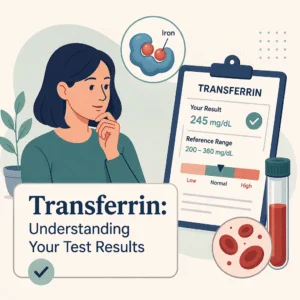
| Transferrin | Amount of the iron carrier protein | How many delivery trucks exist? |
| Total iron-binding capacity | Total carrying room in the blood | How much cargo space is available? |
| Transferrin saturation | Share of that room actually filled | How full are the trucks? |
Each of these deserves its own reading. You can compare the carrier protein itself in our transferrin test results guide, review the calculated fill rate in our transferrin saturation results guide, and check the total carrying room in our total iron-binding capacity explainer. This article stays on serum iron itself.
Why serum iron swings so much from hour to hour
Of all the routine markers on a lab report, serum iron is one of the most restless. Understanding why protects you from over-reacting to a single value.
The daily rhythm
Circulating iron follows a daily cycle. In most people it peaks in the morning and drifts down through the afternoon and evening, and the swing across a single day can be substantial. MedlinePlus notes plainly that the amount of iron in blood varies through the day and may be higher in the morning, which is why the draw is usually scheduled early. A value taken at 8 a.m. and one taken at 5 p.m. are not really the same measurement, and comparing them as though they were is a common source of unnecessary worry.
Meals, supplements and infections
A dose of oral iron can push serum iron up sharply for hours, which means a sample drawn the morning after a supplement may read high without reflecting your true iron status. Vitamin C increases how much iron the gut absorbs from plant foods, and you can read more about that nutrient in our vitamin C blood level guide. In the other direction, any active infection or inflammatory flare pulls iron out of circulation within hours as a defensive response, dropping serum iron even when your reserves are perfectly adequate. That is why an inflammation marker is often read next to it, and our CRP blood test results guide explains how that signal is interpreted.
How to make your result comparable
A few simple habits make one serum iron test comparable with the next:
- Book the draw in the morning, and book any repeat test at roughly the same hour.
- Ask your clinician whether to fast; many labs request a 12-hour fast, others do not, and consistency matters more than the rule itself.
- Pause oral iron supplements for at least 24 hours before the draw, but only with your clinician’s agreement.
- Postpone the test if you have a fever, an active infection, or a recent flare of a chronic inflammatory condition.
- Note recent blood donation or heavy menstrual bleeding, both of which shift the picture.
Reading your serum iron result line by line
Your report shows three things: your value, the unit, and the laboratory’s own reference interval. All three matter.
Units and reference intervals
Reference intervals differ between laboratories because they depend on the analyzer and the local population, so always read your result against the range printed on your own report rather than a range found online. As an illustration only, MedlinePlus publishes the following adult figures.
| Group | Illustrative range (µg/dL) | Same range (µmol/L) |
|---|---|---|
| Adult men | 59 to 158 | 10.6 to 28.3 |
| Adult women | 37 to 145 | 6.6 to 25.9 |
To convert roughly between the two units, multiply the µg/dL figure by 0.179 to obtain µmol/L. A value a few points outside the printed interval is not automatically a diagnosis; a value far outside it, or one that keeps drifting in the same direction across repeat tests, is worth investigating.
What a low serum iron result can mean
A low value means little iron was in transit at that moment. The common explanations fall into four groups: not enough iron coming in, too much iron going out, poor absorption, or iron being deliberately withheld from circulation.
- Blood loss, including heavy periods and slow bleeding in the digestive tract. Our fecal occult blood test results guide covers how hidden gut bleeding is screened for.
- Reduced absorption, seen in gut disorders and after some digestive surgery. Readers investigating gluten-related malabsorption can consult our celiac disease symptoms and treatments guide.
- Increased demand, notably in pregnancy, rapid growth and endurance training.
- Inflammation, which locks iron away in storage and lowers the circulating pool without emptying the reserve.
Sustained low iron eventually shrinks and pales red blood cells, which is why the red cell indices are read alongside. Our mean corpuscular hemoglobin results guide explains that early signal, and if a low result has already progressed to anemia our anemia symptoms and treatments guide covers what follows.
What a high serum iron result can mean
A high value is often innocent. Recent supplementation, a recent iron-rich meal, or simply an early draw on a high day can lift it. Genuine causes of a persistently elevated result include hereditary hemochromatosis, an inherited condition that lets the gut absorb too much iron across a lifetime, repeated blood transfusions, and liver injury that releases stored iron into the blood. The NIH Office of Dietary Supplements sets the tolerable upper intake level for iron at 45 mg per day for adults and warns that high doses cause digestive upset and, at extreme doses, organ damage. One high reading is a prompt to repeat the test under controlled conditions, not a diagnosis of overload.
Serum iron alone can mislead you: the four-marker rule
Because a single value can be pushed in either direction by yesterday’s supplement or this week’s cold, clinicians read serum iron as one line in a pattern. The pattern is far more informative than any single number.
The combinations that tell a story
| Serum iron | Ferritin | Carrying capacity | Usual reading |
|---|---|---|---|
| Low | Low | High | True iron deficiency, reserves genuinely empty |
| Low | Normal or high | Low or normal | Iron withheld by inflammation rather than missing |
| High | High | Low | Possible iron overload, needs confirmation |
| High | Normal | Normal | Often a recent supplement or an early-morning peak |
| Normal | Low | Normal or high | Early depletion, transport pool still defended |
That last row is the one to remember. A normal serum iron test does not rule out early iron depletion, because the body protects the circulating pool while the warehouse quietly empties. The red cell picture adds another layer, and our complete blood count results guide shows how those numbers fit together, while our hemoglobin blood test results guide covers the oxygen-carrying protein that iron ultimately feeds.
Who should have a serum iron test, and when
Situations that justify testing
Iron studies are usually ordered when symptoms or history point toward an imbalance rather than as a routine annual screen. Reasonable triggers include persistent fatigue that rest does not fix, breathlessness on mild exertion, unusual pallor, restless legs at night, hair shedding, heavy menstrual bleeding, pregnancy, frequent blood donation, a vegetarian or vegan diet without planning, a known digestive disorder, or a family history of hemochromatosis. The NIH Office of Dietary Supplements lists pregnant women, infants and young children, people with heavy menstrual bleeding, frequent donors, people with cancer, those with gastrointestinal disorders and people with heart failure among the groups at higher risk of deficiency.
When to see a doctor
Book an appointment rather than waiting for a scheduled review if you notice fatigue severe enough to interrupt daily activities, chest pain or a racing heart on light effort, fainting, black or tarry stools, blood in the stool, or unexplained weight loss alongside an abnormal iron result. Joint pain, bronze-tinted skin and a strong family history of iron overload also warrant a prompt conversation, since inherited overload is treatable and quiet in its early years.
What happens after an abnormal serum iron result
A single out-of-range value almost never leads straight to treatment. The usual sequence is a repeat test under controlled conditions, then a widening of the panel to include the storage marker and the saturation calculation, then a search for a cause.
If deficiency is confirmed, the important question is not only how to replace the iron but why it ran low in the first place. In adults, unexplained iron deficiency is a recognized reason to look for slow bleeding in the digestive tract. If overload is suspected, confirmation usually involves repeat saturation measurements, genetic testing for hemochromatosis, and imaging or liver assessment.
Self-treating with over-the-counter iron before the cause is known carries two risks: it can mask the bleeding or absorption problem that produced the deficiency, and it can add iron to a body that already has too much. Iron is one of the few nutrients the human body cannot actively excrete, so surplus accumulates rather than washing out.
Latest scientific advances
Research over the past three years has been less about new iron tests and more about reading the existing ones better. Three studies are worth translating into plain language.
A 2025 review in Blood Reviews by Kriel and colleagues examined how clinicians interpret iron studies in adults. Its central message is that the routine markers, serum iron included, are frequently misread because iron handling is dynamic and because inflammation distorts several of them at once. The authors argue that iron deficiency without anemia is widely missed, and that no single test settles the question. What this means for you: if your serum iron test came back normal but you have classic symptoms, that is a reason to ask about the wider panel, not a reason to stop asking questions.
A 2026 study in Acta Paediatrica by Larsson and colleagues produced updated reference intervals for serum iron, transferrin and transferrin saturation in infants from birth to twelve months, using a population-based Swedish group of term-born babies. The researchers also confirmed diurnal variation, meaning the same natural rise and fall across the day that adults show. What this means for you: reference ranges are age-specific and not interchangeable, and comparing an infant’s result with an adult range, or a morning value with an evening one, produces false alarms. The work is a reference-interval study rather than a treatment trial, so it changes how numbers are read, not what is prescribed.
A 2025 paper in the British Journal of Haematology by Revel-Vilk and colleagues argued for offering routine iron-deficiency screening to healthy adolescent girls rather than testing only those who already report symptoms. The reasoning is that menstrual losses and dietary patterns make deficiency common in this group, that it affects physical and cognitive function before anemia appears, and that it is often caught late. What this means for you: if you or your teenager fall into that group, asking for iron studies is a reasonable request. This is a position paper making a case for a change in practice, not a settled guideline, and screening policy still varies by country.
Glossary
| Term | Definition |
|---|---|
| Serum | The clear liquid part of blood that remains once cells and clotting proteins are removed. Most routine chemistry tests are run on serum. |
| Serum iron | The quantity of iron circulating in the bloodstream at the moment of the draw, reported in micrograms per deciliter or micromoles per liter. |
| Reference interval | The span of values seen in most healthy people tested on that specific analyzer. It varies between laboratories, which is why your own report is the one that counts. |
| Diurnal variation | A predictable rise and fall of a measurement across a 24-hour day. Serum iron typically peaks in the morning. |
| Iron studies | The small group of tests usually ordered together to assess iron: serum iron, ferritin, transferrin or binding capacity, and saturation. |
| Iron deficiency without anemia | A state in which iron reserves are depleted but red blood cell counts are still normal. Symptoms such as fatigue can appear at this stage. |
| Hemochromatosis | An inherited condition in which the digestive tract absorbs more iron than the body needs, allowing iron to build up in organs over years. |
| Acute-phase response | The body’s rapid reaction to infection or injury. It withdraws iron from circulation and raises certain proteins, which distorts iron test results. |
| Micrograms per deciliter (µg/dL) | The unit used for serum iron in United States laboratories. Multiply by roughly 0.179 to convert to micromoles per liter. |
Frequently asked questions
Is a serum iron test included in a complete blood count?
No. A complete blood count measures cells and cell characteristics, including hemoglobin, red cell size and red cell counts. Serum iron is a chemistry test measured separately, usually as part of an iron panel. A complete blood count can suggest that iron is a problem, for example by showing small, pale red cells, but it does not measure iron itself. If your clinician wants to know your iron status, iron studies have to be requested by name.
What is a normal serum iron test result?
There is no single universal figure. Each laboratory publishes its own interval based on its analyzer and the population it serves, and MedlinePlus gives illustrative adult figures of roughly 59 to 158 µg/dL for men and 37 to 145 µg/dL for women. Ranges differ for children and infants, and they shift in pregnancy. Always compare your value with the interval printed beside it on your own report rather than with a number found elsewhere.
Do I need to fast before a serum iron test?
Practice differs. Some clinicians ask for a 12-hour fast and a morning appointment; others do not require fasting at all. Because the circulating iron level rises after an iron-rich meal or a supplement and follows a daily rhythm, the point of these instructions is consistency rather than any single rule. Follow whatever your own clinician specifies, and try to repeat future tests under the same conditions so the results can be compared meaningfully.
What is the difference between a serum iron test and a ferritin test?
Serum iron measures iron currently moving through your bloodstream, which changes hour by hour. Ferritin reflects the size of your stored iron reserve and changes slowly, which makes it far more stable and generally the more informative single marker for deficiency. Its weakness is that inflammation raises it, sometimes hiding a real shortage. The two are complementary, which is why they are usually ordered together rather than one instead of the other.
Can one high serum iron result mean hemochromatosis?
Not on its own. A single elevated value is far more often explained by a recent supplement, a recent iron-rich meal, or an early-morning draw on a naturally high day. Suspected iron overload is investigated with repeat testing, the storage marker, the saturation calculation and, where the picture persists, genetic testing. Speak with your clinician about the sequence, particularly if a close relative has a confirmed diagnosis.
Can I check my iron levels without a blood test?
No reliable home method exists. Symptoms such as fatigue, pallor, brittle nails or restless legs can raise suspicion, but they overlap with many other conditions and appear late. Finger-prick collection kits sent to a laboratory still involve a blood sample and still need to be interpreted alongside the rest of the panel. If you suspect an imbalance, a laboratory draw remains the only dependable route.
Sources
- MedlinePlus, National Library of Medicine — Serum iron test — MedlinePlus Medical Encyclopedia, reviewed 2025 — medlineplus.gov
- Cleveland Clinic — Iron Blood Test: What It Is and Results — Cleveland Clinic Health Library, 2025 — my.clevelandclinic.org
- Office of Dietary Supplements, National Institutes of Health — Iron: Fact Sheet for Health Professionals — NIH ODS, updated 2025 — ods.od.nih.gov
- Kriel M, Opie J, Rusch J — Old tests and new paradigms: How to interpret iron studies and related biomarkers for the diagnosis of iron deficiency in adults — Blood Reviews, 2025 — doi.org/10.1016/j.blre.2025.101337
- Larsson SM, Hellström-Westas L, Askelöf U, et al. — Developmental Trends in Serum Iron, Transferrin, and Transferrin Saturation From Birth to 12 Months — Acta Paediatrica, 2026 — doi.org/10.1111/apa.70558
- Revel-Vilk S, Ben-Ami T, Constantini N — Is it time to offer routine screening for iron deficiency in healthy adolescent females? — British Journal of Haematology, 2025 — doi.org/10.1111/bjh.20243
Further reading
- Measure the share of your blood made up of red cells with our hematocrit blood test results guide.
- Review the cells that carry oxygen around your body in our red blood cell test results guide.
- Rule out a second nutrient behind unexplained fatigue by reading our vitamin B12 level guide.
- Explore the trace mineral that works closely with iron transport in our copper blood test results guide.
- Investigate exhaustion that lab work does not explain with our chronic fatigue syndrome guide.
Understand your lab results with BloodSense
An iron result rarely makes sense on its own. Seeing your serum iron next to your ferritin, your transferrin saturation and your red cell counts is what turns a set of numbers into a picture you can act on. BloodSense reads your report and explains, in plain language, what each value means and which ones belong together. It helps you understand your results and prepare better questions for your appointment; it does not diagnose and it does not replace your doctor.