






A lipid panel is the blood test your clinician uses to measure the fats circulating in your bloodstream, and it is one of the most common reasons Americans get their blood drawn. The report usually lists four numbers — total cholesterol, LDL cholesterol, HDL cholesterol and triglycerides — sometimes with a calculated non-HDL value or a ratio. On their own, those figures say very little. Read together, and placed next to your age, blood pressure, family history and habits, they describe how much strain your arteries are under and how much room you have to change course. In this article you will learn what each line of the report measures, which ranges laboratories use in the United States, why a single abnormal value rarely settles anything, and which follow-up tests your clinician may add when the standard panel leaves questions open.
What a lipid panel actually measures
Fats do not dissolve in blood. To travel, they are packed inside protein-coated spheres called lipoproteins, and it is those particles — not loose cholesterol — that the laboratory quantifies. Each type of particle behaves differently once it reaches an artery wall, which is why the panel separates them instead of reporting one global fat number.
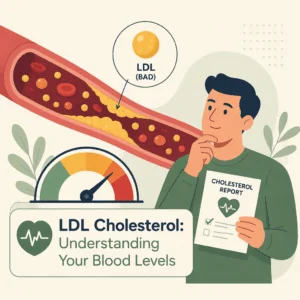
Low-density lipoprotein carries cholesterol away from the liver and toward the tissues. When too many of these particles circulate, some slip into the artery lining and start the slow plaque-building process that underlies most heart attacks and many strokes. Explore how this single value drives long-term risk by reading our LDL cholesterol blood level guide.
High-density lipoprotein works in the opposite direction, collecting surplus cholesterol and returning it to the liver for disposal. Higher values have historically been read as protective, although the picture is more nuanced than the old “good cholesterol” shorthand suggests. Compare your own figure against expected values using our HDL cholesterol level guide.
Triglycerides are the storage form of fat, assembled after meals and released between them for energy. They rise sharply after eating, respond quickly to alcohol and refined carbohydrates, and climb when insulin is not working well. Check what drives this value up and down in our triglycerides blood level guide.
Total cholesterol adds everything together. It is useful as a rough screening figure and almost useless as a target, because a high total can come from a protective HDL just as easily as from a harmful LDL. Review what the summary figure does and does not tell you in our total cholesterol level guide.
How to read your lipid panel results line by line
Most US laboratories report lipids in milligrams per deciliter (mg/dL). Many other countries use millimoles per liter (mmol/L), so a result copied from an overseas report will look roughly forty times smaller. The bands below follow the ranges published by Mayo Clinic and the CDC for US adults, and they are starting points for a conversation rather than pass-fail marks.
| Measurement | Desirable in adults | Borderline | Considered high |
|---|---|---|---|
| Total cholesterol | Below 200 mg/dL | 200 to 239 mg/dL | 240 mg/dL and above |
| LDL cholesterol | Below 100 mg/dL | 130 to 159 mg/dL | 160 mg/dL and above |
| HDL cholesterol | 60 mg/dL and above | 40 to 59 mg/dL (men), 50 to 59 mg/dL (women) | Below 40 mg/dL (men), below 50 mg/dL (women) is unfavorable |
| Triglycerides | Below 150 mg/dL | 150 to 199 mg/dL | 200 mg/dL and above |
| Non-HDL cholesterol | Below 130 mg/dL | 130 to 159 mg/dL | 160 mg/dL and above |
Reading LDL cholesterol in context
The single most important thing to know about LDL is that there is no universal target. An adult with no other risk factors and an LDL of 130 mg/dL is in a very different position from someone with the same value who has already had a heart attack, lives with diabetes or has a parent who had bypass surgery at fifty. Cardiology guidelines set progressively lower goals as background risk rises, which is why two people can receive opposite advice on identical numbers.
Laboratories traditionally calculated LDL from the other three values rather than measuring it directly. That calculation loses accuracy when triglycerides are high or when the sample was drawn shortly after a meal, so many US laboratories have moved to newer equations or to direct measurement.
Reading HDL cholesterol without over-reading it
A low HDL is a genuine warning sign and tends to travel with high triglycerides, abdominal weight gain and reduced insulin sensitivity. A high HDL, on the other hand, is not a license to ignore the rest of the report. Trials designed to raise HDL with medication have repeatedly failed to reduce heart attacks, so clinicians now treat it as a risk marker rather than a treatment target.
Reading triglycerides after a meal
Triglycerides are the most volatile number on the panel. A heavy dinner, two glasses of wine or a poor night of sleep can move the result meaningfully, so an isolated elevation is usually rechecked before anyone draws conclusions. Values above 500 mg/dL move the conversation from heart risk to pancreas safety, because very high triglycerides can trigger inflammation of the pancreas. Understand that complication better with our guide to pancreatitis causes and treatments.
Non-HDL cholesterol and the ratios
Non-HDL cholesterol is simply total cholesterol minus HDL. In one figure it captures every particle capable of depositing cholesterol in an artery wall, including the triglyceride-rich remnants that a plain LDL value misses. It is calculated automatically, needs no fasting and is increasingly the number clinicians watch first. The total-to-HDL ratio serves a similar summarizing purpose, with lower generally being better.
What your lipid panel says about your cardiovascular risk
Cholesterol does not cause symptoms. Nothing about a raised LDL feels like anything until an artery narrows enough to cause chest pain or closes abruptly. That silence is precisely why the panel exists: it is one of very few routine tests that flags a problem years or decades before it announces itself.
What the panel measures is exposure, not destiny. The accumulation of cholesterol-carrying particles in artery walls is the process behind atherosclerosis symptoms and causes, and it advances quietly over years. The same process, further along, produces coronary artery disease symptoms and treatments and contributes to many cases of ischemic stroke.
For that reason, no clinician reads a lipid panel alone. Risk calculators combine your lipids with age, sex, smoking status, blood pressure and diabetes status to estimate the probability of a cardiovascular event over the coming decade. A moderately raised LDL in an otherwise healthy forty-year-old non-smoker may warrant nothing more than dietary attention and a repeat test, while the same value in someone managing high blood pressure symptoms and causes and elevated blood sugar can justify medication straight away.
Markers your clinician may add to the standard panel
The four classic values answer most questions, but not all of them. When a family history looks unusually heavy, when a heart attack happens at a young age, or when the standard numbers look reassuring yet the clinical picture does not, several additional tests can sharpen the estimate.
Apolipoprotein B counts the particles rather than the cholesterol they carry. Because each atherogenic particle carries exactly one apoB protein, the measurement captures particle burden directly and can reveal risk hidden behind an average-looking LDL. Investigate that measurement further in our apolipoprotein B test results guide.
Lipoprotein(a) is largely inherited and barely responds to diet or exercise, which makes it a once-in-a-lifetime measurement for most people rather than a value to track. Learn who benefits from testing it in our lipoprotein(a) blood level guide. Inflammation markers add another dimension, and many preventive clinics now order a high-sensitivity C-reactive protein test alongside the lipids.
What pushes lipid results off target
Genetics set the baseline. Familial hypercholesterolemia, an inherited condition affecting roughly one in 250 people, produces very high LDL from childhood and is still widely undiagnosed. Outside that scenario, the biggest movers are the ones you can influence.
- Diet composition matters more than dietary cholesterol itself. Saturated fat, refined starch and alcohol raise the numbers far more reliably than eggs ever did.
- Body weight and physical activity shift triglycerides and HDL quickly, often within weeks.
- Blood sugar control is tightly linked to lipids: insulin resistance typically raises triglycerides and lowers HDL well before glucose becomes abnormal. Track that connection with our fasting glucose test results guide.
- An underactive thyroid raises LDL and is one of the standard secondary causes checked before starting treatment; read what the screening value means in our TSH blood test results guide.
- Kidney disease, liver disease, pregnancy, corticosteroids, some diuretics and certain hormone therapies all shift the panel in predictable directions.
Because so many conditions influence lipids, an abnormal panel often prompts a broader look at metabolic health rather than an immediate prescription. Persistent abnormalities frequently sit alongside early disturbances in blood sugar handling.
Preparing for the test and deciding when to repeat it
Fasting used to be automatic. Mayo Clinic still describes a typical nine to twelve hour fast, and the CDC mentions eight to twelve hours, but many laboratories now accept non-fasting samples for routine screening because total, HDL and non-HDL cholesterol change very little after a meal. Triglycerides and calculated LDL are the two values that genuinely need an empty stomach, so ask which protocol your clinician wants before the appointment rather than guessing.
On testing frequency, the CDC advises that most healthy adults have cholesterol checked every four to six years, while MedlinePlus describes screening from ages nine to eleven in children and more frequent testing after sixty-five. Anyone with diabetes, established heart disease, a strong family history or a recent medication change is tested far more often, typically every three to twelve months.
Two practical points make results easier to compare over time. Use the same laboratory where possible, since reference ranges and calculation methods differ between them. And avoid testing within about six weeks of an acute illness, surgery or a heart attack, because inflammation temporarily depresses cholesterol values and can make a genuinely high LDL look normal.
When to talk to a doctor about your results
A lipid panel almost never requires urgent action, but several patterns deserve a prompt appointment rather than a note for the next annual visit.
- An LDL above 190 mg/dL at any age, which raises the possibility of an inherited lipid disorder and usually prompts testing of close relatives.
- Triglycerides above 500 mg/dL, because of the pancreatitis risk described earlier.
- Any abnormal lipid result in someone who already has heart disease, diabetes or chronic kidney disease.
- A sudden, unexplained change from a previously stable panel, which more often reflects a new medication, a thyroid problem or a laboratory issue than a genuine metabolic shift.
- A family history of heart attack or stroke before age fifty-five in men or sixty-five in women, whatever your own numbers look like.
Chest discomfort, breathlessness on exertion or new leg pain when walking are reasons to seek care immediately, independent of any blood test. Cholesterol results describe risk; symptoms describe what is happening now.
Latest scientific advances
Lipid research has moved quickly in the past three years, and several findings change how clinicians read an ordinary panel. Everything below comes from published reviews and analyses that pool many studies together; each one is listed with its link in the Sources section.
A 2025 review in a specialist lipid journal compared three ways of summarizing harmful cholesterol: the familiar LDL value, non-HDL cholesterol, and apolipoprotein B — a protein that acts as a headcount of the particles able to lodge in an artery wall. The authors concluded that particle count tracks risk more faithfully than the cholesterol content of those particles, particularly when triglycerides are raised. What this means for you: if your triglycerides are high and your LDL looks acceptable, your report may be understating the situation, and asking whether an apoB measurement would clarify things is a reasonable question.
A large participant-level analysis published in a leading cardiology journal in 2024 examined lipoprotein(a), an inherited particle that standard panels do not measure. It found that the risk carried by lipoprotein(a) adds to the risk carried by LDL rather than overlapping with it. What this means for you: bringing LDL down remains worthwhile even if lipoprotein(a) is high, and a single lifetime measurement can explain why heart disease runs in some families despite unremarkable cholesterol numbers.
A 2024 pooled analysis of sixty randomized trials looked at how quickly lowering LDL translates into fewer cardiovascular events. The benefit was modest in the first year and grew steadily afterwards, becoming clearly larger the longer treatment continued. What this means for you: neither lifestyle changes nor medication pay off overnight, and stopping early because “nothing seems to be happening” forfeits most of the benefit.
On the lifestyle side, a 2024 systematic review — a formal survey pooling every relevant trial — found that regular exercise training produces consistent though moderate improvements in blood lipids, with the clearest gains in triglycerides and HDL. A separate 2023 meta-analysis of randomized trials in a European cardiology journal reported that vegetarian and vegan eating patterns lower total and LDL cholesterol compared with omnivorous diets. What this means for you: shifting the balance of your plate toward plants and moving regularly are supported by pooled trial evidence, not just observation, although neither replaces medication when risk is already high.
One caveat applies to all of it. These are averages drawn from groups, and averages do not predict individuals. They are useful for framing a conversation with your clinician, never for adjusting treatment on your own.
Glossary of key terms
| Term | What it means |
|---|---|
| Lipid panel | A blood test measuring the fats in your bloodstream, usually total cholesterol, LDL, HDL and triglycerides. Also called a lipid profile or cholesterol test. |
| Lipoprotein | A protein-coated particle that carries fat through the blood. Fats cannot dissolve in water, so they travel inside these packages. |
| LDL cholesterol | Low-density lipoprotein cholesterol. Carries cholesterol toward the tissues and can deposit it in artery walls when levels are high. |
| HDL cholesterol | High-density lipoprotein cholesterol. Returns surplus cholesterol to the liver for removal. |
| Triglycerides | The storage form of fat, built after meals and released for energy between them. Highly sensitive to food, alcohol and blood sugar control. |
| Non-HDL cholesterol | Total cholesterol minus HDL. A single figure covering every particle capable of contributing to plaque. |
| Apolipoprotein B (apoB) | A protein present once on each artery-damaging particle, so measuring it counts particles rather than the cholesterol inside them. |
| Lipoprotein(a) | An inherited lipid particle that raises cardiovascular risk independently and changes little with diet or exercise. |
| Atherosclerosis | The gradual buildup of cholesterol-rich plaque inside artery walls, narrowing and stiffening the vessel. |
| mg/dL | Milligrams per deciliter, the unit used on US lipid reports. Much of the world uses mmol/L instead. |
Frequently asked questions
What is a normal lipid panel for an adult?
For most adults without heart disease, laboratories describe total cholesterol below 200 mg/dL, LDL below 100 mg/dL, triglycerides below 150 mg/dL and HDL at or above 60 mg/dL as desirable, with non-HDL cholesterol below 130 mg/dL. These are population reference bands, not personal goals. Someone with diabetes or a previous heart attack is usually given a lower LDL target than the general range suggests, while a young adult with no other risk factors may be comfortably fine at a value the chart calls borderline. Your clinician sets the target after weighing your full risk profile.
Do I have to fast before a lipid panel?
Often, but not always. Total cholesterol, HDL and non-HDL cholesterol barely change after eating, so many laboratories now accept non-fasting samples for routine screening. Triglycerides and calculated LDL do change, so a fast of roughly nine to twelve hours is still requested when those values matter, when triglycerides were previously high, or when treatment decisions hang on the result. Water, and usually prescribed medication, are allowed during the fast. Confirm the instructions with the ordering clinician, because protocols differ between practices.
How long does it take for lipid results to improve?
Triglycerides respond fastest and can fall substantially within two to four weeks of cutting alcohol, refined carbohydrates and excess calories. LDL cholesterol moves more slowly through diet alone, with meaningful change usually visible after six to twelve weeks. Medication acts faster, with most of a statin’s effect apparent within four to six weeks. For that reason, repeat testing is generally scheduled about three months after a change rather than immediately, so the result reflects a new steady state rather than a temporary swing.
Can one bad lipid panel mean I need medication?
Rarely on its own. Except when LDL is extremely high, most clinicians confirm an abnormal result with a second sample, check for secondary causes such as thyroid or kidney problems, and calculate overall cardiovascular risk before discussing drugs. Lifestyle change is usually trialed first in people at low or moderate risk. In people who already have established cardiovascular disease or diabetes, treatment tends to begin sooner because the balance of benefit is different.
Why is my total cholesterol high when my LDL is fine?
Usually because your HDL is high. Total cholesterol sums every fraction, so a generous HDL inflates it without adding risk. This is exactly why total cholesterol alone is a poor guide and why non-HDL cholesterol, which subtracts the HDL contribution, gives a clearer answer. Occasionally the explanation is a high triglyceride level lifting the total instead, which points in a very different direction and deserves follow-up.
Should children have a lipid panel?
US guidance summarized by MedlinePlus describes a first screening between ages nine and eleven, with a repeat in the late teens. Earlier testing is advised when a parent or grandparent developed heart disease young or has very high cholesterol, since inherited lipid disorders are present from childhood and treatable. Testing decisions for children belong with a pediatrician, who will interpret the numbers against age-specific rather than adult reference bands.
Sources
- Mayo Clinic — Cholesterol test — Mayo Clinic Tests & Procedures, 2024 — mayoclinic.org
- Centers for Disease Control and Prevention — Testing for Cholesterol — CDC Cholesterol, 2024 — cdc.gov
- MedlinePlus, National Library of Medicine — Cholesterol — MedlinePlus Health Topic, updated 2025 — medlineplus.gov
- Sehayek D, Cole J, Björnson E, et al. — ApoB, LDL-C, and non-HDL-C as markers of cardiovascular risk — Journal of Clinical Lipidology, 2025 — doi.org/10.1016/j.jacl.2025.05.024
- Bhatia HS, Wandel S, Willeit P, et al. — Independence of Lipoprotein(a) and Low-Density Lipoprotein Cholesterol-Mediated Cardiovascular Risk: A Participant-Level Meta-Analysis — Circulation, 2024 — doi.org/10.1161/CIRCULATIONAHA.124.069556
- Burger PM, Dorresteijn JAN, Koudstaal S, et al. — Course of the effects of LDL-cholesterol reduction on cardiovascular risk over time: A meta-analysis of 60 randomized controlled trials — Atherosclerosis, 2024 — doi.org/10.1016/j.atherosclerosis.2024.118540
- Smart NA, Downes D, van der Touw T, et al. — The Effect of Exercise Training on Blood Lipids: A Systematic Review and Meta-analysis — Sports Medicine, 2024 — doi.org/10.1007/s40279-024-02115-z
- Koch CA, Kjeldsen EW, Frikke-Schmidt R — Vegetarian or vegan diets and blood lipids: a meta-analysis of randomized trials — European Heart Journal, 2023 — doi.org/10.1093/eurheartj/ehad211
Further reading
- Examine what persistently raised numbers do to the body over time with our guide to high cholesterol causes and treatments.
- Assess the particle that carries cholesterol back to the liver by reading our apolipoprotein A1 level guide.
- Check the amino acid sometimes measured alongside lipids in cardiovascular workups with our homocysteine blood level guide.
- Explore how blood sugar handling shapes your triglycerides by reading our insulin blood test results guide.
- Review the liver enzyme that often appears abnormal alongside a disturbed lipid profile in our ALT liver enzyme lab test guide.
Understand your lab results with BloodSense
A lipid panel is easy to obtain and surprisingly hard to read, because the same four numbers mean different things depending on everything else in your health history. BloodSense turns a raw report into plain language, showing how your cholesterol, triglycerides, fasting glucose and liver values fit together and which of them are worth raising at your next appointment. It helps you understand what you are looking at; it does not diagnose, and it does not replace the clinician who knows your history.