










Canker Sores: Causes, Deficiencies to Check and When to See a Doctor
The essentials
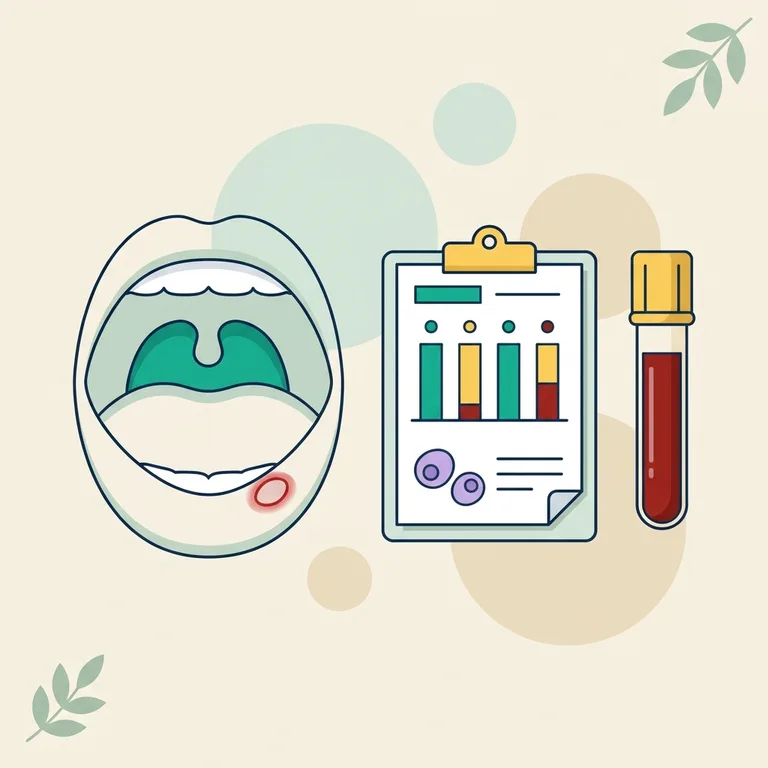
A canker sore is a small, painful ulcer inside the mouth. It is not contagious, it is not a cold sore, and most heal on their own within one to three weeks. When sores keep coming back, blood tests can look for treatable causes: low ferritin, vitamin B12 or folate, celiac disease and, rarely, Behçet's disease. See a doctor or dentist if a sore lasts more than two weeks.
What is a canker sore, at a glance?
Canker sores, also called aphthous ulcers or recurrent aphthous stomatitis, are among the most common conditions of the mouth: more than half of people get them at some point, often starting in adolescence[2]. Up to 25% of the general population has repeated episodes[6]. They are most common in teens and people in their 20s, and women get them more often than men[1][3].
What does a canker sore look like, and what are the symptoms?
A typical canker sore is round or oval, usually less than 1 cm (about a third of an inch) across, with a white or yellow center and a red border[1]. It forms on the soft, movable lining of the mouth: inner lips and cheeks, tongue and soft palate[2]. Pain often eases in 7 to 10 days, and complete healing takes 1 to 3 weeks[1]. There are three types[2]:
- Common Minor canker sores (more than 80% of people affected): under 1 cm, heal in about a week, no scar.
- Possible Major canker sores (about 15%): over 1 cm, last two weeks or more, very painful, may leave a scar.
- Rare Herpetiform canker sores (under 5%): clusters of tiny ulcers that can merge.
Is it a canker sore or a cold sore?
Canker sores are inside the mouth and are not contagious; cold sores (fever blisters) are a different condition, caused by the herpes virus, and they are contagious[1][2]. If your sore is a blister on the lip, read our guide to a blister on the lip and our page on herpes symptoms and tests.
When should I see a doctor about a canker sore?
When to see a doctor
- Emergency: call 911 for trouble breathing or swallowing, or swelling of the face or tongue. Get same-day care for mouth ulcers with a high fever if your immunity is lowered by a disease or medicine.
- Within 24 to 48 hours if sores come with fever, diarrhea, headache or a skin rash[1], with eye pain or redness, or with sores on the genitals or elsewhere on the body[2].
- At your next appointment if a sore has not healed after two weeks, is larger than 1 cm, stops you eating or drinking normally, or if you get canker sores more than two or three times a year[1][3]. A sore that does not heal must be checked: canker sores are not cancer, but some mouth cancers first look like an ulcer that will not heal[1].
What causes canker sores, and which deficiencies are linked?
The exact cause is unknown. Canker sores run in families and seem to involve white blood cells briefly attacking the lining of the mouth[1][2]. Most outbreaks have a simple trigger; a few point to a deficiency or a disease elsewhere in the body:
- Common Minor injury: biting the cheek or tongue, brushing too hard, dental work[1].
- Common Emotional stress, hormonal changes such as menstruation, and food sensitivities (acidic or spicy foods, for example)[1][3].
- Possible Toothpaste containing sodium lauryl sulfate (SLS); some people have fewer outbreaks after switching[2].
- Possible Low iron, vitamin B12 or folate[1], and also low zinc or vitamin D[3]. In a study of 273 people with recurrent canker sores, 20.9% had anemia, 20.1% low iron, 4.8% low vitamin B12 and 2.6% low folate[4].
- Possible Some medicines, including beta-blockers, NSAID pain relievers and drugs that suppress the immune system[3].
- Possible Celiac disease: people with it are about 2.5 times more likely to have recurrent canker sores[5]. Inflammatory bowel disease (Crohn's disease, ulcerative colitis) and HIV are also linked[2][3].
- Rare Behçet's disease, an inflammatory disease in which mouth ulcers come with genital ulcers, eye inflammation or skin lesions[7].
- Rare Cyclic neutropenia, an inherited condition affecting about 1 in a million people: white blood cells (neutrophils) drop about every 21 days for 3 to 5 days, with mouth ulcers and fevers that return on that schedule[8].
Which blood tests are done for recurrent canker sores, and how do I read them?
A single canker sore is diagnosed by looking at it[1][3]. When sores keep returning or are severe, simple blood tests can look for a nutritional deficiency or another cause[2]. One review recommends checking the blood count, iron, vitamin B12, folate and homocysteine before starting treatment for recurrent sores[4].
- Complete blood count: anemia, red cell size, and the neutrophil count.
- Ferritin and an iron panel: your iron stores.
- Vitamin B12 and folate.
- Zinc and sometimes vitamin D[3].
- Celiac screening: the tissue transglutaminase IgA test (tTG-IgA) is the most common, often with a total IgA level to check for IgA deficiency; a DGP test is used when IgA is low[9].
- Sometimes: an HIV test, repeated neutrophil counts over several weeks if ulcers return like clockwork[8], or a biopsy of an unusual ulcer[2].
| Test | Result | Reference range | Flag |
|---|---|---|---|
| Ferritin | 9 ng/mL | 13-150 ng/mL (female) | L |
| Vitamin B12 | 240 pg/mL | 299-1054 pg/mL | L |
| Folate, serum | 8.4 ng/mL | 2.7-17.0 ng/mL | |
| Tissue transglutaminase IgA (tTG-IgA) | Negative | Negative |
- Ferritin: reflects iron stores. The lower it is, even inside the range, the more likely stores are low[10]. Its cause (heavy periods, diet, poor absorption) must then be found.
- Vitamin B12: below 299 pg/mL is a possible deficiency; a methylmalonic acid test can confirm it[11].
- Folate: within the usual range of 2.7 to 17.0 ng/mL[12].
- tTG-IgA: negative makes celiac disease less likely, provided total IgA is normal and you kept eating gluten in the weeks before the test[9].
Blood results back after repeated canker sores? BloodSense explains each line of your report, from ferritin to B12, and helps you prepare your next visit.
Get my blood results explainedMen have a higher ferritin range (30 to 400 ng/mL)[10]; your lab's ranges prevail. Low iron and low B12 together can suggest poor absorption, as in celiac disease. See also our guide to iron deficiency and its blood tests.
Behçet's disease has no confirming blood test. Doctors use a clinical score in which mouth ulcers, genital ulcers and eye inflammation each count 2 points; 4 points or more point to the disease[7].
How are recurrent canker sores followed up?
If a deficiency is found, your doctor looks for its cause and may repeat the test after treatment to check that levels are back to normal. A positive or uncertain celiac test is usually followed by other tests, such as a small-intestine biopsy during an endoscopy[9]. An ulcer diary (dates, foods, toothpaste, stress, periods) helps reveal patterns[2].
How are canker sores treated?
Most canker sores heal without treatment[1]. There is no cure, but treatment can ease pain, shorten outbreaks and reduce how often they return[2]. No doses are given here.
- At home: avoid hot, spicy or acidic foods; rinse with salt water or a mild mouthwash without alcohol; brush gently twice a day[1].
- Over the counter: numbing gels or rinses (for example benzocaine) for short-term relief[1][3].
- Prescription: chlorhexidine rinses, corticosteroid gels or rinses, and sometimes corticosteroid tablets or laser treatment for severe outbreaks[1][3].
- Correcting a deficiency: iron, vitamin B12 or folate when a test shows a lack[3]. In a small trial, six months of vitamin B12 reduced outbreaks, even in people with normal B12 levels: 74.1% had no ulcers in the last month versus 32.0% with placebo[6]. Ask your doctor before starting supplements.
Can I prevent canker sores?
- Use a soft toothbrush and brush gently[1].
- Try a toothpaste without sodium lauryl sulfate for a few months[2].
- Note the foods that seem to trigger outbreaks and limit them[3].
- Floss daily and get routine dental checkups[1].
- If sores keep coming back, ask for blood tests rather than guessing with supplements. See also our guide to iron-rich foods.
Questions to ask your doctor
- Are these canker sores, or could it be something else?
- Should I have a blood count, ferritin, B12, folate or a celiac test?
- Could one of my medicines be causing them?
- Which prescription treatment would help during an outbreak?
- Which signs mean I should come back sooner?
Frequently asked questions
Are canker sores contagious?
No. Even open canker sores do not spread to others, unlike herpes cold sores[2].
Which vitamin deficiency causes canker sores?
Iron, vitamin B12 and folate are the most studied, with zinc and vitamin D[1][3]. Low iron is found most often[4]. Only a blood test can tell.
Can children get canker sores?
Yes, often from the teenage years[2]. A child with mouth ulcers and fevers that return on a regular schedule should see a doctor, who may check blood counts over several weeks[8].
Do canker sores mean I have celiac disease?
Usually not, but they are more frequent with celiac disease[5]. A test makes sense if you also have digestive symptoms, weight loss, low iron or a family history. Read more about celiac disease.
Related articles
- Vitamin B12 levelsHow to read a low or borderline B12 result
- Iron deficiencyThe blood tests that confirm low iron and find its cause
- Celiac diseaseA hidden cause of mouth ulcers and low iron
- Crohn's diseaseWhen mouth ulcers come with gut symptoms
- Blister on the lipCold sore or something else on the outer lip
- MedlinePlus Medical Encyclopedia. Canker sore. US National Library of Medicine. medlineplus.gov (accessed November 3, 2026)
- American Academy of Oral Medicine. Canker Sores. aaom.com (accessed November 3, 2026)
- Cleveland Clinic. Canker Sores. my.clevelandclinic.org (accessed November 3, 2026)
- Chiang CP, Yu-Fong Chang J, Wang YP, et al. Recurrent aphthous stomatitis - Etiology, serum autoantibodies, anemia, hematinic deficiencies, and management. J Formos Med Assoc. 2019;118(9):1279-1289. doi:10.1016/j.jfma.2018.10.023 (accessed November 3, 2026)
- Zhao Y, Feng W. Relative risk of oral manifestations with celiac disease: a systematic review and meta-analysis. BMC Gastroenterol. 2026;26(1). doi:10.1186/s12876-026-04860-z (accessed November 3, 2026)
- Volkov I, Rudoy I, Freud T, et al. Effectiveness of vitamin B12 in treating recurrent aphthous stomatitis: a randomized, double-blind, placebo-controlled trial. J Am Board Fam Med. 2009;22(1):9-16. doi:10.3122/jabfm.2009.01.080113 (accessed November 3, 2026)
- International Team for the Revision of the International Criteria for Behçet's Disease (ITR-ICBD). The International Criteria for Behçet's Disease (ICBD): a collaborative study of 27 countries on the sensitivity and specificity of the new criteria. J Eur Acad Dermatol Venereol. 2014;28(3):338-347. doi:10.1111/jdv.12107 (accessed November 3, 2026)
- MedlinePlus Genetics. Cyclic neutropenia. US National Library of Medicine. medlineplus.gov (accessed November 3, 2026)
- MedlinePlus. Celiac Disease Screening. US National Library of Medicine. medlineplus.gov (accessed November 3, 2026)
- MedlinePlus Medical Encyclopedia. Ferritin blood test. US National Library of Medicine. medlineplus.gov (accessed November 3, 2026)
- MedlinePlus Medical Encyclopedia. Vitamin B12 level. US National Library of Medicine. medlineplus.gov (accessed November 3, 2026)
- MedlinePlus Medical Encyclopedia. Folic acid - test. US National Library of Medicine. medlineplus.gov (accessed November 3, 2026)
This page is general information. It does not replace the advice of a doctor or dentist, who interprets your results with your symptoms, history and examination.