









Strep Throat (Group A Strep): Symptoms, Rapid Test and Antibiotics
The essentials
Strep throat is a sore throat caused by group A strep bacteria. Most sore throats are viral, so a swab test, not the look of your throat, decides whether antibiotics are needed. A positive rapid strep test or throat culture means a full antibiotic course, which shortens the illness, limits spread and helps prevent rheumatic fever. Get urgent care for trouble breathing, drooling or severe one-sided throat pain.
What is strep throat, at a glance?
Strep throat (streptococcal pharyngitis) is an infection of the throat and tonsils by Streptococcus pyogenes, also called group A strep. It is not the same germ as group B strep, which is checked for in pregnancy.
- How common: group A strep causes about 20% to 30% of sore throats in children and 5% to 15% in adults; it is most common from age 5 to 15 and rare under age 3[1].
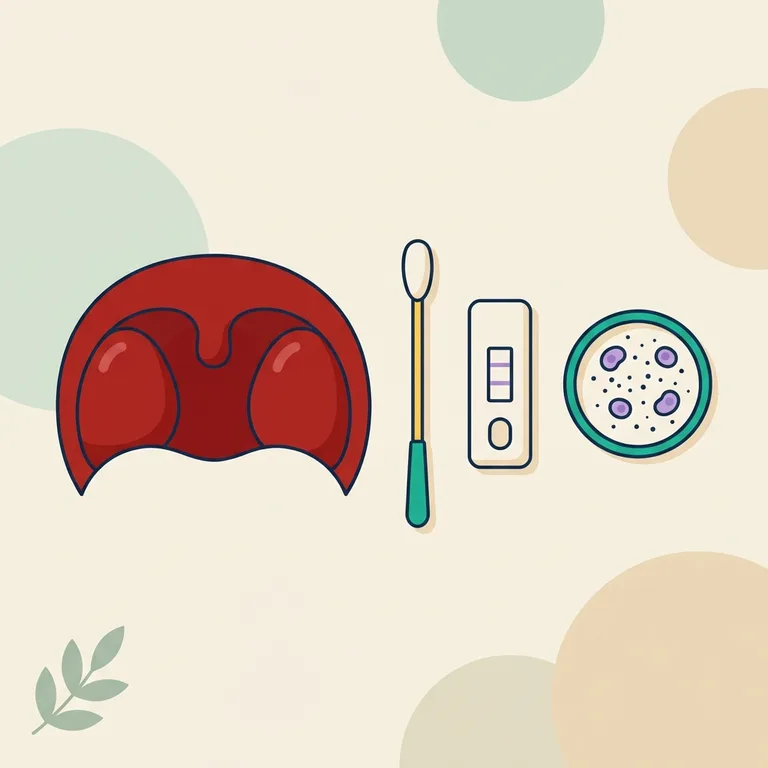
- Key tests: a rapid strep test on a throat swab, a throat culture, or a molecular (PCR-type) test[1][5].
- Treatment: antibiotics, with penicillin or amoxicillin as first choice[1].
What are the symptoms of strep throat?
Symptoms usually start 2 to 5 days after contact with someone who has strep[11]. Typical signs are[1]:
- a sore throat that starts suddenly, with pain when swallowing;
- fever;
- red, swollen tonsils, sometimes with white patches or streaks of pus;
- tiny red spots on the roof of the mouth (petechiae);
- swollen, tender glands at the front of the neck.
Children may also have a headache, stomach pain, nausea or vomiting[1]. A rough red rash means scarlet fever, which is strep throat with a rash[2]. Cough, runny nose, hoarseness, mouth ulcers and pink eye point instead to a virus such as a common cold[1]. Very young children rarely have classic strep throat; under age 3 it tends to look like a runny nose, fever and irritability[1].
When should I see a doctor for a sore throat?
When to see a doctor
- Emergency: call 911 or go to the ER for trouble breathing, drooling or being unable to swallow, severe swelling of the neck, severe pain on one side of the throat, which can signal an abscess, or signs of dehydration such as dizziness[12][2].
- Within 24 to 48 hours for a sudden sore throat with fever and no cough, a sore throat with a rash, or no improvement after 48 hours of antibiotics[11][2].
- At your next appointment for repeated strep infections in one year, or a household where strep keeps coming back[8][11].
What causes strep throat, and who is at risk?
Group A strep spreads through droplets from coughs and sneezes and through shared cups or utensils. The main risk factor is close contact with someone who has it[2].
- Common School-age children, aged 5 to 15[1].
- Common Parents of school-age children and adults who work with children[1].
- Possible Crowded settings such as daycare, schools and military training sites[2].
- Rare Children under 3, in whom testing is usually not done unless an older sibling has strep[3].
How is strep throat diagnosed, and how do I read the strep test?
A doctor cannot tell strep from a virus just by looking: when there are no viral signs, a swab test is needed[1]. No preparation is needed; the back of the throat and tonsils are rubbed with a swab, which can make you gag for a second[10].
Scores that help decide who to test. The Centor score adds one point each for fever, white patches on the tonsils, swollen tender front neck glands and no cough. In the original study of adults, the chance of a positive culture went from 2.5% with no point to 56% with all four[6]. The McIsaac version adjusts the score for age, because strep is more frequent in children aged 3 to 14[7]. A score guides testing; it does not replace it. Only about 10% of adults who seek care for a sore throat have strep, yet 60% or more receive antibiotics[8].
| Test | Sample | What to know |
|---|---|---|
| Rapid strep test (antigen) | Throat swab | Result in about 10 to 20 minutes[10]. A positive is reliable (specificity about 95%); in children it finds about 86 of 100 infections[4]. |
| Molecular test (nucleic acid, PCR-type) | Throat swab | Sensitivity about 97.5% and specificity about 95% in a review of 38 studies, so it misses fewer infections than the rapid antigen test[5]. |
| Throat culture | Throat swab | Result in 24 to 48 hours[10]. The reference test; it can find infections a rapid test misses[2]. |
| ASO (antistreptolysin O) and other antibody tests | Blood sample | Reflect a past strep infection, not the current one; not used to diagnose a sore throat[3]. |
Here is a fictitious report for a 9-year-old whose rapid test was negative and whose backup culture came back positive.
| Test | Result | Reference range | Flag |
|---|---|---|---|
| Strep A rapid antigen, throat swab | Negative | Negative | |
| Throat culture, beta-hemolytic Streptococcus group A | Positive: Streptococcus pyogenes isolated | No group A strep isolated | A |
- Rapid antigen negative: in children and teens, a negative rapid test should be checked with a culture, because the rapid test misses some infections[1][2].
- Culture positive: confirms strep throat; the office calls the family to start antibiotics[1].
- Flag A: "abnormal". Swab results are positive or negative; molecular tests may say "detected" or "not detected".
Negative, positive, isolated: BloodSense reads your whole lab report line by line, in plain language, so you know what to ask at your visit.
Explain my report| Result | Usual meaning |
|---|---|
| Rapid test or culture positive | Strep throat confirmed; antibiotics are usually prescribed[2]. |
| Rapid test negative, child or teen | A throat culture follows[2]. |
| Rapid test negative, adult | A culture is usually not needed, because rheumatic fever is very rare in adults[1]. |
| Culture negative | Group A strep is not the cause; antibiotics are not needed[2]. |
A positive test with clear viral signs may belong to a carrier: someone who has strep in the throat without being ill from it. Up to 20% of school-age children carry it in winter and spring[3]. Carriers rarely spread it, very rarely have complications and usually need no antibiotics[2]. The swab is the test: blood tests are not used to diagnose strep throat[3][10]. If a doctor orders a complete blood count or a CRP test for another reason, neither one can confirm strep. When fatigue and very large glands last, mononucleosis is another cause of a severe sore throat.
What follow-up is needed after strep throat?
- No repeat swab once you feel better: a "test of cure" is not routinely recommended[3].
- Most people feel better within a day or two of starting antibiotics[12]. Call back if there is no improvement after 48 hours[2], and get re-checked if symptoms get worse or last 5 days after treatment starts[8].
- About 10 days after strep throat, watch for dark, reddish-brown urine or puffy eyes in the morning: signs of post-streptococcal glomerulonephritis, a kidney inflammation checked with a urinalysis[9].
- 1 to 5 weeks after the infection, joint pain that moves from joint to joint, jerky movements, fever or chest symptoms can point to acute rheumatic fever[9].
- Frequent strep: removing the tonsils is rarely advised; common thresholds are 7 episodes in one year, 5 a year for 2 years, or 3 a year for 3 years[8].
Which antibiotics treat strep throat?
Everyone with a positive rapid test or culture should be treated, at any age; antibiotics are not used for a viral sore throat[1]. Treatment shortens symptoms, limits spread to others and lowers the risk of complications[1]. Starting within 9 days of the first symptoms still prevents rheumatic fever[3], so waiting a day or two for a culture result does not remove that protection. Your clinician chooses the medicine and dose.
- First choice: penicillin or amoxicillin, usually as a 10-day course by mouth, or one penicillin injection[1]. No group A strep resistant to penicillin has ever been reported[1].
- Penicillin allergy: a cephalosporin such as cephalexin when the allergy is not the immediate, severe type; otherwise clindamycin, azithromycin or clarithromycin[1].
- Why not always azithromycin (the "Z-Pak")? Resistance to azithromycin, clarithromycin and clindamycin is well documented and varies by place[1][8].
- Finish the course even when you feel well after a day or two[12].
For comfort: acetaminophen or an anti-inflammatory such as ibuprofen for pain and fever, but no aspirin for children; corticosteroids are not recommended[3]. Warm tea with honey, salt-water gargles and ice pops help; avoid hard candies and lozenges in young children, who can choke[11].
How do I stop strep throat from spreading?
- Stay home from school, daycare or work until the fever is gone and antibiotics have been taken for at least 12 to 24 hours[2].
- Wash hands often, cover coughs and sneezes, and do not share cups, utensils or bites of food[2].
- Replace the toothbrush after 2 or 3 days of treatment[11].
- Household members without symptoms do not need a test or antibiotics[3].
Questions to ask your doctor
- Which test did I have, and is a culture needed if it is negative?
- Which antibiotic is best for me, given any allergies?
- When can I go back to work, or my child back to school?
- Which signs mean I should come back sooner?
- Could this be carriage, or mono, rather than strep?
Frequently asked questions
Does strep throat go away on its own?
Symptoms often fade in about a week[11], but untreated strep can lead to an abscess, kidney inflammation or rheumatic fever, which is why a confirmed case is treated[1].
How long is strep throat contagious?
Until about 24 to 48 hours after antibiotics start[11]; without treatment, much longer.
Can I have strep throat without a fever?
Yes. Fever is typical but not required, which is why a swab, not a symptom list, gives the answer[6].
Is group A strep the same as group B strep?
No. Group A causes strep throat; group B is a different germ, screened for late in pregnancy. Our group B strep test guide explains that one.
Related articles
- Scarlet feverStrep throat with a sandpaper rash: signs and care
- MononucleosisA viral cause of a severe sore throat and fatigue
- Ear infectionOne of the complications strep can cause
- Hand, foot and mouth diseaseMouth sores and fever in young children, from a virus
- All diseasesOur guides to conditions and their tests
- CDC. Clinical Guidance for Group A Streptococcal Pharyngitis. 2025. cdc.gov (accessed November 1, 2026)
- CDC. About Strep Throat (2026); Testing for Strep Throat or Scarlet Fever (2025). cdc.gov (about), cdc.gov (testing) (accessed November 1, 2026)
- Shulman ST, Bisno AL, Clegg HW, et al. Clinical Practice Guideline for the Diagnosis and Management of Group A Streptococcal Pharyngitis: 2012 Update by the Infectious Diseases Society of America. Clin Infect Dis. 2012;55(10):e86-e102. doi:10.1093/cid/cis629 (accessed November 1, 2026)
- Cohen JF, Bertille N, Cohen R, Chalumeau M. Rapid antigen detection test for group A streptococcus in children with pharyngitis. Cochrane Database Syst Rev. 2016;7(7):CD010502. doi:10.1002/14651858.CD010502.pub2 (accessed November 1, 2026)
- Dubois C, Smeesters PR, Refes Y, et al. Diagnostic accuracy of rapid nucleic acid tests for group A streptococcal pharyngitis: systematic review and meta-analysis. Clin Microbiol Infect. 2021;27(12):1736-1745. doi:10.1016/j.cmi.2021.04.021 (accessed November 1, 2026)
- Centor RM, Witherspoon JM, Dalton HP, Brody CE, Link K. The diagnosis of strep throat in adults in the emergency room. Med Decis Making. 1981;1(3):239-246. doi:10.1177/0272989X8100100304 (accessed November 1, 2026)
- McIsaac WJ, White D, Tannenbaum D, Low DE. A clinical score to reduce unnecessary antibiotic use in patients with sore throat. CMAJ. 1998;158(1):75-83. PMC1228750 (accessed November 1, 2026)
- Hamilton JL, McCrea L II. Streptococcal Pharyngitis: Rapid Evidence Review. Am Fam Physician. 2024;109(4):343-349. aafp.org (accessed November 1, 2026)
- CDC. Clinical Guidance for Acute Rheumatic Fever; Clinical Guidance for Post-Streptococcal Glomerulonephritis. 2025. cdc.gov (rheumatic fever), cdc.gov (glomerulonephritis) (accessed November 1, 2026)
- MedlinePlus. Strep A Test. US National Library of Medicine. medlineplus.gov (accessed November 1, 2026)
- MedlinePlus. Strep throat. Medical Encyclopedia. medlineplus.gov (accessed November 1, 2026)
- Cleveland Clinic. Strep Throat. 2026. clevelandclinic.org (accessed November 1, 2026)
This page is general information. It does not replace the advice of a doctor, who interprets your test results with your symptoms, history and examination.