DIC (Disseminated Intravascular Coagulation): Symptoms, Causes and Lab Tests
The essentials
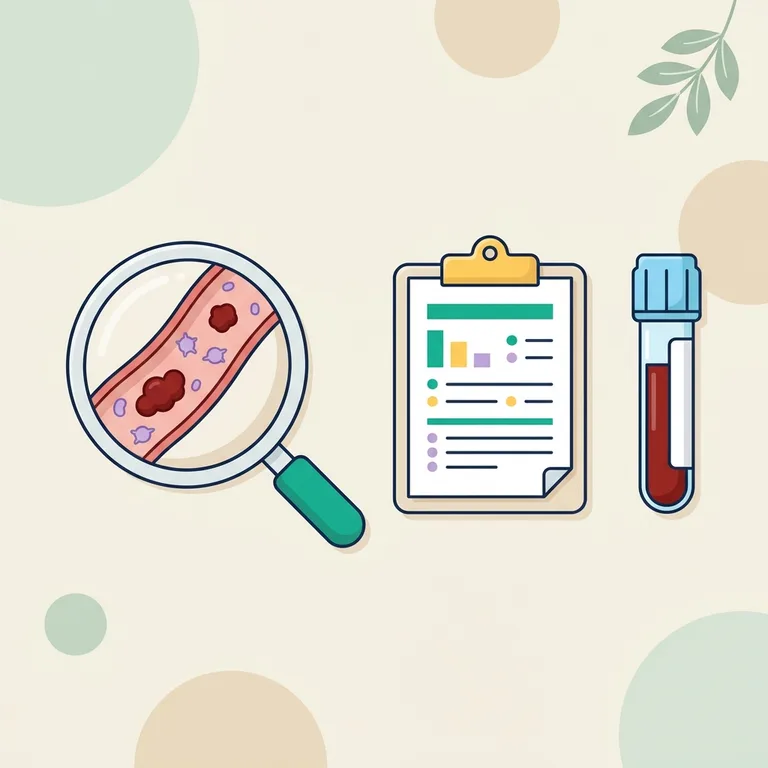
DIC (disseminated intravascular coagulation) is a serious problem in which clotting switches on throughout the body: tiny clots block small vessels, then platelets and clotting proteins run out and bleeding can follow. It is always triggered by another serious illness, most often a severe infection. Doctors read a few blood tests together and repeat them, and treat mainly the cause.
What is DIC, at a glance?
- What happens: clotting proteins become overactive all over the body. Small clots form inside vessels and can reduce blood flow to organs such as the liver, brain or kidneys; at the same time the clotting proteins are consumed, which can cause bleeding[2].
- Other names: consumption coagulopathy, defibrination syndrome[3].
- Always secondary: DIC follows an underlying condition such as a severe infection, a cancer, major trauma or a serious pregnancy complication[5].
- Two speeds: acute DIC develops quickly and is an emergency; slowly evolving (chronic) DIC, seen for example with some cancers, may cause few symptoms[3][4].
- Key blood tests: platelet count, prothrombin time (PT) and INR, partial thromboplastin time (PTT), fibrinogen and D-dimer[2].
What are the symptoms of DIC?
Symptoms come from two opposite problems, and both can happen in the same person[1][4].
- Bleeding: from wounds, drip sites, the nose, gums or mouth; blood in the urine or stool; small or large bruises[1]. Tiny red or purple spots on the skin are a form of purpura.
- Clots: chest pain or shortness of breath, or pain, redness, warmth and swelling in a leg[1].
- Whole body: a drop in blood pressure, confusion, memory loss or a change in behavior, and fever[2].
Most people with acute DIC are already in the hospital for the illness that triggered it. Without treatment, DIC can lead to lung failure (ARDS), bleeding in the digestive tract, a heart attack, shock, a stroke or blood clots in the veins[1].
When should you see a doctor or go to the emergency room?
When to see a doctor
- Emergency: call 911 for bleeding that does not stop[2], blood in vomit or black stools, sudden chest pain or shortness of breath, confusion, or weakness on one side of the body, especially in someone who has a severe infection, has just given birth, had major surgery or an injury, or is being treated for cancer.
- Within 24 hours for new unexplained bruises or tiny red spots on the skin, nosebleeds or gum bleeding that keep coming back, or a painful swollen leg[1].
- At your next appointment if a blood test you received shows a low platelet count or a raised D-dimer and you have a known cancer or liver disease: ask whether a slowly evolving DIC has been considered[3].
What causes DIC?
DIC follows a condition that causes widespread inflammation or releases clot-promoting material into the blood[4].
- Common Sepsis, a bloodstream infection with bacteria or fungi: the most common cause[1][4].
- Common Severe injury, burns, head injury or major surgery[1][2].
- Possible Cancer, especially some types of leukemia such as acute promyelocytic leukemia, and some solid tumors such as prostate cancer; DIC in cancer is often slower and less dramatic[2][4].
- Possible Pregnancy complications: placental abruption, amniotic fluid embolism, retained placental tissue, the death of the baby in the womb and, more rarely, preeclampsia[2][4].
- Possible Pancreatitis and severe liver disease such as cirrhosis[1][2].
- Rare A transfusion reaction, a snake bite, a large hemangioma or an aortic aneurysm; DIC is also a rare complication of COVID-19[1][2][4].
Which blood tests diagnose DIC?
There is no single DIC test. The usual tests are a complete blood count with a blood smear, PT, PTT, fibrinogen and D-dimer[2], all part of a standard coagulation blood test. Here is a fictitious report in suspected acute DIC.
| Test | Result | Reference range | Flag |
|---|---|---|---|
| Platelet count | 58 x10E3/uL | 150-400 x10E3/uL | L |
| Prothrombin time (PT) | 17.2 sec | 11.0-13.5 sec | H |
| INR | 1.6 | 0.8-1.1 | H |
| PTT (activated) | 39 sec | 25-35 sec | H |
| Fibrinogen | 118 mg/dL | 200-400 mg/dL | L |
| D-dimer | 6.40 ug/mL FEU | <0.50 ug/mL FEU | H |
- Platelets: normal is 150,000 to 400,000 per microliter, written 150-400 x10E3/uL[10]. A low count is found in about 98% of DIC cases, and below 50,000 in about half[4].
- PT, INR and PTT: the time blood takes to clot. Usual values are a PT of 11 to 13.5 seconds, an INR of 0.8 to 1.1 and a PTT of 25 to 35 seconds[10]. They are prolonged in only about half of DIC cases, so normal times do not rule it out[4]. See also what INR means.
- Fibrinogen: the protein that becomes the clot; 200 to 400 mg/dL is usual[10]. It also rises with inflammation, so it stays normal in nearly half of patients with DIC[4]. Below 100 mg/dL (1 g/L) counts in the ISTH score[6].
- D-dimer: a fragment released when clots break down. A conventional cutoff is 500 ug/L (0.50 ug/mL)[11], but units (FEU or DDU) and cutoffs vary between labs. A high D-dimer also rises after surgery or trauma, with a clot in a vein, or with liver or kidney problems[4].
Got a coagulation report with several flags? BloodSense reads every line of your full report, explains how the results fit together and helps you prepare questions for your care team.
Get my coagulation report explainedHow do doctors read DIC lab results together?
No single value makes the diagnosis. Doctors look at the combination, the cause and the trend: a platelet count that keeps falling says more than one low value[4]. This is why the tests are repeated over time[1][9].
- Rapidly evolving DIC: more severe drop in platelets, longer PT and PTT, a fibrinogen level that falls fast and a high D-dimer[3].
- Slowly evolving DIC: mildly low platelets, normal or barely prolonged PT and PTT (the PTT can even be shorter than normal), normal or moderately low fibrinogen and a raised D-dimer[3].
The ISTH score. The International Society on Thrombosis and Haemostasis (ISTH) gives points for four results: platelet count, a fibrin marker such as D-dimer, the prolongation of the PT and fibrinogen[6]. A total of 5 or more is compatible with overt DIC; in studies the score had a sensitivity of 91% and a specificity of 97%, and higher scores went with a higher risk of death[4]. In one group of patients with sepsis, mortality was 43% with DIC and 27% without[4].
Conditions that can look like DIC[1][3][4]:
- Severe liver disease: also lowers clotting factors and platelets. Factor VIII is usually low in DIC but not in liver disease, and D-dimer tends to be higher in DIC.
- Thrombotic microangiopathies such as TTP: low platelets and broken red cells, but PT and PTT are usually normal; an ADAMTS13 test helps.
- Also: massive blood loss, heparin-induced thrombocytopenia, vitamin K deficiency.
When red cells break apart in small clogged vessels[2], the blood smear can show fragments and markers such as LDH and haptoglobin may be checked.
What changed in 2025?
In 2025 the ISTH updated its 2001 definition: DIC is an acquired, life-threatening disorder that progresses from an early phase that may have no symptoms to an advanced phase with bleeding and/or organ failure. Detecting it early may improve the outcome[7]. The update separates pre-DIC, early-phase DIC and overt DIC, adapts the criteria to the cause (in sepsis, the sepsis-induced coagulopathy score detects early DIC), and revises the overt DIC score: a D-dimer above 3 times the upper limit of normal now scores 2 points, and above 7 times, 3 points[8].
How is DIC treated?
There is no specific treatment for DIC itself: the priority is to treat the cause, for example the infection, the pregnancy complication or the cancer[2][5]. Care usually takes place in the hospital, often in intensive care[4]. No doses are given here.
- Transfusions: platelets, plasma, cryoprecipitate or fibrinogen concentrate replace what has been used up. They are given mainly to people who are bleeding or need a procedure, not because of lab results alone[9].
- Blood thinners (heparin): may be used when clotting dominates, for example in slowly evolving DIC with clots; they are generally avoided in fast DIC with bleeding[3][9]. Critically ill patients who are not bleeding usually receive preventive doses against clots[9].
How is DIC followed up, and can it be prevented?
A platelet count that stabilizes on repeat tests is an indirect sign that clotting activation has stopped[4]. The outlook depends on that cause, and DIC can be life-threatening[2]. The best prevention is prompt treatment of the conditions that can trigger it[2].
Questions to ask your doctor
- What is causing the DIC, and how is that cause being treated?
- Is it a fast or a slowly evolving DIC, and is bleeding or clotting the bigger risk right now?
- Which results are you watching most closely, and how often will they be repeated?
- Do I need transfusions or a blood thinner, and why?
Frequently asked questions
What does DIC stand for in medical terms?
Disseminated intravascular coagulation: "disseminated" because clotting happens throughout the body, "intravascular" because it happens inside the blood vessels[2].
Can a single blood test rule out DIC?
No. Platelets, fibrinogen and clotting times can still be in the normal range early on, even if they have dropped from your usual values, so the tests are repeated[4].
Is DIC contagious or inherited?
No. DIC is acquired: it is a reaction of the clotting system to another illness, such as a severe infection or an injury[5][7]. The infection that triggered it may be contagious, but DIC itself is not.
Can DIC happen during pregnancy or after childbirth?
Yes. Placental abruption, amniotic fluid embolism and retained placental tissue are recognized causes, which is why fibrinogen is checked when the placenta separates early[2][4][10].
Related articles
- Coagulation blood testThe full panel: PT, INR, PTT, fibrinogen and D-dimer
- D-dimer testWhy it rises and what the units mean
- Fibrinogen levelsLow and high fibrinogen explained
- Platelet countWhat a low count means and when it is urgent
- SepsisThe most common trigger of DIC
- National Heart, Lung, and Blood Institute. Disseminated Intravascular Coagulation (DIC). National Institutes of Health. nhlbi.nih.gov (accessed October 31, 2026)
- MedlinePlus Medical Encyclopedia. Disseminated intravascular coagulation (DIC). Reviewed October 2025. US National Library of Medicine. medlineplus.gov (accessed October 31, 2026)
- Merck Manual Professional Version. Disseminated Intravascular Coagulation (DIC). Full review July 2025. merckmanuals.com (accessed October 31, 2026)
- Venugopal A. Disseminated intravascular coagulation. Indian J Anaesth. 2014;58(5):603-608. doi:10.4103/0019-5049.144666 (accessed October 31, 2026)
- Levi M, Scully M. How I treat disseminated intravascular coagulation. Blood. 2018;131(8):845-854. doi:10.1182/blood-2017-10-804096 (accessed October 31, 2026)
- Taylor FB Jr, Toh CH, Hoots WK, Wada H, Levi M. Towards definition, clinical and laboratory criteria, and a scoring system for disseminated intravascular coagulation. Thromb Haemost. 2001;86(5):1327-1330. doi:10.1055/s-0037-1616068 (accessed October 31, 2026)
- Iba T, Levy JH, Maier CL, et al. Updated definition and scoring of disseminated intravascular coagulation in 2025: communication from the ISTH SSC Subcommittee on Disseminated Intravascular Coagulation. J Thromb Haemost. 2025;23(7):2356-2362. doi:10.1016/j.jtha.2025.03.038 (accessed October 31, 2026)
- Iba T, Maier CL, Scarlatescu E, Levy JH. Introducing the new definition and diagnostic criteria of disseminated intravascular coagulation released by the International Society on Thrombosis and Haemostasis in 2025. Semin Thromb Hemost. 2026;52(1):10-17. doi:10.1055/a-2675-6068 (accessed October 31, 2026)
- Levi M, Toh CH, Thachil J, Watson HG. Guidelines for the diagnosis and management of disseminated intravascular coagulation. British Committee for Standards in Haematology. Br J Haematol. 2009;145(1):24-33. doi:10.1111/j.1365-2141.2009.07600.x (accessed October 31, 2026)
- MedlinePlus Medical Encyclopedia. Platelet count; Prothrombin time (PT); Partial thromboplastin time (PTT); Fibrinogen blood test. US National Library of Medicine (accessed October 31, 2026)
- Righini M, Van Es J, Den Exter PL, et al. Age-adjusted D-dimer cutoff levels to rule out pulmonary embolism: the ADJUST-PE study. JAMA. 2014;311(11):1117-1124. doi:10.1001/jama.2014.2135 (accessed October 31, 2026)
This page is general information. It does not replace the advice of a doctor, who interprets your results with your symptoms, history and examination.