









Purpura: Causes, Types and the Blood Tests That Find the Reason
The essentials
Purpura means red, purple or brown spots of blood under the skin, 4 to 10 mm across, that do not fade when you press on them. It is a sign, not a disease: the cause can be harmless (thin skin with age) or urgent (a serious infection). The first blood test is a complete blood count, because the platelet count splits the causes into two groups.
What is purpura, at a glance?
- Definition: purple-colored spots and patches on the skin or inside the mouth, caused by small blood vessels leaking blood under the surface[1].
- Size words used by doctors: petechiae are pinpoint spots under 4 mm, purpura measures 4 to 10 mm, and ecchymoses (bruises) are larger than 1 cm[1][2].
- Two big groups: thrombocytopenic purpura, with a low platelet count, and nonthrombocytopenic purpura, with a normal count[2].
- Key number: a normal adult platelet count is 150,000 to 450,000 per microliter; below 150,000 is low[3].
What does purpura look like, and what are its symptoms?
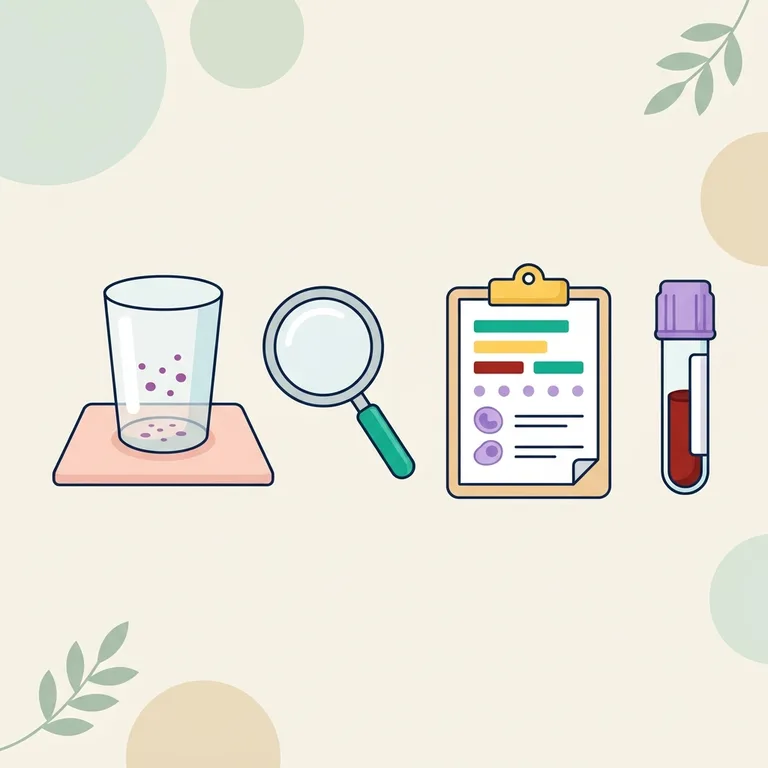
The spots are red at first, then turn purple and later brownish as the blood is cleared. Their key feature: they stay visible when you press them, unlike most rashes, which turn pale[2]. You can check this by pressing the side of a clear glass on the skin. On brown or black skin, look at paler areas such as the palms, soles, inside the eyelids or the roof of the mouth[10].
The shape of the spots gives the doctor a first clue:
- Flat spots with bleeding gums, nosebleeds, heavy periods or blood in urine or stool point toward a platelet problem[4].
- Slightly raised spots you can feel with a fingertip (palpable purpura), mostly on the legs and buttocks, point toward inflammation of small blood vessels (vasculitis). In children, joint pain or belly pain often come with them[7].
- Large dark bruises on the back of the hands and forearms of an older adult, after a minor knock or none at all, suggest fragile skin (senile purpura)[12].
When is purpura an emergency?
When to see a doctor
- Emergency: call 911 if spots that do not fade under a glass come with fever, a feeling of being very unwell, confusion, a stiff neck or a spreading rash: this can be meningococcal infection and needs emergency care at once[10]. Also call for bleeding that does not stop with pressure[4], or purpura with sudden confusion, weakness or trouble speaking.
- Within 24 to 48 hours if new spots appear without a known cause and you feel well, if a child has purpura on the legs with joint or belly pain, or if you take a blood thinner and the spots are spreading[11].
- At your next appointment for old, unchanged bruises on sun-exposed forearms, or for a few spots that have already faded. Bring photos and your medicine list.
The absence of fever does not rule out a serious cause, and most people with meningitis never have a rash at all. Read our guide to meningitis symptoms for the full list of warning signs.
What causes purpura?
Doctors sort the causes by the platelet count, then by how the blood clots and how strong the vessel walls are[1][2]. Frequent causes come first:
- Common Senile (actinic) purpura: age and years of sun exposure thin the skin and make vessels fragile. It is harmless and needs no treatment, although blood thinners and corticosteroids make it worse[12].
- Common Medicines: drugs that affect platelets or clotting (aspirin, clopidogrel, warfarin and other anticoagulants), long-term steroids, and drugs that lower the platelet count[1][12]. Never stop a prescribed blood thinner without medical advice.
- Possible IgA vasculitis (Henoch-Schönlein purpura): the most common vasculitis in children, with 10 to 20 cases per 100,000 children a year, 90% of them between ages 2 and 10. It often follows a cold[7][8].
- Possible Immune thrombocytopenia (ITP): the immune system destroys platelets. In children it often goes away within weeks or months; the long-lasting form mostly affects adults, and women two to three times more often than men[4].
- Possible Infections and other conditions that lower platelets: HIV, hepatitis C, other viral infections, lupus and bone marrow diseases[2].
- Rare Serious emergencies: meningococcal bloodstream infection and other forms of sepsis, disseminated intravascular coagulation (DIC), leukemia, and thrombotic thrombocytopenic purpura (TTP), in which tiny clots form throughout the body[1][2][9]. See how DIC is recognized on blood tests.
- Rare Other vessel causes: vitamin C deficiency (scurvy), amyloidosis and inherited connective tissue conditions such as Ehlers-Danlos syndrome[1][2].
How is purpura diagnosed? The blood tests and how to read them
The doctor examines the skin, asks about medicines, recent infections and bleeding, then orders blood and urine tests; a skin biopsy may be needed[1]. The complete blood count (CBC) comes first, often with clotting tests. A fictitious example of how results may appear:
| Test | Result | Reference range | Flag |
|---|---|---|---|
| White blood cells | 6.8 x10^3/µL | 4.5-11.0 | |
| Hemoglobin | 13.6 g/dL | 12.0-15.5 | |
| Platelet count | 18 x10^3/µL | 150-450 | L |
| Mean platelet volume (MPV) | 11.2 fL | 7.5-11.5 | |
| Prothrombin time (PT) | 12.4 s | 11.0-13.5 | |
| aPTT | 31 s | 25-35 |
- The L flag: 18 x10^3/µL means 18,000 platelets per microliter, far below 150,000. Bleeding risk rises below about 20,000[5].
- Everything else is normal: an isolated low platelet count with normal red and white cells is the usual picture of ITP, which is diagnosed by ruling out other causes[5].
- Normal PT and aPTT: the clotting factors work, so the problem lies with the platelets, not with clotting proteins.
- Not a diagnosis: the count must be confirmed, and a blood smear checked under the microscope[5]. Ranges vary by lab.
A platelet count on one line, clotting times on another, a urine test on a third page? BloodSense explains every line of your complete lab report in plain words and helps you prepare your questions for the doctor.
Explain my lab results| Test | Why it is ordered | Result that changes the picture |
|---|---|---|
| Platelet count and MPV | Splits the causes into two groups[2] | Low count (L): thrombocytopenic purpura. Normal count: look at the vessels or the clotting factors |
| Blood smear | Checks the cells by eye[5] | Platelet clumps mean a falsely low count; fragmented red cells (schistocytes) point to TTP[9] |
| Prothrombin time, INR and aPTT | Check the clotting factors (see our coagulation test guide) | Long times (H) point to an anticoagulant, a liver problem, a factor deficiency or DIC |
| Urinalysis and creatinine | Look for kidney involvement in IgA vasculitis[8] | Blood or protein in the urine, or a rising creatinine (H), needs closer follow-up |
| LDH, haptoglobin and ADAMTS13 activity | Ordered if TTP is suspected[9] | High LDH (H), low haptoglobin (L) and ADAMTS13 activity below 10% support TTP, an emergency[9] |
| HIV and hepatitis C tests | Added when ITP is suspected and there is a risk[4] | A positive result explains the low platelets |
| Vitamin C | Added for poor diet with bleeding gums | A very low level (L) supports scurvy |
A trap on the report: in some people, the anticoagulant in the usual lavender-top tube (EDTA) makes platelets clump in the tube. The machine then reports a falsely low count. A blood smear or a new sample in a citrate or heparin tube gives the true value[13]. A very low count with no bleeding and no spots deserves this check.
In children, IgA vasculitis is classified by purpura or petechiae mostly on the legs, plus at least one of: belly pain, arthritis or joint pain, kidney involvement, or IgA deposits on a biopsy[14]. As a vessel cause, it does not lower the platelet count[2].
How is purpura followed over time?
- ITP: repeat platelet counts. Treatment is rarely needed above 20,000 per microliter without bleeding[5].
- IgA vasculitis: urine tests and blood pressure checks for 6 to 12 months, because kidney involvement can appear after the rash[11]. The illness lasts about 4 weeks on average[7].
- Senile purpura: no tests are needed once the diagnosis is clear. New bruises fade over days; the brown stain can last weeks to months[12].
How is purpura treated?
Treatment targets the cause, and sometimes none is needed[2]. No doses are given here.
- Medicine-related purpura: the doctor may change or adjust the drug.
- ITP: watchful waiting, corticosteroids, intravenous immunoglobulin, anti-D, thrombopoietin receptor agonists, rituximab or splenectomy, chosen with the patient[6].
- IgA vasculitis: mostly rest and pain relief; corticosteroids and kidney treatment only in selected cases[7][8].
- TTP: hospital treatment started quickly, guided by ADAMTS13 testing[9].
- Senile purpura: no treatment speeds healing or is needed[12].
How can you prevent purpura or live with it?
- Protect your forearms and hands from the sun and from knocks if your skin is thin[12].
- Keep an up-to-date list of all medicines and supplements, and ask before taking aspirin or ibuprofen if your platelets are low.
- Photograph new spots with a coin next to them, and note the date.
- Ask about vaccines against meningococcal disease for your age and situation.
- After IgA vasculitis, keep every urine and blood pressure check-up, even if the rash has gone[11].
Questions to ask your doctor
- Is my platelet count low, and has a blood smear ruled out clumping in the tube?
- Are my clotting times normal?
- Could one of my medicines or supplements cause these spots?
- Do I need urine tests or blood pressure checks, and for how long?
- Which signs mean I should go straight to the emergency room?
Frequently asked questions
Is purpura the same as a bruise?
Both are blood under the skin. Doctors keep the word bruise (ecchymosis) for patches larger than 1 cm and purpura for spots of 4 to 10 mm[1]. What matters most is whether they appear without a reason.
Is purpura a sign of leukemia?
Rarely. Leukemia is one possible cause, but it usually changes other lines of the blood count too, such as white cells or hemoglobin[2]. A normal CBC makes it much less likely.
How long does purpura last?
It depends on the cause: a few days to weeks for senile purpura spots[12], about 4 weeks for IgA vasculitis[7], and longer if the platelet count stays low.
Can you have purpura with a normal platelet count?
Yes. Vasculitis, fragile skin, steroids, vitamin C deficiency and clotting factor problems all cause purpura with normal platelets[1].
Related articles
- Platelet countNormal range and what high or low results mean
- Complete blood countHow to read every line of a CBC
- Coagulation testsPT, INR and aPTT explained
- MeningitisThe warning signs that cannot wait
- UrinalysisChecking the kidneys after IgA vasculitis
- MedlinePlus Medical Encyclopedia. Purpura. Review date June 3, 2025. US National Library of Medicine. medlineplus.gov (accessed October 30, 2026)
- Cleveland Clinic. Purpura. Last reviewed April 13, 2022. clevelandclinic.org (accessed October 30, 2026)
- National Heart, Lung, and Blood Institute. Thrombocytopenia. Last updated February 18, 2025. nhlbi.nih.gov (accessed October 30, 2026)
- National Heart, Lung, and Blood Institute. Immune thrombocytopenia (ITP). Last updated July 24, 2025. nhlbi.nih.gov (accessed October 30, 2026)
- Provan D, Arnold DM, Bussel JB, et al. Updated international consensus report on the investigation and management of primary immune thrombocytopenia. Blood Adv. 2019;3(22):3780-3817. doi:10.1182/bloodadvances.2019000812 (accessed October 30, 2026)
- Neunert C, Terrell DR, Arnold DM, et al. American Society of Hematology 2019 guidelines for immune thrombocytopenia. Blood Adv. 2019;3(23):3829-3866. doi:10.1182/bloodadvances.2019000966 (accessed October 30, 2026)
- Leung AKC, Barankin B, Leong KF. Henoch-Schönlein purpura in children: an updated review. Curr Pediatr Rev. 2020;16(4):265-276. doi:10.2174/1573396316666200508104708 (accessed October 30, 2026)
- Ozen S, Marks SD, Brogan P, et al. European consensus-based recommendations for diagnosis and treatment of immunoglobulin A vasculitis: the SHARE initiative. Rheumatology (Oxford). 2019;58(9):1607-1616. doi:10.1093/rheumatology/kez041 (accessed October 30, 2026)
- Zheng XL, Vesely SK, Cataland SR, et al. ISTH guidelines for the diagnosis of thrombotic thrombocytopenic purpura. J Thromb Haemost. 2020;18(10):2486-2495. doi:10.1111/jth.15006 (accessed October 30, 2026)
- NHS. Meningitis. Last reviewed June 12, 2026. nhs.uk (accessed October 30, 2026)
- NHS. Henoch-Schönlein purpura (HSP). Last reviewed October 18, 2023. nhs.uk (accessed October 30, 2026)
- MSD Manual Professional Version. Senile purpura. Reviewed February 2025. msdmanuals.com (accessed October 30, 2026)
- Yan L, Xu S, Yang X, et al. Decision-making error in platelet transfusion caused by EDTA-dependent pseudothrombocytopenia: a case report and literature review. Clin Lab. 2024;70(1). doi:10.7754/Clin.Lab.2023.230703 (accessed October 30, 2026)
- Ozen S, Pistorio A, Iusan SM, et al. EULAR/PRINTO/PRES criteria for Henoch-Schönlein purpura, childhood polyarteritis nodosa, childhood Wegener granulomatosis and childhood Takayasu arteritis: Ankara 2008. Part II: final classification criteria. Ann Rheum Dis. 2010;69(5):798-806. doi:10.1136/ard.2009.116657 (accessed October 30, 2026)
- MedlinePlus. Complete blood count (CBC). Last updated October 15, 2024. US National Library of Medicine. medlineplus.gov (accessed October 30, 2026)
This page is general information. It does not replace the advice of a doctor, who interprets your results with your symptoms, history, medicines and examination.