









POTS Syndrome (Postural Orthostatic Tachycardia Syndrome): Symptoms, Diagnosis Tests and Treatment
The essentials
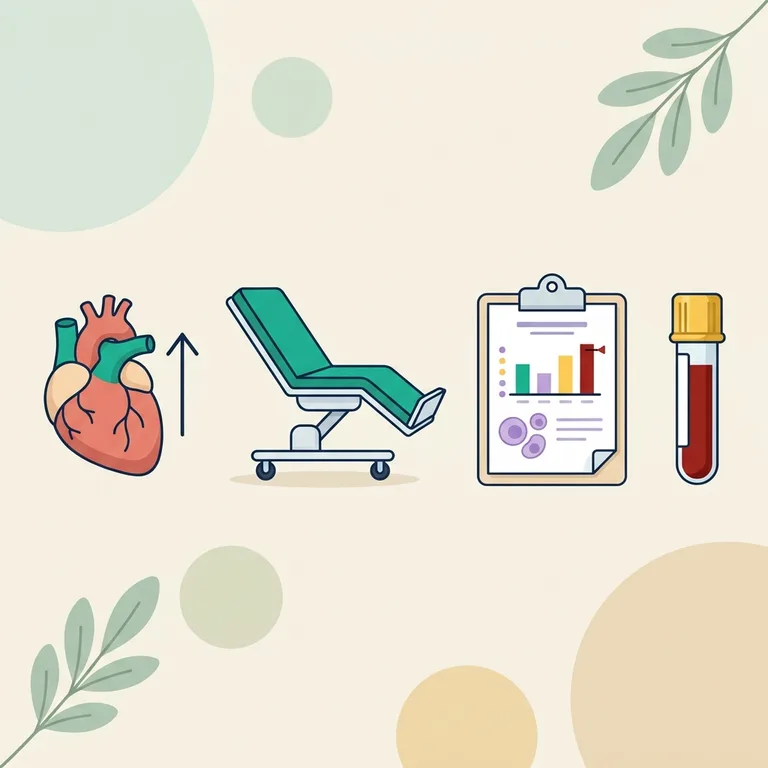
POTS (postural orthostatic tachycardia syndrome) is a long-lasting disorder of the autonomic nervous system: on standing, the heart speeds up by 30 beats per minute or more (40 in teenagers) while blood pressure holds, with dizziness, palpitations and fatigue that ease when lying down. It is diagnosed with a stand test or a tilt table test. Blood tests are usually normal: their job is to rule out conditions that look like POTS.
What is POTS syndrome, at a glance?
- Full name: postural orthostatic tachycardia syndrome, also called postural tachycardia syndrome. It belongs to the orthostatic intolerance disorders: symptoms that appear when you stand up and ease when you lie down[1].
- How common: an estimated 0.1% to 1% of the US population[2], or roughly 1 to 3 million people[3]. About 90% are female, with a peak from age 13 to 29[2].
- The defining finding: a sustained heart rate rise of at least 30 beats per minute (bpm), or at least 40 bpm at age 12 to 19, within 10 minutes of standing or head-up tilt, without orthostatic hypotension, and symptoms for at least 3 months[3].
POTS is not an arrhythmia (abnormal heart rhythm): the heartbeat keeps its normal (sinus) rhythm and simply runs too fast when you are upright, which is why other causes of a fast sinus rhythm must be ruled out[2].
What are the symptoms of POTS?
The classic symptom is a racing or pounding heart on standing, sometimes above 120 bpm, which settles when you lie down again[1]. Other common complaints[1][2]:
- lightheadedness, dizziness on standing, near-fainting or fainting;
- fatigue, exercise intolerance and "brain fog" (trouble thinking or concentrating);
- headaches, blurred or tunnel vision, shakiness and sweating;
- nausea, bloating, constipation or diarrhea;
- chest discomfort, shortness of breath, poor sleep, and purplish hands or feet after standing[7].
Symptoms often vary from day to day and can be worse in the morning[7]. Heat, long standing, large carbohydrate-rich meals, alcohol and periods can make them worse[7]. In a survey of 4,835 patients, about 70% reported a major loss of school or work participation, and the median time to diagnosis was 24 months[2].
When should you see a doctor for POTS?
When to see a doctor
- Emergency: call 911 for fainting with chest pain, severe breathlessness or an injury; fainting during exercise; a racing heartbeat that stays fast while lying down; or a person who does not wake up quickly. These are not typical of POTS.
- Within 24 to 48 hours if you have fainted for the first time, if palpitations come with a very irregular pulse, or if symptoms began after starting or changing a medicine.
- At your next appointment if dizziness and a racing heart on standing have lasted for weeks. Bring home readings of your lying and standing pulse.
What causes POTS, and who is at risk?
The exact cause is unknown, and POTS is best seen as a syndrome with several mechanisms rather than one disease[5]. Three patterns are described, often overlapping[3]: neuropathic (blood pools in the legs and belly), hyperadrenergic (too much stress-hormone activity, with tremor, anxiety-like feelings and migraine) and low blood volume. Deconditioning can add to all three[4].
- Common Onset within about 3 months after an infection such as COVID-19, Epstein-Barr virus or influenza, in 30% to 40% of cases[2]. The risk of new POTS is higher after COVID-19 infection than after COVID-19 vaccination[10].
- Common Other triggers: puberty, pregnancy, major surgery, a concussion or other trauma[1][3].
- Possible Linked conditions: about 40% of people with POTS have migraine, 20% to 30% hypermobile Ehlers-Danlos syndrome and about 15% an autoimmune disease[3], such as Hashimoto's thyroiditis, celiac disease, Sjögren's syndrome or lupus. POTS also overlaps with chronic fatigue syndrome (ME/CFS) and Long COVID[1].
- Possible Medicines that can cause or worsen symptoms: some antidepressants and antipsychotics, some blood pressure and heart medicines, and diuretics[1]. Never stop a medicine without asking your doctor.
How is POTS diagnosed? The stand test and tilt table test
Diagnosis starts with your history, an examination and a 12-lead ECG[4]. Then comes the key measurement: heart rate and blood pressure lying down, then while standing.
- Active stand test: you rest lying down, then stand still for up to 10 minutes while pulse and blood pressure are recorded. It can be done in a regular office and usually identifies POTS[3][7].
- Head-up tilt table test: you lie on a table that is tilted upright while monitors run. It helps when you cannot stand for 10 minutes, or when fainting (vasovagal syncope) or nerve damage is suspected[3].
- Other specialist tests, if needed: a 24-hour Holter monitor, an echocardiogram[4], or a sweat test and skin biopsy for small fiber neuropathy[3].
Reading the numbers: POTS needs a rise of at least 30 bpm (40 bpm at age 12 to 19) and no orthostatic hypotension, meaning blood pressure does not drop by 20 mm Hg or more in the top number, or 10 mm Hg or more in the bottom number[2]. If pressure does fall, the problem is low blood pressure on standing, a different condition. A fast heart rate without symptoms is not POTS, nor are symptoms without the rise[5]. A fictitious example of how results may appear:
| Test | Result | Reference range | Flag |
|---|---|---|---|
| Heart rate, supine (after 5 min) | 72 bpm | 60-100 bpm | |
| Heart rate, standing (10 min) | 118 bpm | Rise under 30 bpm (adults) | H +46 |
| Blood pressure, supine | 108/68 mm Hg | Drop under 20/10 on standing | |
| Blood pressure, standing (10 min) | 110/74 mm Hg | Drop under 20/10 on standing | |
| Hemoglobin | 13.4 g/dL | 12.0-15.5 g/dL | |
| TSH | 1.9 mIU/L | 0.4-4.0 mIU/L | |
| Sodium | 139 mEq/L | 135-145 mEq/L |
- The H flag: only the standing heart rate is out of range; the "+46" is the rise from lying to standing, above the 30 bpm threshold for adults.
- Blood pressure: it does not fall on standing, which rules out orthostatic hypotension in this example.
- Normal labs: normal hemoglobin, TSH and sodium make anemia, an overactive thyroid and major dehydration less likely. That is the usual picture in POTS.
- Not a diagnosis by itself: symptoms must also have lasted at least 3 months, with no other cause found[3]. Ranges vary by lab.
Heart rate readings on one page, blood count and thyroid results on another? BloodSense explains every line of your complete lab report in plain words and helps you list the questions to ask your doctor.
Explain my lab resultsWhich blood tests are done for POTS, and how do you read them?
No blood test diagnoses POTS. Blood work looks for look-alike causes of a fast heart rate, which must be excluded first: thyroid disease, adrenal insufficiency, pheochromocytoma, anemia, dehydration and medication effects, along with heart and lung disease[2]. At a minimum, experts recommend a complete blood count, electrolytes and thyroid tests[3].
| Test | Why it is ordered | Result that changes the picture |
|---|---|---|
| Complete blood count | Looks for anemia[4] | Low hemoglobin (L) suggests anemia, which itself speeds up the heart |
| TSH and thyroid hormones | Looks for an overactive thyroid[4] | Low TSH (L) with high thyroid hormone (T4) suggests hyperthyroidism |
| Electrolyte panel | Looks for dehydration and salt or potassium imbalance[3] | Abnormal sodium or potassium (H or L) calls for its own explanation |
| Morning cortisol | Added if adrenal insufficiency is suspected[2] | A low value (L) can point to Addison's disease |
| Plasma metanephrines | Added if spells with headache, sweating and high blood pressure suggest pheochromocytoma[2] | Clearly high values (H) need imaging; see our catecholamines and metanephrines test page |
In specialist centers, a plasma norepinephrine level drawn after standing may be measured: a value of 600 pg/mL or more, with blood pressure rising on standing, fits the hyperadrenergic pattern[4]. Autoantibody tests are often positive but non-specific in POTS, so a positive result does not confirm an autoimmune cause[3].
How is POTS followed over time?
- Home heart rate and blood pressure lying and standing, at the same time of day, show whether treatment helps. See our blood pressure chart by age.
- Blood tests are repeated only for a reason: an abnormal first result, new symptoms, or a medicine that needs electrolyte checks.
- Referral to a cardiologist, neurologist or autonomic clinic is reasonable when symptoms persist despite first steps or the diagnosis is uncertain[6].
Many people improve over time, though symptoms can come and go and some last for years[1]. No deaths from POTS itself have been reported[4].
How is POTS treated?
There is no cure, and no medicine is approved by the FDA specifically for POTS[3]. Treatment is tailored to each person; no doses are given here.
- First line, without medicine: more fluids, more salt if your doctor agrees, waist-high compression garments, avoiding heat and long standing, and structured exercise that starts lying or seated (rowing, recumbent bike, swimming) before moving upright[2][3].
- Medicines, chosen by symptom: beta-blockers or ivabradine to slow the heart, midodrine to tighten blood vessels, fludrocortisone to hold salt and water, and pyridostigmine[2].
- The evidence is thin: a 2025 review found 21 randomized trials with only 750 patients in total[9].
- Treat what comes with it: common companions such as migraine and fainting (vasovagal syncope) should be looked for and treated in their own right, not simply blamed on POTS[6].
How can you live with POTS day to day?
- Drink about 16 ounces (two glasses) of water before getting out of bed for a short boost[1].
- Get up in stages, avoid standing still for long, and raise the head of your bed[7].
- If you feel faint, lie down and raise your legs; if you cannot, cross your legs, clench your buttocks and fists, or rock on your toes[7].
- Eat smaller meals with fewer refined carbohydrates; limit alcohol[7].
- Keep cool in hot weather and watch for signs of dehydration during illness.
- Ask before adding salt if you have high blood pressure, kidney or heart disease.
Questions to ask your doctor
- Did my heart rate rise enough on standing, and did my blood pressure stay stable?
- Which other causes have my blood tests ruled out, and is anything still to check?
- Could one of my medicines be making my heart race?
- Is extra salt safe for me, and how much fluid should I aim for?
Frequently asked questions
Can I check for POTS at home?
You can note your pulse after lying down for a few minutes, then after standing still for up to 10 minutes, and bring the readings to your doctor. They do not replace a medical stand test[3].
Is POTS just anxiety?
No. Anxiety can raise the heart rate and must be considered, but POTS is a measurable autonomic disorder[3]. Read more about anxiety and its physical symptoms.
Related articles
- ArrhythmiaWhen a racing heart comes from an abnormal rhythm
- Low blood pressure (hypotension)The other cause of dizziness on standing
- DizzinessInner-ear, circulation and other causes
- Chronic fatigue syndromeA condition that often overlaps with POTS
- Complete blood countHow to read the first test in a POTS work-up
- TSH blood testRuling out an overactive thyroid
- National Institute of Neurological Disorders and Stroke. Postural tachycardia syndrome (POTS). Last reviewed March 13, 2026. ninds.nih.gov (accessed October 29, 2026)
- Chung TH, Raj SR. Postural orthostatic tachycardia syndrome (POTS): a review. JAMA. 2026;336(13):1149-1164. doi:10.1001/jama.2026.14809 (accessed October 29, 2026)
- Vernino S, Bourne KM, Stiles LE, et al. Postural orthostatic tachycardia syndrome (POTS): state of the science and clinical care from a 2019 National Institutes of Health Expert Consensus Meeting - Part 1. Auton Neurosci. 2021;235:102828. doi:10.1016/j.autneu.2021.102828 (accessed October 29, 2026)
- Sheldon RS, Grubb BP, Olshansky B, et al. 2015 Heart Rhythm Society expert consensus statement on the diagnosis and treatment of postural tachycardia syndrome, inappropriate sinus tachycardia, and vasovagal syncope. Heart Rhythm. 2015;12(6):e41-e63. doi:10.1016/j.hrthm.2015.03.029 (accessed October 29, 2026)
- Raj SR, Guzman JC, Harvey P, et al. Canadian Cardiovascular Society position statement on postural orthostatic tachycardia syndrome (POTS) and related disorders of chronic orthostatic intolerance. Can J Cardiol. 2020;36(3):357-372. doi:10.1016/j.cjca.2019.12.024 (accessed October 29, 2026)
- Robbins NM, Golden EP, Freeman KC, et al. Approach to postural orthostatic tachycardia syndrome. Neurol Clin Pract. 2026;16(3):e200620. doi:10.1212/CPJ.0000000000200620 (accessed October 29, 2026)
- NHS. Postural tachycardia syndrome (PoTS). Last reviewed July 22, 2026. nhs.uk (accessed October 29, 2026)
- Cleveland Clinic. Postural orthostatic tachycardia syndrome (POTS). Reviewed June 8, 2026. clevelandclinic.org (accessed October 29, 2026)
- Kwok CS, Lee S, Hall M, et al. The evidence for treatments for postural orthostatic tachycardia syndrome: a systematic review of randomized trials. Trends Cardiovasc Med. 2025;35(8):517-527. doi:10.1016/j.tcm.2025.07.001 (accessed October 29, 2026)
- Bushi G, Gaidhane S, Ballal S, et al. Postural orthostatic tachycardia syndrome after COVID-19 vaccination: a systematic review. BMC Cardiovasc Disord. 2024;24(1):643. doi:10.1186/s12872-024-04315-x (accessed October 29, 2026)
- MedlinePlus. Complete blood count (CBC). Updated October 15, 2024. US National Library of Medicine. medlineplus.gov (accessed October 29, 2026)
- National Library of Medicine. Clinical Table Search Service: ICD-10-CM code G90.A. clinicaltables.nlm.nih.gov (accessed October 29, 2026)
This page is general information. It does not replace the advice of a doctor, who interprets your results with your symptoms, history, medicines and examination.