Blood Pressure Chart: Normal Ranges by Age
The essentials
For every US adult, whatever the age, normal blood pressure is below 120/80 mmHg, and high blood pressure starts at 130/80 mmHg[1]. Pressure often rises with age, but common is not healthy. Children are compared with percentile charts until age 13, then use the adult numbers[6].
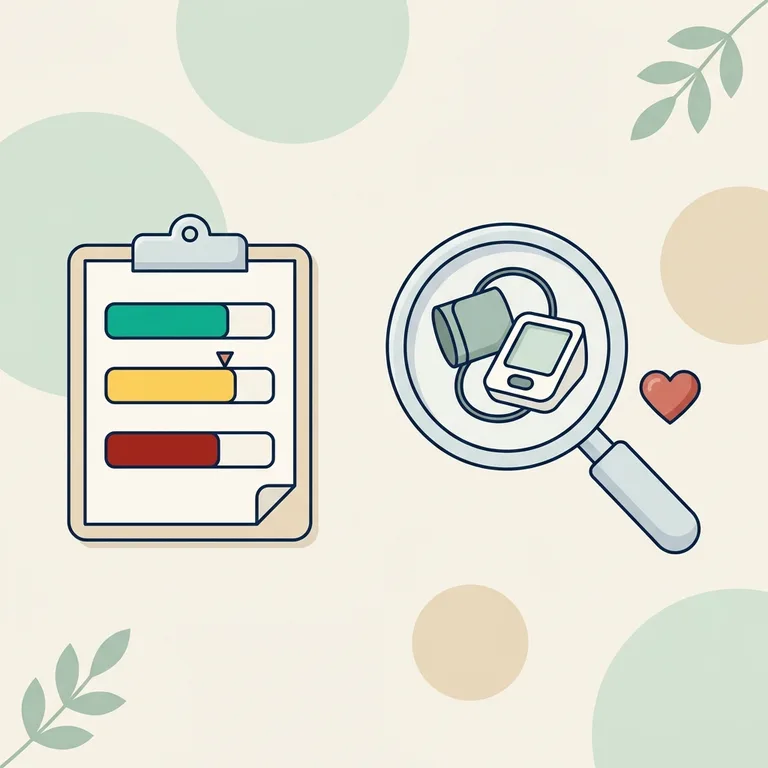
How do you read a blood pressure log, line by line?
| Reading | Result (mmHg) | Pulse (bpm) | Adult category | Flag |
|---|---|---|---|---|
| Monday 7:05 AM, 1st reading | 134/82 | 74 | Stage 1 range | H ↑ |
| Monday 7:07 AM, 2nd reading | 128/79 | 71 | Elevated | H ↑ |
| Monday 9:30 PM, 1st reading | 118/76 | 68 | Normal | None |
| 7-day average (28 readings) | 129/79 | 70 | Elevated | H ↑ |
- Result: top number = systolic (heart squeezing), bottom number = diastolic (heart relaxing), in mmHg.
- Adult category: when the two numbers disagree, the higher category counts: 128/82 is stage 1 because of the 82.
- Pulse: heart rate in beats per minute, not pressure.
- Average: your care team compares office and home readings over time, not one line[9].
- Flag: "H" means above the normal range, not a diagnosis.
When blood pressure runs high, kidney, salt, sugar and cholesterol labs usually follow. BloodSense explains those lab reports in plain words.
Understand your lab resultsWhat does blood pressure actually measure?
Blood pressure is the force of blood on your artery walls. It moves with stress, posture and technique, so one number is a snapshot[9][12]. The unit, mmHg, is the same in every country; only the cut-off lines differ. For how a cuff works, see our guide on what BP means and how it is measured.
What is a normal blood pressure for adults?
The 2025 American Heart Association and American College of Cardiology guideline kept the four categories used since 2017[1][2][3].
| Category | Systolic (top) | Diastolic (bottom) | Source | |
|---|---|---|---|---|
| Normal | Below 120 | and | Below 80 | AHA/ACC 2025, CDC[1][3] |
| Elevated | 120 to 129 | and | Below 80 | AHA/ACC 2025, CDC[1][3] |
| Stage 1 hypertension | 130 to 139 | or | 80 to 89 | AHA/ACC 2025, CDC[1][3] |
| Stage 2 hypertension | 140 or higher | or | 90 or higher | AHA/ACC 2025, CDC[1][3] |
| Very high (needs care the same day) | Above 180 | and/or | Above 120 | NHLBI |
| Low blood pressure | Below 90 | and/or | Below 60 | NHLBI |
Low blood pressure is not a disease in itself: some people always run below 90/60 and feel fine[8].
Why do charts from Europe look different? The 2024 European guideline sets hypertension at 140/90 and calls 120–139/70–89 "elevated"[7]. In the United States, use the US chart.
What is normal blood pressure by age?
For adults, the normal range does not change with age in US guidelines; what changes is how many people are above it. Children differ because their pressure depends on body size.
| Age group | Normal | Elevated | High blood pressure | Source |
|---|---|---|---|---|
| Children 1 to 12 years | Below the 90th percentile for age, sex and height | 90th to 95th percentile, or from 120/80 (whichever is lower) | 95th percentile or higher, or from 130/80 (whichever is lower) | AAP 2017[6] |
| Teens 13 to 17 years | Below 120/80 | 120–129 and below 80 | 130/80 or higher | AAP 2017[6] |
| Adults 18 to 39 years | Below 120/80 | 120–129 and below 80 | 130/80 or higher | AHA/ACC 2025[1] |
| Adults 40 to 59 years | Below 120/80 | 120–129 and below 80 | 130/80 or higher | AHA/ACC 2025[1] |
| Adults 60 and older | Below 120/80 | 120–129 and below 80 | 130/80 or higher | AHA/ACC 2025[1] |
Does "normal" go up as you get older?
This is the myth behind many age charts, including the old rule "100 plus your age". Arteries do stiffen, and blood pressure tends to rise with age[4]. In US data from 2021 to 2023, high blood pressure affected 23.4% of adults aged 18 to 39, 52.5% of those aged 40 to 59 and 71.6% of those aged 60 and older[5]. But common is not healthy: the 2025 US guideline sets no age-specific categories and aims for below 130/80 for most treated adults[1]. Tables of population averages labeled "normal by age" make 140/85 at 65 look fine; it is not.
Age matters for the treatment plan: over 85 or with frailty, European experts accept a less strict goal if the usual target is not tolerated[7]. That is a shared decision, not a different "normal".
Is it different for men, women or in pregnancy?
The categories are the same for both sexes; men more often have high blood pressure in middle age, women in older age[4]. In pregnancy, the guideline recommends treating chronic high blood pressure from 140/90[1], and new high readings are checked for preeclampsia.
What causes blood pressure to be too high or too low?
Readings above the normal range
- Common A poorly taken or stressful reading, including "white coat" readings, higher in the clinic than at home[9].
- Common Age, family history, a diet high in salt and low in potassium, alcohol, inactivity, poor sleep, and overweight[4]. The usual picture of long-term high blood pressure.
- Possible Medicines such as decongestants, some antidepressants, hormonal birth control pills and anti-inflammatory painkillers like ibuprofen[4].
- Possible Sleep apnea, chronic kidney disease or metabolic syndrome[4].
- Rare Hormone causes, such as excess aldosterone, which the 2025 guideline suggests checking in more people, or thyroid problems and some tumors[1][4].
Readings below 90/60
- Common A naturally low pressure with no symptoms, which needs no treatment[8].
- Common Dehydration, or blood pressure medicines, especially in older adults, who may feel dizzy when standing up or after a meal[8].
- Possible Pregnancy, diabetes, or heart rhythm problems such as an arrhythmia[8].
- Rare Sudden blood loss or nervous system disease such as Parkinson's disease[8].
What can make a blood pressure reading wrong?
Small details move the numbers. In a trial, a regular cuff read 4.8 mmHg too high on arms needing a large cuff, and 19.5 mmHg too high on arms needing an extra-large one[10]. An arm resting on the lap added 3.9 mmHg to the systolic; an arm hanging at the side, 6.5 mmHg[11]. Before logging a number, check:
- Cuff size matches your upper arm, placed on bare skin, not over a sleeve[10][12].
- No coffee, exercise, smoking or alcohol in the 30 minutes before[9][13].
- Bladder emptied first[13].
- Seated for 5 minutes, back supported, feet flat, legs uncrossed. Crossed legs can add 5 to 8 mmHg to the systolic[12][13].
- Arm resting on a table, cuff at heart level[9][11].
- No talking during the rest or the measurement[13].
- At least two readings, 1 to 2 minutes apart, and the average written down[13].
- Ask whether home readings can check for white coat or "masked" high blood pressure[9].
When is a blood pressure reading an emergency?
When to see a doctor
- Emergency: call 911 if your blood pressure is above 180/120, stays that high on a second reading 5 minutes later, and you have a sudden severe headache, chest, back or belly pain, trouble breathing, numbness or weakness, a sudden change in vision or trouble speaking[14]. These can signal a stroke. Also call 911 for low pressure with cold, sweaty skin, fast breathing or a weak, fast pulse[8].
- Within 24 to 48 hours if a repeat reading is still above 180/120 without symptoms (call your provider), or if you faint or get dizzy each time you stand up[8][14].
- At your next appointment if your home average is 130/80 or higher, or between 120 and 129 systolic.
Questions to ask your doctor
- Which number should I aim for, given my age and health?
- How many home readings do you want, and on how many days?
- Could one of my medicines be raising or lowering my pressure?
- Do I need blood or urine tests, such as a basic metabolic panel or a urine albumin-to-creatinine ratio?
What else do people ask about blood pressure charts?
Is 130/80 normal for a 60-year-old?
No. 130/80 is the start of stage 1 hypertension at any adult age. It does not always mean medicine.
Does one high reading mean I have hypertension?
No. US screening advice asks for high office readings to be confirmed outside the clinic, usually with a home monitor, before a diagnosis.
What is a good blood pressure for a teenager?
From 13, the adult cut-offs apply: below 120/80 is normal. Under 13, percentile tables for age, sex and height are used.
Which pages should you read next?
- BP meaning: how blood pressure is measuredThe two numbers and the right technique, in detail.
- High blood pressure: stages, tests, treatmentWhat happens after a confirmed high reading.
- What HTN means on your chartThe abbreviation in medical notes and portals.
- Lipid panel resultsCholesterol and blood pressure together shape heart risk.
Where do these numbers come from?
- American Heart Association. New high blood pressure guideline emphasizes prevention, early treatment to reduce CVD risk. AHA Newsroom. August 14, 2025. newsroom.heart.org (accessed Oct 21, 2026)
- Jones DW, Ferdinand KC, Taler SJ, et al. 2025 AHA/ACC/multisociety Guideline for the Prevention, Detection, Evaluation and Management of High Blood Pressure in Adults. Circulation. 2025;152(11):e114-e218. doi:10.1161/CIR.0000000000001356 (accessed Oct 21, 2026)
- Centers for Disease Control and Prevention. About High Blood Pressure. cdc.gov (accessed Oct 21, 2026)
- National Heart, Lung, and Blood Institute. High Blood Pressure: Causes and Risk Factors nhlbi.nih.gov (accessed Oct 21, 2026)
- National Center for Health Statistics. Hypertension Prevalence, Awareness, Treatment, and Control Among Adults Age 18 and Older: United States, August 2021–August 2023. NCHS Data Brief No. 511. October 2024. cdc.gov/nchs (accessed Oct 21, 2026)
- Flynn JT, Kaelber DC, Baker-Smith CM, et al. Clinical Practice Guideline for Screening and Management of High Blood Pressure in Children and Adolescents. Pediatrics. 2017;140(3):e20171904. doi:10.1542/peds.2017-1904 (accessed Oct 21, 2026)
- McEvoy JW, McCarthy CP, Bruno RM, et al. 2024 ESC Guidelines for the management of elevated blood pressure and hypertension. Eur Heart J. 2024;45(38):3912-4018. doi:10.1093/eurheartj/ehae178 (accessed Oct 21, 2026)
- National Heart, Lung, and Blood Institute. Low Blood Pressure nhlbi.nih.gov (accessed Oct 21, 2026)
- National Heart, Lung, and Blood Institute. High Blood Pressure: Diagnosis nhlbi.nih.gov (accessed Oct 21, 2026)
- Ishigami J, Charleston J, Miller ER, et al. Effects of Cuff Size on the Accuracy of Blood Pressure Readings: The Cuff(SZ) Randomized Crossover Trial. JAMA Intern Med. 2023;183(10):1061-1068. doi:10.1001/jamainternmed.2023.3264 (accessed Oct 21, 2026)
- Liu H, Zhao D, Sabit A, et al. Arm Position and Blood Pressure Readings: The ARMS Crossover Randomized Clinical Trial. JAMA Intern Med. 2024;184(12):1436-1442. doi:10.1001/jamainternmed.2024.5213 (accessed Oct 21, 2026)
- Muntner P, Shimbo D, Carey RM, et al. Measurement of Blood Pressure in Humans: A Scientific Statement From the American Heart Association. Hypertension. 2019;73(5):e35-e66. doi:10.1161/HYP.0000000000000087 (accessed Oct 21, 2026)
- Centers for Disease Control and Prevention. Measuring Your Blood Pressure. cdc.gov (accessed Oct 21, 2026)
- National Heart, Lung, and Blood Institute. High Blood Pressure: Symptoms nhlbi.nih.gov (accessed Oct 21, 2026)
- US Preventive Services Task Force. Hypertension in Adults: Screening. 2021. uspreventiveservicestaskforce.org (accessed Oct 21, 2026)
General health information only. It does not replace advice from a clinician who knows your history.