






An aldosterone blood test measures how much of a salt-regulating hormone your adrenal glands are releasing into your circulation, and it is one of the few lab values that speaks directly to why your blood pressure sits where it does. Doctors rarely order it during a routine checkup. It usually appears on a request form after something else looked odd: blood pressure that refuses to come down on several medications, a potassium level that keeps drifting low, or an adrenal nodule spotted on a scan done for another reason. In this article you will learn what the test actually measures, why your posture and your salt intake change the number, how the result is paired with renin to become meaningful, what high and low values tend to point toward, and which findings deserve a prompt conversation with your clinician.
What an aldosterone blood test measures
Aldosterone is a steroid hormone made in the outer layer of each adrenal gland, the two small glands that sit like caps on top of your kidneys. Its job is narrow but powerful: it tells the kidneys to hold on to sodium and to send potassium out into the urine. Because water follows sodium, holding sodium also means holding water, which raises the volume of fluid in your blood vessels and, with it, your blood pressure.
The test reports a concentration, usually in nanograms per deciliter (ng/dL) in the United States. That single number is a snapshot of a hormone that moves constantly through the day, which is why laboratories and clinicians treat it as one input rather than a verdict.
Where aldosterone fits among your other results
Aldosterone almost never travels alone on a lab report. It is normally read next to sodium and potassium, since those are the two electrolytes it controls most directly. If you want to see how those values behave on their own, review our sodium blood test guide. The pattern that raises suspicion is a sodium level at the upper end of normal paired with a potassium level at the low end, in someone whose blood pressure is difficult to control.
The renin loop that switches it on
Aldosterone sits at the end of a chain called the renin-angiotensin-aldosterone system. When the kidneys sense that blood flow or salt delivery has dropped, they release an enzyme called renin. Renin starts a cascade that produces angiotensin II, and angiotensin II tells the adrenal glands to release aldosterone. When blood pressure and salt levels recover, renin falls and aldosterone follows. That feedback loop is the reason renin is measured alongside aldosterone: the relationship between the two says far more than either value alone.
Why your doctor ordered an aldosterone test
Most people are sent for this test because a clinician suspects that a hormone, rather than lifestyle or genetics alone, is driving their blood pressure. The condition being looked for is primary aldosteronism, in which one or both adrenal glands make aldosterone independently of the renin signal that normally regulates them.
Blood pressure that resists treatment
Hypertension that stays high on three or more medications is the classic trigger. So is hypertension that appeared young, hypertension with an adrenal nodule, or a family history of stroke at an early age. To understand what those pressure numbers represent before you interpret a hormone result, read our guide to high blood pressure.
Low potassium and other quiet clues
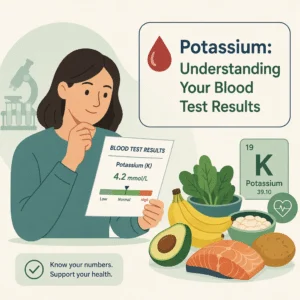
Because aldosterone pushes potassium into the urine, an excess of the hormone can pull blood potassium down. That shows up as muscle weakness, cramps, unusual thirst, or frequent urination, and sometimes as nothing at all. Many people with primary aldosteronism have entirely normal potassium, which is precisely why the diagnosis is missed so often. If your report flagged this electrolyte, our potassium blood test guide explains what the value means in context.
A doctor may also order aldosterone for the opposite reason: dizziness on standing, persistent fatigue, salt craving, and a high potassium level can point toward too little aldosterone rather than too much.
How to prepare so the number means something
Few common blood tests are as easily distorted by circumstances as this one. Preparation is not a formality here; it decides whether the result can be interpreted at all.
Posture, salt, and timing
Aldosterone rises when you stand and falls when you lie down, so the laboratory records your position and often asks you to sit upright for a set period before the draw. Sample timing matters too, since the hormone follows a daily rhythm that peaks in the morning. Salt intake shifts the result in a predictable direction: a very low-salt diet raises aldosterone, while a high-salt diet suppresses it. Your clinician will tell you which pattern of intake they want in the two weeks beforehand.
Medications and foods that distort the result
Several widely used drugs change aldosterone, renin, or both. Spironolactone and eplerenone, diuretics, beta-blockers, ACE inhibitors, angiotensin receptor blockers, and non-steroidal anti-inflammatory drugs all have documented effects. Natural black licorice acts on the same pathway and should be avoided for at least two weeks. Never stop a prescribed medication on your own to prepare for this test; the substitution has to be planned by the clinician who prescribed it.
| What you do before the draw | Effect on the aldosterone reading | Practical takeaway |
|---|---|---|
| Lying down for 30 minutes | Lowers the value | Follow the posture your lab specifies and make sure it is noted |
| Sitting or standing upright | Raises the value | Most screening samples are drawn seated after a set rest period |
| Very low salt intake | Raises the value | Ask which salt intake your clinician wants in the two prior weeks |
| Black licorice or licorice tea | Suppresses the value | Avoid for at least two weeks before the draw |
| Spironolactone or eplerenone | Distorts both aldosterone and renin | Usually paused only under medical supervision |
| Sampling late in the day | Shifts the value away from reference conditions | Morning draws are standard for screening |
Reading your aldosterone result
Reference intervals differ between laboratories because they depend on the assay, the units, and the posture protocol used. A commonly cited adult interval for a seated blood sample runs from roughly 3 to 35 ng/dL, and a 24-hour urine collection is often reported between about 3 and 25 micrograms. Always compare your value to the interval printed on your own report rather than to a range found online.
Units and why they trip people up
Some laboratories report in nanograms per deciliter and others in picomoles per liter, and the numbers look nothing alike. A value that seems alarmingly high in one unit can be squarely normal in the other. Check the unit before you react to the figure.
Why aldosterone alone tells you little
A normal aldosterone level does not rule out a hormonal cause of hypertension, and a raised one does not confirm it. The value has to be read against renin, against your potassium, and against the medications you were taking. Kidney function is part of that picture too, since impaired kidneys change how sodium and water are handled; our eGFR test results guide and our creatinine blood test guide explain the two markers most often used to assess it.
The aldosterone-to-renin ratio explained
The screening test most endocrinologists rely on is not aldosterone by itself but the aldosterone-to-renin ratio, often abbreviated ARR. The laboratory divides your aldosterone concentration by your renin measurement. The logic is straightforward: in primary aldosteronism the adrenal glands produce aldosterone on their own, the body senses the resulting salt and fluid overload, and the kidneys shut renin down. Aldosterone stays up while renin drops, so the ratio climbs.
What a high ratio suggests
A high ratio suggests that aldosterone production has become independent of its normal control signal. It is a screening result, not a diagnosis. The ratio is known to be imperfectly reproducible, so a single positive value is commonly repeated under controlled conditions before anyone acts on it.
What happens after a positive screen
A confirmed positive screen usually leads to a confirmatory test, in which salt or saline is given to see whether aldosterone can be suppressed the way it should be. If it cannot, imaging of the adrenal glands follows, and in selected cases a specialized procedure called adrenal venous sampling determines whether one gland or both are responsible. That distinction matters because a single overactive gland can often be removed surgically, while a two-sided problem is treated with medication.
What high and low aldosterone can mean
The table below groups the common explanations. None of them can be confirmed from a single blood value, and several are far more common than others.
| Pattern | Typical renin behavior | Conditions often considered |
|---|---|---|
| High aldosterone | Low or suppressed | Primary aldosteronism from an adrenal adenoma or from enlargement of both glands |
| High aldosterone | High | Secondary causes such as heart failure, liver cirrhosis, narrowing of a kidney artery, or diuretic use |
| Low aldosterone | High | Adrenal insufficiency, including Addison disease and congenital adrenal hyperplasia |
| Low aldosterone | Low | Diabetes-related kidney changes, some medications, certain chronic kidney conditions |
| Normal aldosterone with low potassium | Suppressed | Primary aldosteronism is still possible and the ratio remains the deciding measure |
When the cause sits outside the adrenal glands
Secondary hyperaldosteronism is the body responding appropriately to a real drop in effective circulating volume. Heart failure, cirrhosis, and narrowed kidney arteries all trigger it, and here both renin and aldosterone rise together. Chronic kidney disease complicates the picture in its own way, altering electrolyte handling and drug clearance at the same time; our chronic kidney disease overview covers how that unfolds.
When aldosterone runs low
Too little aldosterone leaves the body losing sodium and retaining potassium. In adrenal insufficiency the deficit usually extends to cortisol as well, which is why the workup pairs aldosterone with other adrenal markers. Our cortisol blood test guide and our ACTH blood test guide describe the two values most often measured alongside it. Acid-base balance shifts as well, which is why bicarbonate frequently appears on the same panel; our bicarbonate blood level guide explains what that marker adds.
When to see a doctor
Lab numbers are worth acting on when they line up with how you feel. Arrange a prompt appointment if any of the following apply to you.
- Your blood pressure stays above target despite three or more medications taken as prescribed.
- Your potassium has been repeatedly low, especially if you are not taking a diuretic.
- You experience muscle weakness, cramping, palpitations, unusual thirst, or frequent night-time urination alongside high blood pressure.
- You feel faint or dizzy on standing, crave salt, and have a potassium result at the high end.
- An imaging scan done for another reason found a nodule on an adrenal gland.
- You have hypertension and a first-degree relative who had a stroke before the age of 40.
Seek urgent care rather than a routine appointment if severe muscle weakness, an irregular heartbeat, confusion, or fainting develops, since large potassium shifts in either direction affect the heart.
Everyday factors that shift your aldosterone level
Aldosterone responds to daily life more than most hormones on a standard panel, which is both a nuisance for testing and a useful lever once a diagnosis is settled.
Salt, potassium, and hydration
A sustained high-salt diet suppresses aldosterone, while salt restriction and dehydration raise it. Potassium works in the other direction: a potassium-rich diet built on vegetables, legumes, and fruit tends to blunt aldosterone signaling. If your clinician has asked for a 24-hour urine collection to measure how much sodium and potassium you actually excrete, our urine electrolytes results guide explains what those figures represent.
Weight, sleep, and stress
Excess body fat, untreated sleep apnea, and chronic stress are all associated with higher aldosterone activity and with blood pressure that responds poorly to treatment. Magnesium status interacts with potassium handling as well, which is one reason the two are often measured together; our magnesium blood test guide sets out the details. None of these adjustments substitutes for treating primary aldosteronism when it is present, but they shape how well any treatment works.
Latest scientific advances
Research on aldosterone testing has moved quickly over the past three years, mostly around who should be screened and how the sample is measured. Here is what the recent literature says, in plain language.
Screening guidance has widened considerably
In 2025 the Endocrine Society published an updated clinical practice guideline on primary aldosteronism. Its central suggestion is a notable shift: rather than testing only people with difficult-to-treat hypertension, it suggests that everyone with high blood pressure be screened by measuring aldosterone and renin and calculating the ratio. The panel based this on the observation that the condition is common, treatable, and carries more cardiovascular risk than ordinary hypertension, yet is diagnosed in only a small fraction of the people who have it. What this means for you: if you have high blood pressure and have never had aldosterone and renin measured, it is reasonable to ask whether that screen is appropriate for you, particularly before adding another pressure medication.
The laboratory method behind your number is changing
A 2024 comparative study looked at what happens when laboratories move from the older radioimmunoassay technique to newer chemiluminescent and mass-spectrometry methods for measuring aldosterone. The newer approaches agreed closely with each other, while the older method produced more false positives, partly because it also picked up related hormones that are not aldosterone itself. What this means for you: a ratio calculated by one laboratory is not always interchangeable with one from another, so results are best compared within the same lab, and a borderline value is worth repeating rather than acting on immediately.
Age appears to influence where the cutoff should sit
A 2025 hospital study examined how age changes the aldosterone-to-renin ratio. Among people with ordinary hypertension, both aldosterone and renin declined with age while the ratio drifted upward, which can make an older person look positive on screening when they are not. In people who genuinely had primary aldosteronism, age made little difference. The authors concluded that a lower cutoff than the widely quoted one may perform better, and that age deserves to be part of the interpretation. This work comes from a single center and needs confirmation elsewhere. What this means for you: an older adult with a borderline ratio should expect the result to be repeated and interpreted alongside potassium and blood pressure rather than treated as decisive.
Alternative ratios are being tested
A 2025 laboratory study evaluated replacing renin in the calculation with angiotensin II, the hormone that sits immediately upstream of aldosterone. The alternative ratio performed comparably to the standard one on the samples tested, and it may prove more practical to run. The study was small and preliminary, and nothing about routine practice changes on the strength of it. A 2024 review of the field summarizes the wider direction of travel, including newer scanning techniques intended to identify which adrenal gland is responsible without the more invasive sampling procedure. What this means for you: the screening test you take today is the standard one, and the alternatives are still being evaluated rather than adopted.
Glossary of key terms
| Term | Definition |
|---|---|
| Aldosterone | A hormone from the adrenal glands that tells the kidneys to retain sodium and release potassium, raising blood volume and blood pressure. |
| Adrenal glands | Two small hormone-producing glands, one sitting above each kidney. |
| Renin | An enzyme released by the kidneys that starts the chain of signals ending in aldosterone release. |
| Aldosterone-to-renin ratio (ARR) | The aldosterone value divided by the renin value, used as the standard screening measure for primary aldosteronism. |
| Primary aldosteronism | A condition in which the adrenal glands make aldosterone independently of the renin signal, causing hypertension that often responds poorly to usual medications. |
| Adrenal adenoma | A non-cancerous growth on an adrenal gland, which can sometimes produce hormones on its own. |
| Adrenal venous sampling | A specialized procedure that draws blood from the veins of each adrenal gland to determine whether one gland or both are overproducing aldosterone. |
| Mineralocorticoid receptor antagonist | A class of medication, including spironolactone, that blocks the receptor aldosterone acts on. |
| Hypokalemia | A blood potassium level below the reference range, which can cause muscle weakness, cramps, and heart rhythm disturbances. |
| Reference interval | The range of values a laboratory considers typical for its own method and population, printed next to your result. |
Frequently asked questions
Do I need to fast for an aldosterone blood test?
Fasting is not usually required for aldosterone itself. What matters far more is your salt intake in the preceding weeks, your body position before and during the draw, the time of day, and the medications you are taking. Some laboratories bundle aldosterone with tests that do require fasting, so follow the specific instruction sheet you were given rather than a general rule. If nobody told you anything about salt, posture, or licorice, call the ordering office before the appointment and ask, because those instructions change the result more than an empty stomach does.
How long does it take to get aldosterone blood test results?
Aldosterone is not run on the routine chemistry analyzer that produces same-day electrolyte results. Samples are often sent to a specialized laboratory, so most people wait several days to about a week. If renin was drawn at the same time so the ratio can be calculated, both values have to be ready before your clinician can interpret anything. Ask the office how they will notify you, and do not read a lone aldosterone number in a patient portal as a conclusion before renin appears alongside it.
What is a normal aldosterone level?
There is no single universal figure. A frequently cited adult interval for a seated blood sample runs from about 3 to 35 ng/dL, and a 24-hour urine collection is often reported between roughly 3 and 25 micrograms, but each laboratory sets its own interval according to its method, its units, and the posture protocol it uses. Compare your value only to the interval printed on your own report. A number inside that interval still does not exclude a hormonal cause of hypertension when renin is suppressed.
Is an aldosterone test the same as a renin test?
No, they measure two different things, but they are usually ordered together. Aldosterone is the hormone that acts on the kidneys; renin is the kidney enzyme that starts the signal chain leading to it. Because the diagnostic information lies in how the two relate, laboratories report the ratio between them. Seeing only one of the two values on a report is common when results arrive at different times, and it is not a reason to draw conclusions.
Can my medications cause a falsely positive result?
Yes, and this is one of the most common reasons a screen has to be repeated. Beta-blockers and non-steroidal anti-inflammatory drugs can push the ratio upward, while diuretics, ACE inhibitors, and angiotensin receptor blockers can push it down and mask a real problem. Spironolactone and eplerenone interfere the most. Any medication change has to be arranged by the prescribing clinician, who will usually substitute a drug that does not disturb the measurement rather than leaving blood pressure untreated.
Does a high aldosterone result mean I have a tumor?
Not by itself. A raised value with suppressed renin points toward primary aldosteronism, but that condition arises from enlargement of both adrenal glands at least as often as from a single growth, and the growths involved are almost always benign. Establishing which pattern applies requires confirmatory testing and imaging, and sometimes sampling from the adrenal veins. The distinction is practical rather than alarming: one overactive gland may be treated surgically, while a two-sided pattern is managed with medication.
Sources
- MedlinePlus, National Library of Medicine — Aldosterone Test — MedlinePlus Medical Test, reviewed 2025 — medlineplus.gov
- Cleveland Clinic — Aldosterone: What It Is, Function and Levels — Cleveland Clinic Health Library, 2025 — my.clevelandclinic.org
- Centers for Disease Control and Prevention — About High Blood Pressure — CDC, 2025 — cdc.gov
- Adler GK, Stowasser M, Correa RR, et al. — Primary Aldosteronism: An Endocrine Society Clinical Practice Guideline — The Journal of Clinical Endocrinology and Metabolism, 2025 — doi.org/10.1210/clinem/dgaf284
- Taki Y, Kono T, Teruyama K, et al. — Comparative analysis of aldosterone and renin assays for primary aldosteronism screening — Scientific Reports, 2024 — doi.org/10.1038/s41598-024-75645-1
- Peng N, Zhang Z, Xiao Y, et al. — Effect of Age on Aldosterone-Renin Ratio in Screening Primary Aldosteronism — Journal of Clinical Hypertension, 2025 — doi.org/10.1111/jch.70014
- Lo CW, Cheng JY, Tsui TK, et al. — Screening primary aldosteronism by plasma aldosterone-to-angiotensin II ratio — Clinical Chemistry and Laboratory Medicine, 2025 — doi.org/10.1515/cclm-2024-1312
- Ekman N, Grossman AB, Dworakowska D — What We Know about and What Is New in Primary Aldosteronism — International Journal of Molecular Sciences, 2024 — doi.org/10.3390/ijms25020900
Further reading
- Compare the two electrolytes aldosterone controls by reading our chloride blood test guide.
- Measure how much sodium your kidneys actually excrete with our urine sodium test results guide.
- Assess kidney workload alongside your hormone panel using our blood urea nitrogen levels guide.
- Recognize the condition that drives secondary aldosterone elevation by reading our heart failure symptoms and treatments guide.
- Decode the abbreviation clinicians use for high blood pressure with our HTN meaning explainer.
Understand your lab results with BloodSense
An aldosterone value only becomes informative when it is read next to renin, potassium, sodium, and your kidney function markers. BloodSense turns that scattered set of numbers into plain-language explanations, showing you which values sit outside your laboratory’s reference interval and which combinations tend to matter together. It helps you understand what you are looking at and prepare better questions for your appointment. It does not diagnose any condition and it does not replace your doctor.