Rhabdomyolysis (Rhabdo): Symptoms, CK Levels and Kidney Risk
The essentials
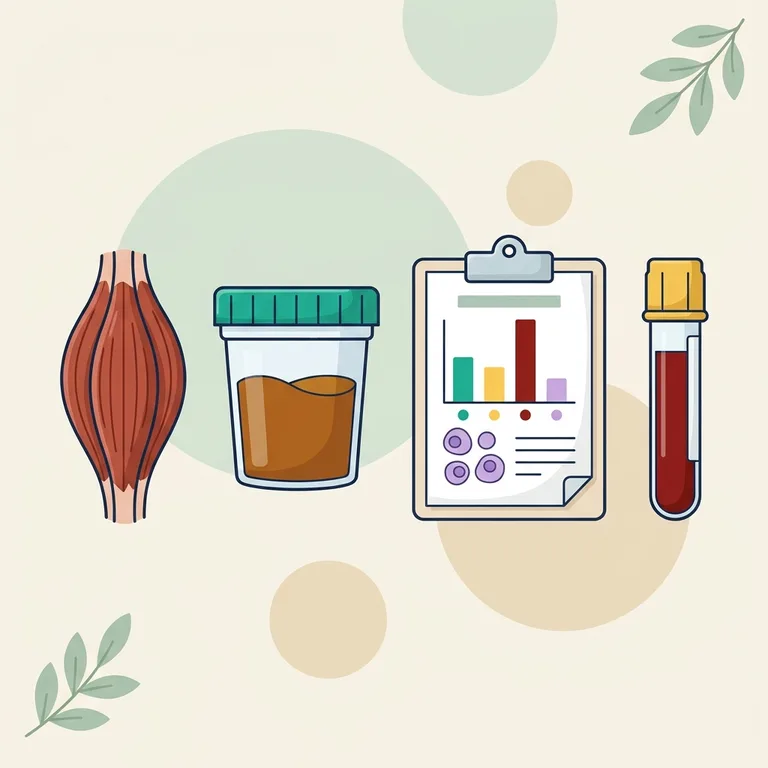
Rhabdomyolysis ("rhabdo") is a fast breakdown of muscle that spills creatine kinase (CK), myoglobin and potassium into the blood. Severe muscle pain, weakness and dark urine after hard exercise, heat, an injury or a new medicine are the warning signs. A blood CK test confirms it; the main danger is to the kidneys, so it needs prompt care.
What is rhabdomyolysis, at a glance?
- Medical name: rhabdomyolysis, often shortened to "rhabdo". Damaged muscle releases its contents into the blood, which can harm the kidneys and the heart rhythm[1].
- Who gets it: anyone. Workers in heat, firefighters, military members and athletes are at higher risk[2]. In US active-duty service members, exertional rhabdo occurs in about 40 cases per 100,000 person-years[10].
- Kidney risk: acute kidney injury is the most common serious complication, reported in 10 to 55% of cases depending on the study[7].
- Key tests: total CK in the blood, a urinalysis for blood and myoglobin, potassium, calcium, phosphorus and creatinine[3].
What are the symptoms of rhabdo?
The CDC lists three main warning signs[1]:
- Muscle pain out of proportion: cramps, aches or pain much worse than expected after the effort.
- Dark urine: tea- or cola-colored, sometimes red. It comes from myoglobin, not always from blood; see our guide to urine color changes.
- Weakness or fatigue: for example, being unable to finish a workout you usually complete.
Muscles may also be stiff or tender, and urine output may drop[3]. But the full trio is seen in fewer than 10% of patients, and more than half have no muscle pain or weakness[6]: only a blood test confirms rhabdo[1].
Normal soreness or rhabdo? Ordinary soreness starts within 24 hours of an unusual workout and peaks around 72 hours[10]; severe, worsening pain with weakness or dark urine is not ordinary soreness.
When is rhabdomyolysis an emergency?
When to see a doctor
- Emergency: call 911 or go to the nearest emergency room for dark or cola-colored urine with severe muscle pain or weakness, very little urine, a seizure, an irregular heartbeat, or a limb that is tense, swollen and extremely painful when the muscle is stretched (possible compartment syndrome)[1][10].
- Within 24 to 48 hours for muscle pain far worse than expected after a workout, or new muscle pain after starting a cholesterol medicine, even if your urine looks normal. Stop the activity and drink water while you arrange care[1].
- At your next appointment for a CK that stays mildly high on routine tests, or after an episode of rhabdo, to plan a safe return to exercise.
What causes rhabdomyolysis, and who is at risk?
Any kind of muscle damage can trigger it[6]. In adults, the main causes are injuries, drugs and infections[7].
- Common Hard, prolonged or unfamiliar exercise, especially a new high-intensity program, in heat, after poor sleep or while dehydrated[2][10]. Heat stroke and severe dehydration add to the risk[3].
- Common Injuries: falls, crush injuries, car accidents, and long immobility, such as lying on the floor for hours after a fall[2][6].
- Common Alcohol and drugs: excessive drinking, cocaine, methamphetamine, amphetamines and heroin[2][3].
- Possible Medicines and supplements: statins, some antibiotics such as erythromycin, tricyclic antidepressants, some cold medicines, creatine, ephedra or large amounts of caffeine[2]. In a US FDA analysis of 8,610 drug-related cases, three statins accounted for about 45%[7], yet muscle damage from statins is rare[5].
- Possible Infections (flu, HIV, strep and others), seizures, uncontrolled diabetes and thyroid disorders[2][3].
- Rare Inherited conditions: sickle cell disease or trait, muscular dystrophy, and disorders of muscle energy (fat or glycogen metabolism)[2][10].
How is rhabdomyolysis diagnosed? CK levels and other tests
The key test is total CK, an enzyme that leaks out of damaged muscle (the test itself is explained on our CPK blood test page).
- The usual threshold: most studies define rhabdo as a CK at least 5 times the upper limit of normal, roughly above 1,000 U/L[6][7]. There is no single agreed cut-off, and "severe" has been set anywhere from 5,000 to 15,000 U/L[7].
- After exercise, higher cut-offs: fit people can reach very high CK without symptoms or kidney injury, so the 2025 US military guideline diagnoses exertional rhabdo at a CK of 5,000 U/L or more with severe muscle symptoms[10].
- Timing: CK starts rising about 12 hours after the injury and peaks at 24 to 72 hours[10], then falls back over the next 6 to 10 days[7]. A first CK taken early can look reassuring, which is why the test is repeated[1].
- Myoglobin clears much faster (half-life 2 to 4 hours) than CK (about 1.5 days)[6].
A fictitious report from an emergency visit, the day after a first indoor cycling class:
| Test | Result | Reference range | Flag |
|---|---|---|---|
| CK, total | 18,450 U/L | 44-196 | H |
| Creatinine | 1.6 mg/dL | 0.74-1.35 | H |
| Potassium | 5.4 mEq/L | 3.5-5.1 | H |
| Calcium | 8.2 mg/dL | 8.6-10.3 | L |
| Urine blood (dipstick) | Large (3+) | Negative | A |
| Urine RBC (microscopy) | 0-2 /HPF | 0-2 |
- CK: about 90 times the upper limit of this lab's range, far above the usual 5-times threshold[7]. It shows how much muscle is damaged, not how the kidneys will do.
- Creatinine: a rise means the kidneys are under strain; doctors follow it closely, with the eGFR.
- Potassium and calcium: potassium leaks from muscle and can disturb the heart rhythm; calcium can drop and phosphate can rise[3][10].
- Urine: a dipstick strongly positive for "blood" with almost no red blood cells under the microscope suggests myoglobin (or hemoglobin) rather than bleeding[7][10].
CK, creatinine, potassium and a urinalysis on the same report, each with its own flag? BloodSense explains every line of your complete report in plain words and helps you prepare the questions to ask your doctor.
Explain my CK and kidney resultsLiver tests can mislead. AST and ALT are also found in muscle: in exertional rhabdo, AST peaks at 3 to 4 days and ALT at 4 to 5 days, and they may stay high for 2 to 3 weeks without any liver disease[10].
What CK level is dangerous for the kidneys?
CK alone predicts kidney failure poorly. In a Boston study of 2,371 hospital patients with CK above 5,000 U/L, the first and peak CK values barely predicted outcome; risk rose clearly only above 40,000 U/L[8]. Doctors therefore combine several results in the McMahon score: age, female sex, the cause, and the first creatinine, CK, phosphate, calcium and bicarbonate values[8].
| Score | Patients who needed dialysis or died |
|---|---|
| Below 5 | 2.3%[8] |
| Above 10 | 61.2%[8] |
The cause matters: dialysis or death occurred in 3.2% of exercise cases, but 39.3% with sepsis[8]. For exertional rhabdo, the military guideline treats a CK of 20,000 U/L or more, a McMahon score of 6 or more, kidney injury, dark urine, an electrolyte problem or sickle cell trait as reasons to consider hospital care[10]. Taking anti-inflammatory painkillers (NSAIDs, such as ibuprofen) before admission was linked to a higher risk of kidney injury[10].
What follow-up tests are needed, and how often?
- In the hospital: CK, a metabolic panel with potassium, plus magnesium and phosphorus, about every 24 hours in mild cases, more often when severe[10].
- Treated at home (mild exertional cases): a repeat check within 24 to 72 hours with CK, creatinine and a urinalysis; once CK is clearly falling, more tests are not needed unless symptoms return[10].
- Red flags at 1 to 2 weeks: CK still above 1,000 U/L despite rest, a creatinine that has not returned to baseline at 2 weeks, a peak CK above 100,000 U/L or rhabdo after only light effort suggest a higher risk of recurrence and a specialist work-up[10].
How is rhabdomyolysis treated?
- IV fluids, early: the cornerstone of treatment, to protect the kidneys[7]. A 2019 guideline suggests early rather than late fluids, and crystalloids (salt solutions) rather than colloids[9].
- Bicarbonate, mannitol, diuretics: sometimes used[3], but the same guideline suggests against their routine use because the evidence is weak[9].
- Treat the cause: stop the triggering drug and correct high potassium promptly[3][7].
- Dialysis: needed by some patients with kidney failure, based on kidney function and complications, not on CK alone[3][10].
- Compartment syndrome: an emergency; a surgeon measures the pressure in the muscle and may open it (fasciotomy)[10].
Outlook: it depends on the kidneys. Prompt treatment lowers the risk of lasting damage; mild cases often return to normal activities within a few weeks to a month, though some people keep fatigue and muscle pain longer[3].
How can I prevent rhabdo and return to exercise safely?
- Build up new workouts gradually, and stop when pain or exhaustion feels out of proportion[10].
- Drink plenty of fluids after hard exercise[3].
- Avoid stimulant supplements, excess alcohol and drugs; list all supplements for your doctor[2][10].
- On a statin for high cholesterol, report new muscle pain; do not stop the medicine on your own[5].
- After an episode, the military guideline uses three phases: about 72 hours of light activity with fluids and 7 to 8 hours of sleep; then light to moderate training over 3 to 4 weeks, without training to muscle failure, once CK is falling and the urinalysis is normal; then a full return when strength is near normal and symptoms are gone[10].
Questions to ask your doctor
- Is my CK still rising, and when will it be rechecked?
- Are my creatinine, potassium and urine results reassuring for my kidneys?
- Could a medicine or supplement I take have played a role?
- When and how can I go back to training or work?
Frequently asked questions
Can you have rhabdo with normal-colored urine?
Yes. Dark urine is often missing: the classic trio of pain, weakness and dark urine appears in fewer than 10% of patients[6]. Only a blood CK test can confirm it.
Is rhabdomyolysis a lifelong condition?
Usually not. Most episodes have a clear trigger and do not come back once it is removed. Repeated episodes, or rhabdo after light effort, call for a search for an inherited muscle condition[10].
Can a high CK on a routine test be rhabdo?
Not necessarily. Recent intense exercise raises CK without rhabdo[4]. The diagnosis needs muscle symptoms or complications plus a high CK; your doctor may simply repeat the test after a few days of rest.
Related articles
- CPK blood testWhat the CK test measures and its normal range
- Myoglobin testThe muscle protein that darkens urine and strains the kidneys
- Creatinine blood testThe kidney marker followed during rhabdo
- Blood in urine testWhy a dipstick can be positive without red blood cells
- Heat strokeA frequent companion of exertional rhabdo
- Potassium blood testThe electrolyte that makes rhabdo dangerous for the heart
- Centers for Disease Control and Prevention, National Institute for Occupational Safety and Health. Rhabdomyolysis and work. Reviewed May 21, 2024. cdc.gov (accessed October 29, 2026)
- Centers for Disease Control and Prevention, National Institute for Occupational Safety and Health. Risk factors for rhabdomyolysis. cdc.gov (accessed October 29, 2026)
- MedlinePlus Medical Encyclopedia. Rhabdomyolysis. Reviewed September 2, 2025. US National Library of Medicine. medlineplus.gov (accessed October 29, 2026)
- MedlinePlus. Creatine kinase (CK) test. Updated October 25, 2023. US National Library of Medicine. medlineplus.gov (accessed October 29, 2026)
- MedlinePlus. Statins. Updated May 5, 2025. US National Library of Medicine. medlineplus.gov (accessed October 29, 2026)
- Torres PA, Helmstetter JA, Kaye AM, Kaye AD. Rhabdomyolysis: pathogenesis, diagnosis, and treatment. Ochsner J. 2015;15(1):58-69. PMID 25829882. PMC4365849 (accessed October 29, 2026)
- Chavez LO, Leon M, Einav S, Varon J. Beyond muscle destruction: a systematic review of rhabdomyolysis for clinical practice. Crit Care. 2016;20(1):135. doi:10.1186/s13054-016-1314-5 (accessed October 29, 2026)
- McMahon GM, Zeng X, Waikar SS. A risk prediction score for kidney failure or mortality in rhabdomyolysis. JAMA Intern Med. 2013;173(19):1821-1828. doi:10.1001/jamainternmed.2013.9774 (accessed October 29, 2026)
- Michelsen J, Cordtz J, Liboriussen L, et al. Prevention of rhabdomyolysis-induced acute kidney injury: a DASAIM/DSIT clinical practice guideline. Acta Anaesthesiol Scand. 2019;63(5):576-586. doi:10.1111/aas.13308 (accessed October 29, 2026)
- Consortium for Health and Military Performance (CHAMP), Uniformed Services University. Clinical practice guideline for the management of exertional rhabdomyolysis in warfighters. September 2025. champ.usuhs.edu (accessed October 29, 2026)
This page is general information. It does not replace the advice of a doctor, who interprets your results with your symptoms, history, medicines and examination.