






Few things prompt a second look quite like a shade you were not expecting in the toilet bowl. Urine color is one of the oldest health signals we have, and it is still the first thing a laboratory records when a sample arrives for urinalysis. Most of the time the explanation is harmless: how much you drank, what you ate, a vitamin, a new prescription. Occasionally the shade points to bleeding, a liver problem, or muscle breakdown. This guide covers the pigment behind the usual yellow, a shade-by-shade chart, the wording your lab uses, and the signs that mean you should call a clinician.
What the color of your urine actually measures
Urine is mostly water carrying dissolved waste filtered by the kidneys, and the color reflects two things: how much pigment is present, and how much water dilutes it. Drink a large glass of water and the pigment spreads through more fluid, so the sample looks pale. Go hours without drinking and the kidneys conserve water, deepening the shade to gold or amber.
That is why the shade tracks hydration, and why it is a rough proxy rather than a measurement. The laboratory quantifies the same idea with urine specific gravity. Color and concentration usually move together, but a pigment from food or medication can override the pattern.
The pigment behind the yellow
The familiar yellow comes from urochrome, also called urobilin, an end product of the body’s recycling of hemoglobin, the oxygen-carrying protein inside red blood cells. As old red cells break down, heme becomes bilirubin, the liver processes it, gut bacteria convert it to urobilinogen, and a portion leaves through the kidneys as the pigment you see. Your urinary urobilinogen result measures an upstream step, and because the process is steady, healthy urine is always some version of yellow.
Urine color chart: what each shade suggests
Use the chart as an orientation tool, not a diagnosis. One odd sample after a beet salad means little; a shade persisting for days without a dietary explanation matters.
| Shade | What it commonly suggests | What to do |
|---|---|---|
| Pale straw to light yellow | Well hydrated, the typical daytime range | Nothing; this is the usual target |
| Deep yellow to gold | Concentrated urine, common in the morning | Drink water and recheck later in the day |
| Bright, almost neon yellow | Excess B vitamins, especially riboflavin | Harmless; review supplement doses |
| Orange | Dehydration, phenazopyridine, laxatives, or a bile flow problem | Rehydrate; seek care if stools are pale or eyes look yellow |
| Pink or red | Blood, beets, blackberries, rhubarb, or rifampin | If food or a drug does not explain it, get a urinalysis promptly |
| Brown or tea-colored | Old blood, liver bilirubin, or muscle pigment after hard exertion | Contact a clinician, especially with muscle pain or jaundice |
| Green or blue | Methylene blue, propofol, dye, or rarely Pseudomonas | Usually a drug or dye; report fever or burning |
| Cloudy or milky | Infection, crystals, mucus, or high phosphate content | Get tested if burning, urgency, or odor accompany it |
| Persistently foamy | Protein leaking through the kidney filter | Ask for a urine protein measurement |
Dark, brown, and tea-colored urine
Dark urine causes fall into three families, and telling them apart is the job of a urinalysis.
Simple concentration
The most common reason is not drinking enough. Fever, vomiting, diarrhea, heat, and hard exercise accelerate fluid loss, and the kidneys hold water back. Urine turns dark gold or amber, output drops, and the smell strengthens. If the color lightens within hours of drinking, concentration was the explanation. Our overview of dehydration symptoms and care covers the accompanying signs.
Bilirubin and the liver
When the liver cannot process bilirubin, or the bile ducts are blocked, that pigment spills into the blood and then the urine, producing a dark brown or cola-like sample. The classic pairing is dark urine with unusually pale stools, because the pigment that colors stool is not reaching the intestine, and yellow eyes often follow. A dipstick that flags bilirubin in the urine is a strong hint, confirmed with blood tests.
Blood and muscle pigments
Two heme-containing proteins darken urine without any liver involvement. Hemoglobinuria occurs when red blood cells break apart in the bloodstream and free hemoglobin is filtered out. Myoglobinuria occurs when damaged skeletal muscle releases myoglobin, its own oxygen-storing pigment, giving urine a brown or cola tint. That kind of severe muscle breakdown is called rhabdomyolysis, and it follows crush injuries, extreme workouts, immobility, certain drugs, or heat illness. Because myoglobin is hard on the kidneys it is urgent, and blood creatine kinase and myoglobin levels confirm it.
Red, pink, and orange urine
Red and pink
Visible blood in the urine is called gross hematuria. It can arise anywhere from the kidneys to the urethra, and common sources include infection, stones, prostate enlargement, hard exercise, and, less often, tumors. Painless red urine is arguably more concerning than painful red urine, and it always deserves evaluation. Our guide to hematuria on a urine test explains how the dipstick and the microscope divide the work.
Not every red sample contains blood. Beets, blackberries, and rhubarb tint urine pink in susceptible people, an effect called beeturia, and the tuberculosis drug rifampin turns urine, tears, and sweat red-orange. A microscopic look settles it quickly, since food pigments produce no red cells.
Orange
Orange has three usual explanations. The first is concentration, where deep gold shades into orange. The second is medication, above all phenazopyridine, the bladder analgesic sold for urinary discomfort. The third, and the one that matters clinically, is a bile flow problem, where the orange travels with itching, pale stools, or jaundice.
Green, blue, cloudy, and foamy urine
Green and blue
These shades are almost always exogenous, meaning the color came from outside the body. Methylene blue, used as a dye and to treat methemoglobinemia, is a frequent culprit, and propofol, some antidepressants, and food colorings do the same. The rare medical cause is Pseudomonas aeruginosa infection, which produces blue-green pigments and brings the usual infection symptoms.
Cloudy and foamy
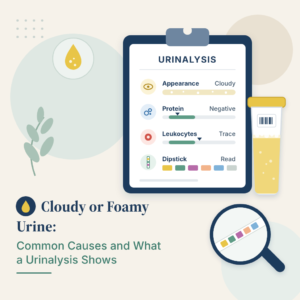
Cloudiness is a change in clarity rather than color, and the lab records it separately. White blood cells, bacteria, crystals, mucus, and phosphate scatter light and turn a sample turbid. With burning or odor, dipstick markers such as urinary nitrite and leukocyte esterase point toward a urinary tract infection. Foam that lingers after several flushes suggests protein escaping the kidney filter, which is why it prompts a urine protein test.
What the laboratory writes in the macroscopic exam
Every urinalysis begins with a visual step, the physical or macroscopic examination. A technologist views the sample against a white background and records color and appearance in standardized words before any chemistry runs. Those words guide the rest of the analysis.
| Report wording | What the lab means | Typical next step |
|---|---|---|
| Yellow, clear | Expected appearance, nothing scattering light | Proceed with the routine dipstick panel |
| Amber or dark yellow | Concentrated sample | Read alongside specific gravity |
| Red or red-brown | Possible blood or heme pigment | Blood pad plus a microscopic red cell count |
| Hazy, cloudy, or turbid | Particles suspended in the sample | Sediment spun down and examined microscopically |
The visual note and the chemistry are read together. A red sample with no red cells on urine microscopy points toward pigment rather than bleeding. For a plain-language reference on shades and causes, the MedlinePlus entry on abnormal urine color is a reliable start.
When to see a doctor about a color change
Most color changes resolve within a day. These do not, and warrant a call:
- Red, pink, or cola-colored urine that no food or medication explains.
- Brown urine with muscle aching, weakness, or swelling after hard exercise, a fall, or immobility.
- Dark urine together with pale stools, itching, or yellowing of the eyes or skin.
- Cloudy urine with fever, flank pain, or vomiting, which can signal infection reaching the kidneys.
- Foam that persists for days, especially with swelling of the ankles or eyes.
- Very little urine despite drinking normally, or none for many hours.
- Any visible blood in someone over 35, a smoker, or a person with a history of stones or urinary cancer.
Bring context: when the change started, what you ate and drank, every supplement and prescription you take, and whether kidney or liver disease runs in the family. Stones also cause bleeding, so mention prior episodes covered in our guide to kidney stones.
Latest scientific advances
A 2025 study in Nutrients tested a field method combining three signals: body weight, urine color, and thirst. When two or three pointed toward dehydration, the assessment matched laboratory measures of concentration closely in both men and women. What this means for you: color is most trustworthy when it is not used alone, so pair a dark first-morning sample with weight and thirst.
A 2025 chart review tested American Urological Association guidance on microscopic hematuria, meaning blood cells visible only under a microscope. Many patients never received the follow-up their risk category called for. What this means for you: if a result mentions blood in your urine, ask what your risk category is and what comes next, then follow up if nothing gets scheduled.
A 2026 clinical review in Chest restated how rhabdomyolysis, the syndrome of muscle breakdown, is recognized and managed. The authors stress that dark or tea-colored urine with muscle pain and weakness should trigger prompt assessment, because early fluid treatment protects the kidneys. What this means for you: brown urine after a punishing workout should not wait.
Finally, a 2026 case report described a healthy trial participant whose urine turned intensely fluorescent yellow after a dose of the acid-suppressing drug vonoprazan, then returned to normal once the drug cleared. It was published so clinicians would avoid needless invasive testing. What this means for you: review medications you started that week before assuming the worst.
Glossary of key terms
| Term | Definition |
|---|---|
| Urochrome (urobilin) | The yellow pigment that gives urine its normal color, left over from the daily breakdown of red blood cells. |
| Urobilinogen | A colorless substance made by gut bacteria from bilirubin; part returns to the blood and leaves in urine as pigment. |
| Bilirubin | An orange-brown pigment from recycled red blood cells. The liver normally clears it, so finding it in urine suggests a liver or bile duct issue. |
| Hematuria | Blood in the urine, gross when you can see it and microscopic when only the laboratory can. |
| Myoglobinuria | Muscle pigment released into urine when muscle tissue is damaged, turning it brown or cola-colored. |
| Rhabdomyolysis | Rapid breakdown of skeletal muscle that floods the blood with muscle contents and can injure the kidneys. |
| Specific gravity | A laboratory measure of how concentrated urine is, the numeric counterpart to how dark it looks. |
FAQ
What color should urine be?
Healthy urine sits between pale straw and light yellow for most of the day. A deeper gold first thing in the morning is expected, because the kidneys conserve water overnight. Clear urine means you have been drinking generously, and a bright, almost fluorescent yellow reflects surplus B vitamins leaving the body. The pigment itself comes from urochrome, a leftover of red blood cell recycling, so what matters is staying inside the yellow family, with anything outside it explained by food, a supplement, or a drug.
Why is the color of my urine orange?
Orange usually has a simple explanation. Dehydration concentrates the normal pigment until deep gold shades into orange, and phenazopyridine, the bladder analgesic, reliably turns urine bright orange. The one that needs attention is a bile flow problem, where bilirubin reaches the urine because the liver is not clearing it; pale stools, itching, and yellow eyes are the clues. If orange persists after a day of normal drinking, get it evaluated.
What color is healthy urine when you are dehydrated?
Dehydration pushes the color toward dark yellow, amber, or honey, and output falls at the same time. This is a normal kidney response rather than a disease, and drinking steadily should lighten the shade within hours. Color alone is imperfect, since vitamins and foods mask or mimic the pattern, so pairing shade with thirst and morning weight gives a more dependable picture.
When should I worry about dark urine?
Worry when the darkness does not lift after a day of adequate drinking, or when it arrives with other symptoms. Brown urine with muscle pain and weakness after intense exertion suggests muscle breakdown and needs same-day assessment. Dark urine with pale stools or yellow eyes points toward the liver, while cola-colored urine with fever or flank pain suggests infection. Visible blood deserves evaluation even when painless.
Can medications and vitamins change urine color?
Frequently, and usually harmlessly. Riboflavin and B-complex supplements produce a vivid yellow, phenazopyridine turns urine orange, and rifampin gives a red-orange tint that also affects tears and sweat. Methylene blue and propofol can turn urine green or blue, and some laxatives and chemotherapy agents cause distinctive shades. Review anything you started in the past week before assuming a color change is a warning sign, then ask a pharmacist to confirm.
Sources
- Keefe MS, Luk HY, Sekiguchi Y, et al. — Hydration Assessment in Males and Females Using the WUT (Weight, Urine Color, and Thirst) Venn Diagram Compared to Blood and Urinary Indices — Nutrients, 2025 — doi.org/10.3390/nu17040689
- Munroe D, O’Keefe J, Moore MA, et al. — Evaluation of the 2020 American Urological Association Microscopic Hematuria Guidelines in Clinical Practice: Retrospective Chart Review Analysis — JMIR Formative Research, 2025 — doi.org/10.2196/75929
- Richert Q, Miller N, Barr B, et al. — Updates on Rhabdomyolysis: A Clinically Oriented Narrative Review — Chest, 2026 — doi.org/10.1016/j.chest.2025.12.048
- Sheng L, Li X — Fluorescent Yellow Urine Induced by Vonoprazan Fumarate: A Case Report of a Benign Phenomenon — Cureus, 2026 — doi.org/10.7759/cureus.101472
- MedlinePlus Medical Encyclopedia — Urine, abnormal color — U.S. National Library of Medicine — medlineplus.gov
- National Institute of Diabetes and Digestive and Kidney Diseases — Hematuria (Blood in the Urine) — NIDDK — niddk.nih.gov
- Mayo Clinic Staff — Urine color: symptoms and causes — Mayo Clinic — mayoclinic.org
Further reading
- Check whether the liver is behind a brown sample by reading our urine bilirubin test explainer.
- Compare the signals of another everyday color change in our stool color results guide.
- Confirm an infection behind cloudy urine by reading our urine culture results guide.
- Track the marker that darkens urine during fasting with our urinary ketones explainer.
- Follow up a jaundice workup in the blood with our total bilirubin results guide.
Understand your lab results with BloodSense
A color change is the visible tip of a larger picture, and the rest sits in your lab report. Results such as urinalysis, specific gravity, urine bilirubin, and creatinine become far more useful when you see how they fit together. BloodSense turns those numbers into plain language so you know what is routine and what to raise at your next appointment. It helps you understand your results; it does not diagnose you and does not replace your doctor.