






Finding ketones in your urine on a lab report can be unsettling, especially when the result reads “moderate” or “large” instead of a plain number. Ketones are normal fuel molecules your body makes when it burns fat, and small amounts show up for ordinary reasons such as an overnight fast, a low-carbohydrate meal plan, a long workout, or a stomach bug. What matters is how much, how fast, and what else is happening at the same time. In this article you will learn what ketones are, how to read small, moderate and large results, which situations produce them, how the urine strip differs from a blood ketone meter, and the specific warning signs that mean you should call a clinician the same day rather than wait.
What ketones in urine actually are
Ketones, also called ketone bodies, are three small molecules your liver produces from fat: acetoacetate, beta-hydroxybutyrate, and acetone. They are not waste products in the usual sense. They are an emergency fuel that the brain, heart and muscles can burn when glucose is scarce or when cells cannot use the glucose that is available.
Because ketones are small and water-soluble, the kidneys filter them freely. Once blood ketone levels rise past a certain point, the excess spills into the urine, where a dipstick can detect it. That spillover is why a urine test can flag a metabolic shift before you feel much of anything.
One technical detail changes how you should interpret the strip. Standard urine dipsticks react mainly with acetoacetate and only weakly with acetone. They do not detect beta-hydroxybutyrate at all, even though beta-hydroxybutyrate is usually the most abundant ketone during a serious episode. This blind spot explains several confusing result patterns discussed later on this page.
Where ketones fit in a urinalysis panel
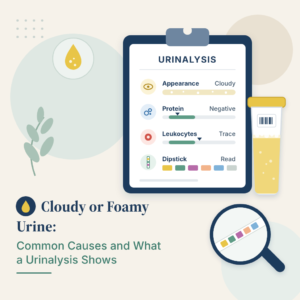
Ketones are one line on a multi-pad dipstick. The pads around them carry useful context. A simultaneous sugar reading, covered in our urine glucose test results guide, points toward a diabetes-related cause. Concentration matters too, so review the hydration signal explained in our urine specific gravity results guide before assuming a small ketone reading means much. Acidity can shift alongside ketone production, which is why clinicians also glance at the value described in our urine pH results guide.
How your body makes ketones
Your cells prefer glucose. When glucose is plentiful and insulin is working, insulin signals fat cells to hold onto their stores and tells the liver to stop making ketones. That single hormone is the off switch.
When glucose runs low, insulin falls. Fat cells release fatty acids, the liver converts them into ketone bodies, and those ketones travel through the blood to tissues that can burn them. This is ordinary physiology. It happens every night while you sleep and accelerates during fasting, illness with poor appetite, prolonged exercise, or a deliberately low-carbohydrate diet.
The problem arises when insulin is not merely low but effectively absent, as in untreated type 1 diabetes or during a severe illness in someone with type 2 diabetes. Nothing tells the liver to stop. Ketone production runs unchecked, blood turns acidic, and the result is diabetic ketoacidosis. Understanding how insulin normally restrains this process is easier after reading our insulin blood test results guide.
Reading your urine ketone result
Most laboratories and home strips report ketones on a semi-quantitative scale, either as words or as a concentration in milligrams per deciliter. The color block you match on the bottle corresponds to the ranges below. Treat the table as an orientation aid, not a diagnosis, because reference wording varies between manufacturers and your own baseline matters.
| Dipstick reading | Typical concentration | Usual meaning |
|---|---|---|
| Negative | Under 5 mg/dL | No detectable ketone spillover; the expected result for most people after a normal meal |
| Trace | About 5 mg/dL | Common after an overnight fast, a skipped meal, or a hard workout; rarely significant on its own |
| Small | About 15 mg/dL | Mild ketosis from fasting, low-carbohydrate eating, vomiting, or early illness |
| Moderate | About 40 mg/dL | Meaningful ketone accumulation; in anyone with diabetes this warrants a same-day call to the care team |
| Large | 80 mg/dL or more | High ketone load; combined with symptoms this is treated as a medical emergency |
Why the words matter more than the number
A urine dipstick cannot tell you how acidic your blood has become. It tells you that ketones have crossed the renal threshold. Two people with an identical “moderate” reading can be in very different situations: one is on day three of a ketogenic diet and feels fine, the other has type 1 diabetes, is vomiting, and is heading toward ketoacidosis. The reading is a prompt to look at the whole picture, never a verdict by itself.
The lag problem
Urine collects in the bladder over time, so a strip reflects the average of the past few hours rather than this minute. During recovery from a ketone episode, urine can stay positive for hours after blood ketones have already normalized, which sometimes makes people think treatment is not working when it is.
What causes ketones in urine
The causes fall into a few clear groups, and the distinction between them changes what you should do next.
- Carbohydrate restriction: ketogenic diets, low-carbohydrate eating plans, intermittent fasting, or simply skipping meals during a busy day.
- Illness with reduced intake: gastroenteritis, influenza, a dental infection, or any condition that causes vomiting or loss of appetite. Children develop ketones faster than adults because their glycogen reserves are smaller.
- Prolonged or intense exercise: endurance events and long training sessions deplete stored carbohydrate and shift fuel use toward fat.
- Uncontrolled diabetes: missed insulin doses, pump failure, a new and undiagnosed type 1 diabetes, or an infection that raises insulin needs beyond the usual dose.
- Pregnancy: morning sickness, longer overnight fasts, and the metabolic demands of the third trimester all promote ketone formation. Anyone tracking a pregnancy result described in our urine hCG test results guide should mention ketones to their obstetric team rather than dismissing them.
- Alcohol: a heavy drinking episode combined with poor food intake can produce alcoholic ketoacidosis, often with near-normal blood sugar.
- Certain medications: SGLT2 inhibitors, a class of diabetes drugs that flush glucose out through the kidneys, raise baseline ketone production and can trigger ketoacidosis without the usual high blood sugar.
Pairing the ketone reading with a blood sugar value usually separates these groups quickly. Anyone with an unexpected ketone result should review the fasting value explained in our fasting glucose test results guide and, if the pattern points toward a diagnosis, read our diabetes symptoms and treatments guide.
Ketones in urine without diabetes
Positive ketones in someone with no diabetes diagnosis are common and usually benign. Dietary ketosis is the most frequent explanation, followed by a short illness. In these cases the person feels reasonably well, is not vomiting repeatedly, and the reading falls as soon as normal eating resumes.
A few scenarios deserve more attention. Persistent ketones over several days without a dietary explanation, ketones accompanied by unexplained weight loss and constant thirst, or ketones in a young child who cannot keep fluids down all warrant medical assessment. New-onset type 1 diabetes frequently announces itself this way, and the sugar reading on the same dipstick is often the first clue.
Starvation ketoacidosis, a milder cousin of the diabetic form, can occur after several days of very low intake, particularly in pregnancy, after bariatric surgery, or during a severe eating disorder. It is treatable but not something to manage alone.
When to see a doctor
This is the part of a ketone result that actually changes decisions. Use the guidance below to sort a reading into a level of urgency. It does not replace instructions your own clinician has given you, and any sick-day plan you already have takes priority.
| Your situation | What to do |
|---|---|
| Trace or small ketones, no diabetes, feeling well, fasting or low-carbohydrate eating | Eat, drink water, retest later. Mention it at your next routine appointment |
| Small ketones with diabetes and blood sugar under 240 mg/dL | Drink fluids, retest in two to four hours, follow your sick-day plan |
| Moderate or large ketones with diabetes, at any blood sugar level | Contact your diabetes care team the same day, before symptoms worsen |
| Ketones plus vomiting, abdominal pain, rapid deep breathing, or fruity-smelling breath | Seek emergency care immediately; these are the signs of ketoacidosis |
| Ketones while taking an SGLT2 inhibitor, even with normal blood sugar | Call your prescriber the same day; normal glucose does not rule out ketoacidosis here |
| Ketones during pregnancy, or in a child who cannot keep fluids down | Contact your obstetric team or pediatrician promptly rather than waiting |
In a hospital, the ketone reading is only one input. Clinicians confirm acidosis using the value explained in our bicarbonate blood level guide and the calculation described in our anion gap blood test guide. Those two numbers, not the dipstick, tell the team how sick someone actually is.
How to test ketones at home accurately
Home strips are inexpensive and genuinely useful when handled correctly. Most false results come from technique rather than the product.
- Check the expiration date and the date you opened the bottle. Most strips expire three to six months after opening because moisture degrades the reagent pad.
- Close the cap immediately and store the bottle away from bathroom humidity and heat.
- Use a fresh sample. Urine left standing loses acetoacetate as it converts to acetone and evaporates, producing a falsely low reading.
- Time the color reading with a clock. Reading too early or too late is the most common source of error.
- Read the strip in good daylight against the bottle chart, not from memory.
- Test at a consistent time. Morning samples are typically the most concentrated, so comparing morning to morning gives a more meaningful trend than comparing scattered times.
Two substances can distort the result. Vitamin C in large doses and some medications containing sulfhydryl groups, such as captopril, can produce false-negative or false-positive color changes. If the color looks odd or does not match your symptoms, retest rather than assume.
Urine strips versus a blood ketone meter
Blood meters measure beta-hydroxybutyrate directly, which is the ketone that dominates during ketoacidosis and the one urine strips cannot see. Blood meters also reflect the present moment rather than the last few hours. For anyone with type 1 diabetes, using an insulin pump, or taking an SGLT2 inhibitor, most diabetes teams now recommend a blood ketone meter as the primary tool and treat urine strips as a backup. For dietary ketosis and general curiosity, urine strips are perfectly adequate.
Hydration also skews the picture in both directions. Drinking heavily dilutes the sample and can mask a real rise, while dehydration concentrates it and can exaggerate a mild one. The colour of the sample itself carries information, as our urine color test results guide explains, and a simultaneous protein reading covered in our urine protein test results guide helps rule out kidney involvement.
Latest scientific advances
Research over the past three years has changed how clinicians think about ketone testing, mostly by widening the list of people who need it. Here is what the recent literature shows, in plain language.
High blood sugar is no longer required for a ketone emergency
A 2023 review of euglycemic diabetic ketoacidosis found that this variant, in which someone develops full ketoacidosis while their blood sugar looks normal or only mildly raised, has become more common alongside the wider use of SGLT2 inhibitors. A 2025 review from the Cleveland Clinic reached the same conclusion and explained the mechanism: these drugs push glucose out through the urine, which keeps the blood sugar reading low while ketone production quietly continues. What this means for you: if you take an SGLT2 inhibitor and feel unwell with nausea, breathlessness or abdominal pain, a reassuring glucose meter reading is not enough. Check ketones as well, and call your prescriber if they are moderate or large.
Guidelines have shifted the diagnosis toward ketones themselves
A 2024 clinical review in a US family medicine journal noted that recent guidance has deliberately de-emphasized the old requirement for very high blood sugar when diagnosing ketoacidosis, precisely because of the euglycemic cases described above. Ketone measurement and blood acidity now carry more diagnostic weight than the glucose number. A 2025 hospital protocol paper went further, describing a dedicated treatment pathway for euglycemic cases because standard insulin-and-glucose protocols work poorly when blood sugar is already normal. These are expert reviews and a single-center protocol rather than large trials, so practice will keep evolving. What this means for you: expect your care team to ask about ketones earlier in the conversation than they might have a few years ago.
Ketones outside diabetes are still an open question
A 2023 systematic review, a study that pools and grades all the available evidence on a question, looked at whether measuring blood ketones helps predict outcomes in emergency department patients who do not have diabetes. The useful evidence was limited almost entirely to children with gastroenteritis, where higher ketones tracked loosely with needing admission, and the authors rated the overall quality as low. What this means for you: a positive ketone strip in a healthy adult who is simply fasting is not a validated warning sign, and there is no reason to read more into it than the situation warrants.
Ketosis as a therapy is being studied, with mixed results
A 2023 systematic review and meta-analysis of ketogenic therapy for migraine found an overall benefit across the studies it pooled, but the authors flagged a striking inconsistency: many trials never measured ketone levels at all, and those that did used different methods, so no link could be drawn between how deep the ketosis was and how much the headaches improved. A separate 2023 meta-analysis of exogenous ketone supplements found no meaningful effect on blood pressure, with a possible small rise in resting heart rate at higher doses. What this means for you: if you are using a ketogenic approach for a health goal, tracking ketones tells you whether the diet is working as intended, but the science does not yet support chasing a particular ketone number. Discuss any therapeutic ketogenic plan with your clinician first.
Glossary of key terms
| Term | Definition |
|---|---|
| Ketone bodies | Three fuel molecules the liver makes from fat: acetoacetate, beta-hydroxybutyrate and acetone. They supply energy when glucose is scarce. |
| Ketonuria | The medical term for ketones appearing in the urine. It describes the finding, not a disease. |
| Ketosis | A normal metabolic state in which ketone levels are raised but blood acidity stays in the safe range, typically from fasting or a low-carbohydrate diet. |
| Ketoacidosis | A dangerous state in which ketones accumulate far enough to turn the blood acidic. It is a medical emergency requiring hospital treatment. |
| Beta-hydroxybutyrate (BHB) | The most abundant ketone during a serious episode. Blood meters measure it; standard urine dipsticks do not detect it. |
| Euglycemic ketoacidosis | Ketoacidosis that develops while blood sugar looks normal or only mildly raised. It is linked to SGLT2 inhibitor use. |
| SGLT2 inhibitor | A class of diabetes medication that lowers blood sugar by making the kidneys excrete glucose into the urine. |
| Renal threshold | The blood concentration above which the kidneys start letting a substance spill into the urine. |
| Semi-quantitative result | A result reported in bands such as trace, small, moderate or large rather than as a precise measured number. |
| Anion gap | A calculated blood value that helps clinicians confirm whether acid is building up in the bloodstream. |
Frequently asked questions
What is a normal ketone level in urine?
A negative or trace result is normal for most people. Laboratories generally consider anything under about 5 mg/dL negative, and a trace reading around 5 mg/dL is a routine finding after an overnight fast or a skipped meal. Small amounts of ketones in urine are expected and do not require action in someone who feels well and has no diabetes diagnosis. What counts as normal for you also depends on your eating pattern, so a person following a ketogenic diet may sit at small or moderate every day without any concern. Discuss your own baseline with your clinician rather than comparing yourself to a generic chart.
What is a dangerous level of ketones in urine?
A moderate reading, roughly 40 mg/dL, is the point at which anyone with diabetes should contact their care team the same day. A large reading, 80 mg/dL or more, is treated as urgent. That said, the number alone does not define danger. Ketones combined with vomiting, abdominal pain, rapid deep breathing, confusion or fruity-smelling breath require emergency care regardless of the exact band, and someone taking an SGLT2 inhibitor can be seriously unwell with a moderate reading and a normal blood sugar.
What causes ketones in urine if you are not diabetic?
The most common causes are simple: fasting, skipping meals, a low-carbohydrate or ketogenic diet, prolonged exercise, pregnancy, and any illness that reduces food intake or causes vomiting. Alcohol combined with poor eating can also produce ketones. In these situations the reading usually returns to negative within a day of normal eating. Ketones that persist for several days without a dietary explanation, or that come with unexplained weight loss and constant thirst, should be assessed by a clinician because they can signal previously undiagnosed diabetes.
When is the best time to test ketones in urine?
For tracking a diet, the first morning sample is the most consistent because it is the most concentrated and least affected by what you drank during the day. For illness or diabetes management, timing follows need rather than routine: test whenever you feel unwell, when blood sugar runs high, before and during any sick day, and again every four to six hours until the reading falls. Comparing samples taken at the same time of day gives a far more useful trend than comparing readings taken at random.
Can dehydration cause ketones in urine?
Dehydration does not create ketones, but it concentrates the urine and can make an otherwise mild reading look higher than it is. The reverse also happens: drinking a large volume of water shortly before testing dilutes the sample and can hide a genuine rise. This is one reason clinicians look at the concentration reading on the same dipstick alongside the ketone pad. If your result seems out of step with how you feel, rehydrate normally and retest a few hours later.
How long does it take for ketones to clear from urine?
Once the underlying cause is addressed, ketones usually fall within several hours to a day. Eating carbohydrate, restoring fluids, or receiving insulin all switch off liver ketone production fairly quickly. Urine lags behind blood, however, because the bladder holds a pooled sample from the previous few hours, so a strip can stay positive for some time after blood ketones have already normalized. This lag is expected and is not a sign that treatment is failing.
Sources
- MedlinePlus, National Library of Medicine — Ketones in Urine Test — MedlinePlus Medical Test, reviewed 2024 — medlineplus.gov
- Centers for Disease Control and Prevention — Diabetic Ketoacidosis — CDC Diabetes, 2024 — cdc.gov
- Mayo Clinic — Diabetic Ketoacidosis: Symptoms and Causes — Mayo Clinic Diseases and Conditions, 2024 — mayoclinic.org
- Chow E, Clement S, Garg R — Euglycemic diabetic ketoacidosis in the era of SGLT-2 inhibitors — BMJ Open Diabetes Research and Care, 2023 — doi.org/10.1136/bmjdrc-2023-003666
- Mehta AE, Zimmerman R — Classic diabetic ketoacidosis and the euglycemic variant: Something old, something new — Cleveland Clinic Journal of Medicine, 2025 — doi.org/10.3949/ccjm.92a.24075
- Veauthier B, Levy-Grau B — Diabetic Ketoacidosis: Evaluation and Treatment — American Family Physician, 2024 — pubmed.ncbi.nlm.nih.gov
- Cardona Z, Friedman JG, Kamal N, et al. — Developing a Protocol for Management of Euglycemic Diabetic Ketoacidosis — Current Diabetes Reports, 2025 — doi.org/10.1007/s11892-025-01604-3
- Hui SA, Chiew AL, Depczynski B — What is the utility of blood beta-hydroxybutyrate measurements in emergency department in patients without diabetes: a systematic review — Systematic Reviews, 2023 — doi.org/10.1186/s13643-023-02203-7
- Neri LCL, Ferraris C, Catalano G, et al. — Ketosis and migraine: a systematic review of the literature and meta-analysis — Frontiers in Nutrition, 2023 — doi.org/10.3389/fnut.2023.1204700
- Marcotte-Chénard A, Tremblay R, Falkenhain K, et al. — Effect of Acute and Chronic Ingestion of Exogenous Ketone Supplements on Blood Pressure: A Systematic Review and Meta-Analysis — Journal of Dietary Supplements, 2023 — doi.org/10.1080/19390211.2023.2289961
Further reading
- Assess how much insulin your own pancreas still produces by reading our C-peptide test results guide.
- Track kidney filtration alongside your ketone reading with our urine creatinine test results guide.
- Interpret the salt and mineral balance behind a sick-day dipstick using our urine electrolytes results guide.
- Decode the average blood sugar figure that appears on many diabetes reports through our estimated average glucose explainer.
- Map hydration and recovery patterns from routine dipsticks with our urinalysis hydration tracking guide.
Understand your lab results with BloodSense
A ketone reading rarely stands alone. It gains meaning next to your glucose, bicarbonate, anion gap and hydration markers, and those numbers are scattered across different sections of a lab report in language most people never learned. BloodSense reads the whole panel together and explains, in plain English, what each value suggests and which combinations deserve a conversation with your clinician. It helps you understand your results and prepare better questions; it does not diagnose and it does not replace your doctor.