






Finding a line for urobilinogen in urine on your lab report can be confusing, because it is one of the few urinalysis entries that can look abnormal when it is high and also when it is missing entirely. Urobilinogen is a colorless compound that gut bacteria create from bilirubin, the pigment left over when worn-out red blood cells are recycled. A small amount normally reaches your kidneys and leaves in your urine, so the reading is really a snapshot of three systems working together: your red blood cells, your liver and bile ducts, and your gut bacteria. In this article you will learn what the value measures, how to read the numbers on a dipstick report, which conditions push the result up or down, what can distort a reading, when the result deserves a doctor’s attention, and what recent research has uncovered about the bacteria behind it.
What urobilinogen in urine actually measures
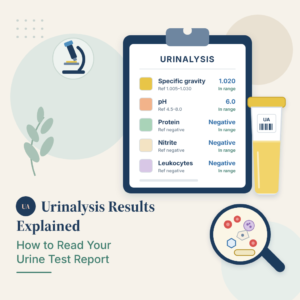
A standard urinalysis includes a plastic dipstick with a row of colored pads. One of those pads reacts with urobilinogen and changes shade in proportion to how much is present. Unlike a blood test that measures one substance precisely, the dipstick gives a semi-quantitative estimate, usually reported in milligrams per deciliter (mg/dL) or as Ehrlich units, which are numerically equivalent on most strips.
The pad is not looking for disease directly. It is looking for the tail end of a recycling loop. Every day your body retires a portion of its red blood cells, and the iron-carrying pigment inside them is broken down into bilirubin. Your liver processes that bilirubin and sends it into bile, bile flows into the intestine, and bacteria there convert it into urobilinogen. Most of the urobilinogen leaves in stool, but a fraction is reabsorbed into the bloodstream, filtered by the kidneys, and excreted in urine.
Because of that chain, the urobilinogen reading rises when more red cells are being broken down or when the liver struggles to reprocess what comes back to it, and it falls when bile cannot reach the intestine at all. Interpreting the number in isolation almost never works. Clinicians read it alongside the urine bilirubin pad, and you can compare the two by reading our urine bilirubin test results guide.
Why this test still appears on modern panels
Newer imaging and blood tests have taken over much of the diagnostic work that urobilinogen once carried, and Cleveland Clinic no longer even lists it among the core dipstick pads on its urinalysis overview. Many US laboratories still include it because it costs almost nothing, it is already printed on multi-pad strips, and an unexpected result can prompt a useful conversation. Treat it as a screening flag, not a diagnosis.
How your body makes urobilinogen, step by step
Understanding the pathway makes the numbers far easier to read. The journey has four stages.
First, red blood cells reach the end of their roughly 120-day lifespan and are dismantled, mostly in the spleen. The heme portion of hemoglobin is converted into unconjugated bilirubin, a fat-soluble pigment that travels through the blood attached to albumin. If you want the blood-side view of this pigment, our total bilirubin blood test guide walks through the reference ranges.
Second, the liver attaches a sugar molecule to bilirubin in a process called conjugation, which makes it water-soluble. The conjugated form is what gets exported into bile. Our direct bilirubin level guide covers this conjugated fraction specifically.
Third, bile carries conjugated bilirubin into the small intestine and onward to the colon, where resident bacteria strip off the sugar and chemically reduce the pigment into urobilinogen and related compounds. This step depends entirely on having the right bacteria present.
Fourth, roughly a tenth to a fifth of the urobilinogen produced is reabsorbed through the intestinal wall into the portal vein. Most of it returns to the liver and is sent back into bile, a loop called enterohepatic circulation. The small remainder that slips past the liver enters the general circulation, is filtered by the kidneys, and shows up in your urine. Some of it oxidizes into urobilin, the pigment that gives urine part of its yellow tone, which is why the urine color results guide often makes sense to read alongside this one.
Reading your urobilinogen result on the lab report
Most US laboratories treat 0.2 to 1.0 mg/dL as the expected range on a dipstick, and many strips report the lowest pad as “normal” or “0.2” rather than zero, because the test cannot reliably distinguish a trace amount from none at all. The table below shows how the common readings are typically grouped.
| Reading on the report | How it is usually read | Typical next step |
|---|---|---|
| Negative or “none detected” | Below the strip’s detection floor; can be normal or can signal blocked bile flow | Only investigated if you also have jaundice, pale stools, or dark urine |
| 0.2 mg/dL (or “normal”) | The expected everyday finding in a healthy adult | No action needed |
| 1.0 mg/dL | Upper edge of the expected range; often a concentrated sample | Usually rechecked on a well-hydrated morning sample |
| 2.0 mg/dL | Above range; prompts a look at liver enzymes and red blood cell markers | Blood panel, review of symptoms and medications |
| 4.0 mg/dL or higher | Clearly elevated; suggests active red cell breakdown or liver strain | Prompt medical evaluation, not a wait-and-see result |
Two cautions matter here. Reference ranges differ slightly between laboratories and strip manufacturers, so always read the range printed next to your own result rather than a range you found online. And a single mildly raised value in a person with no symptoms is a weak signal; the pattern across repeat tests carries far more meaning than one number.
What high urobilinogen in urine can mean
An elevated reading means more urobilinogen than usual is escaping the liver’s recycling loop and reaching the kidneys. There are two broad reasons for that, and they point in different clinical directions.
More red blood cells are being broken down
When red cells are destroyed faster than normal, a condition called hemolysis, the liver receives a surge of bilirubin, ships more into bile, and the gut produces more urobilinogen than the liver can reabsorb and re-excrete. Hemolytic anemias, inherited red cell disorders, certain infections, and some transfusion reactions can all do this. Doctors usually confirm the picture with blood markers rather than urine: a low haptoglobin blood level, a raised LDH blood test result, and a rising reticulocyte count together make a much stronger case than a dipstick pad.
The liver is not reprocessing what comes back
In hepatitis, cirrhosis, fatty liver disease, or drug-related liver injury, liver cells lose some of their capacity to pull reabsorbed urobilinogen out of the portal blood and return it to bile. More of it spills into the general circulation and out through the kidneys. This is why an unexpected urobilinogen result usually triggers a look at liver enzymes. The relevant markers are covered in our ALT liver enzyme lab test guide and our AST lab test normal range guide.
Less commonly, severe constipation or bacterial overgrowth in the small intestine gives gut bacteria extra time and territory to convert bilirubin, nudging the reading up without any liver or blood disease behind it.
What low or absent urobilinogen can mean
A negative result is trickier, because the dipstick simply cannot tell “very little” from “none,” and a genuinely healthy person can register negative. The reading only becomes meaningful when it appears next to other findings.
The situation that matters most is obstructed bile flow, sometimes called cholestasis. If a gallstone, a stricture, a tumor, or severe inflammation blocks the bile ducts, conjugated bilirubin never reaches the intestine, gut bacteria have nothing to work with, and no urobilinogen is produced or reabsorbed. The characteristic combination is a negative urobilinogen pad next to a positive urine bilirubin pad, often with pale or clay-colored stools, dark urine, and yellowing of the skin or eyes. That pairing warrants prompt medical assessment. Bile-duct problems also tend to raise cholestatic enzymes, described in our alkaline phosphatase results guide and our gamma-glutamyl transferase levels guide.
A second common cause is far more mundane. Broad-spectrum antibiotics reduce the gut bacteria that make urobilinogen in the first place, so a course of treatment can flatten the reading for days or weeks with no underlying disease at all.
What can distort a urobilinogen reading
The urobilinogen pad is one of the more fragile parts of a dipstick, and several everyday factors change the result without changing your health.
- Sample age and light exposure: urobilinogen oxidizes to urobilin within a couple of hours, so a sample left sitting on a counter reads falsely low. Fresh testing matters more here than for most pads.
- Urine concentration: a dehydrated, concentrated first-morning sample concentrates urobilinogen along with everything else, while a heavily diluted sample can drop it below detection. Comparing the result with the urine specific gravity results guide helps put the value in context.
- Urine pH: strongly acidic urine tends to lower the apparent reading, while alkaline urine can raise it.
- Medications: sulfonamides, nitrofurantoin, phenazopyridine, and some other drugs interfere with the color reaction in either direction. Vitamin C in high doses can also blunt several dipstick pads.
- Formalin or other preservatives in the collection container can suppress the reaction entirely.
None of this makes the test useless. It simply means an isolated odd value should be repeated on a fresh morning sample before anyone draws conclusions from it.
When to see a doctor
Most people with a slightly unusual urobilinogen reading and no symptoms need nothing more than a repeat test. The reading becomes worth acting on when it travels with other signs. Use the guidance below to gauge urgency, and remember that it supports a conversation with a clinician rather than replacing one.
| What you are seeing | How urgent it is |
|---|---|
| Mildly raised urobilinogen, no symptoms, feeling well | Mention it at your next routine visit; a repeat sample usually settles it |
| Raised urobilinogen with fatigue, pale skin, or shortness of breath on mild exertion | Book an appointment within days for blood work on red cell breakdown |
| Negative urobilinogen with positive urine bilirubin and pale stools | Contact a clinician promptly; blocked bile flow needs assessment |
| Yellowing of the skin or the whites of the eyes, at any reading | Seek medical care without delay |
| Dark cola-colored urine with fever, chills, or right-upper-abdominal pain | Treat as urgent; go to urgent care or an emergency department |
Tell your clinician about every prescription, supplement, and recent antibiotic course when you bring the result in. Several of the most common explanations for an odd reading sit in that list rather than in your liver.
Latest scientific advances
For most of the twentieth century, textbooks stated that gut bacteria turn bilirubin into urobilinogen without being able to name a single bacterium or enzyme responsible. That gap closed recently, and the consequences are still unfolding.
In 2024, a research team identified the specific bacterial enzyme that performs the conversion and named it bilirubin reductase. They found it is carried by a wide range of common gut bacteria and is present in nearly every healthy adult, but appears far less often in newborns and in people living with inflammatory bowel disease. What this means for you: the urobilinogen line on your report is partly a readout of your gut bacteria, not only of your liver, which helps explain why a course of antibiotics or a recent bowel illness can move the number on its own. It also offers a plausible reason why newborn jaundice is so common, since infants have not yet built up the bacteria that clear bilirubin through this route.
A 2025 commentary in a molecular medicine journal placed that discovery in a wider frame, arguing that the gut microbiome should now be treated as an active participant in bilirubin handling rather than a passive downstream step. What this means for you: researchers are beginning to view liver results, gut health, and pigment metabolism as one connected system, so a doctor investigating an odd urobilinogen value may reasonably ask about your digestive history as well as your alcohol intake and medications.
Two review papers have gone further and asked whether urobilin, the oxidized form of urobilinogen, could itself be informative. A 2024 review in a metabolism journal proposed that raised urinary urobilin may track with insulin resistance and cardiovascular-kidney-metabolic problems, and a 2026 review in a gastroenterology journal examined a possible link between this pathway and colorectal cancer risk. Both are reviews that gather existing evidence and propose a direction, not trials that prove one. What this means for you: nothing about how your result is interpreted today changes on the strength of these papers. They are a signal that the field is expanding, and any clinical use of urobilin as a metabolic marker would need confirmation in large prospective studies before it reaches a lab report.
The honest summary is that the science behind this humble dipstick pad has moved more in the past three years than in the previous fifty, while the way clinicians use it in practice has not yet changed. Read your result the traditional way, in context, and treat the newer findings as background rather than guidance.
Glossary of key terms
| Term | Definition |
|---|---|
| Urobilinogen | A colorless compound formed when gut bacteria break down bilirubin. A small amount is reabsorbed and leaves the body in urine. |
| Urobilin | The oxidized form of urobilinogen. It is a yellow pigment and contributes to normal urine color. |
| Bilirubin | The yellow-orange pigment produced when the body recycles the hemoglobin from worn-out red blood cells. |
| Conjugation | The liver step that attaches a sugar molecule to bilirubin, making it water-soluble so it can be sent into bile. |
| Enterohepatic circulation | The loop in which a substance leaves the liver in bile, is reabsorbed from the intestine, and returns to the liver to be used again. |
| Hemolysis | The breakdown of red blood cells. When it happens faster than normal, more bilirubin and therefore more urobilinogen is produced. |
| Cholestasis | Reduced or blocked flow of bile from the liver into the intestine, whatever the cause. |
| Dipstick | A plastic strip carrying chemical pads that change color in urine, giving a quick estimate of several substances at once. |
| Jaundice | Yellowing of the skin and the whites of the eyes caused by too much bilirubin circulating in the blood. |
| Bilirubin reductase | The gut bacterial enzyme, identified in 2024, that converts bilirubin into urobilinogen. |
Frequently asked questions
What does a urobilinogen reading of 2.0 in urine mean?
A value of 2.0 mg/dL sits above the range most US laboratories treat as expected, but on its own it is a prompt to look further rather than a diagnosis. It can reflect faster red blood cell turnover, a liver that is not reprocessing bilirubin efficiently, a very concentrated sample, or interference from a medication. The usual next step is a repeat urinalysis on a fresh morning sample plus a blood panel covering liver enzymes and red cell markers. If you feel well and have no jaundice, dark urine, or unusual fatigue, this is rarely an emergency, but it should not be ignored either.
Is a negative urobilinogen result a problem?
Usually not. Dipsticks cannot distinguish a very small amount from none, so plenty of healthy people register negative. It becomes worth investigating when it appears together with a positive urine bilirubin pad, pale or clay-colored stools, dark urine, or yellowing of the skin or eyes, because that combination can point to bile that is not reaching the intestine. A recent course of antibiotics is another frequent and harmless explanation, since it reduces the gut bacteria that produce urobilinogen.
Can diet change my urobilinogen level?
Diet has a modest and indirect effect. Hydration matters most, because a concentrated sample raises the apparent value and a very dilute one can push it below detection. Foods that shift urine pH can nudge the reading slightly. High-dose vitamin C supplements can interfere with several dipstick pads. Alcohol matters through the liver rather than through the sample itself, and heavy sustained intake can affect the result by affecting liver function. No ordinary food raises urobilinogen enough to explain a clearly abnormal value.
Is urobilinogen checked during pregnancy?
Urinalysis is a routine part of prenatal care in the United States, so the urobilinogen pad is often read along with everything else, though the main focus is usually protein, glucose, and signs of infection. Mildly raised readings are not unusual in pregnancy and are frequently related to hydration. Any result your prenatal team considers unexpected will be repeated and, if needed, followed by blood tests. Always raise questions with the clinician managing your pregnancy rather than comparing your value with ranges found online.
How often should urobilinogen be tested?
There is no schedule for testing urobilinogen on its own. It is included in a general urinalysis, which most adults have during routine checkups, before certain procedures, during pregnancy care, or when symptoms suggest a urinary, liver, or blood problem. If a previous result was abnormal, your clinician may repeat the urinalysis after a few weeks alongside blood work, but repeat testing is driven by the wider clinical picture rather than by the pad itself.
Can medications cause a false urobilinogen result?
Yes, and this is one of the more common explanations for a surprising value. Sulfonamide antibiotics, nitrofurantoin, and phenazopyridine, a bladder-pain medication that dyes urine orange, can all distort the color reaction. Broad-spectrum antibiotics lower the reading by reducing the gut bacteria that produce urobilinogen. High-dose vitamin C can blunt several dipstick pads at once. Bring a full list of what you take, including supplements, when you discuss your results.
Sources
- MedlinePlus, National Library of Medicine — Urobilinogen in Urine — MedlinePlus Medical Test — medlineplus.gov
- Mayo Clinic — Urinalysis — Mayo Clinic Tests & Procedures — mayoclinic.org
- Cleveland Clinic — Urinalysis: What It Is, Purpose, Procedure, Results & Types — Cleveland Clinic Diagnostics — my.clevelandclinic.org
- Hall B, Levy S, Dufault-Thompson K, et al. — BilR is a gut microbial enzyme that reduces bilirubin to urobilinogen — Nature Microbiology, 2024 — doi.org/10.1038/s41564-023-01549-x
- Vítek L, Tiribelli C — Gut microbiota and bilirubin metabolism: unveiling new pathways in health and disease — Trends in Molecular Medicine, 2025 — doi.org/10.1016/j.molmed.2024.12.007
- Kipp ZA, Badmus OO, Stec DE, Hall B, Hinds TD — Bilirubin bioconversion to urobilin in the gut-liver-kidney axis: A biomarker for insulin resistance in the Cardiovascular-Kidney-Metabolic (CKM) Syndrome — Metabolism, 2024 — doi.org/10.1016/j.metabol.2024.156081
- Davis JM, Ogbewekon A, Gordon DM, et al. — Microbiome-derived cancer: the catabolism of bilirubin to urobilin in the liver-gut axis and its consequences — Gastroenterology Report, 2026 — doi.org/10.1093/gastro/goag065
Further reading
- Explore the viral cause most often behind unexplained liver findings by reading our hepatitis C symptoms and treatments guide.
- Recognize the condition that follows sustained red blood cell loss with our anemia symptoms and causes guide.
- Decode the oxygen-carrying protein released during red cell breakdown using our hemoglobin blood test results guide.
- Examine what the sediment under the microscope adds to a dipstick report with our urine microscopy results guide.
- Discover how algorithms are reshaping the reading of raised liver enzymes in our AI liver enzyme interpretation guide.
Understand your lab results with BloodSense
A single urobilinogen value rarely tells a complete story. Its meaning depends on the urine bilirubin pad beside it, on liver enzymes such as ALT and alkaline phosphatase, and on red blood cell markers like haptoglobin and the reticulocyte count. BloodSense reads those results together and explains in plain language what the pattern suggests and which questions are worth raising with your doctor. It helps you understand your results; it does not diagnose you and it does not replace medical care.