






Your urine specific gravity is the line on a urinalysis report that quietly describes how well your kidneys are handling water. The test compares the density of your urine with the density of pure water, so a higher number means more dissolved material packed into the same volume of fluid, and usually less spare water in your body. Most American laboratories report a reference span of roughly 1.005 to 1.030, and a perfectly healthy person can travel across that entire span within a single day.
In this article you will learn what urine specific gravity actually measures, how to read your own value, which everyday habits push it up or down, which patterns deserve a conversation with a clinician, and what recent research has changed about the way doctors investigate unusually dilute urine.
What urine specific gravity measures
Specific gravity is a ratio, not a concentration. Pure water is assigned the value 1.000. Urine always contains dissolved substances such as urea, creatinine, sodium, potassium and chloride, so it is always denser than water and its value always sits above 1.000. A reading of 1.020 simply means your urine is two percent denser than water.
Because it is a ratio, urine specific gravity has no units. Lab reports sometimes print it with a placeholder such as “SG” or leave the unit column blank, which confuses many readers into thinking something is missing. Nothing is missing — a bare four-digit decimal is the correct format.
The number is a proxy for how concentrated your urine is. A more precise laboratory measure of the same idea is osmolality, which counts the actual number of dissolved particles rather than their combined weight. If you want the blood-side equivalent of that measurement, read our serum osmolality lab results guide. In everyday practice, specific gravity is used far more often because a dipstick can estimate it in seconds at the point of care.
One practical consequence: specific gravity is also the yardstick labs use to judge whether a urine sample is worth interpreting at all. A very dilute sample can wash out other dipstick findings, which is why an unexpectedly negative result on a diluted specimen sometimes gets repeated.
How your kidneys set the number
Every kidney contains about a million filtering units called nephrons. They filter an enormous volume of fluid each day and then reclaim almost all of it. The amount they choose to reclaim is what sets your urine specific gravity.
The decision is made by a hormone called antidiuretic hormone, also known as arginine vasopressin. When sensors in your brain detect that your blood is becoming too concentrated, or when blood pressure drops, the pituitary gland releases more of this hormone. It instructs the kidney’s collecting ducts to pull water back into the bloodstream. Less water leaves in the urine, the urine becomes darker and denser, and specific gravity climbs.
The reverse happens after you drink a large glass of water. The hormone signal falls away, the collecting ducts stop reclaiming water, and dilute urine flows out with a value near 1.005. This swing is normal physiology, not a malfunction. It is also the reason a single reading tells you far less than a pattern of readings.
Why your first morning sample is different
Overnight you go seven or eight hours without drinking while still losing water through breathing and skin. Antidiuretic hormone rises, and the first urine of the day is typically the most concentrated sample you will produce, often between 1.020 and 1.030. Clinicians often request that sample deliberately, because a kidney that can concentrate urine overnight is demonstrating that a core function is intact. The same logic explains why urine color test results tend to look darkest first thing in the morning.
How to read your urine specific gravity result
Reference ranges vary slightly between laboratories, so always compare your value with the range printed on your own report. The table below shows how most American labs frame the numbers, alongside the everyday situations that usually explain them.
| Value | What it indicates | Common everyday explanation |
|---|---|---|
| 1.000 to 1.004 | Extremely dilute, below the usual reference range | Very large fluid intake shortly before the test, or a diluted sample |
| 1.005 to 1.010 | Dilute but within range | Well hydrated, or a sample given later in the day after steady drinking |
| 1.010 to 1.020 | Mid-range, the most common result | Ordinary hydration in an ordinary day |
| 1.020 to 1.030 | Concentrated but still within range | First morning sample, hot weather, exercise, or modest fluid restriction |
| Above 1.035 | Higher than physiology alone usually allows | Often a substance in the urine such as glucose, heavy protein or a contrast dye |
A value that hovers near 1.010 on every sample deserves a second look. That figure is close to the density of the fluid the kidney filters before it does any concentrating or diluting work. Urine that is persistently fixed at that point can suggest the kidney has lost some of its ability to adjust, which is one reason clinicians look at specific gravity together with kidney blood markers rather than alone.
What a high urine specific gravity can mean
A high value means your urine is concentrated. The overwhelmingly common cause is that you are short of water. Insufficient drinking, hot weather, heavy sweating, vomiting, diarrhea, fever and burns all reduce the water available to your kidneys, and the kidneys respond exactly as designed by conserving it. If your reading is high and you feel thirsty with a dry mouth and dark urine, review the signs described in our guide to dehydration symptoms and care.
Beyond simple fluid loss, several medical situations raise the number:
- Heart failure and liver disease, which reduce effective blood flow reaching the kidney and trigger water conservation
- Adrenal insufficiency and other conditions that disturb salt and water balance
- The syndrome of inappropriate antidiuretic hormone secretion, in which the water-retaining hormone stays switched on when it should be off
- Uncontrolled diabetes, where sugar spilling into the urine adds weight and lifts the reading
That last point matters because it is a false signal about hydration. Dissolved glucose and protein are heavy molecules, so they inflate specific gravity without telling you anything about water balance. When a reading looks improbably high, clinicians check the rest of the dipstick, particularly the panels covered in our urine glucose test results guide and our urine protein test results guide. Intravenous contrast dye from a recent imaging scan produces the same artificial elevation and can persist for a day or two.
What a low urine specific gravity can mean
A low value means dilute urine. Again, the usual explanation is entirely benign: you drank a lot of fluid, or you took a diuretic medication, or you simply produced the sample an hour after a large drink. Caffeine and alcohol both suppress the water-retaining hormone temporarily and can push a reading down.
Persistently dilute urine, especially alongside heavy urine output and constant thirst, is the pattern that clinicians take seriously. It can point toward:
- Arginine vasopressin deficiency, the condition long known as central diabetes insipidus, in which the pituitary does not release enough water-retaining hormone
- Arginine vasopressin resistance, previously called nephrogenic diabetes insipidus, in which the hormone is present but the kidney cannot respond to it
- Primary polydipsia, a habit of drinking very large volumes that leaves the kidney with nothing to concentrate
- Chronic kidney disease, in which damaged nephrons gradually lose their concentrating power
Losing the ability to concentrate urine is often one of the earlier functional changes in kidney disease, which is why a fixed low value is read alongside filtration markers rather than in isolation. Our guides to urine creatinine test results and chronic kidney disease symptoms and treatments explain how those pieces fit together.
How the test is done and what can skew it
Three methods are in routine use. A reagent dipstick uses a chemical pad that changes color according to the ionic strength of the sample, giving a fast estimate in steps of 0.005. A refractometer measures how much the sample bends light and needs only a drop or two. A urinometer, a weighted float in a cylinder of urine, is the oldest method and is now rare because it needs a large volume and is sensitive to temperature.
The dipstick method has a known blind spot worth understanding: it responds to charged particles, so it can underestimate the density of urine loaded with uncharged substances such as glucose. That is one reason an unexpected dipstick value is sometimes confirmed by refractometer.
Preparing for the test
No fasting is required. Unless your clinician tells you otherwise, keep your normal drinking pattern rather than loading up on water beforehand, because a deliberately flooded sample hides the very information the test is meant to reveal. Collect a clean-catch midstream sample, and mention any diuretic, lithium or recent contrast scan. Samples left standing at room temperature for hours can shift as bacteria multiply, which also affects urine pH test results.
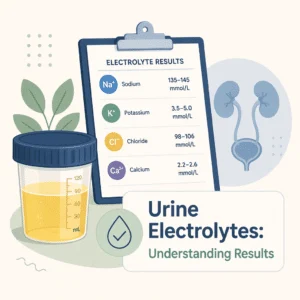
Specific gravity is rarely interpreted by itself. It provides the context that makes every other line of the urinalysis readable, from the microscopic sediment findings to the mineral panel covered in our urine electrolytes results guide.
When to see a doctor
A single out-of-range value on an otherwise normal report is usually not a reason for concern, and drinking a glass of water is not a medical intervention. The signals below are the ones worth acting on.
| What you notice | Reasonable next step |
|---|---|
| One high reading, you were thirsty, everything else normal | Rehydrate steadily and mention it at your next routine visit |
| Readings stuck near 1.010 across several samples | Ask your clinician about kidney concentrating ability and filtration testing |
| Low readings with heavy urine output and unrelenting thirst | Book an appointment; this pattern needs a structured workup |
| High reading alongside protein or glucose on the same dipstick | Follow up promptly, since those findings change the interpretation |
| Confusion, dizziness on standing, very little urine, or no urine | Seek urgent medical care the same day |
Children, older adults and people taking diuretics sit at the edges of these rules. Infants concentrate urine less efficiently, so their upper values are lower than an adult’s. Concentrating ability also declines gradually with age, meaning an older adult can be genuinely short of fluid while showing a reading that looks unremarkable, and thirst is a less reliable warning at that stage of life.
Everyday habits that move the number
Understanding what you control makes a repeat test easier to interpret. Total fluid intake is the dominant lever, and it includes water contained in fruit, vegetables and soup, not only what you pour into a glass. Salt intake matters too, because a salty meal gives the kidney more solute to excrete and pushes the value up; our guide to urine sodium test results covers that relationship in detail.
Protein-heavy diets raise urea production and have a similar effect. Exercise in heat can lift a reading well into the upper range within a couple of hours, which is why athletic staff often use the measurement as a same-day hydration check rather than a diagnosis. Some medications matter as well: diuretics lower the value, while lithium can impair the kidney’s response to the water-retaining hormone over time.
Consistently concentrated urine also creates the conditions in which minerals crystallize, a mechanism explained further in our guide to kidney stone symptoms and treatment options.
Latest scientific advances
Research over the past three years has changed less about the measurement itself than about the workup it triggers. Here is what that means in plain language.
The names of the conditions behind dilute urine have changed
An international expert group renamed the two classic causes of very dilute urine. What was called central diabetes insipidus is now arginine vasopressin deficiency, and what was called nephrogenic diabetes insipidus is now arginine vasopressin resistance. The point of the change was to stop the confusion with diabetes mellitus, an entirely different disease. What this means for you: if your records use one set of names and a newer report uses the other, they refer to the same conditions, and it is worth asking your clinician to confirm which term applies to you.
A blood test is replacing the old fluid-restriction test
For decades, the standard way to investigate dilute urine was a water deprivation test — hours without drinking while urine concentration is tracked, which is uncomfortable and often gives ambiguous answers. Recent reviews report that measuring a blood marker called copeptin, a stable fragment released together with the water-retaining hormone, separates the possible causes more reliably, particularly when combined with a controlled salt-water infusion that provokes the hormone. What this means for you: if you are referred for suspected arginine vasopressin deficiency, the modern pathway may involve a shorter, better-tolerated blood-based protocol rather than a long thirsting test. Availability still varies between centers, so ask what your hospital uses.
Case-based guidance now sets out where each test fails
A 2025 clinical review walked through real patient scenarios to show where each approach can mislead — including situations in which the older thirsting test points the wrong way while the newer marker gets it right. What this means for you: an inconclusive first result is a recognized outcome rather than a failure, and repeating or switching tests is a normal part of reaching the answer.
Specific gravity remains a practical hydration tracker in sport
A 2026 randomized trial in firefighters recovering from a simulated emergency drill used urine specific gravity, alongside urine color and salivary measures, to compare plain water with electrolyte drinks during the hour after intense exertion in protective clothing. The electrolyte drinks restored fluid balance better than water alone. What this means for you: the measurement continues to be treated as a usable field marker of short-term hydration, and after heavy sweating, replacing salts as well as water helps you rehydrate more completely. This was one small trial in one occupational group, so treat it as supporting evidence rather than a rule for everyone. If you track hydration alongside training, our guide to urinalysis-based hydration tracking covers the practical side.
Glossary
| Term | Definition |
|---|---|
| Specific gravity | The density of a fluid compared with pure water, which is set at 1.000. It has no units. |
| Osmolality | A laboratory measure of how many dissolved particles a fluid contains, regardless of their weight. |
| Antidiuretic hormone | Also called arginine vasopressin. A pituitary hormone that tells the kidney to reclaim water. |
| Nephron | The microscopic filtering unit of the kidney. Each kidney holds roughly a million of them. |
| Refractometer | A small instrument that measures how much a fluid bends light, used to read specific gravity precisely. |
| Copeptin | A stable protein fragment released with antidiuretic hormone, measurable in blood as a proxy for it. |
| Arginine vasopressin deficiency | The new name for central diabetes insipidus, in which too little antidiuretic hormone is released. |
| Primary polydipsia | Drinking very large volumes of fluid by habit, which produces persistently dilute urine. |
| Clean-catch sample | A midstream urine sample collected after cleaning, to limit contamination from the skin. |
Frequently asked questions
What does a urine specific gravity of 1.030 mean?
A value of 1.030 sits at the top of the usual reference range and means your urine is highly concentrated. In most people it reflects a first morning sample, a hot day, hard exercise or simply not having drunk much. It becomes more interesting when it appears on a sample taken later in the day after normal drinking, or when the same dipstick also shows glucose or protein, since those substances can lift the figure on their own. One high reading in an otherwise normal report rarely calls for anything beyond steady rehydration.
What does a urine specific gravity of 1.025 mean?
A reading of 1.025 is within the normal range and indicates fairly concentrated urine. It is a very common morning result and often follows a night without fluids, a salty meal or a sweaty workout. If you feel well and your other urinalysis lines are unremarkable, it usually needs no action. If it appears together with persistent thirst, headaches or reduced urine output, mention it to your clinician.
What does a urine specific gravity of 1.010 mean?
A single value of 1.010 is squarely mid-range and generally unremarkable. What draws attention is a value fixed near 1.010 on repeated samples taken under different conditions, because that suggests the kidney is neither concentrating nor diluting much. Clinicians investigate that pattern with filtration blood tests rather than acting on the urinalysis alone.
What does a urine specific gravity of 1.005 mean?
A reading of 1.005 sits at the dilute end of the reference range. Most often it means you drank a good deal of fluid in the hours before the sample, or you take a diuretic. It only becomes a concern when it persists across samples and comes with large urine volumes and constant thirst, a combination that warrants medical assessment.
What unit is urine specific gravity measured in?
None. Specific gravity is a ratio between the density of urine and the density of water, so the two units cancel out and the result is a plain number such as 1.015. A blank unit column on your report is normal, not an error.
Can I change my urine specific gravity before a test?
You can, and that is exactly why you should not try. Drinking large amounts of water shortly before a sample dilutes it and can mask findings the test is meant to detect, while deliberately restricting fluids can create a falsely alarming value. Unless your clinician has asked for a first morning sample or a specific preparation, keep your normal routine.
Sources
- MedlinePlus, National Library of Medicine — Urine specific gravity test — MedlinePlus Medical Encyclopedia, reviewed 2025 — medlineplus.gov
- Cleveland Clinic — Urinalysis: What It Is, Purpose, Procedure, Results and Types — Cleveland Clinic Health Library, 2025 — my.clevelandclinic.org
- Mayo Clinic — Urinalysis — Mayo Clinic Tests and Procedures, 2025 — mayoclinic.org
- Atila C, Refardt J, Christ-Crain M — Arginine vasopressin deficiency: diagnosis, management and the relevance of oxytocin deficiency — Nature Reviews Endocrinology, 2024 — doi.org/10.1038/s41574-024-00985-x
- Newell-Price J, Drummond JB, Gurnell M, et al. — Approach to the Patient With Suspected Hypotonic Polyuria — The Journal of Clinical Endocrinology and Metabolism, 2025 — doi.org/10.1210/clinem/dgae565
- Flynn K, Hatfield J, Brown K, Vietor N, Hoang T — Central and nephrogenic diabetes insipidus: updates on diagnosis and management — Frontiers in Endocrinology, 2025 — doi.org/10.3389/fendo.2024.1479764
- Hsu YJ, Ho CS, Chang CH, Chuang TW, Shang SH — Effects of carbohydrate-electrolyte solutions with and without L-menthol on hydration and performance recovery following simulated firefighting exercise — Journal of the International Society of Sports Nutrition, 2026 — doi.org/10.1080/15502783.2026.2676193
Further reading
- Compare the two urine tests that flag early kidney damage by reading our albumin-to-creatinine ratio results guide.
- Interpret the blood-side marker of kidney filtration with our blood creatinine test results guide.
- Recognize a urinary tract infection on a lab report by reading our urine culture results guide.
- Explore the fat-burning marker that appears when carbohydrates run low in our urine ketones results guide.
- Check how salt balance shows up in a blood panel with our blood sodium test results guide.
Understand your lab results with BloodSense
A urine specific gravity value only becomes meaningful next to the rest of your report. BloodSense reads your urinalysis as a whole, connecting concentration with markers such as urine creatinine, urine protein, urine glucose and blood sodium, and translating the combination into plain language you can bring to your next appointment. It helps you understand what your numbers describe and which questions are worth asking; it does not diagnose and it does not replace your doctor.