






A urine sodium measurement shows how much salt your kidneys are letting go of, and it is one of the few laboratory tests that reflects both your body’s internal signalling and your eating habits. When blood sodium is low, when fluid balance is hard to interpret, or when salt intake needs measuring objectively rather than estimated from memory, this is the test clinicians reach for.
In this article you will learn what the test measures, the difference between a spot sample and a 24-hour collection, the ranges laboratories commonly print, what high and low values suggest, which everyday factors distort them, and what recent research says about the number on your report.
What a urine sodium test measures
Sodium is the main positively charged mineral in the fluid outside your cells. It sets the volume of that fluid, which in turn helps set your blood pressure, and it works with potassium to keep nerve and muscle signals running. Almost all the sodium you take in comes from salt in food, and almost all of the surplus leaves through the kidneys.
That last point is what makes this test useful. Your kidneys constantly decide how much sodium to hold and how much to release, guided by hormones that sense circulating volume. The urine value shows that decision in progress. A blood sodium value shows concentration, which depends as much on water as on salt. The two answer different questions, and pairing the urine result with a same-day blood sodium test guide value is what turns a raw figure into an explanation.
Why sodium and water must be read together
Low blood sodium usually means too much water relative to salt, not necessarily too little salt. Urine sodium helps separate those situations. If the kidneys are conserving sodium hard, the body senses that circulating volume is low. If they are releasing sodium despite a low blood level, the signalling itself is disturbed. Clinicians often add a serum osmolality lab results guide value and a urine osmolality to complete the picture.
Why a clinician orders this test
- Blood sodium is low or high and the mechanism needs identifying.
- Fluid status is unclear: swelling, dehydration, or an unexplained drop in blood pressure.
- Acute kidney injury needs characterizing, since sodium handling helps distinguish the causes.
- A salt reduction plan for blood pressure or heart failure needs objective monitoring.
- An adrenal or pituitary hormone problem is suspected.
- Kidney stones are recurring and dietary salt is being reviewed, a topic covered in our guide to kidney stones symptoms and treatment options.
How the sample is collected
The spot sample is one cup of urine given at a single moment. It is the standard choice in hospital, where the answer is needed quickly and the clinical question is usually about direction rather than exact quantity.
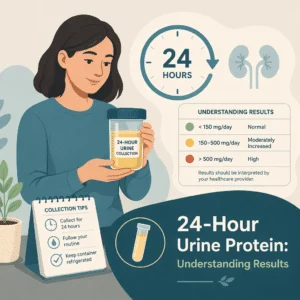
The 24-hour collection captures every void over a full day. Discard the first morning urine, note the time, then collect everything for the next 24 hours including the following morning’s first void. Keep the container cold if instructed. This is the format used when the goal is to measure habitual salt intake, because a full day averages out meals, drinks and the natural daily rhythm of kidney output.
No fasting is required. Report every medication, particularly diuretics, since they change the result dramatically while they are active. Many laboratories pair a spot sodium with urine creatinine test results so the value can be corrected for how concentrated the sample was.
How to read your lab report
Reference ranges vary between laboratories. The range printed on your report always takes precedence over any general figure.
| Collection type | Commonly reported adult range | What the value reflects |
|---|---|---|
| Random (spot) sample | Generally more than 20 mEq/L | Kidney handling at that moment, plus recent salt and fluid |
| 24-hour collection | 40 to 220 mEq (40 to 220 mmol) per day | Total daily salt intake, in a person whose kidneys are stable |
| Spot value used in volume assessment | Below roughly 20 mEq/L suggests the body is conserving sodium | Dehydration, heart failure, cirrhosis, blood loss |
One practical translation is worth remembering: roughly 40 mEq of sodium corresponds to about one gram of sodium, and a gram of sodium comes from about 2.5 grams of table salt. A 24-hour result near the top of the range therefore reflects an intake well above the federal recommendation of under 2,300 mg of sodium per day. Average intake in the United States sits above 3,300 mg per day, and most of it comes from processed and restaurant food rather than the salt shaker.
What a high result can mean
- A high-salt diet, which is the most common explanation by a wide margin.
- Diuretic medication currently active in the body.
- Adrenal insufficiency, in which the hormone that normally conserves sodium is lacking.
- Kidney tubule damage or salt-wasting conditions.
- The syndrome of inappropriate antidiuretic hormone, in which the body retains water and keeps releasing sodium despite a low blood level.
- Intravenous saline given in hospital.
When a high urine sodium appears alongside a low blood sodium, clinicians look carefully at hormone signalling rather than at the diet.
What a low result can mean
- Low salt intake.
- Dehydration from vomiting, diarrhea, fever or heavy sweating, described further in our guide to dehydration symptoms and care.
- Heart failure, cirrhosis or nephrotic syndrome, where the body senses low effective circulating volume and holds on to salt even though total body fluid is high.
- Reduced blood flow to the kidney, a pattern that helps distinguish causes of acute kidney injury.
- Excess of the salt-retaining hormone aldosterone.
The apparent contradiction of visible swelling with a very low urine sodium is one of the most informative findings in clinical medicine: the kidney is responding to the volume it senses, not the fluid you can see.
What can distort your result
| Factor | Typical effect on urine sodium |
|---|---|
| Restaurant or processed food the day before | Raises the value, often sharply |
| Loop or thiazide diuretic taken within hours | Raises the value substantially |
| Heavy sweating, fever or hot weather | Lowers the value |
| Vomiting or diarrhea | Lowers the value |
| Nonsteroidal anti-inflammatory drugs | Can lower the value by promoting sodium retention |
| Incomplete 24-hour collection | Falsely lowers the daily total |
| Sampling on an unusually low-salt day | Underestimates habitual intake |
Day-to-day variation in salt intake is large, so a single 24-hour collection estimates your average imperfectly. If the result will guide a treatment decision, your clinician may repeat it on a different day.
When to talk with a clinician
- Confusion, unusual drowsiness, seizures or persistent headache with a low blood sodium, all of which need urgent assessment.
- Nausea, muscle cramps or marked weakness that continue for more than a day.
- New or worsening swelling of the legs or abdomen.
- Light-headedness on standing, reduced urine output, or very dark urine.
- Blood pressure that stays high despite treatment, in which case a 24-hour sodium measurement can be genuinely useful. Our guide to high blood pressure symptoms and treatments explains the wider approach.
Latest scientific advances
Urinary sodium has become the reference method for measuring salt intake in research, and the last three years have produced several results that touch directly on how your report is used.
A 2025 umbrella review in Annals of Medicine pooled 21 previous reviews covering 91 outcomes. Higher salt intake was associated with more cardiovascular disease, more high blood pressure and more stroke; moderate salt reduction was associated with lower cardiovascular and overall death rates, and with no harmful effect on cholesterol levels. What this means for you: a high 24-hour sodium result is not just a dietary detail, it is a modifiable marker linked to long-term heart risk. Because much of the underlying evidence is observational, it describes a consistent pattern rather than a guaranteed outcome for any one person.
A 2024 meta-analysis in Hypertension, covering 35 trials, examined people already on blood pressure medication and measured intake by 24-hour urinary sodium. For every 100 mmol reduction in daily sodium excretion, systolic blood pressure fell by close to 7 mmHg on top of the medication effect, with the size of the benefit varying by drug class. What this means for you: reducing salt still works when you are already treated, and a urine collection gives your clinician a real starting figure rather than an estimate.
A 2024 study in JAMA Dermatology took a different angle, using estimated 24-hour sodium excretion calculated from a single spot urine sample in more than 215,000 UK Biobank participants. Higher estimated sodium intake was associated with modestly higher odds of having eczema, and a separate US survey group showed a similar pattern. What this means for you: sodium may matter beyond the heart and kidneys, though this was a cross-sectional analysis, which cannot show that salt causes the skin condition.
Finally, a 2025 European Heart Journal study validated an equation that predicts a person’s total salt clearance from a single urine sample taken two hours after an oral water tablet, in heart failure clinics. Patients’ own impressions of how well the tablet had worked were unreliable, while the urine-based calculation was accurate. What this means for you: a quick spot urine sodium can guide treatment adjustments that used to require a full day of collection.
Glossary
| Term | Definition |
|---|---|
| Sodium | The main positively charged mineral outside cells. It controls fluid volume and helps set blood pressure. |
| Hyponatremia | A lower than normal level of sodium in the blood, usually reflecting excess water rather than lack of salt. |
| Osmolality | A measure of how concentrated a fluid is with dissolved particles. |
| Aldosterone | An adrenal hormone that instructs the kidney to keep sodium and release potassium. |
| Antidiuretic hormone | A hormone that tells the kidney to retain water, concentrating the urine. |
| mEq/L | Milliequivalents per liter, a unit expressing the electrical activity of a mineral in a volume of fluid. |
| Diuretic | A medication that increases urine production, often called a water tablet. |
| 24-hour collection | All urine passed over a full day, gathered so the daily total can be measured. |
| Natriuresis | The process of the kidneys excreting sodium into urine. |
Frequently asked questions
What is a normal urine sodium level?
Laboratories commonly report more than 20 mEq/L in a random sample and 40 to 220 mEq per day in a 24-hour collection for adults. The range is wide because the value follows what you eat and drink. Interpretation depends on your blood sodium, your fluid status and your medications, so a figure inside or outside the range means little on its own.
Can this test tell me how much salt I eat?
A complete 24-hour collection gives a good estimate, and it is the method researchers use for exactly this purpose. A spot sample cannot do the same job reliably, because it captures one moment. Even a 24-hour result reflects one particular day, so your clinician may repeat it if the figure will guide a decision.
Why is my urine sodium low when my legs are swollen?
This combination is common in heart failure, liver cirrhosis and nephrotic syndrome. The body holds a large amount of fluid overall, but the volume actually circulating in the arteries is sensed as low, so hormone signals tell the kidney to conserve salt. The result is visible swelling alongside a kidney that behaves as if you were dehydrated.
Do I need to stop my water tablet before the test?
Do not stop any prescribed medication without asking. Diuretics raise urine sodium while they are active, and your clinician may either take that into account or plan the sample timing around your dose. Stopping the drug on your own can be more risky than an imperfect laboratory value.
How does urine sodium differ from urine chloride?
The two usually move together, since both come mainly from salt. Chloride becomes the more useful of the two when the blood is unusually acidic or alkaline, because it can diverge from sodium in those situations. Many laboratories report both, which is why you may see them side by side.
Does drinking more water lower my urine sodium?
It lowers the concentration in a spot sample by diluting it, without changing the total amount of sodium your body releases. A 24-hour collection is far less affected, since it measures a total rather than a concentration. This is one reason clinicians prefer timed collections when the exact quantity matters.
Sources
- MedlinePlus, National Library of Medicine — Sodium urine test — MedlinePlus Medical Encyclopedia, reviewed 2025 — medlineplus.gov
- Mayo Clinic — Hyponatremia: Diagnosis and treatment — Mayo Clinic Patient Care, 2025 — mayoclinic.org
- Centers for Disease Control and Prevention — About Sodium and Health — CDC Salt, 2025 — cdc.gov
- Kong F, Liu Q, Zhou Q, Xiao P, Bai Y, Wu T, Xia L — Dietary salt intake and cardiovascular outcomes: an umbrella review of meta-analyses and dose-response evidence — Annals of Medicine, 2025 — doi.org/10.1080/07853890.2025.2582065
- Song J, Chen L, Xiong H, Ma Y, Pombo-Rodrigues S, MacGregor GA, He FJ — Blood Pressure-Lowering Medications, Sodium Reduction, and Blood Pressure — Hypertension, 2024 — doi.org/10.1161/HYPERTENSIONAHA.124.23382
- Chiang BM, Ye M, Chattopadhyay A, Halezeroglu Y, Van Blarigan EL, Abuabara K — Sodium Intake and Atopic Dermatitis — JAMA Dermatology, 2024 — doi.org/10.1001/jamadermatol.2024.1544
- Ivey-Miranda JB, Rao VS, Cox ZL, Moreno-Villagomez J, Ramos Mastache D, Collins SP, Testani JM — Natriuretic response prediction equation for use with oral diuretics in heart failure — European Heart Journal, 2025 — doi.org/10.1093/eurheartj/ehaf268
Further reading
- Review the full mineral report that includes sodium in our urine electrolytes results guide.
- Compare the mineral that mirrors sodium in the kidney using our urine potassium test guide.
- Check how concentrated your sample was by reading our urine specific gravity guide.
- Explore the hormone that drives sodium retention in our aldosterone blood test guide.
- Understand the waste marker paired with sodium on many reports through our blood urea nitrogen levels guide.
Understand your lab results with BloodSense
Get your results interpreted in minutes
Urine sodium is only interpretable next to blood sodium, kidney filtration, osmolality and the medications you take. BloodSense reads those numbers together and explains in plain language what the combination suggests and which questions are worth raising with your clinician. It helps you understand your results; it does not diagnose you and it does not replace medical care.