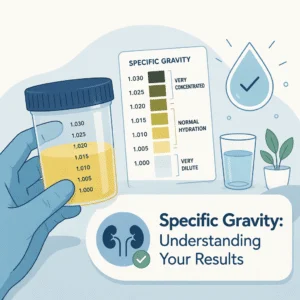







A urine electrolytes report puts several mineral measurements on one page, usually sodium, potassium and chloride, sometimes calcium as well. On its own each number looks unremarkable. Together, and read next to a blood panel from the same day, they show something a blood test cannot: whether your kidneys are the source of an electrolyte problem or are responding sensibly to one that started elsewhere.
In this article you will learn which minerals appear on the report, why the test is ordered, how spot samples differ from 24-hour collections, what ranges laboratories print, how clinicians combine the values into an answer, and what recent research has added.
What a urine electrolytes test measures
An electrolyte is a mineral that carries an electrical charge when dissolved in body fluid. The body relies on them for fluid balance, nerve signalling, muscle contraction, heart rhythm and blood acidity. The kidneys are the main regulators, deciding minute by minute how much of each mineral to keep and how much to send out.
Measuring what leaves in urine therefore shows the regulator at work. Most reports include:
- Sodium, the main mineral controlling the volume of fluid outside your cells, covered in detail in our urine sodium test guide.
- Potassium, essential to heart and muscle function, explained in our urine potassium test guide.
- Chloride, the negatively charged partner of sodium and a key marker in acid-base problems, described in our urine chloride test guide.
- Calcium, when stone formation or a bone or parathyroid problem is being investigated.
Why a clinician orders this panel
This is a targeted test, not part of a routine check-up. It is ordered when a specific question needs answering:
- A blood electrolyte value is abnormal and the cause is not obvious.
- Fluid status is unclear, whether from dehydration, swelling or an unexplained fall in blood pressure.
- Acute kidney injury needs characterizing, since sodium handling helps separate reduced blood flow from tubular damage.
- Blood has become too acidic or too alkaline and the kidney’s contribution needs assessing.
- A hormonal cause is suspected, particularly one involving the adrenal glands.
- Recurrent kidney stones prompt a metabolic assessment.
- Salt intake needs measuring objectively during treatment for high blood pressure or heart failure.
How the sample is collected
A spot sample is one cup of urine, collected at a single moment. It is quick, it is what hospitals usually use, and it answers questions about direction rather than exact quantity.
A 24-hour collection gathers every void across a full day. You discard the first morning urine, note the time, then collect everything for the next 24 hours, ending with the following morning’s first void. The container is often kept refrigerated. This format is used when total daily output matters, for instance when estimating salt intake or investigating stones.
No fasting is needed for either format. What matters most is an accurate medication list. Diuretics, corticosteroids, laxatives, potassium supplements and salt substitutes all move these numbers. Laboratories frequently report urine creatinine test results alongside the panel so a spot value can be corrected for how dilute the sample was.
How to read your lab report
Ranges differ between laboratories and the interval printed on your own report is the one that applies. The figures below are those commonly published for adults.
| Mineral | Random sample | 24-hour collection |
|---|---|---|
| Sodium | Generally more than 20 mEq/L | 40 to 220 mEq per day |
| Potassium | 15 to 40 mEq/L | 25 to 125 mEq per day |
| Chloride | No single universal range | 110 to 250 mEq per day |
Two points cause most of the confusion. First, spot values are concentrations per liter while timed values are totals per day, so they cannot be compared with one another. Second, a value inside the range does not automatically mean the kidney is behaving appropriately, because appropriateness depends on what the blood is doing at the same moment.
Fractional excretion, explained simply
Clinicians often calculate a fractional excretion, which is the percentage of a mineral filtered by the kidney that ends up in urine rather than being reabsorbed. The calculation uses the mineral and creatinine in both blood and urine, which cancels out how concentrated the sample was. A low fractional excretion of sodium means the kidney is holding on tightly, which fits dehydration or reduced blood flow. A higher figure fits tubular damage or diuretic use. You may see this value on a hospital report even if you did not see it in an outpatient setting.
How the values are combined into an answer
The panel is most useful when read as a pattern. The table below shows some of the combinations clinicians look for.
| Clinical question | Urine finding | What it suggests |
|---|---|---|
| Low blood sodium | Low urine sodium | The body senses low circulating volume and is conserving salt |
| Low blood sodium | High urine sodium | Hormone signalling or a kidney or adrenal cause rather than dehydration |
| Low blood potassium | Low urine potassium | Loss through the gut or skin; the kidney is compensating correctly |
| Low blood potassium | High urine potassium | Loss through the kidney, often a diuretic or a hormonal cause |
| Blood too alkaline | Low urine chloride | A form that generally improves with fluid and salt replacement |
| Blood too alkaline | High urine chloride | Ongoing diuretic effect or excess salt-retaining hormone |
This is a simplified map rather than a diagnostic tool. Interpretation always depends on your history, your medications and your examination, and the same numbers can mean different things in different people.
What can distort your results
- Recent meals, especially salty or potassium-rich food.
- Diuretics and other medications taken within the previous few hours.
- Heavy drinking just before a spot sample, which dilutes every value.
- Vomiting, diarrhea, fever or heavy sweating.
- An incomplete 24-hour collection, which lowers every daily total.
- Blood in the sample, sometimes visible on a routine dipstick, which can interfere with measurement. Our guide to urine hematuria test results explains that finding.
When to talk with a clinician
- Confusion, unusual drowsiness or seizures, which need same-day assessment.
- Palpitations or a heartbeat that feels irregular.
- Persistent vomiting or diarrhea, muscle cramps or marked weakness.
- New swelling of the legs or abdomen, or a sudden fall in urine output.
- Any abnormal electrolyte result if you have reduced kidney function, described further in our guide to chronic kidney disease symptoms and treatments.
Do not change a diuretic dose, start a potassium supplement or switch to a potassium-based salt substitute on the strength of a urine result alone.
Latest scientific advances
Three developments from the past three years are worth knowing about.
The European Urinalysis Guideline, published in 2024 in Clinical Chemistry and Laboratory Medicine, updated how urine testing should be performed across European laboratories. It set quality indicators for sample collection and urine concentration, recommended measuring both albumin and a second small protein when kidney risk is high, and defined reference procedures for urine bacterial culture. What this means for you: the way your sample is handled and reported is becoming more standardized, which makes results from different laboratories easier to compare over time.
A 2025 study in the European Heart Journal validated a bedside equation that predicts how much salt a person will clear after an oral water tablet, using a single urine sample taken two hours after the dose. In two heart failure groups the calculation identified a poor response accurately, while patients’ own impressions of how well the tablet had worked did not. What this means for you: a spot urine electrolyte measurement can now guide diuretic dosing quickly. The work was carried out in specialist heart failure clinics, so it is not yet a general tool.
A 2025 umbrella review in Annals of Medicine, pooling 21 earlier reviews, found that moderate salt reduction lowered blood pressure and was associated with lower cardiovascular and overall death rates, while also raising urinary potassium and lowering the sodium-to-potassium ratio. What this means for you: the balance between minerals, which is exactly what this panel measures over a full day, appears to matter as much as any single value.
Glossary
| Term | Definition |
|---|---|
| Electrolyte | A mineral that carries an electrical charge in body fluid, such as sodium, potassium or chloride. |
| Fractional excretion | The percentage of a filtered mineral that leaves in urine rather than being reabsorbed by the kidney. |
| Renal tubule | The microscopic tube inside the kidney where minerals and water are reabsorbed or released. |
| Nephron | The filtering unit of the kidney. Each kidney contains around a million of them. |
| Creatinine | A muscle waste product used to correct urine results for how concentrated the sample was. |
| mEq/L | Milliequivalents per liter, a unit expressing the electrical activity of a mineral in a volume of fluid. |
| Acid-base balance | The body’s control of blood acidity, in which chloride and bicarbonate play central roles. |
| Spot sample | A single cup of urine collected at one moment rather than over a timed period. |
| 24-hour collection | All urine passed across a full day, gathered so daily totals can be calculated. |
Frequently asked questions
Is a urine electrolytes test the same as a urinalysis?
No. A routine urinalysis is a screening test that checks appearance, dipstick chemistry and, if needed, cells and crystals under a microscope. A urine electrolytes panel measures specific mineral quantities using chemical analysis. The two are often ordered together but they answer different questions, and only the electrolyte panel gives numerical mineral values.
Do I need a 24-hour collection or is a spot sample enough?
It depends on the question. If your clinician needs to know which direction the kidney is moving, for instance during an acute illness, a spot sample usually answers it. If the goal is to quantify daily salt intake or investigate recurrent stones, a full 24-hour collection is necessary because totals matter.
What if I forgot to collect one sample during the 24 hours?
Tell the laboratory. A missed void lowers every daily total and can make normal kidney handling look abnormal. Repeating the collection is straightforward and avoids a misleading conclusion. Many people find it easier to schedule the collection for a day spent mostly at home.
Can medication make my results look abnormal?
Frequently, yes. Diuretics are the clearest example: they raise urine sodium, chloride and often potassium while they are active. Corticosteroids, laxatives, anti-inflammatory drugs and potassium supplements also shift the values. This is why an accurate medication list matters as much as the sample itself.
Should I drink extra water before giving a sample?
No, unless you are told to. Drinking heavily dilutes a spot sample and lowers every concentration on the report, which can mask a meaningful finding. Drink as you normally would, and mention it if you happened to drink a large amount shortly beforehand.
Will this test show whether I have kidney disease?
Not by itself. Kidney disease is identified with an estimated filtration rate from blood and a urine albumin measurement. The electrolyte panel describes how the kidney tubules handle minerals, which is a separate function that can be normal in early kidney disease and abnormal in people whose filtration is fine.
Sources
- MedlinePlus, National Library of Medicine — Electrolytes – urine — MedlinePlus Medical Encyclopedia, reviewed 2025 — medlineplus.gov
- Cleveland Clinic — Electrolytes: Types, Purpose and Normal Levels — Cleveland Clinic Health Library, 2025 — my.clevelandclinic.org
- Centers for Disease Control and Prevention — Effects of Sodium and Potassium — CDC Salt, 2025 — cdc.gov
- Kouri TT, Hofmann W, Falbo R, Oyaert M, Schubert S, Gertsen JB, Merens A, Pestel-Caron M — The EFLM European Urinalysis Guideline 2023 — Clinical Chemistry and Laboratory Medicine, 2024 — doi.org/10.1515/cclm-2024-0070
- Ivey-Miranda JB, Rao VS, Cox ZL, Moreno-Villagomez J, Ramos Mastache D, Collins SP, Testani JM — Natriuretic response prediction equation for use with oral diuretics in heart failure — European Heart Journal, 2025 — doi.org/10.1093/eurheartj/ehaf268
- Kong F, Liu Q, Zhou Q, Xiao P, Bai Y, Wu T, Xia L — Dietary salt intake and cardiovascular outcomes: an umbrella review of meta-analyses and dose-response evidence — Annals of Medicine, 2025 — doi.org/10.1080/07853890.2025.2582065
Further reading
- Check the buffer that balances chloride in the blood using our bicarbonate blood level guide.
- Understand the calculated value that flags hidden acids in our anion gap blood test guide.
- Measure how concentrated your blood is by reading our serum osmolality lab results guide.
- Follow your filtering capacity over time with our eGFR blood test guide.
- Explore the acidity reading that accompanies electrolytes on many reports in our urine pH results guide.
Understand your lab results with BloodSense
Get your results interpreted in minutes
A urine electrolytes report is a pattern, not a list of isolated numbers, and the pattern only emerges when the blood panel and kidney markers are read alongside it. BloodSense brings those values together and explains in everyday language what they suggest and which questions deserve a place on your next appointment list. It helps you understand your results; it does not diagnose you and it does not replace your clinician.