






Urine culture results answer two questions at once: is there a genuine bacterial infection, and if so, which antibiotics will work against it. The report often looks intimidating, with a colony count, a species name and a grid of drug abbreviations. Once you know what each part is for, it becomes one of the more readable documents in laboratory medicine.
In this article you will learn how the test is performed, what colony counts mean, how to read a sensitivity chart, why growth does not always mean infection, what contamination looks like, and what current evidence says about when a culture is genuinely needed.
What a urine culture actually does
Urine in the bladder is normally close to sterile. A culture takes a sample, spreads a measured volume onto a nutrient plate, and incubates it, usually for 24 to 48 hours. If bacteria are present and able to grow, they form visible colonies. The laboratory counts those colonies, identifies the species, and then tests the isolate against a panel of antibiotics.
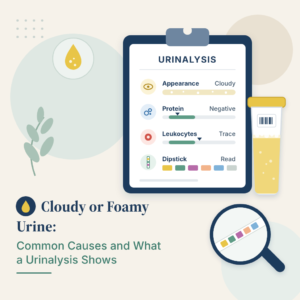
This differs from the dipstick screening done in the clinic. A dipstick can flag signs suggesting infection within a minute, especially through leukocyte esterase test results and urine nitrite test results, but it cannot name the organism or predict which antibiotic will work. The culture is slower and far more specific.
How the sample is collected and why it matters
Most samples are midstream clean-catch: you clean the genital area, begin urinating into the toilet, then collect the middle portion in a sterile container. The first part of the stream washes away skin and urethral organisms that would otherwise contaminate the result, which is why the middle portion is used.
Other collection routes include a catheter specimen, used when someone cannot provide a clean sample, and, rarely, a needle drawn directly from the bladder in infants. A first morning sample is often preferred because bacteria have had time to multiply overnight.
Two practical points make a real difference. First, samples should reach the laboratory quickly or be refrigerated, because bacteria keep multiplying at room temperature and inflate the count. Second, if you have already started antibiotics, say so: a course begun before collection can produce a falsely negative culture.
How to read your report
A typical report has three parts: how much grew, what grew, and what it responds to.
| What the report says | Usual meaning |
|---|---|
| No growth | No bacteria grew. If symptoms persist, another cause is considered, or antibiotics were already started |
| Growth of a single organism at a high colony count | Consistent with genuine infection when symptoms are present |
| Low count of a single organism | Can still mean infection in someone with clear symptoms, particularly in women with cystitis |
| Mixed growth of two or more organisms | Most often contamination from the skin; a repeat sample may be requested |
| Growth with no white cells in the sample | Raises the possibility of bacteria present without inflammation |
Colony counts are expressed as colony forming units per milliliter, written CFU/mL. A threshold of 100,000 CFU/mL has been used for decades, but modern practice treats it as a guide rather than a rule. Lower counts matter in a woman with clear cystitis symptoms, while a high count in someone with no symptoms at all usually does not call for treatment.
The organism named on your report is most often Escherichia coli, which causes the large majority of community urinary infections. Other frequently reported species include Klebsiella pneumoniae, Proteus mirabilis, Enterococcus species and Staphylococcus saprophyticus. Growth of yeast in urine test results is a different situation and is often colonization rather than infection.
Reading the sensitivity chart
Beside each antibiotic you will usually see one of three letters. S means susceptible: the drug is expected to work at standard dosing. I means intermediate, sometimes reported as susceptible only at increased exposure, meaning higher doses or particular sites of infection. R means resistant: that antibiotic is not expected to work.
Not every drug tested will appear as an option for you. Some are reserved for hospital use, some are unsuitable for kidney infections even though they work in the bladder, and some are avoided in pregnancy. The chart informs the choice; it does not make it.
Growth is not always infection
This is the single most useful thing to understand about your report. Bacteria can live in the bladder without causing disease, a state called asymptomatic bacteriuria. It becomes more common with age, and it is very common in people with long-term catheters. Treating it with antibiotics generally does not help, and it exposes people to side effects, to Clostridioides difficile infection and to the development of resistant organisms.
There are important exceptions. Screening and treatment are recommended in pregnancy, and before certain urological procedures that break the lining of the urinary tract. Outside those situations, the presence of bacteria in a person with no urinary symptoms is usually left alone.
The practical consequence is that a positive culture must be read together with how you feel. Burning, urgency, frequency, lower abdominal discomfort and new incontinence point toward true infection. Cloudy or strong-smelling urine on its own does not. Our guide to urinary tract infection symptoms and treatment covers this in more depth, and our overview of lower urinary tract symptoms terminology explains the vocabulary clinicians use.
When a culture is needed and when it is not
For a healthy non-pregnant woman with typical cystitis symptoms and no vaginal discharge, symptoms alone are usually accurate enough to justify treatment without a culture. A culture becomes worthwhile when:
- Infections keep recurring.
- Initial treatment has failed.
- There is a history of resistant organisms.
- The presentation is unusual, or fever and flank pain suggest the kidney is involved.
- The person is pregnant.
- The person is male, since male urinary infections are treated differently and prostate involvement must be considered. Our guide to prostatitis symptoms and treatment explains why.
- The person has a catheter, a urinary tract abnormality, or reduced immunity.
What can distort your result
- Skin or vaginal contamination during collection, the leading cause of mixed growth.
- A delay before the sample reaches the laboratory, which inflates counts.
- Antibiotics started before the sample was taken, which can produce no growth despite genuine infection.
- Very dilute urine after heavy drinking, which lowers the count.
- Menstrual blood or vaginal discharge in the sample.
- Organisms that grow poorly on standard media and may be missed.
If your culture shows mixed growth and your symptoms continue, a repeat sample collected carefully is usually the right next step rather than a change of antibiotic. A parallel look at urine microscopy results often helps, because a large number of squamous epithelial cells points to a contaminated sample.
When to seek care promptly
- Fever, chills, or pain in the side or back, which suggest the infection has reached a kidney.
- Nausea and vomiting alongside urinary symptoms.
- Blood in the urine, explained further in our guide to urine hematuria test results.
- Confusion or a sudden change in alertness in an older adult.
- Symptoms that do not improve within 48 hours of starting an antibiotic.
- Any urinary symptoms during pregnancy.
Latest scientific advances
Recent work has focused less on new laboratory technology and more on using the culture wisely.
A 2024 review in the American Journal of Kidney Diseases set out how urinalysis and culture should be used together, stressing that separating true infection from bacteria simply living in the bladder is the central skill. It noted that antibiotics are unnecessary for most non-pregnant people with bacteria and no symptoms, and can cause harm. What this means for you: if a clinician sees bacteria on your report and still decides not to prescribe, that is a considered decision rather than an oversight.
A 2024 review in Infectious Disease Clinics of North America described diagnostic stewardship, which means changing when tests are ordered and how results are reported so that unnecessary treatment is avoided. Approaches include ordering a culture only when symptoms fit, and reporting results in a way that discourages reflex prescribing. What this means for you: some hospitals now release culture results with a note about symptoms, which is designed to protect you rather than to withhold information.
The European Urinalysis Guideline, published in 2024 in Clinical Chemistry and Laboratory Medicine, updated laboratory practice for urine culture across Europe. It recommended chromogenic agar as the primary growth medium, revised the growth thresholds considered significant, and endorsed mass spectrometry for rapid organism identification. What this means for you: identification is becoming faster, so treatment can be narrowed to the right drug sooner.
A 2024 rapid evidence review in American Family Physician confirmed that in women with typical symptoms and no vaginal discharge, self-diagnosis is accurate enough to start treatment, while culture should be reserved for recurrent infection, treatment failure, resistant history or atypical presentation. It also noted that men with urinary symptoms should always receive antibiotics guided by culture. What this means for you: not receiving a culture for a straightforward first infection is consistent with current evidence.
Finally, a 2024 review in Urologic Clinics of North America reaffirmed that screening with a urine culture is required during pregnancy, and that a positive result is treated with a targeted antibiotic course, while research continues into shorter courses and non-antibiotic prevention. What this means for you: pregnancy is the clearest situation in which bacteria without symptoms should still be found and treated.
Glossary
| Term | Definition |
|---|---|
| Urine culture | A laboratory test that grows bacteria from a urine sample so they can be counted and identified. |
| CFU/mL | Colony forming units per milliliter, the unit used to express how many bacteria were in the sample. |
| Asymptomatic bacteriuria | Bacteria present in urine in someone with no urinary symptoms. Usually not treated outside pregnancy. |
| Midstream clean-catch | A collection method in which the middle portion of the stream is captured to limit contamination. |
| Antibiotic sensitivity testing | Laboratory testing of a grown organism against several antibiotics to see which ones stop it. |
| Susceptible, intermediate, resistant | The three standard verdicts on a sensitivity chart, often shortened to S, I and R. |
| Cystitis | Infection or inflammation of the bladder, the most common form of urinary tract infection. |
| Pyelonephritis | Infection that has reached the kidney, typically causing fever and flank pain. |
| Contamination | Bacteria entering the sample from skin or genital surfaces rather than from the bladder. |
Frequently asked questions
How long do urine culture results take?
Most laboratories report preliminary findings after about 24 hours and a final result with sensitivities after 48 hours, sometimes longer for slow-growing organisms. If you were given an antibiotic before the result arrived, your clinician may change it once the sensitivity chart is available. That is a normal part of the process, not a sign that something went wrong.
What does mixed growth mean on my report?
It usually means more than one type of bacteria grew, which most often reflects contamination during collection rather than a genuine mixed infection. A repeat clean-catch sample is the usual next step. Genuine infections with more than one organism do occur, particularly in people with catheters or urinary tract abnormalities, but they are much less common.
My culture was negative but I still have symptoms. What now?
Several possibilities exist: antibiotics started before collection, an organism that does not grow well on standard media, or a non-infectious cause such as bladder irritation or a sexually transmitted infection. Persistent burning with a negative culture is a recognized situation and deserves further evaluation rather than a repeat course of the same antibiotic.
Should bacteria in my urine always be treated?
No. Outside pregnancy and certain urological procedures, bacteria without symptoms are generally not treated, because antibiotics do not improve outcomes in that situation and carry real risks. If you have symptoms, treatment is appropriate. The decision rests on the combination of symptoms and culture, not the culture alone.
Can I collect the sample at home?
Sometimes, if your clinic provides a sterile container and instructions. The sample needs to reach the laboratory quickly or be refrigerated in the meantime, because bacteria continue multiplying at room temperature and can turn a contaminated sample into an apparently positive one. Follow the timing instructions you are given.
Does drinking cranberry juice change my culture result?
It will not meaningfully change what grows on the plate. Increased fluids and cranberry products are sometimes used to help prevent recurrent infections, with modest evidence behind them, but they are prevention measures rather than treatments and they do not alter a culture already taken.
Sources
- MedlinePlus, National Library of Medicine — Urine culture — MedlinePlus Medical Encyclopedia, reviewed 2025 — medlineplus.gov
- Mayo Clinic — Urinary tract infection (UTI): Diagnosis and treatment — Mayo Clinic Patient Care, 2025 — mayoclinic.org
- Centers for Disease Control and Prevention — Urinary Tract Infection Basics — CDC, 2025 — cdc.gov
- Al Lawati H, Blair BM, Larnard J — Urinary Tract Infections: Core Curriculum 2024 — American Journal of Kidney Diseases, 2024 — doi.org/10.1053/j.ajkd.2023.08.009
- Coffey KC, Claeys K, Morgan DJ — Diagnostic Stewardship for Urine Cultures — Infectious Disease Clinics of North America, 2024 — doi.org/10.1016/j.idc.2024.03.004
- Kouri TT, Hofmann W, Falbo R, Oyaert M, Schubert S, Gertsen JB, Merens A, Pestel-Caron M — The EFLM European Urinalysis Guideline 2023 — Clinical Chemistry and Laboratory Medicine, 2024 — doi.org/10.1515/cclm-2024-0070
- Kurotschka PK, Gágyor I, Ebell MH — Acute Uncomplicated UTIs in Adults: Rapid Evidence Review — American Family Physician, 2024 — pubmed.ncbi.nlm.nih.gov
- Grant A, Bai K, Badalato GM, Rutman MP — Advances in the Treatment of Urinary Tract Infection and Bacteriuria in Pregnancy — Urologic Clinics of North America, 2024 — doi.org/10.1016/j.ucl.2024.07.001
Further reading
- Interpret the organisms seen before a culture is grown with our bacteria in urine results guide.
- Understand the pus-cell finding that often accompanies infection in our pyuria test results guide.
- Check the immune cells counted in your sample using our urine white blood cell levels guide.
- Review the contamination marker laboratories watch for in our urine epithelial cells results guide.
- Explore how acidity shifts during infection by reading our urine pH results guide.
Understand your lab results with BloodSense
Get your results interpreted in minutes
A urine culture is only half the picture. The dipstick findings, the white cell count in the sample, the epithelial cells that hint at contamination and your kidney function all shape what the growth actually means. BloodSense reads those results together and explains in plain language what they suggest and what to ask your clinician. It helps you understand your report; it does not diagnose infection and it does not prescribe treatment.