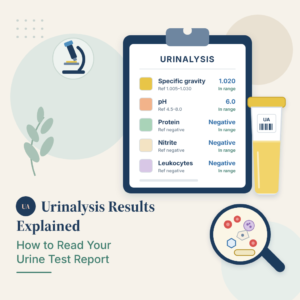







Your urine pH is the single number on a urinalysis report that tells you how acidic or alkaline your urine was at the moment you gave the sample. It sits on the dipstick panel between specific gravity and protein, it rarely comes with an explanation, and it moves more than almost any other value on the page. In this article you will learn what the normal urine pH range actually is, why a reading of 5.0 one morning and 7.5 the next afternoon can both be perfectly healthy, which patterns genuinely deserve a conversation with your clinician, and how this one number connects to kidney stones, urinary infections and the way your kidneys manage acid every day.
What urine pH measures
The pH scale runs from 0 to 14. A value of 7.0 is neutral, anything below 7.0 is acidic, and anything above 7.0 is alkaline. Each whole step is a tenfold change, so urine at pH 5.0 carries ten times more free acid than urine at pH 6.0. That is why small-looking differences on your report are not trivial in chemical terms, even when they are entirely normal in medical terms.
Your blood, by contrast, is held in an extraordinarily narrow band around 7.4. Your body will not negotiate on that number. The kidneys are the organ that does the negotiating on its behalf. Every day they filter your blood and decide how much acid to push out into the urine and how much bicarbonate, the body’s main buffer, to reclaim. Urine pH is essentially the receipt for that transaction. When your diet, your breathing or a medication loads your system with acid, the kidneys excrete more of it and your urine turns more acidic. When the load swings the other way, they hold acid back and your urine turns alkaline.
This is why urine pH is best read as a snapshot of a working system rather than as a verdict. It is a physiology readout, not a disease marker. Its diagnostic value comes almost entirely from context: what else is on the report, what you ate, what you take, and whether the same pattern repeats.
How the measurement is taken
In most clinics the value comes from a reagent strip dipped into a fresh sample. The pad contains dyes that change color across the acid-alkaline range, and either a technician or an automated reader matches the color to a scale. Strips typically report in half-unit steps, which is why you see values like 5.0, 5.5, 6.0 and 6.5 rather than precise decimals. Laboratories that need a more exact figure, usually for stone or metabolic workups, use a pH meter with an electrode instead.
The normal urine pH range and how to read your report
MedlinePlus, from the National Library of Medicine, gives a normal urine pH range of 4.6 to 8.0. Cleveland Clinic lists 5.0 to 8.0 on its urinalysis reference table. The slight difference between those two figures is not a disagreement about biology; it reflects how different laboratories set their reporting limits. Most healthy people spend most of their time between 5.5 and 7.0, with the first sample of the day usually landing at the acidic end because acid accumulates overnight while you are not eating or drinking.
The table below translates the values you are most likely to see. Read it alongside the rest of your panel rather than on its own, and check your hydration status against your urine specific gravity result, which tells you how concentrated the sample was.
| Reading | How it reads | Common everyday explanation |
|---|---|---|
| 4.6 to 5.0 | Strongly acidic, still inside the reference range | First morning sample, meat-heavy or low-carbohydrate eating, intense exercise the day before |
| 5.5 to 6.0 | Mildly acidic, the most frequently reported band | A typical mixed Western diet on an ordinary day |
| 6.5 to 7.0 | Near neutral | Later in the day, after a large meal, or on a diet rich in fruit and vegetables |
| 7.5 to 8.0 | Alkaline, at the top of the range | Mostly plant-based eating, bicarbonate or antacid use, or a sample left standing before testing |
| Above 8.0 on repeat testing | Persistently alkaline | Worth investigating: urea-splitting infection, a kidney tubule problem, or a delayed sample |
One practical caution deserves its own sentence. Urine that sits at room temperature drifts alkaline, because bacteria in the container break urea down into ammonia. A pH of 8.5 on a sample that spent two hours on a counter says more about the counter than about your kidneys. Fresh samples are the only ones worth interpreting.
What pushes urine pH down
Acidic urine is the body’s normal response to an acid load, and most of that load comes from food. Protein from meat, poultry, fish, eggs and hard cheese contains sulfur-bearing amino acids that generate acid as they are metabolized. Grains contribute as well. The kidneys clear that acid, and your urine pH falls.
Several other situations reliably drive the number down:
- Fasting, very low-carbohydrate eating or poorly controlled diabetes, all of which raise ketone production. When ketones rise, urine turns acidic, and a positive urine ketone test result often appears on the same report.
- Dehydration, which concentrates everything in the urine, including acid.
- Severe or prolonged diarrhea, which strips bicarbonate from the gut and forces the kidneys to compensate.
- Chronic lung disease that traps carbon dioxide, which the kidneys offset by excreting more acid.
- Medications such as ammonium chloride, methenamine and some diuretics.
Persistently acidic urine matters for one reason above all: uric acid dissolves poorly in acid. Below about pH 5.5 it begins to fall out of solution, which is the mechanism behind uric acid stones. If your report shows acidic urine alongside an elevated urinary uric acid level, those two findings belong in the same conversation.
What pushes urine pH up
Alkaline urine has an equally ordinary explanation most of the time. Fruits, vegetables and citrus generate bicarbonate as they are metabolized, so a plant-forward diet shifts urine toward the alkaline end. Antacids, sodium bicarbonate, potassium citrate and the diuretic acetazolamide all do the same by design. So does simply testing later in the day, after a meal has triggered a temporary surge of acid secretion into the stomach and a matching alkaline shift in the urine.
The medically important causes are fewer but worth knowing:
- Infection with urea-splitting bacteria, most often Proteus, Klebsiella or certain Staphylococcus species. These organisms convert urea into ammonia and can drive urine pH above 8.0. A positive urine nitrite result or a positive leukocyte esterase reading on the same strip strengthens that suspicion, and a urine culture report settles it.
- Renal tubular acidosis, a group of conditions in which the kidney tubules cannot excrete acid properly. The signature is alkaline urine at a time when the blood is acidic, which is the opposite of what healthy kidneys would do. A low serum bicarbonate blood level alongside stubbornly alkaline urine is the pattern clinicians look for.
- Vomiting or gastric suction, which removes stomach acid and leaves the body relatively alkaline.
Persistently alkaline urine has its own stone risk. Calcium phosphate and struvite crystals form readily above pH 7.0, which is why a urine crystals finding is always read together with the pH that produced it.
Urine pH and kidney stones: the connection that matters most
If urine pH earns its place on the report anywhere, it is here. Different stone types have different chemical preferences, and pH is the lever that decides which minerals stay dissolved and which precipitate out. This is also the one clinical setting where doctors deliberately move urine pH as a treatment.
| Stone type | Forms most readily when urine is | Typical management direction |
|---|---|---|
| Uric acid | Acidic, generally below pH 5.5 | Raise urine pH toward 6.0 to 6.5, usually with prescribed alkali such as potassium citrate |
| Cystine | Acidic | Raise urine pH under specialist supervision, alongside high fluid intake |
| Calcium phosphate | Alkaline, generally above pH 6.5 | Avoid over-alkalinizing; investigate an underlying tubule disorder |
| Struvite (infection stones) | Strongly alkaline, often above pH 7.2 | Treat the underlying infection; the pH follows |
| Calcium oxalate | Relatively pH-independent | Focus on fluid volume, calcium timing, oxalate and sodium instead |
Two things follow from that table, and both are commonly misunderstood. The first is that there is no universally good urine pH. Pushing your urine alkaline helps if you form uric acid stones and can actively hurt if you form calcium phosphate stones. The second is that calcium oxalate, by far the most common stone type, is largely indifferent to pH. Someone who has passed a calcium oxalate stone and starts chasing an alkaline reading is optimizing the wrong variable. If stones are part of your history, our guide to the causes and treatment of kidney stones sets out the fuller picture.
It is also worth separating urine pH from the commercial idea of an alkaline diet. Eating more plants genuinely changes your urine pH, because that is what the kidneys are excreting. It does not change your blood pH, which stays locked near 7.4 whatever you eat. Any product that promises to alkalize your blood is describing something your body will not permit.
When to see a doctor about your urine pH
A single out-of-pattern value on an otherwise clean report almost never needs action. Use the guidance below to judge whether yours falls into that category.
A urine pH result on its own is generally not a reason to seek care when: it is the only abnormal item on the panel, you feel well, the sample was a first morning collection, or you can point to an obvious dietary or medication explanation. Repeat the test on a normally hydrated day before drawing any conclusion.
Raise it with a clinician at your next appointment when: the same direction shows up on two or more separate reports, it appears alongside a positive nitrite or leukocyte esterase result, you have a personal or family history of kidney stones, or you take potassium citrate, acetazolamide, bicarbonate or a diuretic and no one has reviewed the effect. Checking your urine electrolyte results at the same time often adds useful context.
Seek medical attention promptly when a pH result comes with symptoms rather than in isolation: fever with flank or back pain, burning on urination with cloudy or foul-smelling urine, visible blood, sharp one-sided pain that comes in waves, or unexplained weakness with muscle cramps, which can point to a potassium disturbance. In these situations the symptoms drive the urgency and the pH is a supporting detail. Sudden changes in urine color and what it indicates deserve the same prompt attention.
How to prepare for the test and avoid a misleading result
Because urine pH is so responsive, a large share of confusing results are collection artifacts rather than biology. A few practical steps remove most of that noise.
- Ask what the test is for. If your clinician wants a baseline, keep eating normally. Changing your diet the day before a stone workup hides exactly what they are trying to see.
- Use a clean-catch midstream sample and hand it in promptly. Delay is the single biggest cause of falsely alkaline readings.
- List every supplement. Cranberry, vitamin C, potassium citrate, sodium bicarbonate and antacids all move the number, and none of them are prescriptions people think to mention.
- Note the time of collection. A 7 a.m. sample and a 4 p.m. sample from the same healthy person can differ by more than a full pH unit.
- If you are tracking pH at home for a stone condition, test at the times your clinician specified and record them, rather than testing at random and reacting to individual readings. Home strips are also less precise than laboratory methods.
Interpretation improves sharply when pH is read as part of a set. Alongside specific gravity, protein, glucose, blood and the microscopic findings, it helps distinguish a hydration effect from an infection from a metabolic problem. Comparing a urine result with a matching blood panel, such as a serum potassium blood test result, is often what turns an isolated number into an actual answer.
Latest scientific advances
Research over the past three years has sharpened, and in one case corrected, the way specialists think about urine pH. Here is what has changed and what it means for you.
A large prospective study published in the American Journal of Kidney Diseases in 2024 followed thousands of adults who had provided 24-hour urine collections and compared their urine chemistry with whether they later formed a stone. Almost every measured factor mattered: urine volume, calcium, citrate, oxalate, potassium and magnesium all shifted the risk. Urine pH, on its own, did not. The strongest influences turned out to be how much urine a person produced, how much calcium was in it, and how much citrate. What this means for you: if you have had a stone, drinking enough to keep urine dilute is a bigger lever than any attempt to fine-tune your pH, and a normal or unusual pH by itself is not a prediction that you will form a stone. The finding does not contradict the stone chemistry described earlier; it puts pH in proportion.
A 2025 review in Nature Reviews Nephrology, drawing together the current evidence on stone disease, keeps urine pH firmly in the picture but assigns it a specific job. The authors note that uric acid and calcium phosphate stones are the two types closely tied to urinary pH, while calcium oxalate stones, the most common kind, are driven mainly by calcium, oxalate, citrate and urine volume. They also frame stone disease as a whole-body condition linked to chronic kidney disease and metabolic syndrome. What this means for you: a persistently unusual urine pH is most informative when your clinician knows, or is trying to find out, what your stones are actually made of. Without that, the number is hard to act on.
On the prevention side, a 2023 review in Advances in Nutrition gathered the dietary evidence for avoiding stones. The measures with the best support are unglamorous: drink enough that you produce a good volume of urine each day, keep dietary calcium at normal levels rather than restricting it, limit sodium, moderate animal protein, and increase citrate-rich foods such as citrus fruit. Alkalinizing agents including potassium citrate have a real role, but as prescribed treatment for specific stone types, not as general self-care. What this means for you: the everyday habits that lower stone risk are largely the same ones that keep urine pH in a reasonable middle range, so you do not need to manage the pH separately.
Finally, an AJKD Core Curriculum review from 2023 written for practicing nephrologists shows how the number is used in real clinics. Urine pH is read as one input in a broader metabolic evaluation, next to stone composition and blood chemistry, and it is deliberately targeted only where the stone type makes that worthwhile. What this means for you: an unexpected pH on a routine urinalysis is a prompt for context, not a conclusion. All four publications are reviews or cohort studies rather than treatment trials, so they describe patterns and current expert consensus.
Glossary
| Term | Definition |
|---|---|
| pH | A scale from 0 to 14 measuring how acidic or alkaline a liquid is. Below 7.0 is acidic, 7.0 is neutral, above 7.0 is alkaline. |
| Alkaline | The opposite of acidic. Alkaline urine has a pH above 7.0. Also called basic. |
| Bicarbonate | The body’s main chemical buffer. The kidneys reclaim or release it to keep blood pH steady. |
| Urinalysis | A panel of urine tests combining a chemical dipstick, a visual inspection and often a microscopic examination. |
| Dipstick | A plastic strip carrying reagent pads that change color in urine, giving rapid readings for pH and several other markers. |
| Renal tubular acidosis (RTA) | A group of conditions in which the kidney tubules cannot remove acid from the blood normally, often producing alkaline urine despite acidic blood. |
| Struvite | A stone made of magnesium ammonium phosphate that forms in alkaline urine, usually as a result of infection with urea-splitting bacteria. |
| Citrate | A compound in urine that binds calcium and helps prevent crystals from forming. Low urinary citrate raises stone risk. |
| Clean-catch midstream | A collection method in which the first part of the stream is discarded to reduce contamination from the skin. |
| Urea-splitting bacteria | Bacteria that break urea down into ammonia, raising urine pH sharply and encouraging struvite stones. |
Frequently asked questions
Is a high pH in urine dangerous?
On its own, no. A urine pH of 7.5 or 8.0 on a single test is usually explained by diet, a recent meal, an antacid or a sample that was not tested promptly. It becomes worth investigating when it repeats across several reports, when it appears with signs of infection such as a positive nitrite or leukocyte esterase result, or when you already form calcium phosphate or struvite stones. Persistently alkaline urine in someone whose blood is on the acidic side can also point to a kidney tubule problem, which a clinician can check with a simple blood panel.
Is a low pH in urine dangerous?
Not in itself. Acidic urine is the normal state for most people first thing in the morning and for anyone eating a protein-rich diet. It matters mainly if it is consistently very low, generally under 5.5, and you have a history of uric acid stones or gout, because uric acid does not dissolve well in acid. It can also accompany uncontrolled diabetes, prolonged fasting or severe diarrhea, so those situations are worth ruling out if the reading is unexpected.
What does a urine pH of 5 mean?
It means your urine was acidic at the time of the test, and it sits within the standard reference range. This is a very common result on a first morning sample, after a day of meat, fish or cheese, or after strenuous exercise. Taken alone it needs no action. If you form uric acid stones, however, your clinician may want your pH sitting somewhat higher, closer to 6.0 to 6.5, and may prescribe an alkalinizing medication to get it there.
What does a urine pH of 6.5 mean?
A pH of 6.5 is just on the acidic side of neutral and is a comfortably normal result. It typically reflects a mixed diet or a sample taken later in the day. It is also the region clinicians often aim for when treating uric acid stones, because it keeps uric acid dissolved without pushing far enough into alkaline territory to encourage calcium phosphate crystals. No follow-up is needed for this value alone.
Is the normal pH of urine different in females and males?
The reference range is the same for both, generally quoted as 4.6 to 8.0. Diet, hydration, time of day and medications explain far more of the variation between people than sex does. Females do have a higher rate of urinary tract infections, and an infection with urea-splitting bacteria can raise pH, so an unexplained alkaline reading may be followed up with a urine culture more often. That is a difference in what is being investigated, not a difference in the normal range.
How can I lower my urine pH?
Urine pH responds to diet within a day or so: more animal protein and grains lowers it, and fewer citrus fruits, vegetables and antacids stops pushing it up. Before making changes, though, it is worth asking why you want to. Deliberately acidifying urine is only appropriate for a small number of conditions and is usually done under medical supervision, because it can raise the risk of uric acid and cystine stones. If a clinician has not told you to target a particular pH, adequate hydration and a balanced diet are the sensible defaults.
Sources
- MedlinePlus, National Library of Medicine — Urine pH test — MedlinePlus Medical Encyclopedia, reviewed 2025 — medlineplus.gov
- Cleveland Clinic — Urinalysis: What It Is, Purpose, Procedure, Results and Types — Cleveland Clinic Health Library, reviewed 2024 — my.clevelandclinic.org
- National Institute of Diabetes and Digestive and Kidney Diseases — Eating, Diet and Nutrition for Kidney Stones — NIDDK, National Institutes of Health — niddk.nih.gov
- Ferraro PM, Taylor EN, Curhan GC — 24-Hour Urinary Chemistries and Kidney Stone Risk — American Journal of Kidney Diseases, 2024 — doi.org/10.1053/j.ajkd.2024.02.010
- Bargagli M, Scoglio M, Howles SA, Fuster DG — Kidney stone disease: risk factors, pathophysiology and management — Nature Reviews Nephrology, 2025 — doi.org/10.1038/s41581-025-00990-x
- Peerapen P, Thongboonkerd V — Kidney Stone Prevention — Advances in Nutrition, 2023 — doi.org/10.1016/j.advnut.2023.03.002
- Shastri S, Patel J, Sambandam KK, Lederer ED — Kidney Stone Pathophysiology, Evaluation and Management: Core Curriculum 2023 — American Journal of Kidney Diseases, 2023 — doi.org/10.1053/j.ajkd.2023.03.017
Further reading
- Examine the cells and crystals a laboratory sees under the lens by reading our urine microscopy results guide.
- Investigate the marker that flags early kidney filter damage with our protein in urine test guide.
- Understand how declining kidney function develops over years by reading our chronic kidney disease overview.
- Identify what a positive bacterial finding on a urine sample means with our bacteria in urine results guide.
- Assess how efficiently your kidneys clear waste from the blood by reading our creatinine blood test guide.
Understand your lab results with BloodSense
A urine pH value means very little on its own and quite a lot next to the rest of your panel. BloodSense reads your urinalysis as a whole, connecting pH with specific gravity, ketones, nitrite, protein and the microscopic findings so you can see what the pattern suggests rather than guessing at one number. It explains each marker in plain language and shows you which results are worth raising with your clinician. It helps you understand your results; it does not diagnose you and it does not replace your doctor.