






A urine chloride measurement tells your care team how much chloride your kidneys are letting go of, and that single number often explains a puzzling blood result. Chloride is the most abundant negatively charged mineral in your body, and it travels almost everywhere sodium goes. When a blood test shows an unexplained electrolyte problem, checking the amount of chloride in your urine is one of the fastest ways to find out whether the kidneys are the source of the problem or are simply reacting to something else.
In this article you will learn what this test measures, how spot samples differ from 24-hour collections, which reference ranges laboratories use, what high and low values suggest, which everyday factors can distort a result, and what questions are worth raising at your next appointment.
What a urine chloride test measures
Chloride is an electrolyte, which simply means a mineral that carries an electrical charge when dissolved in body fluid. Alongside sodium and potassium, it keeps the volume of fluid inside and outside your cells stable, helps nerves fire, and plays a central role in keeping your blood at the right acidity. Your stomach also uses chloride to make hydrochloric acid for digestion.
Most of the chloride you take in comes from table salt, which is sodium chloride. Your kidneys decide how much to keep and how much to send out in urine. Measuring what appears in the urine therefore gives a direct read on that decision. A blood test shows the concentration circulating right now; the urine test shows what the kidneys are doing about it. Reading the two together is far more informative than reading either alone, which is why clinicians usually order a urine chloride alongside a blood chloride test guide value from the same day.
How chloride relates to sodium and potassium
Chloride rarely acts alone. It follows sodium through the kidney tubules, and it shifts in the opposite direction to bicarbonate when the body corrects its acidity. That is why a urine chloride result is usually interpreted next to urine sodium test results and urine potassium test results. Some laboratories report all three together as a panel; you can review that combined report in our overview of urine electrolyte panel results.
Why a clinician orders this test
Nobody gets a urine chloride test as part of a routine physical. It is a targeted test, usually requested when a specific question needs answering:
- Blood chloride, sodium or bicarbonate levels are abnormal and the cause is unclear.
- Blood is more alkaline than it should be, and the clinician needs to know whether fluid and salt replacement is likely to correct it.
- Persistent vomiting, prolonged diarrhea, or heavy diuretic use has disturbed fluid balance.
- Dehydration or fluid overload needs to be characterized more precisely.
- An adrenal or kidney tubule disorder is suspected.
- A dietary salt reduction plan needs objective monitoring rather than self-reported intake.
Because chloride handling is tightly linked to fluid status, this test is also used when someone shows signs of dehydration symptoms and causes without an obvious explanation.
How the sample is collected
There are two collection formats, and knowing which one you had matters when you read your report.
A spot sample is a single cup of urine collected at one moment, usually in the clinic. It is quick and is often enough when the clinician needs a snapshot, particularly in urgent situations. Because it captures one point in a day of constantly changing kidney output, it is best read as a direction rather than a precise quantity.
A 24-hour collection captures every drop of urine passed over a full day. You discard the first morning void, note the time, then collect everything for the next 24 hours, including the first void of the following morning. The container is usually kept cold. This format smooths out the peaks and troughs and gives the most reliable estimate of total daily chloride output, which in practice reflects how much salt you ate.
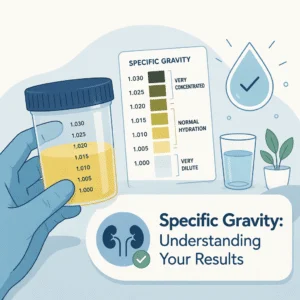
No fasting is needed. Tell your clinician about every medication and supplement you take, because diuretics, corticosteroids and some laxatives change the result substantially. A concurrent measurement of urine specific gravity results helps the laboratory judge how concentrated or dilute the sample was.
How to read your lab report
Reference ranges vary between laboratories, and the range printed on your own report always takes precedence. The values below are the ones commonly published for adults.
| Collection type | Commonly reported adult range | What drives the number |
|---|---|---|
| 24-hour collection | 110 to 250 mEq per day (110 to 250 mmol per day) | Total salt eaten over the day, plus kidney handling |
| Spot sample | No single universal range; interpreted against the clinical question | Recent fluid intake, recent meals, time of day, medications |
| Threshold often used in alkalosis workup | Below roughly 20 mEq/L versus above roughly 20 mEq/L | Whether the problem responds to fluid and salt replacement |
Two features of the report deserve attention. First, a urine chloride value is almost meaningless without knowing what the blood value was on the same day. Second, the units differ between spot and timed collections: spot results are usually a concentration per liter, while 24-hour results are a total quantity per day. Comparing one directly with the other is a common source of confusion.
What a high result can mean
A high urine chloride figure means the kidneys are releasing a lot of chloride. In most people the explanation is simply a salty diet, and that is exactly why researchers use timed urine collections as an objective measure of salt intake. Other explanations include:
- Diuretic medication, which increases the excretion of both sodium and chloride.
- Adrenal insufficiency, in which the hormone signals that normally tell the kidney to hold on to salt are reduced.
- Certain inherited kidney tubule disorders that waste salt.
- Kidney tubule damage that reduces the ability to reabsorb electrolytes.
- Excessive intravenous saline.
When high chloride excretion is paired with an unusual blood acid-base picture, clinicians often bring in the bicarbonate blood level guide value and the calculated anion gap blood test results to narrow the possibilities.
What a low result can mean
A low urine chloride figure means the kidneys are holding on to chloride, usually because the body is short of salt or fluid. Common reasons include:
- A low-salt diet.
- Repeated vomiting or continuous drainage from the stomach, both of which remove chloride-rich fluid directly.
- Dehydration from sweating, fever, or reduced drinking.
- Heart failure, cirrhosis, or nephrotic syndrome, in which the body senses low circulating volume and clamps down on salt loss.
- Hormonal states that increase salt retention.
This is where the test earns its place. In a person whose blood has become too alkaline, a low urine chloride points toward a problem that generally improves with fluid and salt replacement, while a value that stays high points elsewhere, often toward mineral hormone excess or ongoing diuretic use. That distinction changes treatment, which is why the number matters even though the test itself is inexpensive and simple.
What can distort your result
Urine chloride is one of the most movable numbers in laboratory medicine. Before assuming a result reflects disease, consider the following:
| Factor | Typical effect on urine chloride |
|---|---|
| Salty meal the day before | Raises the value, sometimes substantially |
| Loop or thiazide diuretics | Raises the value while the drug is active |
| Vomiting or stomach drainage | Lowers the value |
| Heavy sweating or fever | Lowers the value |
| Corticosteroids | Can lower the value by promoting salt retention |
| Incomplete 24-hour collection | Falsely lowers the daily total |
| Very dilute sample after heavy drinking | Lowers the concentration in a spot sample |
Missing even one void during a 24-hour collection is the single most common technical problem, and it makes the total look artificially low. If you know your collection was incomplete, say so; repeating it is far better than acting on a wrong number.
When to talk with a clinician
An isolated urine chloride value outside the printed range is not an emergency on its own. Arrange a prompt conversation with your clinician if the result comes with any of the following:
- Persistent vomiting or diarrhea lasting more than a day or two.
- Marked light-headedness on standing, unusual weakness, or muscle cramps.
- Confusion, unusual drowsiness, or an irregular heartbeat, which warrant same-day assessment.
- Swelling of the legs or abdomen alongside a low urine chloride.
- Blood pressure that is difficult to control despite treatment.
- Known kidney disease, in which case the result should be read alongside your chronic kidney disease symptoms and treatments follow-up plan.
Latest scientific advances
Research over the past three years has sharpened how clinicians use urinary salt measurements. Because chloride travels with sodium, most of this work reports sodium figures, and the findings apply directly to how your chloride result is interpreted.
A 2025 umbrella review in Annals of Medicine pooled 21 earlier reviews covering 91 separate outcomes. It found that higher salt intake was linked to more cardiovascular disease, more high blood pressure and more stroke, while moderate salt reduction was linked to lower cardiovascular and overall death rates. What this means for you: the number on a 24-hour urine collection is not just a laboratory curiosity, it is a measurable stand-in for a habit that affects long-term heart risk. The review pooled observational studies as well as trials, so it describes an association pattern rather than proving cause for any one person.
A 2024 systematic review and meta-analysis in Hypertension looked specifically at people already taking blood pressure medication, using 24-hour urinary sodium as the yardstick for intake. Cutting salt lowered blood pressure on top of the medication, and the size of the benefit differed depending on the drug class being used. What this means for you: if you take blood pressure tablets, reducing salt is not redundant, and a urine collection gives your clinician an objective starting point rather than a guess.
A 2025 study in the European Heart Journal validated a bedside equation that uses a single urine sample taken two hours after an oral water tablet to predict how much salt the body will actually clear over the whole dose. Patients in the study were poor judges of their own response, while the urine-based calculation was accurate. What this means for you: a spot urine electrolyte measurement can guide diuretic dosing quickly, without waiting for a full day of collection. The work was carried out in heart failure clinics, so it is not yet a general-purpose tool.
None of these findings change the reference range on your report. They explain why a clinician may repeat the test, or ask you to collect urine over a full day rather than accept a single cup.
Glossary
| Term | Definition |
|---|---|
| Chloride | A negatively charged mineral that helps control fluid balance and blood acidity. Most of it enters the body as table salt. |
| Electrolyte | A mineral that carries an electrical charge in body fluid, such as sodium, potassium or chloride. |
| mEq/L | Milliequivalents per liter, a unit that expresses the electrical activity of a mineral in a volume of fluid. |
| Metabolic alkalosis | A state in which the blood becomes more alkaline than normal, often after vomiting or diuretic use. |
| Spot sample | A single cup of urine collected at one moment, as opposed to a timed collection. |
| 24-hour collection | All urine passed over a full day, gathered in one container so the daily total can be measured. |
| Diuretic | A medication that increases urine production, often called a water tablet. |
| Renal tubule | The microscopic tube inside the kidney where minerals are reabsorbed or released into urine. |
| Bicarbonate | A buffer in the blood that works against acid. It moves in the opposite direction to chloride. |
Frequently asked questions
Do I need to fast before a urine chloride test?
No. Fasting is not required for either a spot sample or a 24-hour collection. What matters far more is your recent salt and fluid intake, and whether you are taking medication that affects the kidneys. Eat and drink as you normally would in the days before a 24-hour collection, because the point of that test is to capture your usual pattern rather than a special diet. If your clinician wants you to change anything, they will say so explicitly.
Why did my doctor order a urine test when my blood test was already abnormal?
The blood test shows the concentration circulating at that moment; the urine test shows how your kidneys are responding. Two people can have the same abnormal blood value for completely different reasons, and the urine result often separates them. In practice this changes treatment, so the extra test is usually worth the small inconvenience.
Can drinking a lot of water change the result?
Yes, in a spot sample. Drinking heavily shortly before giving a sample dilutes the urine and lowers the measured concentration, even though your body chemistry has not changed. A 24-hour collection is much less sensitive to this because it measures a total amount rather than a concentration. This is one reason laboratories often report specific gravity or creatinine alongside a spot electrolyte value.
Is a high urine chloride result dangerous?
Not by itself. In most people it simply reflects a salty diet or a diuretic that is working as intended. It becomes clinically important when it accompanies an abnormal blood result, ongoing symptoms, or a suspected hormone or kidney tubule disorder. Your clinician will read it in that wider context rather than treating the number in isolation.
How is urine chloride different from urine sodium?
They usually move together, since both come mainly from salt. Chloride is measured separately because it sometimes diverges from sodium, particularly when the blood is unusually acidic or alkaline. In those situations chloride is the more informative of the two, which is why clinicians order it rather than assuming sodium tells the whole story.
What if I missed part of my 24-hour collection?
Tell the laboratory or your clinician. A missed void makes the daily total look lower than it truly is, and acting on that number could lead to the wrong conclusion. Repeating the collection is straightforward and avoids a misleading result. Many people find it easier on a day spent mostly at home.
Sources
- MedlinePlus, National Library of Medicine — Chloride – urine test — MedlinePlus Medical Encyclopedia, reviewed 2025 — medlineplus.gov
- Cleveland Clinic — Hypochloremia (Low Chloride Levels): Causes and Symptoms — Cleveland Clinic Health Library, 2025 — my.clevelandclinic.org
- Centers for Disease Control and Prevention — About Sodium and Health — CDC Salt, 2025 — cdc.gov
- Kong F, Liu Q, Zhou Q, Xiao P, Bai Y, Wu T, Xia L — Dietary salt intake and cardiovascular outcomes: an umbrella review of meta-analyses and dose-response evidence — Annals of Medicine, 2025 — doi.org/10.1080/07853890.2025.2582065
- Song J, Chen L, Xiong H, Ma Y, Pombo-Rodrigues S, MacGregor GA, He FJ — Blood Pressure-Lowering Medications, Sodium Reduction, and Blood Pressure — Hypertension, 2024 — doi.org/10.1161/HYPERTENSIONAHA.124.23382
- Ivey-Miranda JB, Rao VS, Cox ZL, Moreno-Villagomez J, Ramos Mastache D, Collins SP, Testani JM — Natriuretic response prediction equation for use with oral diuretics in heart failure — European Heart Journal, 2025 — doi.org/10.1093/eurheartj/ehaf268
Further reading
- Compare the mineral that moves alongside chloride by reading our urine sodium test guide.
- Check how acidity is reflected in your sample with our urine pH results guide.
- Understand how concentrated your blood is by reading our serum osmolality lab results guide.
- Explore the hormone that tells your kidneys to hold on to salt in our aldosterone blood test guide.
- Interpret the timed collection most often paired with electrolytes using our 24-hour urine protein results guide.
Understand your lab results with BloodSense
Get your results interpreted in minutes
A urine chloride value only makes sense next to the rest of your panel: blood chloride, sodium, potassium and bicarbonate, plus the basic markers of kidney function. BloodSense reads those numbers together and explains in plain language what pattern they form and which questions are worth raising with your clinician. It helps you understand your report; it does not diagnose you and it does not replace the doctor who knows your history.