






Few things send someone to a search engine faster than an unexpected shade in the toilet bowl. Stool color is among the simplest observations in a stool analysis, and among the most misread. Most shifts trace back to something eaten yesterday, a new supplement, or how fast the gut moved things along. A smaller number point to bile not reaching the intestine, or to blood entering it. This guide explains where normal brown comes from, what green, yellow, pale, black, and red suggest, and which combinations deserve a phone call.
What the color of your stool actually measures
On a laboratory report, color is a macroscopic observation: a technician looks at the sample and writes a descriptor such as brown, green, pale, or black. It sits beside other visual findings like stool consistency test results and any mucus in a stool sample. No number is attached and no reference range applies, which makes color a screening clue rather than a diagnosis.
Its value lies in what it reflects: how much bile pigment reaches the intestine, how long it is altered on the way, and what else is mixed in — food pigments, dyes, fat, or blood.
Why healthy stool is brown
From bilirubin to stercobilin
Old red blood cells break down continuously, and the heme they carry becomes bilirubin, a yellow-orange pigment. The liver makes it water-soluble and sends it into bile, which drains through the bile ducts into the small intestine.
In the colon, bacteria reduce bilirubin into urobilinogen and then into stercobilin, the brown pigment behind normal stool color. Part of the urobilinogen is reabsorbed and leaves through the kidneys instead, which is why the urobilinogen level in a urine sample and the color of stool read the same pathway from two ends.
How transit time changes the shade
Bile leaves the liver green, and turning it brown takes bacterial work over several hours. When stool moves through quickly — a stomach bug, antibiotics, diarrhea — the conversion is cut short and the sample arrives green. Slow transit does the opposite, giving darker brown stool. Neither extreme is a disease by itself.
A stool color chart and what each shade suggests
The table below is a reference, not a diagnostic key. Read each row alongside how long the change has lasted and whether pain, fever, or weight loss came with it.
| Color | What it usually suggests | What to do |
|---|---|---|
| Medium to dark brown | Normal bile flow and normal pigment conversion | Nothing; this is expected |
| Green | Fast transit, leafy greens, iron, or green dye | Watch briefly; seek care if diarrhea lasts a week |
| Yellow, greasy, foul-smelling | Unabsorbed fat: pancreatic, bile-related, or celiac | Book a visit if it repeats over weeks |
| Pale, clay-colored, chalky white | Little or no bile pigment reaching the intestine | Call promptly, above all with dark urine |
| Black, sticky, tar-like | Digested blood from the upper gut, or iron or bismuth | Urgent unless a supplement clearly explains it |
| Bright or dark red | Bleeding lower in the bowel, hemorrhoids, or red dye | Same-week visit; urgent if heavy or repeated |
| Orange | Beta-carotene from carrots or squash; some antacids | Usually dietary; reassess if it outlasts a diet change |
Food, dyes, supplements, and medicines
Before treating a color change as a medical sign, subtract everything that entered the digestive tract over the previous two or three days. Deeply pigmented plants pass through largely intact, and artificial coloring in frostings, sports drinks, and popsicles produces the most alarming shades of all. Supplements matter as much: oral iron darkens stool without any bleeding involved, and bismuth subsalicylate reacts with sulfur in the gut to form a black compound that also blackens the tongue.
- Iron tablets and iron-fortified infant formula: black or very dark green
- Bismuth stomach remedies and activated charcoal: black
- Beets, red gelatin, tomato juice, red dye: red or reddish
- Leafy greens, chlorophyll supplements, blue or green dye: green
- Aluminum hydroxide antacids: pale or whitish streaking
The practical test is simple: a dietary color returns to normal within a day or two of removing the source and brings no other symptoms. A color that persists once the obvious explanation is gone deserves a closer look, and the fat droplets seen under the microscope often separate a dietary effect from a digestive one.
Warning patterns worth acting on
Pale stool with dark urine and yellow eyes
This trio is the most informative pattern in the subject. When bile cannot reach the intestine — a gallstone, an inflamed duct, a mass in the way — brown pigment never forms and stool turns pale. Bilirubin that cannot leave through bile enters the bloodstream, spills into urine and darkens it to the shade of strong tea, which is why the bilirubin reading on a urine dipstick often turns positive too. Enough of it yellows the eyes and skin.
One pale stool is rarely dramatic. Pale stool that keeps returning, especially with dark urine and jaundice, is a reason to be seen quickly, and gallstones blocking a bile duct are among the first things a clinician looks for.
Black, tarry stool
Melena is the clinical name for stool that is black, sticky, and unusually foul-smelling. It appears when blood from the esophagus, stomach, or upper small intestine is digested on the way down, and it can arrive with lightheadedness, a racing pulse, or new fatigue from anemia.
Red that will not go away
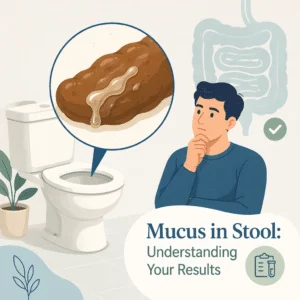
Bright red streaks on formed stool or on the paper usually come from hemorrhoids or a small anal fissure, while red mixed evenly through the stool points further up the colon. Either way, visible blood in a stool sample lasting beyond a few days is worth investigating.
Tests that follow an abnormal stool color
Color narrows the question; laboratory work answers it. Which tests are ordered depends on your pattern.
| Test | What it looks at | Typically ordered when |
|---|---|---|
| Total and direct bilirubin | How much pigment is in blood and if the liver processed it | Stool is pale or jaundice is visible |
| ALT and alkaline phosphatase | Whether liver injury or blocked drainage fits better | Pale stool, dark urine, abnormal bilirubin |
| Fecal occult blood or FIT | Blood too scarce to change the color of stool | Anemia, screening age, unexplained dark stool |
| Fecal calprotectin | Inflammation in the wall of the intestine | Ongoing diarrhea, mucus, suspected IBD |
| Fecal elastase | Whether the pancreas releases enough enzyme | Pale, greasy, floating stool with weight loss |
| Abdominal ultrasound | Gallstones, duct dilation, and liver shape | Suspected obstruction of the bile ducts |
Two deserve emphasis: the fecal occult blood test result exists because the eye is a poor blood detector, and a low fecal elastase measurement explains greasy pale stool unrelated to the bile ducts. In blood, a rise in alkaline phosphatase test results beside high direct bilirubin levels is the classic shadow of an obstructed duct, while a dominant ALT liver enzyme reading points inside the liver instead.
When to see a doctor
Use urgency, not anxiety, as the rule. Tables published by Mayo Clinic and other clinical centers converge on the same short list.
- Seek care the same day for black tarry stool, heavy red bleeding, or bleeding with dizziness or a rapid heartbeat.
- Seek care within days for pale or clay-colored stool with dark urine, yellowing eyes, itching, or right-sided pain.
- Book a routine visit for greasy yellow stool lasting weeks, any color change with weight loss, or a lasting change in bowel habit after age forty-five.
- In a newborn, treat pale, white, or chalky stool beyond two weeks of age as urgent even if the baby seems well.
- Reassess calmly when one odd color follows an identifiable meal and clears within two days.
Latest scientific advances
Research from the past three years has focused less on describing colors than on turning one of them — the pale stool of blocked bile flow — into a dependable screening tool, especially in babies.
A 2024 study from Bangladesh tested a stool color card, a printed strip of reference shades parents compare against a diaper, as a way to flag biliary atresia, a condition in which an infant’s bile ducts scar shut and where early surgery works far better. Among infants referred for jaundice, the card caught most of those who had it but flagged many who did not. What this means for you: a color card is a good reason to get a baby checked quickly, never a reason to consider the matter settled.
A 2024 survey from Türkiye asked medical students and primary care staff to identify acholic stool — stool with no bile pigment — from reference photographs. Recognition was patchy, and mildly pale shades were missed far more often than chalk-white ones. What this means for you: photographing an unusually light stool gives the clinician information memory cannot reconstruct.
A 2025 audit of fifteen years of neonatal intensive care in New Zealand asked how far testing should go when a premature baby shows cholestasis, meaning bile that is not flowing properly. Almost all had causes tied to prematurity, and the few with true biliary atresia showed clinical signs, pale stool among them, within the first month. What this means for you: clinicians favor fewer invasive tests and closer attention to simple observations.
Finally, a 2024 systematic review of colorectal cancer screening across Latin America made a point color cannot. Programs built on a stool test for hidden blood found precancerous growths at rates comparable to wealthier regions, in people whose stool looked ordinary. What this means for you: normal-looking stool is no substitute for age-appropriate screening.
Glossary of key terms
| Term | Definition |
|---|---|
| Bilirubin | A yellow-orange pigment made when old red blood cells break down; the liver sends it into bile. |
| Bile | A greenish fluid from the liver that helps digest fat and carries pigment into the intestine. |
| Stercobilin | The brown pigment gut bacteria make from bilirubin, which colors normal stool. |
| Urobilinogen | An in-between pigment formed from bilirubin in the colon; part of it leaves in urine. |
| Cholestasis | A slowdown or blockage of bile flow, causing pale stool, dark urine, and itching. |
| Acholic stool | Stool with essentially no bile pigment, so it looks pale, clay-colored, or chalky white. |
| Melena | Black, sticky, foul-smelling stool caused by blood digested in the gut. |
| Biliary atresia | A rare infant condition in which bile ducts scar shut, causing jaundice and pale stool. |
FAQ
Why is stool green in color?
Green is usually a timing effect. Bile enters the small intestine green, and bacteria need hours to convert its pigment into brown stercobilin. If stool moves through faster than usual, during a stomach bug or a bout of diarrhea, that conversion stays incomplete. Diet does the rest: spinach, chlorophyll supplements, and green dye all tint stool green. Isolated green stool in someone who feels well is not a warning sign, but green stool with diarrhea beyond a week, fever, or blood deserves a medical opinion.
What color should stool be?
Any shade of brown, from light tan to dark chocolate, is expected, and occasional green falls inside the normal range too. The tone varies with diet, hydration, and transit speed, so what matters is a lasting departure from your own baseline. Four colors sit outside the reassuring range: pale or clay-colored, chalky white, black and tarry, and red not explained by beets or dye.
What color is clay-colored stool?
Clay-colored stool is a dull, light beige or grayish tan, much like wet modeling clay, and clearly lighter than the palest normal brown. It looks that way because bile pigment is not reaching the intestine, leaving only food residue behind. Give it more weight when urine has darkened at the same time.
What does yellow stool color indicate?
Yellow stool most often reflects fat that was not absorbed. Fat lightens the color, adds a greasy look, makes stool float, and gives it a strong odor. Causes include reduced pancreatic enzyme output, insufficient bile, celiac disease, and giardiasis. Brief yellow stool after a fatty meal is not concerning; greasy yellow stool repeating over weeks, especially with weight loss, calls for pancreatic and celiac testing.
Why is stool color black?
There are two very different reasons. The harmless one is a supplement: oral iron, bismuth subsalicylate, or activated charcoal all darken stool, and bismuth darkens the tongue too. The serious one is melena, blood from the upper gut altered during digestion. Melena is not merely dark but sticky, tar-like, and strikingly foul-smelling, and may come with fatigue or lightheadedness. Without a supplement that explains it, black stool should be assessed urgently.
Why is my stool light in color?
Light stool means less pigment is arriving from bile, less fat is being absorbed, or both. Causes range from a viral illness affecting the liver to gallstones blocking a duct, and include pancreatic conditions and some antacids. A single light stool is rarely meaningful; what raises the priority is repetition, and above all light stool with dark urine and yellowing eyes.
Sources
- MedlinePlus — Stools, pale or clay-colored — National Library of Medicine — medlineplus.gov
- MedlinePlus — Black or tarry stools — National Library of Medicine — medlineplus.gov
- Mayo Clinic — Stool color: When to worry — Mayo Clinic Health Library — mayoclinic.org
- NIDDK — Biliary Atresia — National Institutes of Health — niddk.nih.gov
- Alam R, et al. — Use of stool color card as screening tool for biliary atresia in resource-constraint country — Gastroenterology and Hepatology from Bed to Bench, 2024 — doi.org/10.22037/ghfbb.v17i2.2931
- Gürcan Kaya N, et al. — Are Medical Students and Primary Health-care Professionals Aware of Neonatal Cholestasis and Acholic Stool — Turkish Archives of Pediatrics, 2024 — doi.org/10.5152/TurkArchPediatr.2024.23316
- Moin ZS, et al. — Less is more: 15-year audit of the evaluation of cholestatic jaundice in the neonatal intensive care unit — Journal of Pediatric Gastroenterology and Nutrition, 2025 — doi.org/10.1002/jpn3.70248
- Montalvan-Sanchez EE, et al. — Colorectal Cancer Screening Programs in Latin America: A Systematic Review and Meta-Analysis — JAMA Network Open, 2024 — doi.org/10.1001/jamanetworkopen.2023.54256
Further reading
- Check the marker that reveals hidden gut inflammation by reading our fecal calprotectin results guide.
- See how the same pigment pathway shows up on a dipstick by reading our urine color test results guide.
- Understand the blood value that rises when bile cannot drain by reading our total bilirubin results explainer.
- Explore the long-term liver condition that can follow untreated bile duct damage in our guide to cirrhosis symptoms and treatment.
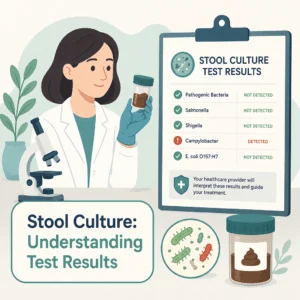
- Rule out an infectious cause of sudden green or watery stools with our stool culture results guide.
Understand your lab results with BloodSense
A color noted on a stool report becomes useful only when read next to everything else that was measured. Bilirubin, alkaline phosphatase, ALT, and a stool test for hidden blood each answer part of the question a pale, black, or red stool raises. BloodSense turns those values into plain language so you can see how they fit together and arrive at your appointment with sharper questions. It does not diagnose and does not replace your doctor.