






A urine drug screen is one of the fastest laboratory tests in modern medicine: a cup of urine, a few minutes on an automated analyzer, and a list of drug classes marked positive or negative. That speed is exactly why the test is so easy to misread. A screening result is a signal that something may be present, not a verdict about a person, a behavior, or a diagnosis. Understanding how the test works, where it fails, and what has to happen before a preliminary result becomes a confirmed one gives you a realistic picture of what your report can support. This guide walks through the science, the limits, and the questions worth asking your clinician.
What a urine drug screen actually measures
Most initial urine testing uses an immunoassay. Antibodies are engineered to bind a target molecule, and when enough of that molecule is present in the sample, the analyzer records a signal above a preset threshold. The result is reported as positive or negative for a drug class, not for a specific molecule.
This class-level design matters. An opiate screen does not distinguish morphine from codeine, and an amphetamine screen does not separate prescribed medication from anything else that happens to fit the antibody. Urine is used because the kidneys concentrate drug metabolites, so concentrations are typically higher and detectable for longer than in blood. That advantage comes with a trade-off: urine reflects what the body has already processed, so it tells you about past exposure rather than current impairment.
Why clinicians order this test
Emergency and inpatient care
In an emergency department, a patient may arrive confused, sedated, or agitated with no reliable history. A urine drug screen can rapidly narrow the field of possible contributors. It rarely changes immediate management on its own, since treatment follows the clinical picture, but it can support or weaken a working hypothesis.
Treatment monitoring
In pain management, opioid use disorder treatment, and mental health care, periodic testing is used as a supportive tool. Clinicians look for expected findings as much as unexpected ones: a patient prescribed a medication should generally show evidence of it. The conversation that follows an unexpected result is the point of the test, not the number itself.
Transplantation and specialized programs
Transplant programs and some surgical pathways include toxicology testing as part of a broader assessment of medical risk and post-procedure safety. Policies vary widely between institutions, and a single result is interpreted alongside interviews and records rather than in isolation.
Workplace and regulated testing
Occupational testing follows separate rules. Federally regulated programs in the United States specify which substances are tested, which cutoffs apply, and how the chain of custody must be documented. In these programs, a nonnegative screen is reviewed by a Medical Review Officer who contacts the donor before any result is released, precisely because legitimate medical explanations are common.
Screening versus confirmation: two different tests
The single most useful concept in this field is that screening and confirmation are not the same procedure and do not carry the same weight. Screening is presumptive. Confirmation, performed by gas chromatography mass spectrometry (GC-MS) or liquid chromatography tandem mass spectrometry (LC-MS/MS), separates compounds physically and then identifies them by molecular fingerprint. Confirmation names the specific substance and can quantify it.
| Feature | Immunoassay screen | GC-MS or LC-MS/MS confirmation |
|---|---|---|
| What it identifies | A drug class | A specific molecule and its metabolites |
| Typical turnaround | Minutes to about an hour | Usually one to several days |
| Cross-reactivity risk | Meaningful and well documented | Very low |
| Legal and clinical standing | Presumptive only | Definitive identification |
| Cost per sample | Low | Substantially higher |
If a preliminary positive carries any consequence for employment, custody, treatment access, or legal standing, confirmation is the step that turns a signal into evidence. Asking whether confirmation was performed is a reasonable and routine question.
Panels: what 5, 10, and 12 substances mean
Panels are simply bundles of assays. A larger panel is not automatically better; it is broader, and breadth increases the chance of an unexpected preliminary positive that then needs sorting out.
- A 5-panel is the classic federal workplace configuration: cannabis metabolites, cocaine metabolite, amphetamines, opiates, and phencyclidine.
- A 10-panel typically adds benzodiazepines, barbiturates, methadone, propoxyphene, and methaqualone or a similar legacy analyte, depending on the laboratory.
- A 12-panel usually extends further into prescription opioids such as oxycodone, plus additional sedatives or synthetic opioids.
Many panels do not include fentanyl, synthetic cannabinoids, gabapentin, or novel substances unless they are specifically requested. A negative screen therefore means the tested classes were not detected above their thresholds, not that no substance was used. Laboratories publish their own menus, and a clinician can order targeted testing when a specific compound matters. Anyone reviewing a report alongside a routine urine microscopy examination will notice that the two tests answer entirely different questions.
Approximate detection windows
Detection windows are ranges, not guarantees. They shift with dose, frequency of use, metabolism, kidney function, hydration, and the cutoff used by the laboratory. Chronic heavy use of fat-soluble compounds extends windows considerably. The figures below are commonly cited approximations for adults.
| Substance or class | Typical single or occasional use | Heavy or chronic use |
|---|---|---|
| Cannabis metabolites (THC-COOH) | About 2 to 5 days | Several weeks, sometimes longer |
| Cocaine metabolite (benzoylecgonine) | About 2 to 3 days | Up to roughly a week |
| Amphetamines and methamphetamine | About 2 to 3 days | Up to about 5 days |
| Opiates (morphine, codeine) | About 1 to 3 days | Up to about 4 days |
| Short-acting benzodiazepines | About 1 to 3 days | Up to about a week |
| Long-acting benzodiazepines | About 3 to 7 days | Up to about 30 days |
| Methadone | About 3 days | Up to about 2 weeks |
| Ethanol (parent alcohol) | About 8 to 12 hours | Rarely beyond a day |
| Ethyl glucuronide (alcohol marker) | About 1 to 3 days | Up to about 5 days |
Because alcohol itself clears quickly, a blood measurement answers a different question than a urine marker; our guide to the ethanol blood test covers that distinction in detail.
False positives and false negatives
Substances known to cross-react
Antibodies recognize molecular shapes, and several everyday medications share enough of a shape to trigger a signal. Published reports over the past decade have documented interference patterns across most screened classes.
- Certain antidepressants, including trazodone through its metabolite, and some antipsychotics such as quetiapine, have been linked to amphetamine or methadone class positives on specific assays.
- Decongestants and related sympathomimetics such as pseudoephedrine and ephedrine can react on amphetamine assays.
- Some quinolone antibiotics have historically produced opiate-class positives.
- Poppy seeds contain trace morphine and codeine and can raise opiate results, which is why the federal opiate cutoff was raised years ago.
- Ibuprofen, naproxen, and other nonsteroidal anti-inflammatory drugs have been reported to interfere with cannabinoid or barbiturate assays on older platforms.
- Antihistamines such as fexofenadine, diphenhydramine, and promethazine have been described as interferents on selected assays.
Interference is assay-specific. Two laboratories using different manufacturers can produce different answers on the same sample, which is one reason confirmation exists.
Why negatives can also mislead
A false negative happens when a substance is present but not reported. Common reasons include a compound that is simply not on the panel, a concentration below the cutoff, a very dilute sample, rapid elimination, or degradation of the analyte in a specimen stored too long at room temperature. Timing matters as much as chemistry: sampling too early or too late relative to exposure can miss the window entirely.
Cutoffs, dilution, and specimen validity
Every assay has a cutoff, a concentration below which the result is reported as negative. Cutoffs are administrative decisions balanced between sensitivity and false-positive burden, not biological boundaries. A sample just below the cutoff is reported exactly like one containing nothing at all.
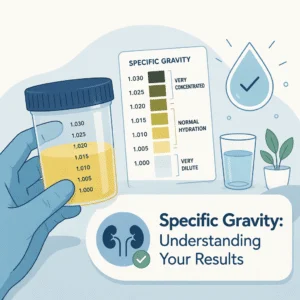
Laboratories also run specimen validity checks to confirm that what arrived is plausible human urine. These include urine creatinine, which reflects concentration; specific gravity, which measures dissolved solute density; pH; temperature at collection; and tests for oxidizing adulterants. A sample with very low creatinine and low specific gravity is flagged as dilute, which is a laboratory observation about concentration rather than a finding about any substance. Reading a screen alongside urine creatinine results, urine specific gravity values, and urine pH measurements explains most validity flags. Visible changes described in our guide to urine color and clarity often accompany a dilute specimen, and kidney filtering capacity itself is reflected in the serum creatinine test.
Extreme pH or an out-of-range temperature usually leads to a repeat collection rather than a conclusion. If your sample is flagged, ask what specifically was out of range and whether recollection is the next step.
What a positive result means, and what it does not
A confirmed positive establishes that a substance or its metabolite was present in the sample above a defined threshold. That is a narrower statement than most people assume.
- It does not establish impairment. Urine reflects prior exposure, and metabolites can persist long after any effect has passed.
- It does not establish a substance use disorder. Diagnosis rests on clinical criteria over time, not on a laboratory value.
- It does not establish dose, route, or timing without careful expert interpretation.
- It does not by itself distinguish prescribed medication from other sources.
When to talk to a doctor
Raise the result with a clinician if it conflicts with your medication list, if it carries consequences at work or in a legal setting, if you were not told which panel was ordered, or if you were never asked about prescriptions before testing. Bring a complete list of prescription drugs, over-the-counter products, and supplements. You can ask whether confirmatory testing was performed, which laboratory ran it, and whether the original sample can still be retested. In regulated workplace programs, that conversation is a formal step handled by a Medical Review Officer. In clinical care, informed consent, an explanation of purpose, and a chance to respond to unexpected findings are reasonable expectations, as summarized by the National Library of Medicine drug testing overview, and testing that carries consequences should always be discussed rather than imposed silently. Chronic conditions that alter kidney handling, described in our overview of chronic kidney disease, can also change how results should be read.
Latest scientific advances
Recent work has focused less on inventing new screening chemistry and more on documenting exactly where existing assays go wrong, which is what clinicians need in order to interpret a report responsibly.
A 2026 review in the Journal of Analytical Toxicology re-examined more than a decade of published reports of false-positive urine screens across opioids, amphetamines, benzodiazepines, cannabinoids, barbiturates, cocaine, and alcohol markers. The authors concluded that despite better antibodies, screening remains presumptive and needs orthogonal confirmation, meaning a second method based on entirely different physics. What this means for you: a preliminary positive should be treated as a question, and the follow-up mass spectrometry test is the answer.
A 2026 study in the Scandinavian Journal of Clinical and Laboratory Investigation compared two amphetamine screening formats in emergency patients against mass spectrometry. Several false positives traced back to ordinary medications including a local anesthetic, an antidepressant, and a blood pressure drug, and the two formats disagreed with each other. What this means for you: the brand of test used by a particular laboratory genuinely affects the answer, so listing every medication before collection is practical protection.
A 2026 analysis in the same journal reviewed thousands of real-world methadone screens from two commercial platforms checked against confirmation. One platform confirmed the large majority of its positives; the other confirmed far fewer, with several medications used in mental health care appearing repeatedly among the unconfirmed results. What this means for you: unexpected positives in patients taking multiple medications deserve scrutiny rather than automatic acceptance.
A 2026 review in Mayo Clinic Proceedings placed urine drug screening among the laboratory artifacts, meaning spurious results with identifiable mechanical causes, that clinicians encounter most often. The authors described both false positives from structurally similar molecules and false negatives from rapid elimination or specimen tampering. What this means for you: an unexpected laboratory result is often explainable, and asking about the mechanism is more productive than assuming error or assuming guilt.
Glossary of key terms
| Term | Definition |
|---|---|
| Immunoassay | A test that uses antibodies to detect a family of similar molecules. It is fast and inexpensive but identifies a class rather than a single substance. |
| Confirmation testing | A second, more precise analysis using mass spectrometry that names the exact compound present and can measure how much of it there is. |
| Cutoff | The concentration a laboratory sets as the dividing line between a negative and a positive report. Below it, the result reads negative. |
| Cross-reactivity | The tendency of an antibody to bind a molecule it was not designed for, because the shapes are similar. It is the main cause of false positives. |
| Metabolite | A breakdown product the body creates from a substance. Many urine tests look for metabolites rather than the original drug. |
| Detection window | The approximate span of time after exposure during which a test can still detect a substance or its metabolite in urine. |
| Specimen validity testing | Checks such as creatinine, specific gravity, pH, and temperature that confirm a sample is plausible, undiluted human urine. |
| Dilute specimen | A sample with unusually low creatinine and specific gravity, indicating a watery specimen in which low concentrations may go undetected. |
| Chain of custody | Documentation tracking who handled a sample and when, used when a result may have legal or employment consequences. |
| Medical Review Officer | A licensed physician who reviews nonnegative workplace results and contacts the person tested to check for legitimate medical explanations. |
FAQ
What does a urine drug screen test for?
It tests for whichever drug classes the ordering panel includes. Standard configurations cover cannabis metabolites, cocaine metabolite, amphetamines, opiates, and phencyclidine, with larger panels adding benzodiazepines, barbiturates, methadone, and selected prescription opioids. Alcohol may be included either as ethanol itself or as the longer-lasting marker ethyl glucuronide. Substances outside the ordered panel, including many synthetic opioids, are not detected unless specifically requested. The laboratory report lists every analyte tested along with its cutoff.
How accurate is a urine drug screen?
Accuracy depends entirely on which stage you mean. Screening immunoassays are sensitive but only moderately specific, so preliminary positives are not rare and vary by manufacturer. Confirmation by gas chromatography mass spectrometry or liquid chromatography tandem mass spectrometry is highly accurate and identifies the specific molecule involved. A screening result alone should never be treated as definitive, while a confirmed result is reliable evidence that a compound was present above a stated threshold.
Does a urine drug screen test for alcohol?
Not automatically. Alcohol is tested only when it is included in the panel. Ethanol itself clears from urine within roughly half a day, so it detects only very recent intake. Many programs instead measure ethyl glucuronide, a metabolite that remains detectable for several days and is therefore useful for monitoring abstinence. Because it is very sensitive, that marker can occasionally react to incidental exposures from alcohol-containing products, so results are read alongside clinical context.
What does a 10-panel urine drug screen test for?
A 10-panel builds on the standard five classes by adding roughly five more. Typical additions are benzodiazepines, barbiturates, methadone, propoxyphene, and a legacy sedative such as methaqualone, though laboratories differ and some substitute oxycodone or another prescription opioid. The number in the name refers only to how many assays run. Two laboratories can both offer a 10-panel and test partly different substances, so the printed analyte list is more informative than the label.
Is a drug screen a urine test?
Urine is the most common matrix, but not the only one. Blood testing reflects recent exposure and correlates better with current effects. Oral fluid captures a short recent window and is easy to observe during collection. Hair provides a much longer retrospective picture measured in months. Each matrix answers a different question. When a report says drug screen without further detail, checking which sample type was collected is worthwhile.
What causes abnormal pH in a urine drug screen?
Urine pH varies naturally with diet, hydration, time of day, and metabolic state, and certain medications or urinary infections shift it as well. Laboratories flag values far outside the physiological range because they can indicate that something was added to the sample or that the specimen degraded during storage. An abnormal pH is a validity observation, not a drug finding, and usually prompts a repeat collection.
Sources
- Saitman A, Fitzgerald RL, Lund K, Suhandynata RT, Menlyadiev M — False positive urine drug screens — Journal of Analytical Toxicology, 2026 — doi.org/10.1093/jat/bkag007
- Sainz-Pastor N, Martin E, Julia E, Cosmina Sabau L, Navas E, Alcaraz Quiles J, Gonzalez de la Presa B, Parra-Robert M — Challenges in the interpretation of amphetamine results: differences of reactivity between immunoassay and immunochromatography — Scandinavian Journal of Clinical and Laboratory Investigation, 2026 — doi.org/10.1080/00365513.2026.2694040
- Pagaduan JV — Comparative performance of methadone urine immunoassays based on real-world data reveals assay interference — Journal of Analytical Toxicology, 2026 — doi.org/10.1093/jat/bkag023
- Kanjee Z, Lippi G, Freed JA — Laboratory Artifacts in Clinical Medicine: A Review — Mayo Clinic Proceedings, 2026 — doi.org/10.1016/j.mayocp.2026.04.009
- MedlinePlus, National Library of Medicine — Drug Testing — medlineplus.gov
- National Institute on Drug Abuse — Commonly Used Drugs Charts — nida.nih.gov
- Mayo Clinic Laboratories — Delta-8 and Delta-9-Carboxy-Tetrahydrocannabinol (THC) Confirmation, Random, Urine — mayocliniclabs.com
Further reading
- Find out how infection is distinguished from contamination by reading our urine culture results guide.
- Learn why sugar appears in a sample by reviewing our urine glucose test explainer.
- Understand what leaking protein signals about the kidneys with our urine protein results guide.
- Compare the two most reported liver enzymes using our AST lab test reference.
- Explore how everyday medications reach the liver first by reading our ALT liver enzyme guide.
Understand your lab results with BloodSense
A urine drug screen rarely arrives alone. It usually sits next to creatinine, specific gravity, pH, and a full urinalysis, and those neighboring values often explain why a result was flagged in the first place. BloodSense turns that page of numbers into plain language, showing which findings fit together and which ones deserve a question at your next appointment. It helps you understand a report; it does not diagnose conditions and does not replace your physician.