Pale or Clay-Colored Stool: Causes, Urgent Signs and the Liver Tests to Read
The essentials
Stool gets its brown color from bile, made by the liver. One pale stool, or white stool after a barium X-ray, is not alarming. Stool that stays clay-colored for several days, especially with dark urine or yellow eyes, suggests bile is blocked: a liver panel, bilirubin and an ultrasound usually show where.
When does pale stool need emergency care?
When to see a doctor
- Emergency: call 911 or go to the ER if light-colored stool comes with belly pain lasting hours, fever or chills, vomiting, yellow eyes or tea-colored urine. These can signal a serious infection or inflammation of the gallbladder, liver or pancreas[4].
- Within 24 to 48 hours if clay-colored stool comes with yellow skin or eyes and dark urine, even without pain[2], or if a baby older than 2 weeks still looks yellow or passes pale yellow, gray or white stools[11][12].
- At your next appointment, booked soon, if stools are not brown again after several days without a clear reason[1].
Is light brown stool normal, or is it pale?
Normal stool is a shade of brown, and that shade varies from day to day[2]. Light brown stool that still looks brown is usually fine. Pale stool is much lighter: white, gray or light tan, like putty or clay[2][1]. Other shades are in our stool color chart.
What harmless things can make stool pale?
- Common A single off-color stool. One pale stool now and then is not usually a cause for concern[2].
- Common A barium X-ray. After a barium enema, it is normal for stool to be white for a few days[3].
- Possible Some medicines are on the list of causes[1]. Bring the full list, including over-the-counter remedies.
- Possible Greasy, light stool that floats points to poor fat absorption: see yellow, greasy stool.
What liver, gallbladder or pancreas problems cause clay-colored stool?
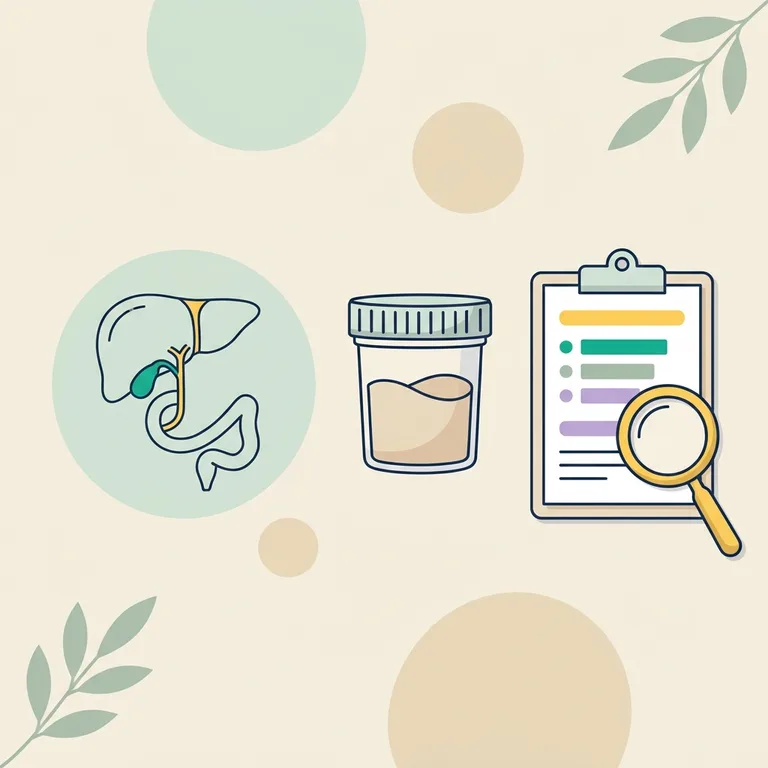
Bile flows from the liver through the bile ducts, past the pancreas, into the gut. Stool turns pale when the liver makes too little bile or the flow is blocked. The pigment then backs up into the blood, which is why jaundice and dark urine often come with clay-colored stool[1].
- Common Gallstones. A stone in a bile duct blocks it; attacks often follow heavy meals, in the evening or at night[4]. See gallstone symptoms.
- Common Hepatitis. Viral, alcohol-related or toxic hepatitis[1][2]. See hepatitis A and hepatitis B.
- Possible Fatty liver disease and cirrhosis[2]: see cirrhosis.
- Possible Narrowed or inflamed bile ducts: biliary strictures, sclerosing cholangitis, bile duct cysts[1], and cholestasis, including the cholestasis of pregnancy[2].
- Possible Pancreatitis[2]: see pancreatitis causes.
- Rare Tumors or cysts of the liver, bile ducts, gallbladder or pancreas[1][2]. See pancreatic cancer signs.
Why is pale stool in a baby urgent?
Many newborns look yellow in their first 2 weeks, so problems are easy to miss[12]. Jaundice from bile that does not drain affects about 1 in 2,500 term babies and is never normal; biliary atresia, where the bile ducts scar shut, causes 25% to 40% of cases[11]. Its signs are jaundice beyond 3 weeks and pale yellow, gray or white stools[12]. Any baby still jaundiced after 2 weeks should have total and direct bilirubin measured; a direct bilirubin above 1.0 mg/dL calls for prompt referral to a specialist[11]. Photograph the diaper for the doctor.
Which tests will the doctor order for pale stool?
The key question: is the problem inside the liver, or in the ducts that drain it[1]?
| Test | What it answers | Learn more |
|---|---|---|
| Total and direct bilirubin | Is bile pigment backing up into the blood? | Total bilirubin, direct bilirubin |
| ALP and GGT | Is bile flow blocked, and is the source the liver rather than bone? | Alkaline phosphatase, GGT |
| ALT and AST | Are liver cells inflamed or damaged? | ALT levels, high liver enzymes |
| Hepatitis virus tests | Is a virus inflaming the liver? | Ordered with the liver panel[1] |
| Urine bilirubin (dipstick) | Is the pigment spilling into urine, darkening it? | Bilirubin in urine |
| Ultrasound, CT, MRI; sometimes ERCP | Is there a stone, a narrowing or a mass in the bile ducts? | Imaging of the liver and ducts[1] |
Got a liver panel back after pale stools? BloodSense explains every line of your report in plain language, so you know which values to discuss.
Explain my liver resultsHow do I read a liver panel when stool is pale?
| Test | Result | Reference range | Flag |
|---|---|---|---|
| Bilirubin, total | 3.4 mg/dL | 0.1–1.2 mg/dL | H |
| Bilirubin, direct | 2.6 mg/dL | < 0.3 mg/dL | H |
| Alkaline phosphatase (ALP) | 386 IU/L | 40–129 IU/L | H |
| GGT | 290 U/L | 5–40 U/L | H |
| ALT | 58 U/L | 4–36 U/L | H |
Direct bilirubin: the line that links pale stool to bile
A normal direct (conjugated) bilirubin is below 0.3 mg/dL and total bilirubin is 0.1 to 1.2 mg/dL[5]. A high direct fraction points to liver disease or a blocked bile duct in most settings[10]. A high indirect fraction alone usually has another cause, such as faster red blood cell breakdown[5]: see indirect bilirubin.
ALP and GGT high together: a bile flow pattern
ALP rising out of proportion to ALT and AST, as in the example, is a cholestatic pattern: bile is not flowing. ALT and AST rising far more than ALP is a hepatocellular pattern: liver cells are injured, as in hepatitis[10]. GGT shows whether a high ALP comes from the liver rather than bone[7].
Dark urine: a positive bilirubin dipstick
Bilirubin in urine suggests liver disease or a blocked bile duct[9]. With pale stool and a high direct bilirubin, imaging comes next to look for a stone, a narrowing or a mass[1][5].
What should I note before the appointment?
- When stools turned pale, and whether every stool is affected
- A photo of the stool or diaper
- Urine, skin and eye color; itching
- Pain: where, how long, after meals
- Fever, weight loss, appetite
- Barium X-ray, new medicines, alcohol, pregnancy
Questions to ask your doctor
- Does my liver panel show a bile flow pattern or a liver cell pattern?
- Is my direct bilirubin high?
- Do I need an ultrasound, and how soon?
- Could one of my medicines be involved?
Frequently asked questions
How long can pale stool last before I should call?
If stools are not back to normal brown after several days, call your clinician[1]. Do not wait that long if yellow eyes or dark urine appear[2].
Can pale stool go away on its own?
Yes, when it comes from barium, which clears in a few days[3]. Gallbladder attacks also stop when a stone moves, but tend to return[4], so get checked if pain or jaundice came with it.
Is pale stool in pregnancy a concern?
It can be. Cholestasis of pregnancy is one of the listed causes[2], so mention pale stools, dark urine or itching to your prenatal care team.
Related tests and guides
- Stool color: what your results meanThe full chart, from green to black to red.
- Direct bilirubinThe key blood value when bile cannot drain.
- Alkaline phosphatase (ALP)Why it rises when the bile ducts are blocked.
- GallstonesThe most frequent cause of a blocked bile duct.
- Yellow stool causes and testsWhen light stool is greasy rather than clay-colored.
References
- MedlinePlus Medical Encyclopedia. Stools - pale or clay-colored. medlineplus.gov (accessed November 3, 2026)
- Cleveland Clinic. Clay-colored or pale stool. clevelandclinic.org (accessed November 3, 2026)
- MedlinePlus Medical Encyclopedia. Barium enema. medlineplus.gov (accessed November 3, 2026)
- National Institute of Diabetes and Digestive and Kidney Diseases. Symptoms & causes of gallstones. niddk.nih.gov (accessed November 3, 2026)
- MedlinePlus Medical Encyclopedia. Bilirubin blood test. medlineplus.gov; MedlinePlus Lab Tests. Bilirubin blood test. medlineplus.gov (accessed November 3, 2026)
- MedlinePlus Medical Encyclopedia. ALP - blood test. medlineplus.gov (accessed November 3, 2026)
- MedlinePlus Medical Encyclopedia. Gamma-glutamyl transferase (GGT) blood test. medlineplus.gov (accessed November 3, 2026)
- MedlinePlus Medical Encyclopedia. Alanine transaminase (ALT) blood test. medlineplus.gov (accessed November 3, 2026)
- MedlinePlus Lab Tests. Bilirubin in urine. medlineplus.gov (accessed November 3, 2026)
- Kwo PY, Cohen SM, Lim JK. ACG clinical guideline: evaluation of abnormal liver chemistries. Am J Gastroenterol. 2017;112(1):18-35. doi:10.1038/ajg.2016.517 (accessed November 3, 2026)
- Fawaz R, Baumann U, Ekong U, Fischler B, Hadzic N, Mack CL, et al. Guideline for the evaluation of cholestatic jaundice in infants: joint recommendations of NASPGHAN and ESPGHAN. J Pediatr Gastroenterol Nutr. 2017;64(1):154-168. doi:10.1097/MPG.0000000000001334 (accessed November 3, 2026)
- National Institute of Diabetes and Digestive and Kidney Diseases. Symptoms & causes of biliary atresia. niddk.nih.gov (accessed November 3, 2026)
This article is general health information. It does not replace a medical examination, diagnosis or treatment. If pale stool comes with severe belly pain, fever or yellow eyes, seek care without waiting.