





Blister on the Lip: Cold Sore, Mucocele, or Something Else
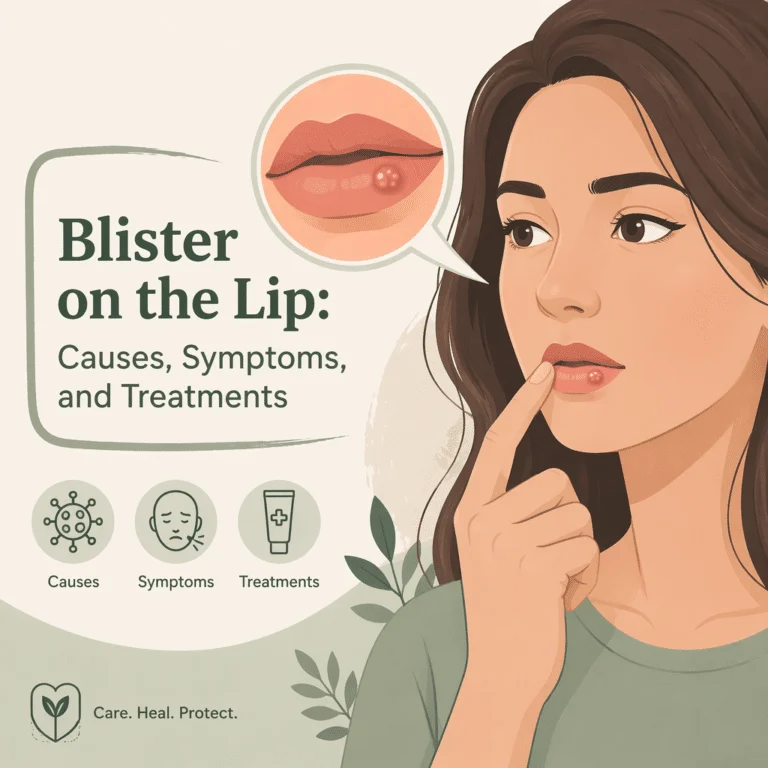
A blister on the lip is one of those small problems that feels much bigger than it looks, mostly because you cannot stop seeing it and neither, you assume, can anyone else. The good news is that most lip blisters are harmless and heal on their own within one to three weeks. The useful news is that they do not all have the same cause, and telling them apart changes what you should do about it. A cold sore, a mucocele, angular cheilitis and a friction blister look similar at a glance but behave very differently.
In this article you will learn how to recognize the most common types, which clues actually separate them, which warning signs deserve a same-week appointment, and the narrow set of situations where blood work genuinely adds something.
What a blister on the lip actually is
A blister is a small pocket of fluid between the outer and deeper layers of skin or mucous membrane. The fluid is usually clear serum, sometimes cloudy if the area is inflamed, occasionally dark red if a tiny vessel has broken underneath. The lip blisters easily because it sits at a junction: dry outer skin, the red vermilion border and the moist inner lining all meet within a few millimeters, and each layer reacts differently to viruses, friction, heat and irritants.
Blister, ulcer and bump are not the same thing
A blister is raised and fluid-filled. An ulcer is a shallow crater where the surface layer has been lost, usually with a white base and a red rim. A bump is solid and does not burst. Cold sores start as blisters and become ulcers when they rupture; canker sores start as ulcers and never pass through a blister stage at all.
The common causes, and how each one behaves
Cold sores, also called herpes labialis
Cold sores are the most frequent cause of a true blister on the lip. They come from herpes simplex virus type 1, which infects more than half of the United States population by early adulthood according to the National Library of Medicine consumer health service. After the first infection, the virus stays dormant in a nerve cluster near the jaw and periodically reactivates.
The signature is the sequence: twelve to twenty-four hours of tingling in one spot, then a tight cluster of small blisters on the vermilion border where lip meets skin. They merge, break, weep and crust over, and the crust falls away after a week to ten days. Recurrences return to the same square centimeter of lip, a strong clue on its own. Triggers include fever, sun exposure, stress, dental work, menstruation and sleep debt. Cold sores are contagious, most of all while weeping.
Angular cheilitis
Angular cheilitis affects the corners of the mouth rather than the lip itself. It produces cracked, red, sometimes crusted skin at one or both corners, and it stings when you open wide or eat something acidic. It is not a virus. A 2024 clinical review described it as a mixed condition, usually involving Candida yeast, sometimes staphylococcal bacteria, on skin kept chronically damp.
What keeps the corners damp matters more than the germs. Saliva pooling from lip licking, ill-fitting dentures, a loss of facial height as teeth wear down, and inhaled corticosteroids used without rinsing are recognized contributors. Angular cheilitis more often affects people who have diabetes, and it is one of the few lip conditions where a nutritional or immune issue underneath is worth considering.
Mucocele, a mucous cyst
A mucocele is a smooth, dome-shaped, bluish or translucent bubble, almost always on the inner surface of the lower lip. It forms when a minor salivary gland duct is severed or blocked, usually by an accidental bite, and saliva collects under the lining. It is painless, soft, and often changes size day to day. Many rupture, refill, then eventually resolve; a persistent one is removed in a small in-office procedure.
Canker sores, the look-alike that is not a blister
Recurrent aphthous stomatitis, better known as canker sores, produces round ulcers with a gray-white center and a red halo, on the moist inner lip, inner cheek or under the tongue. It never appears on the outer lip or the vermilion border, and it is not contagious. A 2024 review of common oral conditions reported that people with recurrent canker sores show nutritional deficiencies more often than those without, and that the condition is linked to celiac disease more often than chance would predict.
Contact reactions to lip products and irritants
Irritant and allergic contact cheilitis produces swelling, redness, scaling and sometimes small blisters across the whole lip rather than one tight cluster. The timing is the giveaway: symptoms track a new lip balm, toothpaste, whitening product or mouthguard. Cinnamon and mint flavorings, propolis and lanolin are recurring culprits. The lesion covers whatever surface touched the product, a distribution no virus produces.
Sunburn and actinic damage
The lower lip receives more ultraviolet exposure than almost any other part of the face and has little melanin to defend it. An acute sunburn can blister a lip within hours. Long-term cumulative damage causes actinic cheilitis instead: a persistently dry, scaly, blotchy lower lip that never quite settles. That one matters, because it is considered a precancerous change and needs evaluation rather than indefinite moisturizing.
Hand, foot and mouth disease
This viral illness, most common in children under five but capable of infecting adults, causes fever, painful mouth sores and a blistering rash. The Centers for Disease Control and Prevention notes that the rash typically appears on the hands and feet, which is exactly the distinguishing feature.
Impetigo
Impetigo is a superficial bacterial infection producing fragile blisters that rupture quickly and dry into a honey-colored crust around the mouth and nose. It spreads fast within households and schools, and needs antibiotics rather than antiviral treatment.
Blood blisters, trauma and shingles
A dark purple or black blister after biting your lip, a burn from hot food, or friction from a new dental appliance is usually a simple blood blister and resolves without treatment. Shingles, separately, can affect the facial nerve and produce blisters on one side of the face only, in a strip stopping abruptly at the midline, with burning pain preceding the rash. A strictly one-sided eruption with severe pain deserves prompt attention, especially near the eye.
How to tell which is which
Location, timing and whether the lesion is a blister or an ulcer do most of the discriminating work.
| Condition | Typical location | What it looks like | Timing clue | Contagious |
|---|---|---|---|---|
| Cold sore | Vermilion border, same spot each time | Cluster of small blisters, then crusting | Tingling 12 to 24 hours beforehand | Yes |
| Angular cheilitis | Corners of the mouth, often both sides | Cracks, redness, sometimes crust | Gradual, lingers for weeks | No |
| Mucocele | Inner surface of the lower lip | Smooth bluish painless bubble | Follows a lip bite, may refill | No |
| Canker sore | Moist inner lip or cheek only | Shallow ulcer, gray-white center | No blister stage at all | No |
| Contact reaction | Whole lip surface touched | Diffuse swelling and scaling | Hours to days after a new product | No |
| Sunburn or actinic damage | Lower lip, evenly | Redness and blistering, or dry scaly patches | Hours after sun, or months-long | No |
| Hand, foot and mouth disease | Mouth, plus hands and feet | Mouth sores plus a blistering rash | Fever and sore throat first | Yes |
| Impetigo | Around the mouth and nose | Fragile blisters, honey-colored crusts | Spreads within a household over days | Yes |
A four-question way to narrow it down at home
Working through these in order resolves most cases without guesswork.
- Where exactly is it? Corners of the mouth point toward angular cheilitis. Inner lower lip suggests a mucocele or a canker sore. The border between lip and skin points toward a cold sore.
- Is it a fluid-filled blister or a shallow crater? Craters with a white base and no blister stage are canker sores, not herpes.
- Did anything come before it? A tingle means cold sore. A lip bite means mucocele or blood blister. A new balm or toothpaste means contact reaction. Fever plus a rash on the hands means a different illness entirely.
- Has it happened before in the same place? Repeated blistering at one fixed spot is characteristic of reactivating herpes simplex virus.
When to see a doctor about a blister on the lip
Most lip blisters need patience rather than a prescription. These situations do not.
- A sore that has not healed after three weeks, or that keeps enlarging.
- Any lesion that bleeds easily, feels hard at its base, or has irregular raised edges.
- Blisters spreading toward the eye, or eye pain and grittiness with an outbreak.
- One-sided facial blistering with burning pain, which can indicate shingles and is time-sensitive.
- Fever, swollen neck glands, or so much mouth pain that you cannot drink normally.
- Outbreaks recurring more than five or six times a year, or lasting longer each time.
- Any lip blister in someone immunosuppressed, on chemotherapy, or taking transplant medication.
- A newborn or infant with mouth blistering, which always warrants a same-day call.
Persistent lesions matter because a non-healing sore on the lower lip is one of the ways oral cancer presents. That is rarely the explanation for a bump you noticed yesterday, but it is why the three-week rule exists.
What treatment usually looks like
Treatment follows the cause, which is exactly why identifying it first is worth the effort.
For cold sores, topical antivirals such as acyclovir cream or docosanol shorten an episode modestly if you start at the tingling stage, before blisters appear. Oral antivirals, prescribed as a short high-dose course, work better and are the option for frequent or severe recurrences. Cool compresses, plain petrolatum and over-the-counter pain relief handle the rest. Picking at crusts prolongs healing and spreads virus to fingers and eyes.
For angular cheilitis, the treatment is antifungal cream, sometimes with a mild anti-inflammatory, plus removing whatever keeps the corners wet. Correcting a denture, breaking a lip-licking habit and applying a barrier ointment at night prevent the next episode more reliably than the cream itself.
For mucoceles, watchful waiting, then minor surgical removal if it persists. For contact reactions, stopping the product and using a bland emollient. For impetigo, antibiotics. For canker sores, topical corticosteroids. For sun damage, daily lip sunscreen and evaluation of any patch still scaly after a month.
Where blood tests actually fit in
Most lip blisters need no laboratory testing whatsoever. A typical cold sore is diagnosed by looking at it, and testing adds cost without changing management. That is worth saying plainly before describing where blood work does contribute.
Herpes simplex serology
A blood test can show whether you carry antibodies to herpes simplex virus type 1 or type 2. Type-specific antibody testing tells you about past exposure, not about whether today’s blister is an active outbreak, and it cannot say when or how you were infected. Because HSV-1 is so widespread, a positive result is common and by itself explains very little. Clinicians reserve serology for an unclear diagnosis, pregnancy planning or an atypical presentation. When the question is whether a current lesion is herpes, a swab taken directly from the blister answers it better than blood.
Blood counts and nutrient markers in recurrent cases
The picture changes when lesions keep returning, heal slowly, or appear alongside other symptoms. Here a basic panel can identify a treatable contributor. Clinicians frequently order a complete blood count, which screens for anemia and abnormal white cell patterns. That same report lists lymphocyte levels, a rough indicator of immune status.
Iron status is the most consistently relevant nutrient thread. Many people also review their ferritin blood levels, which reflect iron stores, and a doctor may add a serum iron test for context. Depleted stores can produce anemia and are associated with cracked mouth corners and recurring ulcers. Labs also measure vitamin B12 levels, and the same workup often includes folic acid blood levels. Some clinicians also check zinc blood test levels. A 2023 review of nutrition and the oral mucosa listed angular cheilitis, glossitis and recurrent ulcers among the mouth findings that accompany deficiencies of these micronutrients.
Two further avenues sometimes make sense. Repeated mouth ulcers occasionally reveal celiac disease, so screening for it is reasonable when ulcers coexist with digestive symptoms or iron deficiency. When outbreaks are unusually frequent or slow to heal, a clinician may review HIV test results and other measures of immune competence, and some panels add C-reactive protein when a broader inflammatory process is suspected.
What testing will not tell you
No blood test predicts your next cold sore, measures how contagious you are today, or distinguishes a mucocele from a blood blister. Testing earns its place when a pattern suggests something systemic underneath, not as a routine response to a single blister.
Reducing the odds of the next one
Prevention is specific to the cause, and a few habits cover several causes at once.
- Apply a lip balm containing sun protection daily, not only at the beach. Ultraviolet light triggers cold sore reactivation and drives long-term actinic damage.
- Break the lip-licking loop. Saliva evaporates and leaves the lip drier than before, which is the engine behind both chapping and angular cheilitis.
- Keep sleep and stress in a manageable range, since both are recognized reactivation triggers.
- Do not share lip balm, drinkware, razors or towels during an active outbreak.
- Have dentures, retainers and night guards checked if they rub or have altered your bite.
Latest scientific advances
Research here has been steady rather than dramatic over the past three years. Here is what has actually moved, in plain terms.
Antiviral treatment has been mapped more precisely
A 2025 systematic review — a study that gathers and weighs all the published trials on a question — compared topical and systemic treatments for oral herpes simplex infection. Creams and tablets do different jobs: creams applied very early mainly shorten how long a single lesion lasts, while tablets taken as a short course can also reduce how often outbreaks return. What this means for you is that if your complaint is frequency rather than severity, a cream is unlikely to solve it, and the conversation with your doctor should be about oral antiviral options.
Light-based therapy shows promise, with caveats
A 2025 review pooling six randomized trials found that photobiomodulation, a low-level light treatment applied to the lesion, reduced pain and shortened healing by roughly a day compared with standard antiviral treatment. The authors noted the trials were small and uneven in quality, so this is still preliminary and needs confirmation. What this means for you is that it is reasonable to ask about if a local clinic offers it, but not worth chasing at significant cost.
A vaccine is still in development, not in pharmacies
A 2024 review of herpes simplex virus type 1 summarized where prevention research stands. Several vaccine approaches are being tested, and the virus is also being engineered as a delivery tool for other therapies. None has reached routine clinical use. What this means for you is that prevention still rests on avoiding triggers and treating early, and any product marketed as a cold sore vaccine deserves skepticism.
The link between recurrent mouth ulcers and nutrition is firmer
The 2024 review of common oral conditions mentioned earlier pooled case-control studies and found that people with recurrent canker sores are meaningfully more likely to have low vitamin B12, low folate and low iron stores, and more likely to have celiac disease. What this means for you is that repeated inner-lip ulcers are one of the few mouth complaints where a nutrient panel is genuinely justified rather than excessive.
Glossary
| Term | Definition |
|---|---|
| Vermilion border | The sharp line where the colored part of the lip meets the surrounding facial skin. It is the classic site of cold sores. |
| Herpes labialis | The medical name for a cold sore, meaning a herpes simplex outbreak on the lip. |
| HSV-1 | Herpes simplex virus type 1, the virus behind most cold sores. It stays dormant in nerve tissue between outbreaks. |
| Angular cheilitis | Inflammation, cracking and soreness at one or both corners of the mouth, usually involving yeast or bacteria on chronically damp skin. |
| Mucocele | A painless fluid-filled bubble on the inner lip caused by saliva leaking from a damaged minor salivary gland. |
| Recurrent aphthous stomatitis | The medical term for repeated canker sores, which are shallow ulcers inside the mouth rather than blisters. |
| Actinic cheilitis | Chronic sun damage to the lower lip, seen as persistent dryness and scaling. It is considered a precancerous change. |
| Serology | A blood test that looks for antibodies, showing past exposure to an infection rather than whether an infection is active right now. |
| Ferritin | A protein that stores iron. Measuring it in blood is the usual way to estimate how much iron the body has in reserve. |
| Photobiomodulation | A treatment that applies low-level light to tissue to reduce pain and support healing. It is being studied for cold sores. |
Frequently asked questions
How do I know if my lip blister is not a cold sore?
Three features argue against a cold sore. First, location: cold sores sit on the outer lip or the vermilion border, so a lesion on the moist inner lip is more likely a mucocele or a canker sore. Second, the absence of a warning tingle in the day before it appeared. Third, a shallow crater with a white or gray base rather than a raised fluid-filled bubble, which describes a canker sore instead. Cracks specifically at the corners of the mouth point toward angular cheilitis, and a diffuse reaction across the whole lip after a new product suggests a contact reaction. If it is a first-ever lesion and none of these patterns fit, having it examined is reasonable.
How long does a blister on the lip take to heal?
A cold sore usually resolves in two to three weeks from the first tingle to fully healed skin, with the crust stage falling away after seven to ten days. A simple blood blister from a bite or a burn typically settles within a week. A mucocele is less predictable and may rupture and refill several times over weeks before disappearing, or persist until it is removed. Angular cheilitis often lingers for weeks and tends to come back until the underlying dampness is addressed. Anything still present at three weeks should be looked at by a clinician regardless of how minor it seems.
What causes blisters on lips to keep coming back in the same place?
Recurrence at a fixed spot is the signature of herpes simplex virus type 1. The virus lies dormant in a nerve cluster and travels back down the same nerve branch each time it reactivates, which is why the lesion reappears within roughly the same square centimeter. Common reactivation triggers include ultraviolet exposure, fever, illness, dental procedures, physical or emotional stress, hormonal shifts and sleep deprivation. Frequency varies widely between people and often decreases with age. If outbreaks come more than five or six times a year, a preventive antiviral strategy is worth discussing with your doctor.
Should I pop a blister on my lip?
No. Popping a cold sore releases infectious fluid, increases the risk of spreading virus to your fingers, other people and your eyes, and typically slows healing by opening the skin to bacterial infection. A mucocele that you drain will usually refill because the damaged gland duct is still leaking. A blood blister left intact heals under its own protective roof. Keep the area clean, apply a bland ointment to stop it drying and cracking, and let the natural crust form and separate on its own.
Do I need a blood test for a cold sore?
In most cases, no. A typical cold sore is diagnosed on appearance, and antibody testing does not change how it is treated. Blood testing becomes useful in narrower situations: an unclear diagnosis, pregnancy planning, an unusual presentation, or outbreaks that are unusually frequent and severe. If lip and mouth lesions keep recurring, a doctor may look instead at iron stores, vitamin B12, folate and zinc, or screen for celiac disease, since those can be treatable contributors. When the question is whether a lesion present right now is herpes, a swab of the lesion answers it better than blood.
Are lip blisters contagious?
It depends entirely on the cause. Cold sores are contagious, most of all while the blisters are weeping, and spread through kissing, shared drinkware, lip balm, razors and towels. Hand, foot and mouth disease and impetigo are also contagious and spread readily within families and schools. Canker sores, mucoceles, angular cheilitis, contact reactions, sunburn and blood blisters are not contagious at all. During an active cold sore, avoid sharing anything that touches your lips, wash your hands after applying treatment, and avoid contact with newborns and anyone whose immune system is suppressed.
Sources
- MedlinePlus, National Library of Medicine — Cold Sores, 2025 — medlineplus.gov
- Mayo Clinic — Cold sore: symptoms and causes, 2024 — mayoclinic.org
- Centers for Disease Control and Prevention — About Hand, Foot, and Mouth Disease, 2024 — cdc.gov
- Mancini A, Inchingolo AM, Marinelli G, et al. — Topical and Systemic Therapeutic Approaches in the Treatment of Oral Herpes Simplex Virus Infection: A Systematic Review — International Journal of Molecular Sciences, 2025 — doi.org/10.3390/ijms26178490
- Yang Q, Farooq W, Haroon M, et al. — Comparison of photobiomodulation therapy with conventional treatment in patients with herpes labialis: a systematic review and meta-analysis of randomized controlled trials — Lasers in Medical Science, 2025 — doi.org/10.1007/s10103-025-04648-9
- Su D, Han L, Shi C, et al. — An updated review of HSV-1 infection-associated diseases and treatment, vaccine development, and vector therapy application — Virulence, 2024 — doi.org/10.1080/21505594.2024.2425744
- Stoopler ET, Villa A, Bindakhil M, et al. — Common Oral Conditions: A Review — JAMA, 2024 — doi.org/10.1001/jama.2024.0953
- Chiriac A, Chiriac AE, Pinteala T, et al. — Angular cheilitis: an oral disease with many facets — Wiener Medizinische Wochenschrift, 2024 — doi.org/10.1007/s10354-024-01037-9
- Straczek A, Szalkowska J, Sutkowska P, et al. — Impact of nutrition on the condition of the oral mucosa and periodontium: A narrative review — Dental and Medical Problems, 2023 — doi.org/10.17219/dmp/156466
Further reading
- Readers investigating a viral cause often consult the mononucleosis symptoms and recovery guide
- People with recurring mouth ulcers and joint symptoms sometimes explore the lupus symptoms and treatment guide
- Anyone assessing antibody results can read the IgG blood test guide
- Understanding infection-fighting white cells means reviewing the neutrophils results guide
- Those checking immune and bone health can review vitamin D blood levels
Understand your lab results with BloodSense
A blister on the lip is usually a visual diagnosis, but when lesions keep returning or heal slowly, the answers often sit in a lab report you were handed without much explanation. BloodSense turns results such as a complete blood count, ferritin, vitamin B12, folate and zinc into plain language you can actually act on, so you know which numbers are unremarkable and which ones deserve a follow-up question. It helps you understand your results; it does not diagnose, and it does not replace your doctor.