






Bipolar II Disorder: Hypomania, Depression, and Care
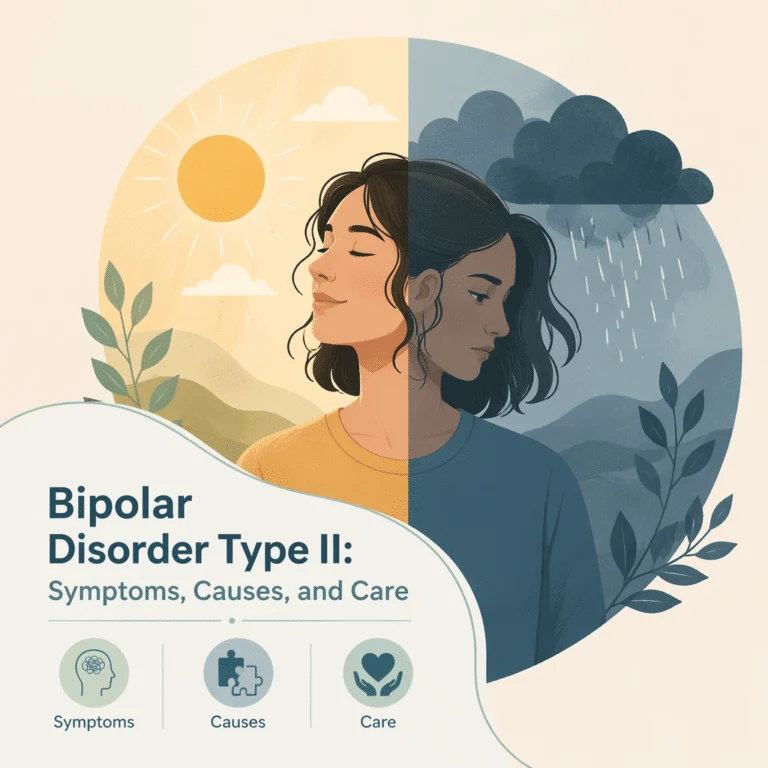
Bipolar II disorder is defined by a pairing that is simple to state and hard to spot: at least one hypomanic episode and at least one major depressive episode, with no full manic episode, ever. That clause is the dividing line. In bipolar I, a single manic episode — severe enough to wreck functioning, prompt hospitalization, or involve psychosis — makes the diagnosis. In type II the highs stay below it.
That quieter high misleads people, clinicians included, and bipolar II gets filed away as the lighter version. The reality runs the other way: people living with bipolar II spend most of their symptomatic time in depression, and it is the depression that drives lost work and real risk to life.
What is bipolar II disorder?
Hypomania is a distinct period of elevated, expansive, or irritable mood with clearly increased energy, lasting at least four consecutive days, nearly every day. Major depression is at least two weeks of low mood or lost interest, with disrupted sleep, appetite change, fatigue, and impaired concentration.
What defines the diagnosis is the ceiling on the high end. Hypomania is an unmistakable change from a person’s usual self and is visible to others, but it does not cause marked impairment, require hospitalization, or involve psychosis. Cross any of those thresholds and the episode is mania. For the wider frame, read a general overview of how bipolar disorder is classified.
Hypomania: what it feels like and why it gets missed
Hypomania is not a mood, it is a state change. Sleep need drops, and a person may run on four hours without feeling tired. Thoughts accelerate, speech speeds up, and confidence inflates. Activity surges: ventures started, messages sent at 3 a.m., plans made faster than they can be finished. Irritable hypomania is common and under-recognized — many people become tense and wired rather than happy.
The reason it gets missed is structural. Almost nobody seeks care during hypomania, because the person feels capable rather than unwell. Help-seeking happens in the depression that follows, by which point the earlier weeks read as a stretch when things were going well.
How hypomania differs from a good mood or a productive stretch
A good mood follows something — rest, a success, a resolved worry — and moves with circumstances. Hypomania appears without proportionate cause and holds regardless. A productive stretch still involves normal sleep; hypomania cuts the felt need for sleep while energy stays high. Work done in a well state tends to be finished, while hypomanic activity is fast, scattered, and often abandoned. Hypomania is not a performance enhancer and is not something to pursue or protect. It is one half of an illness process, typically followed by a depressive episode that costs far more than the high delivered.
Bipolar II depression: the heavier half of the illness
Depression is where bipolar II does its damage. A review in JAMA put symptomatic time in bipolar disorder at roughly 75% depressive, and in type II these episodes are often more frequent and more persistent than in type I. The picture departs from the textbook one: sleeping far more rather than less, appetite increase, heaviness in the limbs, and cognitive fog that people find most disabling.
Bipolar II carries a serious risk of suicide, comparable to bipolar I, largely because of that depressive load. This is a reason for a plan rather than for alarm. If you are having thoughts of suicide or self-harm, or you are worried about someone else, the 988 Suicide & Crisis Lifeline is available 24 hours a day across the United States: call or text 988, or chat at 988lifeline.org. It is free and confidential. Telling a treating clinician is ordinary care.
Bipolar II vs bipolar I
The two share a great deal of biology but differ in ways that shape treatment.
| Feature | Bipolar II | Bipolar I |
|---|---|---|
| Defining high-end episode | Hypomania only; mania never occurred | At least one manic episode |
| Minimum duration | Four consecutive days | Seven days, or any length if hospitalized |
| Psychosis when elevated | Never, by definition | May be present |
| Depression required? | Yes, required for diagnosis | Common but not required |
| Symptomatic time | Heavily weighted toward depression | Depression predominates, more elevated time |
| Usual route to diagnosis | Often years of treatment for depression first | Frequently identified during acute mania |
Past that point the comparison becomes its own subject, so readers wanting the manic side should consult a dedicated guide to bipolar I disorder and its manic episodes.
Why bipolar II is often misdiagnosed as depression
Delay is the norm. The same JAMA review found diagnosis and optimal treatment are typically delayed by a mean of roughly nine years after a first depressive episode. Almost everyone presents while depressed, and people rarely volunteer hypomanic history because it did not feel like a symptom.
A first depressive episode is genuinely indistinguishable from major depressive disorder and the symptoms that define it until hypomania appears in the history. Racing thoughts and restlessness also overlap with attention-deficit hyperactivity disorder and its patterns of inattention, though ADHD traits run continuously from childhood while hypomania is episodic.
Causes and risk factors
Bipolar II arises from inherited vulnerability meeting environmental load. Heritability works through many common variants of small effect, with a first-degree relative carrying the diagnosis being the strongest known risk factor. Research also points to disrupted circadian regulation and altered prefrontal-limbic connectivity, none of it measurable in clinic.
Environmental contributors include childhood adversity, shift work, postpartum periods, substance use, and sustained stress. Many people also live with an anxiety disorder that amplifies mood instability.
How bipolar II is diagnosed
Diagnosis rests on a clinical interview establishing a lifetime history: has there ever been a period of four days or more of elevated or irritable mood with increased energy, visible to others, without reaching mania? Collateral history is not optional in practice — partners and parents see hypomania from outside and often recall what the person cannot. Screening tools such as the Mood Disorder Questionnaire prompt the right questions but confirm nothing alone.
The blood tests that matter
No blood test diagnoses bipolar II, and any service claiming otherwise overstates it. Labs do two other jobs. The first is excluding mimics, so clinicians usually order a thyroid stimulating hormone test that can explain low mood, and a workup should rule out an underactive thyroid that produces fatigue and depressed mood. A complete blood count screens for anemia, and low vitamin D or vitamin B12 can generate fatigue and cognitive complaints.
The second job is monitoring treatment. Lithium involves periodic serum levels plus thyroid and kidney testing, so care teams track an estimated glomerular filtration rate that reflects kidney function. Valproate requires liver tests, and antipsychotics call for metabolic monitoring: fasting glucose, hemoglobin A1c, lipids, and weight.
Treatment options
What follows describes categories of treatment and the monitoring they involve. It is not advice about what anyone should take, and no medication should be started, stopped, or adjusted without a prescriber.
Mood stabilizers form the base. Lithium has the longest evidence record, including for reducing suicide risk, and lamotrigine is used particularly for the depressive pole. Atypical antipsychotics are central to treating bipolar depression, and quetiapine has the strongest evidence in type II. Sedation and metabolic effects are the main trade-offs, which is why the metabolic labs matter.
The antidepressant question is where clinical opinion genuinely divides. The concern is a treatment-emergent switch into hypomania or mania when an antidepressant is used without a mood stabilizer. Most guidelines advise against antidepressant monotherapy while accepting that some people with type II respond well to one added on top of a stabilizer. This is a decision for a prescriber who knows your episode history — not a reason to stop a medication on your own.
Psychotherapy is not an optional extra. Cognitive behavioral therapy adapted for bipolar disorder, interpersonal and social rhythm therapy, family-focused therapy, and psychoeducation all have trial support for reducing relapse.
Daily management and relapse prevention
Sleep is the highest-value lever. Regular sleep and wake times, protected across weekends and travel, stabilize mood more than almost any other daily behavior, and disrupted sleep is often the first sign an episode is building. Plans should therefore address the chronic insomnia that destabilizes mood over time.
Early warning signs are individual, which is the point of tracking them: needing less sleep for several nights, a jump in project starts, faster speech, or withdrawing and sleeping longer. A written relapse plan — which signs matter, who gets told, what the clinician wants to hear about — turns recognition into action, and sharing it means it does not rest on insight alone.
Living with bipolar II: outlook
Bipolar II is lifelong and manageable. Most people who receive an accurate diagnosis and consistent treatment reach substantial stability, work, sustain relationships, and raise families. Episodes may still come, but they typically become less frequent, shorter, and milder.
What predicts a better course is consistent: earlier diagnosis, treatment adherence, stable sleep, limited substance use, and people who know what to watch for. Stopping medication when things feel stable is the most common route to relapse. Cardiovascular risk also runs higher, so physical health monitoring belongs inside the plan.
Latest scientific advances
The clearest recent work on the antidepressant debate is a network meta-analysis, a method that compares many treatments at once by pooling trials with shared comparators. Researchers analyzed 13 randomized trials covering 1,362 patients treated with antidepressants for bipolar depression, measuring how often a switch into mania followed. None showed a significantly higher switch rate than placebo. Venlafaxine had the highest estimate, a risk ratio of 4.53, but the confidence interval ran from 0.47 to 43.25 — too wide to distinguish from chance (Oliva et al., 2025). What this means for you: the switch risk is smaller than older assumptions implied but still real, and since most data covered antidepressants added to a stabilizer, this belongs with your prescriber.
A second study explains why laboratory monitoring accompanies lithium. Investigators followed people in Hong Kong newly diagnosed with bipolar disorder between 2002 and 2018, comparing lithium against other mood stabilizers over an average of more than eight years. Lithium was associated with roughly double the risk of hypothyroidism (adjusted hazard ratio 2.00, 95% confidence interval 1.72 to 2.33) and a modestly higher risk of stage 3 or worse chronic kidney disease (1.35, 1.15 to 1.60), with no increase in advanced kidney disease (Chan et al., 2025). What this means for you: lithium remains highly effective, and this shows why thyroid and kidney testing is scheduled rather than optional.
Third, a randomized trial tested accelerated theta-burst stimulation, a compressed form of magnetic brain stimulation given ten times a day for five days. Twenty-four adults with treatment-refractory bipolar depression, all on a mood stabilizer, received active or sham stimulation. Depression scores on the Montgomery-Åsberg scale fell from 30.4 to 10.5 with active treatment versus 28.0 to 25.3 with sham (Sheline et al., 2024). What this means for you: this was a small early trial, but options exist when depression has not responded to medication.
Myths and facts
| Myth | Fact |
|---|---|
| Type II is the mild one | Only the highs are milder. The depressive burden is often heavier and more disabling than in type I, and the suicide risk is serious. |
| Hypomania is a productivity boost | It impairs judgment, damages relationships and finances, and is usually followed by depression. It is part of an illness, not a resource. |
| A blood test can diagnose bipolar II | No lab test diagnoses it. Blood tests rule out mimics and monitor treatment safety. |
| Medication can stop once things feel stable | Stability is usually evidence the treatment is working. Stopping without a plan is a leading cause of relapse. |
Glossary
| Term | Meaning |
|---|---|
| Hypomania | Four or more days of elevated or irritable mood with increased energy, visible to others but without marked impairment. |
| Major depressive episode | Two or more weeks of low mood or lost interest with changes in sleep, appetite, and concentration. |
| Mood stabilizer | A medication class used to reduce the frequency and severity of episodes, such as lithium or lamotrigine. |
| Treatment-emergent switch | A shift into hypomania or mania that begins during treatment for a depressive episode. |
| Rapid cycling | Four or more distinct mood episodes within twelve months; more common in type II. |
| Euthymia | A stable mood state between episodes, the usual goal of maintenance treatment. |
| Collateral history | Information from family or close contacts about episodes the person may not recall. |
Frequently asked questions
What is bipolar 2 disorder?
Bipolar II is a mood condition defined by at least one hypomanic episode and at least one major depressive episode, with no history of full mania. Hypomania lasts four days or more and involves elevated or irritable mood with clearly increased energy, visible to others but not severe enough to require hospitalization. Depression is the dominant experience over time and accounts for most of the disability.
Is bipolar 2 worse than bipolar 1?
Neither is straightforwardly worse; they are differently shaped. Type I involves manic episodes that can be dangerous and often lead to hospitalization. Type II involves a heavier, more persistent depressive burden and comparable suicide risk. Functional impairment measured across years is often similar or greater in type II, which is why calling it the mild form misleads people. The useful question is which pattern someone actually has.
What causes bipolar 2?
There is no single cause. Genetic vulnerability is substantial, working through many common variants rather than one, and having a first-degree relative with bipolar disorder is the strongest known risk factor. Alongside that sit differences in circadian regulation, neurotransmitter signaling, and brain connectivity. Environmental contributors include childhood adversity, chronic sleep disruption, shift work, substance use, and sustained stress rather than one identifiable trigger.
How is bipolar 2 diagnosed?
Through a clinical interview establishing a lifetime history, not through any test. A clinician asks about past periods of elevated or irritable mood with increased energy lasting four days or longer, and confirms no full manic episode has occurred. Information from a partner or family member is often decisive. Blood tests exclude mimics such as thyroid disease but cannot confirm the diagnosis.
Can bipolar 2 turn into bipolar 1?
Yes, though it is uncommon. If someone diagnosed with bipolar II later experiences a full manic episode, the diagnosis is revised to bipolar I. Estimates of how often this happens vary between studies, but most people with type II never develop mania. Risk appears somewhat higher with earlier onset and a family history of type I. A diagnosis describes what has happened so far, so it may be revisited.
Is bipolar 2 a disability?
It can be. Bipolar II may qualify as a disability under the Americans with Disabilities Act when it substantially limits major life activities, which can entitle a person to workplace accommodations such as adjusted schedules or leave. Social Security benefits are assessed individually against documented functional limitations rather than on the diagnosis alone. Many people work full time without accommodations.
Sources
- National Institute of Mental Health — Bipolar Disorder — NIMH, 2025 — nimh.nih.gov
- MedlinePlus — Bipolar Disorder — U.S. National Library of Medicine, 2024 — medlineplus.gov
- SAMHSA — 988 Suicide & Crisis Lifeline — SAMHSA, 2025 — samhsa.gov
- Nierenberg AA, et al. — Diagnosis and Treatment of Bipolar Disorder: A Review — JAMA, 2023 — doi.org
- Yildiz A, et al. — Pharmacological interventions for acute bipolar depression — Lancet Psychiatry, 2023 — doi.org
- Oliva V, et al. — Switch to mania after acute antidepressant treatment — EClinicalMedicine, 2025 — doi.org
- Chan JKN, et al. — Lithium and Risk of Thyroid Dysfunction and Chronic Kidney Disease — JAMA Network Open, 2025 — doi.org
- Sheline YI, et al. — Theta-Burst Stimulation and Treatment-Refractory Bipolar Depression — JAMA Psychiatry, 2024 — doi.org
Further reading
- Anyone starting out should read a complete overview of bipolar disorder and its subtypes.
- Care teams monitoring antipsychotics check a fasting glucose result that signals metabolic change.
- People investigating fatigue often measure a vitamin D level that may contribute to low energy.
- Clinicians assessing cognitive symptoms order a vitamin B12 level that can mimic depressive symptoms.
Understand your lab results with BloodSense
Living well with bipolar II means a long relationship with a small set of laboratory tests. Depending on the plan, a care team may track thyroid function, kidney function, liver enzymes, a complete blood count, and metabolic markers such as fasting glucose and lipids. None of this diagnoses bipolar II — it is how treatment is kept safe over years.
BloodSense turns a lab report into plain-language explanations of each marker and what tends to influence it. It complements your clinical team rather than replacing it, and every treatment decision stays with your prescriber.