






Atherosclerosis: Symptoms, Causes, Tests & Treatment
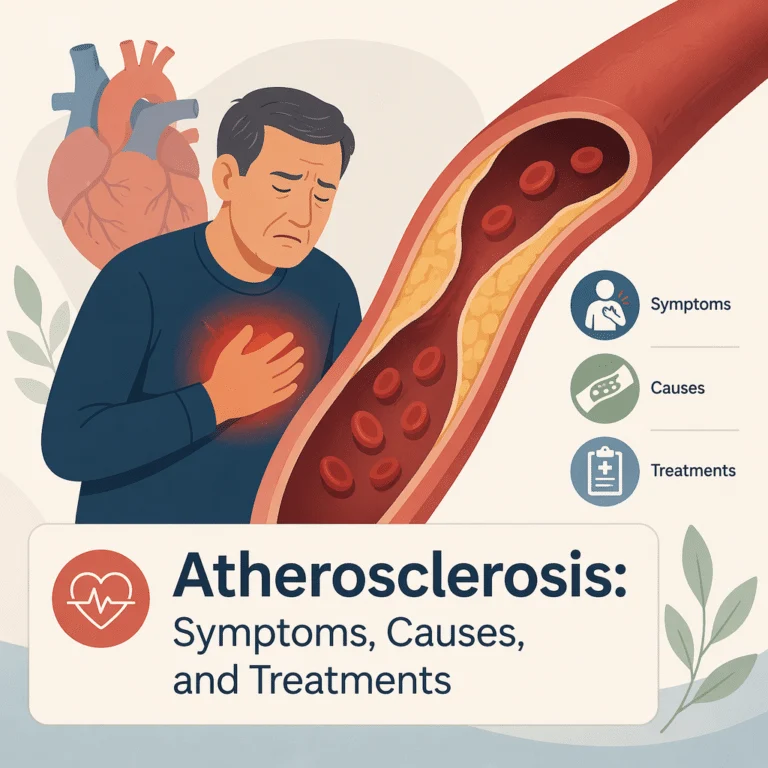
Atherosclerosis is the slow, silent process behind most heart attacks, most strokes, and most cases of leg pain that stops people mid-walk. It begins as a microscopic injury to an artery’s smooth inner lining, collects cholesterol-carrying particles and immune cells there, and gradually builds a raised deposit called plaque.
Autopsy studies of young accident victims have found fatty streaks in the aortas of teenagers. By the time chest pain arrives, the disease is usually decades old. That cuts both ways: the window for changing course is enormous, and what happens inside your arteries shows up in blood work long before symptoms.
What is atherosclerosis?
Atherosclerosis is the buildup of plaque inside arteries. Plaque is a mixture of cholesterol, fatty debris, calcium, and fibrous tissue that accumulates within the artery wall itself rather than coating its surface. As it grows, the channel narrows and the vessel stiffens.
The word is often confused with arteriosclerosis, the umbrella term for any hardening or thickening of arterial walls, including age-related stiffening. Atherosclerosis is the specific subtype driven by lipid-rich plaque. Every case of atherosclerosis is a form of arteriosclerosis, but not the reverse.
The biology starts with endothelial injury. The endothelium is the single-cell layer lining every blood vessel, and high blood pressure, tobacco smoke, high blood sugar, and excess cholesterol particles all damage it. LDL then slips into the wall, becomes oxidized, and attracts white blood cells that engulf it and turn into foam cells. Those cells die and spill their lipid contents, forming a soft core under a fibrous cap.
What happens next decides everything. A thick, calcified cap over a small core is relatively stable. A thin cap over a large, inflamed core can rupture without warning, and the body responds by forming a clot that seals the artery in seconds. That is the mechanism behind most heart attacks, and it explains why the deadliest plaques are rarely the largest.
When plaque narrows the vessels feeding the heart muscle, clinicians diagnose coronary artery disease, the most common cause of heart attack in the United States. Atherosclerosis is the process; coronary, carotid, and peripheral artery disease are the names it takes in different territories.
Symptoms and warning signs
Why atherosclerosis stays silent for decades
Arteries compensate. Early on, the wall bulges outward as plaque accumulates, preserving the internal channel and keeping flow normal, and the body grows collateral vessels that reroute blood around a narrowing. Symptoms usually emerge only when a narrowing reaches roughly 70 percent of the vessel diameter, or when a plaque ruptures abruptly. That is why someone can pass a routine physical on Monday and have a heart attack on Friday.
How symptoms differ by artery bed
In the heart, reduced flow during exertion typically produces angina, the chest pressure or tightness that appears with activity and eases with rest. Discomfort may radiate to the jaw, neck, or left arm. Women, older adults, and people with diabetes more often report breathlessness, fatigue, or nausea.
In the brain and neck, a carotid plaque can shed debris that lodges in a smaller cerebral vessel and triggers a stroke that destroys brain tissue within minutes. Watch for sudden one-sided weakness, slurred speech, vision loss in one eye, or loss of balance. If these resolve quickly, the event is a transient ischemic attack, which often precedes a full stroke.
In the legs, narrowed arteries cause claudication: cramping in the calf, thigh, or buttock that starts after a predictable walking distance and fades with rest. Other clues include one colder foot and foot wounds that refuse to heal.
Causes and risk factors
Decades of genetic and randomized trial evidence implicate LDL cholesterol, the particle that carries fat into the artery wall and starts the entire process. The relationship is cumulative: exposure over years, not any single reading, determines how much plaque accumulates.
Blood pressure is the second driver, because mechanical stress damages the endothelium and forces lipid particles into the wall. That is why guidelines push clinicians to treat high blood pressure that stiffens and scars the arterial lining over time.
Elevated blood sugar injures the vessel lining and modifies lipoproteins so they stick more readily, which is why cardiologists and endocrinologists jointly monitor type 2 diabetes that accelerates plaque growth in every vascular bed.
Smoking damages the endothelium, raises clotting tendency, and lowers protective HDL; risk starts falling within weeks of quitting. Other contributors include chronic inflammation from rheumatoid arthritis, lupus, or psoriasis; kidney disease; sleep apnea; abdominal obesity; and sedentary living. Age sets the baseline, with risk rising sharply in men after 45 and women after 55, and familial hypercholesterolemia, affecting roughly 1 in 250 people, produces very high LDL from birth.
How atherosclerosis is diagnosed
Because symptoms arrive late, diagnosis usually starts with risk estimation rather than complaints. A clinician combines age, sex, blood pressure, smoking, diabetes, and cholesterol into a 10-year risk calculation, then decides whether imaging or extra biomarkers would change management.
The blood tests that matter most
A standard lipid panel reports total cholesterol, LDL cholesterol, HDL cholesterol, and triglycerides. It is the foundation, but not the whole picture, because LDL measures the cargo rather than the number of delivery vehicles.
Since two people with identical LDL values can carry very different particle counts, preventive cardiologists increasingly order an apolipoprotein B test that counts every atherogenic particle in circulation. Each LDL, VLDL, and Lp(a) particle carries one ApoB molecule, so the result is a direct particle count.
Professional societies now recommend a once-in-a-lifetime lipoprotein(a) measurement that exposes an inherited risk diet cannot touch. Because levels are more than 90 percent genetically determined, one result usually suffices for life.
When risk sits in a gray zone, clinicians often add a high-sensitivity CRP test that gauges the low-grade inflammation driving plaque instability. HbA1c reveals average blood sugar over about three months and can uncover prediabetes years before fasting glucose turns abnormal.
Imaging then confirms what blood work suggests. A coronary artery calcium score is a low-dose CT quantifying calcified plaque; zero is strongly reassuring, while a score above 100 usually prompts intensive treatment. Carotid ultrasound detects neck plaque without radiation, and the ankle-brachial index compares ankle and arm pressure, with a ratio below 0.90 indicating peripheral artery disease.
Treatment options
Treatment has three aims: lower the drivers feeding plaque growth, stabilize plaque so it does not rupture, and restore flow where a narrowing already causes harm. Most people need the first two; only a minority need the third.
| Approach | Examples | What it targets |
|---|---|---|
| Lifestyle change | Mediterranean eating, exercise, quitting tobacco | LDL, blood pressure, insulin resistance, inflammation |
| Statins | Atorvastatin, rosuvastatin, simvastatin | Liver cholesterol production and plaque stability |
| Non-statin lipid drugs | Ezetimibe, PCSK9 inhibitors, inclisiran, bempedoic acid | Extra LDL and ApoB reduction beyond statins |
| Blood pressure medication | ACE inhibitors, ARBs, calcium blockers, thiazides | Mechanical stress on the vessel wall |
| Antiplatelet therapy | Low-dose aspirin, clopidogrel | Clot formation on a ruptured plaque |
| Metabolic therapy | Metformin, SGLT2 inhibitors, GLP-1 receptor agonists | Glucose, weight, and event risk |
| Revascularization | Angioplasty with stenting, bypass, endarterectomy | One severe narrowing causing symptoms |
One nuance matters: a stent relieves symptoms and saves lives during a heart attack, but it does not treat disease elsewhere. Medication and lifestyle work everywhere at once, which is why they remain the backbone of care.
Prevention and daily management
Diet has the widest reach. Mediterranean-style eating, built on vegetables, legumes, whole grains, fish, nuts, and olive oil, has the strongest randomized evidence for cutting cardiovascular events. Soluble fiber from oats, beans, and psyllium lowers LDL, unsaturated fat beats saturated fat, and holding sodium below 2,300 milligrams daily lowers blood pressure.
Physical activity raises HDL, lowers triglycerides, improves insulin sensitivity, and stimulates collateral vessel growth. Aim for 150 minutes of moderate aerobic activity weekly plus two resistance sessions.
Consistency matters, because statins and blood pressure drugs work only while taken. If side effects appear, the answer is usually switching agents or adjusting the dose rather than stopping.
Living with atherosclerosis: outlook
A diagnosis is not a countdown clock. People with well-managed disease routinely live full lives for decades, and modern therapy has changed the arithmetic.
Plaque regression is possible, though usually partial. Serial imaging trials show intensive LDL lowering can shrink plaque volume by a few percent and, more importantly, change its composition by thickening the fibrous cap and shrinking the lipid core. That shift reduces rupture risk even when the narrowing barely moves.
Management also means recognizing emergencies: chest pain lasting more than a few minutes, sudden one-sided weakness, garbled speech, vision loss, or a cold painful limb all require immediate care.
Latest scientific advances
In late 2025, the New England Journal of Medicine published VESALIUS-CV, a trial testing whether aggressive cholesterol lowering helps people who have atherosclerosis or diabetes but have never had a heart attack or stroke. Investigators randomly assigned 12,257 adults with LDL cholesterol of at least 90 mg/dL to evolocumab, an injectable PCSK9 inhibitor (a drug blocking a liver protein that would otherwise destroy the receptors clearing LDL from blood), or placebo, then followed them a median of 4.6 years. At five years, 6.2 percent of the evolocumab group had suffered coronary death, heart attack, or ischemic stroke, versus 8.0 percent on placebo, a 25 percent relative reduction. Counting artery-opening procedures too, rates were 13.4 versus 16.2 percent, with no difference in safety events (Bohula et al., 2025). What this means for you: waiting until after a first heart attack to treat cholesterol intensively is no longer the default, and if imaging already shows plaque, your LDL target may be lower than you were once told.
A second 2025 trial in the Journal of the American College of Cardiology examined the opposite end of the risk spectrum. VICTORION-Mono enrolled 350 adults aged 18 to 75 with LDL between 100 and 190 mg/dL, no cardiovascular disease, no diabetes, and no cholesterol medication. Participants received inclisiran, a small interfering RNA therapy that silences PCSK9 production inside liver cells and is dosed twice yearly, or ezetimibe, or placebo. By day 150, LDL had risen 1.4 percent on placebo, fallen 11.2 percent on ezetimibe, and fallen 46.5 percent on inclisiran, an advantage of 47.9 percentage points over placebo (Taub et al., 2025). What this means for you: people who cannot tolerate statins now have controlled evidence behind a twice-yearly injection, though long-term outcome data are still being collected.
A 2024 review in The Lancet consolidated what is known about lipoprotein(a), an LDL-like particle carrying an extra protein that makes it more inflammatory and more clot-promoting. The authors concluded that roughly one in five people worldwide carry concentrations high enough to raise their risk of atherosclerotic cardiovascular disease and aortic valve narrowing. Levels are more than 90 percent genetically determined and run about 17 percent higher in postmenopausal women than in men. No approved drug lowers Lp(a) yet, but at least five compounds in development cut concentrations by 65 to 98 percent, three of them in large outcome trials (Nordestgaard and Langsted, 2024). What this means for you: if your Lp(a) has never been measured, a single test can meaningfully reclassify your risk.
Myths and facts
Myth: atherosclerosis is a disease of old age. Fact: fatty streaks appear in adolescence and measurable plaque is common by the third decade. It is old when diagnosed, not when it starts.
Myth: normal cholesterol means healthy arteries. Fact: roughly half of first heart attacks occur in people whose LDL sits inside the standard reference range. Blood pressure, blood sugar, Lp(a), inflammation, and smoking all contribute independently.
Myth: supplements can clear out arteries. Fact: no supplement has been shown to dissolve plaque, and chelation therapy has failed to show meaningful benefit in controlled trials.
Glossary
| Term | Meaning |
|---|---|
| Plaque | Cholesterol, immune cells, calcium, and fibrous tissue deposited inside the artery wall |
| Endothelium | The single-cell layer lining every blood vessel, whose injury starts atherosclerosis |
| ApoB | Apolipoprotein B, one molecule per atherogenic particle, so a direct particle count |
| Lp(a) | An inherited LDL-like particle that is more inflammatory and clot-promoting |
| hs-CRP | High-sensitivity C-reactive protein, a marker of low-grade inflammation |
| Calcium score | A low-dose CT measurement of calcified plaque in the coronary arteries |
| Claudication | Predictable leg cramping brought on by walking and relieved by rest |
Frequently asked questions
What is atherosclerosis in simple terms?
Atherosclerosis is plaque buildup inside your arteries. Cholesterol-carrying particles slip through a damaged spot in the artery lining, immune cells follow, and the resulting mix of fat, cells, and fibrous tissue forms a raised deposit within the wall. Over years it narrows the channel and stiffens the vessel. The danger is twofold: narrowing starves tissue during exertion, and the deposit can rupture and trigger a clot.
What is the difference between arteriosclerosis and atherosclerosis?
Arteriosclerosis is the general term for any hardening or thickening of artery walls, including the stiffening that comes with age and the small-vessel changes caused by long-standing high blood pressure. Atherosclerosis is one specific subtype, caused by cholesterol-rich plaque forming inside the wall. Every case of atherosclerosis counts as arteriosclerosis, but not the reverse. In practice most reports mentioning arteriosclerosis describe atherosclerotic disease.
Can atherosclerosis be reversed?
Partially. Intensive cholesterol lowering combined with lifestyle change can shrink plaque volume modestly in serial imaging studies, and it reliably alters plaque structure by thickening the protective fibrous cap and shrinking the soft lipid core. That shift matters more than volume, because it makes rupture far less likely. What does not happen is a return to clear arteries; the realistic goal is halting progression and stabilizing what is there.
What does mild atherosclerosis mean on a scan report?
It means imaging picked up plaque that is not currently restricting blood flow in a meaningful way. That is a finding rather than an emergency, but it is not nothing: it confirms the process is underway and your risk is higher than someone with clear arteries. Mild disease is the ideal moment to act, because treatment started here prevents far more events than treatment started later.
What are the stages of atherosclerosis?
The process moves through recognizable phases. First comes endothelial injury, damage to the artery’s inner lining. Next, LDL particles enter the wall and become oxidized, attracting immune cells that turn into foam cells and create a fatty streak. Those streaks develop into fibrous plaque with a lipid core under a cap. Over time plaque may calcify and narrow the channel, and an inflamed thin-capped plaque can rupture.
Is atherosclerosis the same as coronary artery disease?
They are related but not identical. Atherosclerosis is the underlying disease process, and it can occur in arteries anywhere in the body. Coronary artery disease is what that process is called when it affects the arteries supplying the heart muscle. The same biology in the neck is carotid artery disease, and in the legs peripheral artery disease. Disease in one bed predicts disease in the others.
Sources
- Centers for Disease Control and Prevention — About Heart Disease — CDC, 2024 — cdc.gov
- National Heart, Lung, and Blood Institute — Atherosclerosis — National Institutes of Health, 2022 — nhlbi.nih.gov
- Mayo Clinic — Arteriosclerosis and Atherosclerosis — Mayo Clinic, 2024 — mayoclinic.org
- American Heart Association — Atherosclerosis — American Heart Association, 2024 — heart.org
- Bohula EA, Marston NA, Sabatine MS, et al. — Evolocumab in Patients without a Previous Myocardial Infarction or Stroke — New England Journal of Medicine, 2025 — doi.org
- Taub PR, Wright RS, et al. — Safety and Lipid-Lowering Efficacy of Inclisiran Monotherapy in Patients Without ASCVD — Journal of the American College of Cardiology, 2025 — doi.org
- Nordestgaard BG, Langsted A — Lipoprotein(a) and Cardiovascular Disease — The Lancet, 2024 — doi.org
Further reading
- Anyone reviewing a lipid report for the first time should start with our full guide to high cholesterol, its causes, symptoms, and treatments.
- Readers who want to decode the headline number on their panel can explore total cholesterol and what your levels actually indicate.
- People with insulin resistance should also review triglycerides and what your blood levels reveal about cardiovascular risk.
- Anyone tracking blood sugar alongside lipids can check fasting glucose and how to interpret your test results.
Understand your lab results with BloodSense
Atherosclerosis is one of the few serious diseases whose progress you can genuinely follow in a blood tube. LDL cholesterol, apolipoprotein B, lipoprotein(a), triglycerides, HbA1c, and high-sensitivity CRP together show how hard the process is being pushed and whether your plan is working. Watching those numbers move over months and years tells you far more than any single reading.
BloodSense turns a raw lab report into plain-language explanations of what each marker means, where your value sits against reference ranges, and which results deserve a conversation with your clinician.