






Bipolar I Disorder: Symptoms, Mania, Causes, Treatment
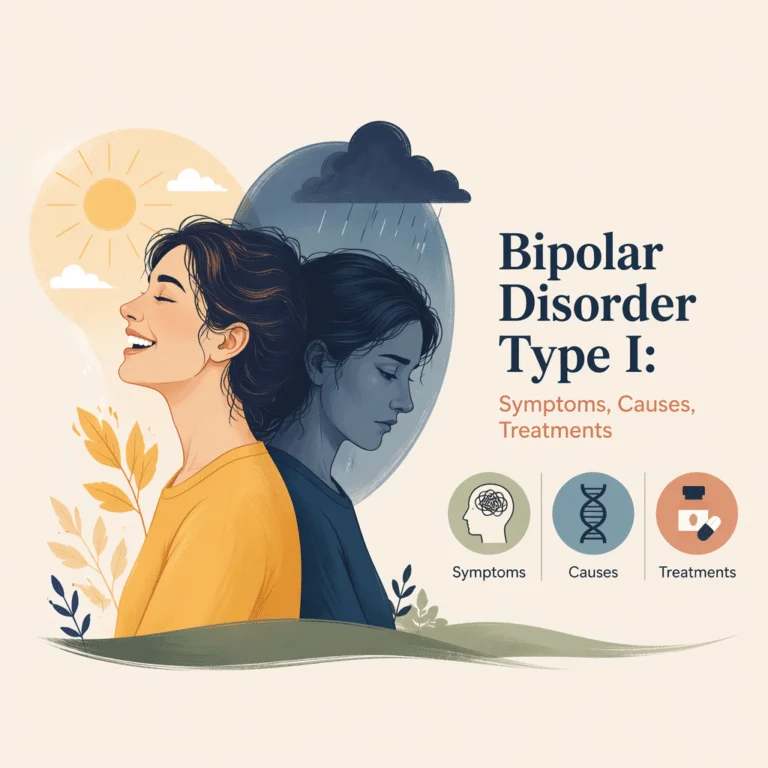
Bipolar I disorder is defined by one thing above all: at least one full manic episode. That single criterion separates it from bipolar II, where elevated periods stay at the level of hypomania and never reach full mania. A bipolar I diagnosis can follow one manic episode even if major depression never occurred, though most people living with bipolar I experience depression too.
This guide stays close to what makes bipolar I distinct: what mania looks like, why psychosis can accompany it, when hospital care is safest, and how it is treated. Bipolar I is a long-term condition, but it is treatable, and many people go years between episodes. For the wider view, read a general bipolar disorder guide that introduces the whole diagnostic family.
What is bipolar I disorder?
Bipolar I is a mood disorder in which the brain’s regulation of energy, sleep, drive, and emotion periodically shifts far outside a person’s usual range. The diagnostic anchor is the manic episode: a distinct period of abnormally elevated, expansive, or irritable mood with a persistent rise in activity or energy, present most of the day nearly every day for at least a week, or any duration if hospital care is needed.
Between episodes many people return to baseline, a state clinicians call euthymia. The National Institute of Mental Health estimates that about 4.4% of U.S. adults meet criteria for some form of bipolar disorder in their lifetime, bipolar I among them. Symptoms usually begin in the late teens or twenties.
Manic episodes: what they actually look like
The word “manic” is used loosely in everyday speech to mean busy or hectic; clinically it describes something far more disruptive. During a manic episode a person may need dramatically less sleep yet feel energized, speak so rapidly that others cannot interrupt, and think faster than words follow.
Episodes typically include several of these: grandiosity, reduced need for sleep, pressured speech, racing thoughts, distractibility, a surge in goal-directed activity or agitation, and activities with a high potential for painful consequences such as unplanned spending. Mania is not simply an unusually good mood; irritable, agitated mania is common, and insight is often reduced, which is why family or coworkers notice it first.
Psychosis during mania
Psychotic features occur in a substantial share of severe manic episodes and are among the clearest markers separating bipolar I from bipolar II. Psychosis here usually means delusions, fixed beliefs held despite contrary evidence, and less often hallucinations, with content that is frequently mood-congruent: special abilities, a grand mission, or an important identity.
Because these features appear in more than one condition, a clinician assessing a first psychotic episode also considers a primary psychotic disorder such as schizophrenia that shares overlapping features. What distinguishes bipolar I is timing: psychosis arrives with mood episodes and clears as they clear, so it is a treatable symptom rather than a permanent state.
When hospitalization becomes necessary
A manic episode requiring hospital care meets the bipolar I threshold regardless of duration. Admission is considered when someone has gone several nights with almost no sleep, when judgment is impaired enough that safety cannot be maintained, when psychosis is present, or when there are thoughts of suicide.
Inpatient care has narrow goals: restore sleep, reduce agitation and psychotic symptoms, adjust medication under supervision, and provide a calm environment. Most stays last days to a couple of weeks, then step down to outpatient care. Hospitalization treats an acute episode; it is not evidence that treatment has failed.
Depressive episodes in bipolar I
Although mania defines the diagnosis, depression accounts for more of the time a person spends unwell. Depressive episodes bring persistently low mood or loss of interest with altered sleep and appetite, fatigue, slowed thinking, and feelings of worthlessness. Bipolar depression more often involves sleeping too much, eating more, and heaviness in the limbs. Many people also want to understand the broader picture of depression as a standalone condition.
Depressive and mixed states carry real suicide risk in bipolar I, and this is where reaching out early matters most. If you are having thoughts of suicide, you can call or text 988 in the United States to reach the 988 Suicide & Crisis Lifeline, at any hour. It is free and confidential, and open to family or friends worried about someone else. Telling a clinician about these thoughts changes the treatment plan rather than ending it.
Mixed features, where low mood arrives with racing thoughts or agitation, feel especially distressing and call for prompt review.
Bipolar I vs bipolar II
The two diagnoses differ in the ceiling that elevated mood reaches.
| Feature | Bipolar I | Bipolar II |
|---|---|---|
| Defining episode | One full manic episode | One hypomanic plus one depressive episode |
| Duration of elevated mood | Seven days or more, or any length if hospitalized | At least four consecutive days |
| Depressive episode required | No | Yes |
| Psychosis when elevated | Possible | Absent; if present, it is mania |
| Hospital care when elevated | Sometimes necessary | Uncommon |
| Functional impact | Marked disruption | Visible to others, no marked disruption |
Neither is a milder version of the other, since bipolar II often brings longer depressive periods. Anyone weighing the two should read a dedicated bipolar II guide that covers hypomania and its care plan in depth.
Causes and risk factors
No single cause explains bipolar I. Genetics carry the largest measurable weight: twin and family studies place the heritability of bipolar disorder among the highest in psychiatry, and having a parent or sibling with it raises risk substantially. The contribution is polygenic, from many common variants of small effect, some shared with schizophrenia and depression.
Certain circumstances can precipitate an episode. Sleep loss is the most consistently reported trigger, including the kind produced by night shifts, travel, or a new baby, and the postpartum weeks are a high-risk window. Alcohol and stimulant use, medications such as corticosteroids, and intense stress also recur in personal histories. What does not cause bipolar I is worth naming: it is not the result of parenting style, weakness, or moral failing.
How bipolar I is diagnosed
Diagnosis rests on a clinical interview and a careful lifetime history, not on any single test. A clinician asks about the current episode, then works backward looking for any period of elevated or irritable mood with increased energy, how long it lasted, and what it changed. Because insight during mania is limited, an account from a partner or close friend is often decisive, and screening questionnaires never confirm a diagnosis. Bipolar I is often missed at first because most people seek help while depressed, not while manic.
The blood tests that matter
No blood test diagnoses bipolar disorder. Lab work serves two other purposes: ruling out conditions that mimic mania or depression, and monitoring treatment safety once medication begins.
Thyroid function comes first, since overactive and underactive thyroid states both produce mood and energy changes. Care teams following lithium treatment routinely order a thyroid stimulating hormone test that tracks thyroid function. Serum calcium is checked too, since lithium can raise it through the parathyroid glands, and clinicians monitor an estimated glomerular filtration rate that shows how efficiently the kidneys filter blood.
Second-generation antipsychotics need metabolic follow-up including fasting glucose and a lipid panel, and some mood stabilizers require clinicians to repeat liver enzymes and a complete blood count that measures red cells, white cells, and platelets. A workup for reversible contributors may add a vitamin D measurement and a vitamin B12 level that influences mood, memory, and energy.
Treatment options
Treatment is organized around three jobs: settling acute mania, treating acute depression, and preventing the next episode. This section describes the classes that exist, not what any individual should take.
For acute mania, the mainstays are mood stabilizers such as lithium and valproate and second-generation antipsychotics such as aripiprazole, quetiapine, and cariprazine. In severe episodes the two are often combined, a sedating medication may briefly restore sleep, and antidepressants are usually paused. For acute bipolar depression, several medications carry U.S. Food and Drug Administration approval, including quetiapine, lurasidone, and lumateperone; antidepressants alone are generally avoided because they can destabilize mood.
Maintenance treatment is where long-term outcomes are decided. Lithium has the strongest evidence for preventing relapse at both poles, with valproate, lamotrigine, and several antipsychotics also used depending on a person’s history. Maintenance works only while treatment continues, and stopping a mood stabilizer without medical supervision is genuinely risky, since abruptly discontinuing lithium is associated with early relapse. If side effects are troubling, the productive step is a conversation about alternatives, not a unilateral stop.
Medication is necessary but rarely sufficient. Psychoeducation, family-focused therapy, cognitive behavioral therapy, and interpersonal and social rhythm therapy all have supporting evidence as additions to medication. Electroconvulsive therapy remains an option for treatment-resistant mania, mania with psychosis, catatonia, and severe bipolar depression.
Daily management and relapse prevention
Sleep is the most important daily variable in bipolar I, since a shortened night is both a symptom and a trigger. Anyone whose nights are consistently broken should say so early, because a care plan may need to address persistent insomnia that keeps a sleep schedule from stabilizing. A predictable daily rhythm also reduces the shocks the system absorbs.
Mood tracking makes early warning signs visible. Most people have a signature that precedes an episode by days or weeks: needing less sleep, starting projects late at night, talking faster, spending more, or withdrawing and losing interest in food. Writing these signs down while well, with a plan naming who to contact first, turns a vague worry into a checklist. Reducing alcohol, cannabis, and stimulants lowers relapse risk further.
Living with bipolar I: outlook
Bipolar I follows a relapsing and remitting course: episodes come and go rather than persist, and that course is highly modifiable. People who start treatment early, stay in contact with a care team, and maintain medication tend to have fewer and shorter episodes. Stability measured in years is realistic, not exceptional. Rates of cardiovascular and metabolic conditions are also higher in bipolar disorder, making routine blood pressure, glucose, and lipid checks part of good psychiatric care.
Latest scientific advances
A 2024 overview in BMJ Open examined how well valproate performs across every phase of bipolar disorder. An overview of systematic reviews pools the conclusions of many earlier review papers rather than analyzing individual patients. Drawing on 26 reviews, the authors found that in acute mania, across 31 randomized trials with 4,376 participants, valproate produced a better response than placebo (risk ratio 1.42, 95% CI 1.19 to 1.71), with no significant difference from lithium. In maintenance, across 11 trials with 1,063 participants, it beat placebo at preventing relapse of any mood episode (risk ratio 0.63, 95% CI 0.48 to 0.83) (Mari et al., 2024). What this means for you: valproate is well supported for acute mania and for prevention, and it requires liver and blood count monitoring.
A 2024 randomized clinical trial in JAMA Psychiatry tested whether the type of add-on group psychotherapy matters. Researchers enrolled 305 adults who were currently well, 207 of them (68%) living with bipolar I, and assigned them at random to a structured skills-based cognitive behavioral program or a supportive, emotion-focused one, each given as 24 hours of group therapy across four days, then followed them for 18 months. Relapse rates were essentially the same, 49% and 46%, and outcomes were predicted by diagnosis, coexisting conditions, and session attendance rather than by which therapy people received (Hautzinger et al., 2024). What this means for you: attending consistently matters more than the brand of therapy.
Myths and facts
- Myth: bipolar I means mood flipping several times a day. Fact: episodes are sustained states lasting days, weeks, or months, though mixed features can bring both poles at once.
- Myth: mania feels good, so people enjoy it. Fact: irritability, agitation, and fear are common, and the aftermath often includes damaged finances and relationships.
- Myth: people living with bipolar I are unpredictable or dangerous. Fact: bipolar I is a medical condition, and people living with it are far likelier to be harmed than to cause harm.
- Myth: medication can stop once you feel well. Fact: feeling well is usually evidence that maintenance treatment is working, and any change should be planned with a prescriber.
Glossary
| Term | What it means |
|---|---|
| Manic episode | A week or more of elevated or irritable mood with increased energy and marked disruption, or any length if hospitalized. |
| Hypomania | A shorter, milder version of the same state, lasting at least four days. |
| Mixed features | Symptoms of both poles at once, such as low mood with racing thoughts. |
| Euthymia | Stable mood between episodes, near a person’s usual baseline. |
| Psychotic features | Delusions or hallucinations during a mood episode, clearing as it clears. |
| Mood stabilizer | A medication class that reduces the frequency and severity of mood episodes. |
| Rapid cycling | Four or more mood episodes within twelve months. |
| Electroconvulsive therapy | A procedure under brief anesthesia for severe or treatment-resistant episodes. |
Frequently asked questions
What is bipolar 1 disorder?
Bipolar 1 disorder is a mood condition diagnosed when a person has had at least one full manic episode: roughly a week or more of abnormally elevated or irritable mood with sustained high energy that markedly disrupts daily life, or a shorter episode needing hospital care. Most people also have depressive episodes, with stable mood in between. It usually begins in the late teens or twenties and responds well to treatment.
What is the difference between bipolar 1 and bipolar 2?
The difference is how high elevated mood goes. Bipolar 1 requires one full manic episode, lasting seven days or more, which can involve psychosis and may need hospital care. Bipolar 2 requires a hypomanic episode lasting at least four days, noticeable to others but without severe impairment or psychosis, plus a major depressive episode, which bipolar 1 does not require.
What are the early signs of a manic episode?
The most reliable early sign is needing less sleep without feeling tired the next day. Others include talking faster than usual, thoughts outrunning speech, starting several projects at once, increased spending, heightened confidence, and unusual irritability. These changes often appear days or weeks ahead, and because insight fades as mania builds, writing your warning signs down while well helps you catch episodes early.
Is there a bipolar test or blood test that confirms the diagnosis?
No. There is no blood test, brain scan, or genetic test that diagnoses bipolar 1. Diagnosis comes from a clinical interview covering your full mood history, usually supported by observations from family or close friends. Online questionnaires flag the possibility but cannot confirm it. Blood work still plays two roles: ruling out conditions that mimic mood episodes, such as thyroid disease, and monitoring organ and metabolic health once medication begins.
Can someone with bipolar 1 live a normal life?
Yes. Bipolar 1 is a long-term condition, but it is treatable, and many people living with it work, study, maintain relationships, and raise families. The factors most associated with good outcomes are practical: consistent maintenance treatment, protected sleep, an ongoing relationship with a care team, early recognition of warning signs, and a plan agreed in advance for what happens if an episode begins.
Sources
- National Institute of Mental Health — Bipolar Disorder — NIMH, 2025 — nimh.nih.gov
- MedlinePlus — Bipolar Disorder — U.S. National Library of Medicine, 2025 — medlineplus.gov
- SAMHSA — 988 Suicide & Crisis Lifeline — SAMHSA, 2025 — samhsa.gov
- Mari J, et al. — Efficacy of valproate in acute mania, bipolar depression and maintenance therapy — BMJ Open, 2024 — doi.org
- Haenen N, et al. — Efficacy of lamotrigine in bipolar disorder — Bipolar Disorders, 2024 — doi.org
- Hautzinger M, et al. — Adjuvant Psychotherapies to Prevent Relapse in Bipolar Disorder — JAMA Psychiatry, 2024 — doi.org
Further reading
- Anxiety frequently accompanies bipolar I, and this guide explains the symptoms, causes, and effective treatments for anxiety disorders.
- Attention difficulties are often confused with early mania, so it is worth reading how ADHD symptoms are recognized and treated.
- An underactive thyroid can imitate a depressive episode, and this article covers hypothyroidism and the treatments that manage it.
- Second-generation antipsychotics affect blood sugar, so it helps to understand a fasting glucose result and what its reference range means.
Understand your lab results with BloodSense
Nobody diagnoses bipolar I from a lab report, but blood work runs alongside treatment for years. A care team following someone on lithium watches thyroid function, kidney function, and serum calcium. Some mood stabilizers add liver enzymes and a complete blood count, while second-generation antipsychotics bring metabolic follow-up including fasting glucose and a lipid panel. Vitamin D and B12 are often checked early to rule out reversible causes of low mood and fatigue.
Those numbers arrive as abbreviations and reference ranges, making it hard to tell what changed and what deserves a question at your appointment. BloodSense turns a lab report into plain-language explanations of each marker.