









White Spots on Tonsils and Throat: Causes, Tests and When to Worry
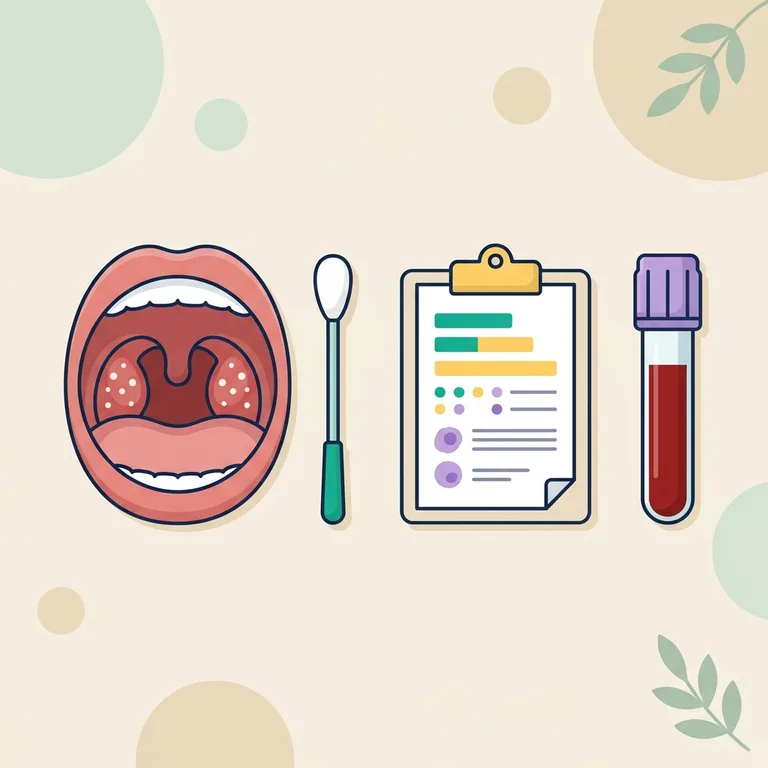
The essentials
White spots or patches on the tonsils are usually a sign of tonsillitis, and most cases are caused by a virus, not by strep. Other common causes are mono and harmless tonsil stones; thrush and rarer conditions are also possible. A throat swab and sometimes a blood test (complete blood count and mono test) show which one it is, and only a bacterial cause needs antibiotics.
What are white spots on the tonsils, at a glance?
- What they are: a symptom, not a disease. Doctors call the white or yellow coating "tonsillar exudate" or pus on the tonsils[1]. The spots can also be tonsil stones, a fungal coating or, rarely, a patch of the lining itself.
- How common: sore throat with tonsillitis is very common, especially in children[2]. Strep bacteria cause only 20 to 30% of sore throats in children and 5 to 15% in adults[3].
- The key point: pus on the tonsils does not prove a bacterial infection. Even with a high score on the doctor's checklists (pus, fever, no cough), strep is found in only 32 to 65% of people[1].
- Key tests: a rapid strep test or throat culture, a complete blood count and a mono test[5].
What do white spots on the throat look like, and what comes with them?
What you see in the mirror, and what you feel, already points toward a cause:
- Spots or streaks of pus on red, swollen tonsils, with a painful throat, fever and tender glands at the front of the neck: tonsillitis, viral or bacterial[2].
- A thick whitish-yellow coating on large tonsils, with marked tiredness and swollen glands at the back of the neck, sometimes in the armpits: typical of mono[4][5].
- Small, hard, white or yellow lumps in the holes of the tonsils, with bad breath but little or no pain or fever: tonsil stones[8].
- White, velvety patches on the tongue, cheeks and throat that bleed a little when scraped: thrush, a yeast infection[7].
- A white patch that does not wipe off and does not go away, usually painless: it needs to be checked by a dentist or doctor[9].
White spots without fever or pain are often tonsil stones or a past infection settling down. A rough red rash with the sore throat suggests scarlet fever[2].
When should I worry about white spots on my tonsils?
When to see a doctor
- Emergency: call 911 for trouble breathing, noisy breathing, drooling or being unable to swallow your saliva, or a severe, one-sided throat pain with difficulty opening the mouth and a muffled voice (possible abscess)[10]. Also for sudden, severe belly pain during mono[5].
- Within 24 to 48 hours for pus on the tonsils with a fever of 101°F (38.3°C) or more, tender swollen neck glands, a rough red rash, or a sore throat so painful that eating and drinking are hard[2]. Also if you have white patches and a weakened immune system[7].
- At your next appointment if a sore throat has not improved after about 1 week[1], if tonsil stones keep coming back, or if a white patch in the mouth or throat does not go away[9].
What causes white patches on the throat?
Common causes come first; the rare ones are worth knowing but should not be your first thought.
- Common Viral tonsillitis (colds, flu, adenovirus): the most frequent cause of a sore throat, which gets better on its own[1][12].
- Common Strep throat (group A streptococcus): sudden pain, fever, pus and tender front neck glands, usually without cough, most often at ages 5 to 15[3]. Our strep throat guide covers the rapid test and antibiotics in detail.
- Common Tonsil stones (tonsilloliths): small deposits in the folds of the tonsils, seen on 27.6% of head and neck scans in one study of 3,516 people, more often with age[8]. They are harmless.
- Possible Infectious mononucleosis (Epstein-Barr virus), most common between 15 and 24 years of age[4]. In one study, pus on the throat and swollen glands at the back of the neck were the two signs that best predicted it[6].
- Possible Oral thrush (candida infection): more likely after antibiotics, with steroid inhalers for asthma, with diabetes and high blood sugar, with dentures that fit badly, or with a weakened immune system such as HIV[7].
- Rare Sexually transmitted infections of the throat, such as gonorrhea or syphilis, after oral sex; testing is the only way to know.
- Rare Diphtheria: a thick grey coating over the tonsils and throat 2 to 3 days after infection, with weakness and a swollen neck, in people who are not vaccinated[11].
- Rare Leukoplakia: a white patch that cannot be scraped off, linked to smoking and tobacco; a small number can turn into cancer, which is why a lasting patch is checked and sometimes biopsied[9]. A tonsil that stays much larger on one side also needs a check (rarely a lymphoma).
Which tests find the cause, and how do I read the results?
The doctor first looks at your throat and counts simple signs. Two scores are used: Centor (pus on the tonsils, tender front neck glands, fever over 38°C or 100.4°F, no cough) and FeverPAIN (fever, pus, visit within 3 days, very inflamed tonsils, no cough or runny nose). A low score makes strep unlikely; a high one makes a test or antibiotic more useful[1]. Then, depending on the signs:
- Throat swab: rapid strep test in minutes, or a culture that takes longer. A negative rapid test in a child is often checked by culture[2][3].
- Complete blood count with differential: asked when mono is suspected. Mono is unlikely when the lymphocyte count is below 4,000 per mm³ (4.0 × 10³/µL). Lymphocytes making up at least 50% of white cells, with at least 10% atypical lymphocytes, are typical of mono[4]. See our page on lymphocytes.
- Mono test (heterophile antibody, "Monospot"): fast, but negative in about 25% of people during the first week; if doubt remains, EBV antibodies (VCA IgM) are checked[4][5].
- Other tests, case by case: a scraping for thrush[7], CRP as a general sign of inflammation, liver tests when mono causes hepatitis[5] (see high liver enzymes), an HIV test or STI tests depending on the story.
A fictitious report from a 19-year-old with white tonsils, fever and great tiredness:
| Test | Result | Reference range | Flag |
|---|---|---|---|
| WBC (white blood cells) | 12.6 x10³/µL | 4.5-11.0 | H |
| Lymphocytes | 58 % | 20-40 | H |
| Lymphocytes, absolute | 7.3 x10³/µL | 1.0-4.8 | H |
| Atypical lymphocytes | 14 % | 0 | H |
| Heterophile antibody (Monospot) | Positive | Negative | A |
- H and A: H means above the laboratory's range, A means abnormal for a positive/negative test. Each laboratory prints its own ranges; only those on your report apply.
- Lymphocytes 58% and atypical lymphocytes 14%: above the 50% and 10% marks typical of mono[4].
- Monospot positive: with these symptoms, it supports mono. A negative result in the first week would not rule it out[4].
- What this report does not say: whether strep is also present; only a throat swab answers that.
Swab result, blood count and mono test arriving on different days, each with its own flags? BloodSense explains every line of your complete report in plain words and helps you prepare the questions for your doctor.
Explain my test resultsWhat follow-up is needed?
- Viral tonsillitis: no test of cure. Symptoms often last about 1 week; see a doctor again if they get worse quickly or do not start to improve after a week[1].
- Strep throat: symptoms usually improve 2 to 3 days after starting antibiotics[2]; a new check is needed only if they do not.
- Mono: fever usually drops in about 10 days and swollen glands and spleen settle in about 4 weeks; tiredness can last 2 to 3 months[5]. Sports are avoided for at least the first 3 weeks because of the risk of spleen rupture[4]. A repeat blood count is sometimes done if the first one was very abnormal.
- Thrush that keeps coming back: a check of blood sugar and of the immune system is reasonable[7].
- A lasting white patch: regular checks, sometimes a biopsy[9].
How are white spots on the tonsils treated?
Treatment depends on the cause, not on the white spots themselves. No doses are given here; ask your doctor or pharmacist.
- Virus: rest, fluids, cool drinks, salt-water gargles for adults, and acetaminophen or ibuprofen for pain and fever; never aspirin in children[2][12]. Antibiotics shorten symptoms by only about 16 hours on average[1].
- Strep: an antibiotic after a positive test, taken to the end[2].
- Mono: rest and symptom relief; antibiotics do not work, and amoxicillin or ampicillin can cause a rash[5].
- Thrush: an antifungal mouthwash, lozenge or tablet[7].
- Tonsil stones: usually nothing; gargling and good oral hygiene help. Do not scrape the tonsils with sharp objects.
- Abscess: drainage and antibiotics in hospital[10].
Removing the tonsils is rare, kept for severe tonsillitis that keeps coming back[12].
Can white spots on the throat be prevented?
- Wash your hands, use tissues and stay home while you have a fever[12]. Do not share glasses, cutlery or kisses during mono[5].
- Rinse your mouth after using a steroid inhaler and keep blood sugar under control to limit thrush[7].
- Brush your teeth and tongue and gargle after meals if you get tonsil stones.
- Do not smoke or chew tobacco, and see a dentist regularly[9].
- Keep diphtheria vaccination up to date, including boosters[11].
Questions to ask your doctor
- Do these white spots look like pus, tonsil stones or thrush?
- Is a strep test useful for me, and is a culture needed if it is negative?
- Should I have a blood count and a mono test, and when should the mono test be repeated if it is negative?
- Which signs mean I should come back sooner?
- Is a white patch that has lasted several weeks worth a dental or ENT check?
Frequently asked questions
Are white spots on the tonsils contagious?
The spots themselves are not, but the germs behind them often are: viruses, strep and the mono virus spread through saliva and droplets[5][12]. Tonsil stones are not contagious.
I have white spots but no fever and no pain. Is that normal?
It is often tonsil stones, which cause bad breath more than pain[8]. If a patch does not wipe off and lasts, have it checked[9].
Should I squeeze or scrape the white spots off?
No. Scraping can hurt the tonsil and does not treat an infection. Gentle gargling is enough for tonsil stones.
Can a child get white spots on the tonsils without strep?
Yes. Most sore throats in children are viral, and strep causes only 20 to 30% of them[3]. Young children with hand, foot and mouth disease can also have small sores at the back of the throat.
Related articles
- Strep throatThe rapid test, the culture and which antibiotics are used
- MononucleosisThe virus behind thick white tonsils and long tiredness
- Complete blood countHow to read the white cell lines of your report
- CandidiasisThe yeast infection behind thrush
- Canker soresWhite mouth ulcers and the blood tests that explain them
- National Institute for Health and Care Excellence (NICE). Sore throat (acute): antimicrobial prescribing. NG84; 2018. Recommendations and terms used (FeverPAIN and Centor criteria). nice.org.uk (recommendations), nice.org.uk (criteria) (accessed November 12, 2026)
- MedlinePlus Medical Encyclopedia. Tonsillitis. US National Library of Medicine. medlineplus.gov (accessed November 12, 2026)
- Centers for Disease Control and Prevention. Clinical Guidance for Group A Streptococcal Pharyngitis. 2025. cdc.gov (accessed November 12, 2026)
- Womack J, Jimenez M. Common questions about infectious mononucleosis. Am Fam Physician. 2015;91(6):372-376. aafp.org (accessed November 12, 2026)
- MedlinePlus. Mononucleosis (Medical Encyclopedia) and Mononucleosis (Mono) Tests. US National Library of Medicine. medlineplus.gov (mono), medlineplus.gov (mono tests) (accessed November 12, 2026)
- de Paor M, Boland F, Cai X, et al. Derivation and validation of clinical prediction rules for diagnosis of infectious mononucleosis: a prospective cohort study. BMJ Open. 2023;13(2):e068877. doi:10.1136/bmjopen-2022-068877 (accessed November 12, 2026)
- MedlinePlus Medical Encyclopedia. Thrush - children and adults. US National Library of Medicine. medlineplus.gov (accessed November 12, 2026)
- Yasan H, Sivrice ME, Kumbul YÇ, Büyükçelik B, Kayan M. Is there a relationship between tonsillolith formation and nasal septal deviation or chronic sinusitis, with or without nasal polyps? Turk Arch Otorhinolaryngol. 2025;63(1):16-20. doi:10.4274/tao.2025.2024-12-10 (accessed November 12, 2026)
- NHS. Leukoplakia.nhs.uk (accessed November 12, 2026)
- MedlinePlus Medical Encyclopedia. Peritonsillar abscess. US National Library of Medicine. medlineplus.gov (accessed November 12, 2026)
- World Health Organization. Diphtheria: fact sheet. who.int (accessed November 12, 2026)
- NHS. Tonsillitis. Reviewed March 8, 2024. nhs.uk (accessed November 12, 2026)
This page is general information. It does not replace the advice of a doctor or dentist, who looks at your throat and interprets your results with your symptoms and history.