Chagas Disease: Symptoms, Blood Tests and Treatment
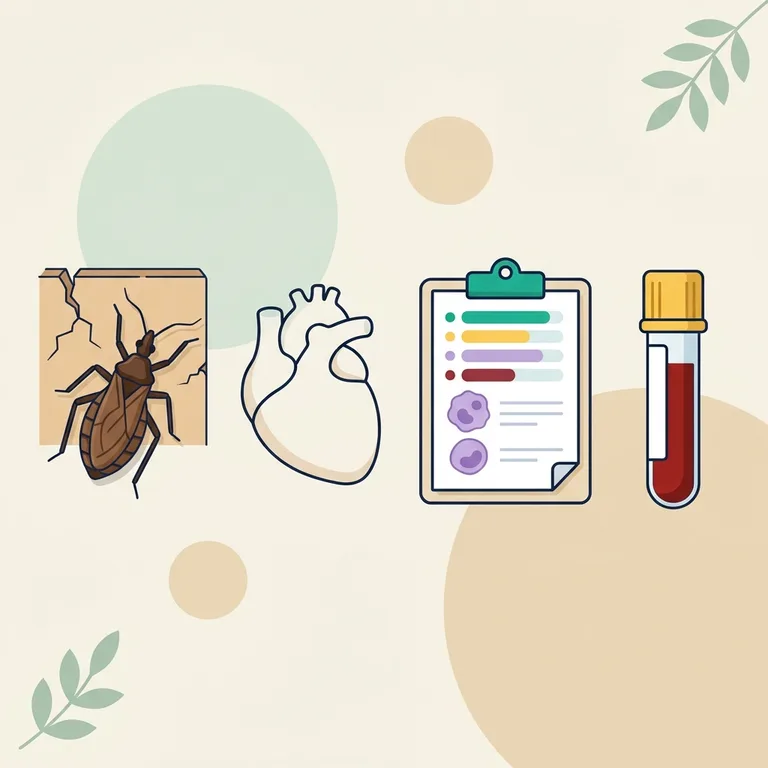
The essentials
Chagas disease is a parasite infection spread mainly by "kissing bugs" in rural Mexico, Central and South America, and from mother to baby. Most people feel nothing for years, while the parasite can slowly damage the heart or gut. A blood test for antibodies, confirmed by a second, different test, finds it. Treatment works best early, so anyone who grew up in an affected area should ask to be tested once.
What is Chagas disease, at a glance?
- Cause: the parasite Trypanosoma cruzi; the illness is also called American trypanosomiasis[1].
- How common: about 8 million people are infected worldwide, mostly in 21 Latin American countries, with more than 10,000 deaths a year[1]. The infection has been found in 44 countries, including the United States, Canada and much of Europe[1].
- In the United States: an estimated 280,000 people live with it, most without knowing[2]; a working group of US experts puts the figure at 326,000 to 347,000[7].
- Key tests: two different antibody tests (IgG antibodies) for a long-standing infection; a blood smear or PCR for a recent one; an ECG to check the heart[3][7].
What are the symptoms of Chagas disease?
Acute phase. In most cases there are no symptoms, or only mild ones that look like any viral illness[1].
- Common No symptoms at all, or fever, fatigue, body aches and headache[2].
- Possible Swollen lymph nodes, rash, loss of appetite, diarrhea or vomiting[1][2].
- Rare A swollen sore where the bug bit (chagoma), or a painless, purplish swelling of the eyelids of one eye, called Romaña's sign[1].
Chronic phase. Most people have no symptoms for the rest of their lives[2]. But 10 to 30 years after infection, up to a third develop heart problems and up to 1 in 10 develop digestive, nerve or mixed problems[1].
- Common Heart: a pounding or irregular heartbeat, fainting, shortness of breath, swollen ankles. The disease can lead to an enlarged heart, heart failure, rhythm problems and sudden death[2][8].
- Possible Gut: an enlarged esophagus or colon, with trouble swallowing or long-lasting constipation[2][12].
- Rare Brain and nerves: stroke caused by clots from a weak heart, and nerve damage[8][10].
When should I see a doctor about Chagas disease?
When to see a doctor
- Emergency: call 911 for fainting, chest pain, severe shortness of breath, a very fast or irregular heartbeat, or sudden weakness or trouble speaking. In a person with Chagas disease, these can be signs of a dangerous heart rhythm or a stroke[8].
- Within 24 to 48 hours for fever with a swollen eyelid or a swollen bite mark after a stay in a rural area of Latin America, or for palpitations, swollen ankles or growing breathlessness if you have tested positive[1][2].
- At your next appointment if you were born or lived for a long time in Mexico, Central or South America, if your mother or a sibling has Chagas disease, or if you are planning a pregnancy and have one of these risks. Ask for a screening test[7].
How do you get Chagas disease, and who is at risk?
Triatomine bugs, nicknamed kissing bugs, hide in cracks of walls and roofs and bite at night, often on the face. They leave droppings near the bite, and the parasite enters when a person rubs the droppings into the bite, a scratch, the eyes or the mouth[1]. The disease does not spread from person to person like a cold or the flu[2].
- Common Bug droppings: having lived in a rural area of Mexico, Central or South America, especially in a house where the bugs can hide in cracks of the walls or roof[2][12].
- Common Mother to baby: during pregnancy or birth. This is now the main route worldwide, with more than 10,000 newborns infected each year[1].
- Possible Food: drinks or food contaminated by the droppings of bugs or opossums, which can cause local outbreaks[1].
- Rare Blood or organs: transfusion or transplant from an infected donor, and laboratory accidents[1]. Most US blood banks have screened donors since 2007[12].
Kissing bugs also live in the southern United States, but infections caught there are rare[9].
Which blood tests diagnose Chagas disease, and how do I read them?
The right test depends on the phase. In the acute phase, many parasites circulate, and they can be seen in a blood smear under the microscope[3]. In the chronic phase, parasites are hidden in the heart and gut, so the laboratory looks for antibodies instead[1][3]. No single antibody test is accurate enough on its own, so a positive result is confirmed with a second test that uses different parasite antigens[3][7]. Here is a fictitious report.
| Test | Result | Reference range | Flag |
|---|---|---|---|
| Trypanosoma cruzi IgG antibody, ELISA (screening test) | Reactive, index 4.2 | Nonreactive (index below the laboratory cutoff) | A |
| T. cruzi antibody, second assay (different antigens) | Reactive | Nonreactive | A |
| T. cruzi DNA, PCR (blood) | Not detected | Not detected | |
| BNP (B-type natriuretic peptide) | 240 pg/mL | Below 100 pg/mL | H |
- Screening test, flagged A: "reactive" means antibodies against the parasite were found. The index compares your sample with the laboratory's cutoff; the further above it, the clearer the result. Read more on reactive and nonreactive results.
- Second assay, flagged A: two different tests that are both positive confirm a chronic infection[7]. If the two disagree, a third test is usually done, sometimes at a reference laboratory[7].
- PCR not detected: this does not rule out a chronic infection. Parasites circulate only now and then: in a large trial of people with Chagas heart disease, only 60.5% had a positive PCR before treatment[11]. PCR is most useful in the acute phase and in newborns[9].
- BNP, flagged H: above 100 pg/mL, it suggests the heart is under strain[13]. Ranges shown are examples; your laboratory's range applies.
A reactive Chagas test next to a high BNP on the same report? BloodSense reads every line of your complete report, shows which results belong together and helps you prepare your questions for your doctor.
Get my full report explainedOnce the infection is confirmed, every patient should have an electrocardiogram (ECG). The typical early changes are a right bundle branch block and a left anterior fascicular block, two patterns of slowed electrical conduction[8]. An echocardiogram, a Holter monitor and blood tests such as BNP or NT-proBNP are added when the ECG or symptoms point to the heart[8].
Babies of mothers with Chagas disease are tested with PCR or a microscope in the first weeks of life, then with antibody tests at 9 to 12 months of age, once the mother's antibodies have disappeared[7][9]. Chagas disease is not part of the standard TORCH panel, so it has to be asked for.
How is Chagas disease followed over time?
- Without heart signs: a clinical check and an ECG, usually once a year, to catch conduction changes early[8].
- With heart disease: follow-up by a cardiologist, with an echocardiogram, a Holter monitor and natriuretic peptides according to the stage[8].
- During treatment: regular visits, with a complete blood count and liver tests, because the medicines can lower white cells and irritate the liver[9].
- After treatment: antibody tests fall very slowly. In adults with a long-standing infection, they can stay positive for many years, so a positive test after treatment does not mean it failed[9][10].
How is Chagas disease treated?
No doses are given here: your medical team decides.
- Two antiparasitic medicines: benznidazole and nifurtimox, usually taken for about 60 days[1][4]. In the US, benznidazole is FDA approved for children aged 2 to 12, and nifurtimox (Lampit) from birth to under 18; adults are treated with them too[5].
- Who benefits most: given early, in the acute phase or to infected babies, treatment cures almost every case[1][6]. It is strongly recommended for children and for adults up to 50 without advanced heart disease; after 50, the decision is made case by case[4]. Treating girls and women before pregnancy prevents passing the parasite to a baby[1].
- Side effects: up to 40% of adults have one, such as rash, headache, loss of appetite, weight loss, sleep problems or nerve pain[1][12]. The medicines are not given during pregnancy or with kidney or liver failure[1].
- Established heart disease: in the BENEFIT trial of 2,854 patients, benznidazole cleared the parasite from the blood more often but did not slow the heart disease over about 5 years[11]. Care then focuses on the heart: heart failure medicines, treatment of arrhythmias, a pacemaker or defibrillator, blood thinners when clots are a risk, and sometimes a transplant[8].
How can Chagas disease be prevented, and how do you live with it?
There is no vaccine[1].
- When staying in a rural area of Latin America, sleep under a bed net, especially in houses with cracked walls or roofs[1][12].
- Follow good hygiene when preparing, storing and eating food in areas where outbreaks occur[1].
- If you test positive, do not donate blood, and tell the medical team before any organ donation: transfusion and transplant can pass the parasite on[1].
- Ask for testing of your children and your mother, brothers and sisters: family members of a person with Chagas disease should be screened[7].
- Keep your yearly ECG, even if you feel well, and report new palpitations, fainting or breathlessness[8].
Most people with a chronic infection never develop heart or gut disease[2].
Questions to ask your doctor
- Given where I grew up, should I be tested for Chagas disease?
- Was my positive result confirmed by a second, different test?
- Does my ECG show any change linked to Chagas disease?
- Would antiparasitic treatment help me at my age?
- Which blood tests will be checked during treatment?
- Should my children, mother or siblings be tested?
Frequently asked questions
Can Chagas disease be cured?
Yes, when treated early: benznidazole and nifurtimox cure almost all acute and congenital infections. The longer a person has been infected, the lower the chance of cure, but treatment can still slow the disease in some adults[1][6].
Is Chagas disease contagious between people?
Not through everyday contact. It can pass from mother to baby, and through blood transfusion or organ transplant from an infected donor[2].
Can I breastfeed if I have Chagas disease?
Talk about it with your doctor. What is known is that antiparasitic treatment is postponed until after breastfeeding, because its safety for babies exposed through breast milk has not been established[4].
Related articles
- Reactive test resultWhat reactive means on an antibody test
- BNP blood testThe heart strain marker used in follow-up
- Congestive heart failureThe main long-term risk of Chagas disease
- Intestinal parasitesOther parasites, found in stool tests
- MalariaAnother parasite infection found in a blood smear
- Disease guidesAll our disease guides
- World Health Organization. Chagas disease (also known as American trypanosomiasis). Fact sheet, April 8, 2026. who.int (accessed November 12, 2026)
- Centers for Disease Control and Prevention. About Chagas disease. September 4, 2024. cdc.gov (accessed November 12, 2026)
- Centers for Disease Control and Prevention. Clinical testing and diagnosis for Chagas disease. cdc.gov (accessed November 12, 2026)
- Centers for Disease Control and Prevention. Clinical care of Chagas disease. February 2, 2024. cdc.gov (accessed November 12, 2026)
- Centers for Disease Control and Prevention. Treatment of Chagas disease. cdc.gov (accessed November 12, 2026)
- Pan American Health Organization. Chagas disease. paho.org (accessed November 12, 2026)
- Forsyth CJ, Manne-Goehler J, Bern C, et al. Recommendations for screening and diagnosis of Chagas disease in the United States. J Infect Dis. 2022;225(9):1601-1610. doi:10.1093/infdis/jiab513 (accessed November 12, 2026)
- Nunes MCP, Beaton A, Acquatella H, et al. Chagas cardiomyopathy: an update of current clinical knowledge and management. A scientific statement from the American Heart Association. Circulation. 2018;138(12):e169-e209. doi:10.1161/CIR.0000000000000599 (accessed November 12, 2026)
- Bern C. Chagas' disease. N Engl J Med. 2015;373(5):456-466. doi:10.1056/NEJMra1410150 (accessed November 12, 2026)
- Pérez-Molina JA, Molina I. Chagas disease. Lancet. 2018;391(10115):82-94. doi:10.1016/S0140-6736(17)31612-4 (accessed November 12, 2026)
- Morillo CA, Marin-Neto JA, Avezum A, et al. Randomized trial of benznidazole for chronic Chagas' cardiomyopathy. N Engl J Med. 2015;373(14):1295-1306. doi:10.1056/NEJMoa1507574 (accessed November 12, 2026)
- MedlinePlus Medical Encyclopedia. Chagas disease. Reviewed November 10, 2024. US National Library of Medicine. medlineplus.gov (accessed November 12, 2026)
- MedlinePlus Medical Encyclopedia. Natriuretic peptide tests (BNP, NT-proBNP). Reviewed July 14, 2024. US National Library of Medicine. medlineplus.gov (accessed November 12, 2026)
This page is general information. It does not replace the advice of a doctor, who interprets your results with your history, the places where you have lived and your examination.