Hepatitis: Types, Symptoms, Causes and Blood Tests
The essentials
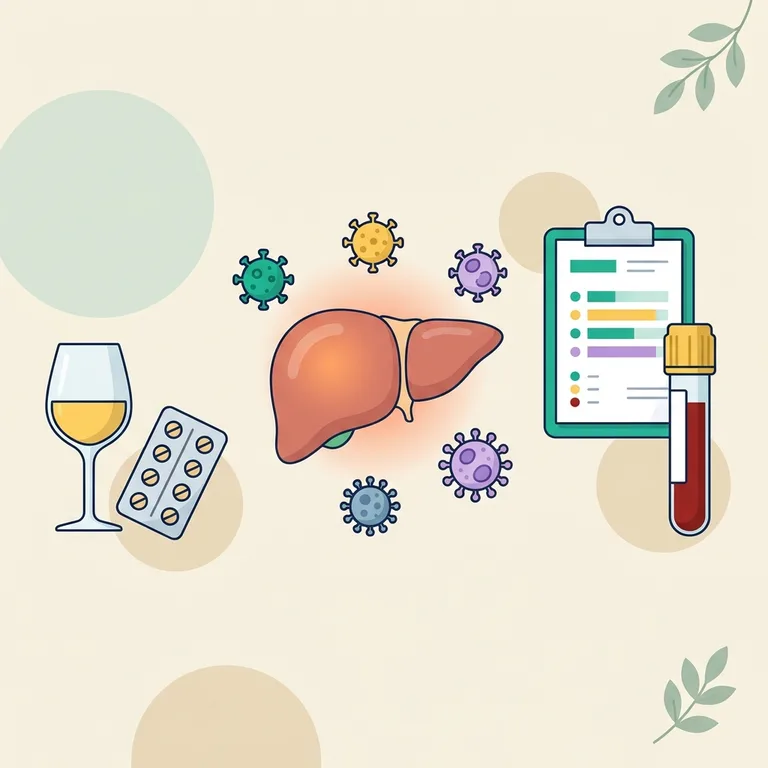
Hepatitis means inflammation of the liver. Five viruses (A to E) are the best-known causes, but alcohol, medicines, autoimmunity and fatty liver can do the same. Symptoms look alike, and many people have none. Liver enzymes show the inflammation; specific blood tests show the cause.
What is hepatitis, at a glance?
- Medical name: hepatitis. It can be acute (a short illness that heals) or chronic (lasting inflammation that can scar the liver)[1].
- How common: worldwide, about 240 million people were living with chronic hepatitis B in 2024[3] and about 47 million with chronic hepatitis C[4].
- Main causes: the five hepatitis viruses, alcohol, medicines, autoimmune hepatitis, fatty liver and rare inherited diseases[1][8].
- Key tests: liver enzymes (ALT and AST), bilirubin, then a viral hepatitis panel and, depending on the case, autoimmune antibodies[7][8].
What are the symptoms of hepatitis?
Acute viral hepatitis can be silent, especially hepatitis C and hepatitis A in young children[7]. Otherwise, symptoms are similar whatever the cause:
- First days: loss of appetite, tiredness, nausea and vomiting, sometimes a low fever[7].
- Then: after 3 to 10 days the urine darkens, followed by yellow skin and eyes (jaundice), which usually peaks within 1 to 2 weeks[7]. Pale stools, itching and belly pain can occur[1].
- Chronic hepatitis B or C: often silent for years, hence screening[1]; the first signs may be those of cirrhosis.
When should I see a doctor about hepatitis?
When to see a doctor
- Emergency: call 911 for jaundice with confusion, unusual sleepiness, vomiting blood or easy bleeding: signs of possible acute liver failure[7].
- Within 24 to 48 hours for new yellow eyes or skin, dark urine or a very high ALT; sooner if you are pregnant, as hepatitis E is more dangerous late in pregnancy[6].
- At your next appointment for mildly raised liver enzymes found by chance, or a reactive screening test.
What causes hepatitis? Types A to E and other causes
The five viruses differ in how they spread and whether they last:
| Type | Main route | Can become chronic? | Vaccine |
|---|---|---|---|
| Hepatitis A | Food or water contaminated by stool[2] | No[2] | Yes[2] |
| Hepatitis B | Blood and body fluids; mother to baby at birth[3] | About 95% after infection in infancy, under 5% in adults[3] | Yes[3] |
| Hepatitis C | Blood: shared drug equipment, unsafe injections[4] | Yes; about 30% clear it within 6 months[4] | No[4] |
| Hepatitis D | Like hepatitis B, and only in people who have it[5] | Yes, the most severe chronic form[5] | The hepatitis B vaccine prevents it[5] |
| Hepatitis E | Contaminated water or food[6] | Rarely, mainly after a transplant[6] | Licensed in China and a few countries, not in the US[6][7] |
Hepatitis is not always viral:
- Common Fatty liver (MASLD), linked to weight and blood sugar; its inflamed form is a hepatitis too. See fatty liver disease[1].
- Common Alcohol. Alcohol-associated hepatitis is a severe form with jaundice in people who have been drinking heavily for months[9].
- Possible Medicines and supplements (including an acetaminophen overdose) and toxins such as some wild mushrooms[1].
- Possible Other viruses, such as Epstein-Barr (mononucleosis) or cytomegalovirus[7].
- Possible Autoimmune hepatitis, where the immune system attacks the liver; it is most common in women and girls[10].
- Rare Inherited diseases: hemochromatosis (iron overload), Wilson disease (copper) and alpha-1 antitrypsin deficiency[8].
Which blood tests diagnose hepatitis and tell the types apart?
Testing works in two steps. First, liver tests show the inflammation: ALT and AST leak from damaged liver cells, bilirubin explains the jaundice, and alkaline phosphatase points to the bile ducts when it rises most[8]. Then, specific tests find the cause. A fictitious report after a trip abroad:
| Test | Result | Reference range | Flag |
|---|---|---|---|
| ALT (SGPT) | 1,240 U/L | 7-55 U/L | H |
| AST (SGOT) | 860 U/L | 8-48 U/L | H |
| Bilirubin, total | 4.2 mg/dL | 0.1-1.2 mg/dL | H |
| Alkaline phosphatase | 118 U/L | 40-129 U/L | |
| INR | 1.1 | 0.8-1.2 | |
| Hepatitis A IgM antibody | Reactive | Nonreactive | A |
| Hepatitis B surface antigen | Nonreactive | Nonreactive | |
| Hepatitis B core IgM antibody | Nonreactive | Nonreactive | |
| Hepatitis C antibody | Nonreactive | Nonreactive |
- ALT and AST: in acute viral hepatitis, often 15 times the upper limit or more, ALT above AST; the level does not measure severity[7]. Healthy ALT is lower than many lab ranges suggest: 29 to 33 U/L in men, 19 to 25 in women[8].
- INR: shows how well the liver still works; a prolonged INR with confusion suggests liver failure[7]. See our page on the prothrombin time and INR.
- The four panel lines: a reactive hepatitis A IgM means current hepatitis A; the others rule out acute hepatitis B and screen for C[7]. "Reactive" simply means positive: see reactive and nonreactive results.
- Ranges vary between laboratories; only those on your report apply.
Enzymes, bilirubin, INR and four virus tests on the same page? BloodSense explains every line of your complete report in plain words and helps you prepare the questions for your doctor.
Explain my liver test results| Suspected cause | Tests that make the difference |
|---|---|
| Hepatitis A | IgM anti-HAV for a current infection; total anti-HAV for immunity[7] |
| Hepatitis B | HBsAg and IgM anti-HBc; for screening, HBsAg, anti-HBs and total anti-HBc[7][11] |
| Hepatitis C | Anti-HCV antibody, then HCV RNA to confirm a current infection[7] |
| Hepatitis D | Anti-HDV, then HDV RNA, only if HBsAg is positive[7] |
| Hepatitis E | IgM anti-HEV, or HEV RNA by PCR[6] |
| Alcohol | AST 50 to 400 U/L, AST more than 1.5 times ALT, bilirubin above 3 mg/dL[9]; GGT often raised |
| Autoimmune | ANA, anti-smooth muscle and anti-LKM-1 antibodies, high IgG; often a liver biopsy[10] |
| Medicines | No specific test: your medicine and supplement list, and ruling out other causes[1][8] |
| Inherited causes | Iron studies and ferritin, copper tests, alpha-1 antitrypsin[8] |
A liver ultrasound often completes the work-up[1]. See also how to read liver function tests and our guide to high liver enzymes.
What follow-up tests are needed, and how often?
- Acute hepatitis: liver tests are repeated until normal. Acute viral hepatitis usually resolves 4 to 8 weeks after symptoms start[7].
- Hepatitis B: HBsAg still present after 6 months means chronic infection; viral load (HBV DNA) and ALT then guide lifelong follow-up[11].
- Hepatitis C: an undetectable HCV RNA 12 weeks after treatment confirms the cure, called sustained virologic response.
- Scarred liver: with cirrhosis, checks include albumin, platelets and liver imaging, as hepatitis B and C are the leading causes of cirrhosis and liver cancer[1][3].
How is hepatitis treated?
Treatment depends on the cause; no doses are given here.
- Hepatitis A and E: usually no specific medicine; rest, fluids and no alcohol[2][6].
- Hepatitis B: antiviral tablets control the virus when needed, usually for life[3].
- Hepatitis C: direct-acting antiviral tablets for 12 to 24 weeks cure more than 95% of people[4].
- Alcohol-associated hepatitis: stopping alcohol is key; corticosteroids help some severe cases[9].
- Autoimmune hepatitis: corticosteroids, often with azathioprine, to reach and keep remission[10].
- Medicines: the suspected product is stopped, with medical advice.
How can I prevent hepatitis and protect my liver?
- Get vaccinated against hepatitis A and B; the B vaccine also protects against hepatitis D[1][5].
- Wash your hands; avoid untreated water and unsafe food when traveling[1].
- Never share razors, toothbrushes or drug equipment, and use condoms[1].
- Keep alcohol low and never exceed the acetaminophen dose.
- Manage weight, diabetes and cholesterol to limit fatty liver[1].
- Get screened for hepatitis B and C at least once as an adult[11][12].
Questions to ask your doctor
- Is my hepatitis acute or chronic, and what is the most likely cause?
- Which tests are still needed to find the cause, and when should my liver tests be repeated?
- Have I been screened for hepatitis B and C, and am I protected against hepatitis A and B?
- Should I stop any medicine, supplement or alcohol while my liver heals?
Frequently asked questions
Which type of hepatitis is the most dangerous?
Hepatitis D is the most severe chronic form[5], while hepatitis B and C cause the most deaths because they are common and often silent[3][4]. Hepatitis A almost always heals completely[2].
Can you have hepatitis with normal liver enzymes?
Yes. In chronic hepatitis B or C, ALT can stay normal or only slightly raised for long periods. That is one reason screening uses virus tests, not liver enzymes[11][12].
Can you get hepatitis twice?
Not hepatitis A: recovery gives lifelong immunity[2]. Hepatitis C can be caught again after a cure, and there is no vaccine[4]. One type never protects against the others.
Related articles
- Hepatitis BThe full hepatitis B panel, combination by combination
- Hepatitis CThe two-step test and the cure with tablets
- Hepatitis AHow it unfolds and why recovery is complete
- Fatty liver disease (MASLD)The most common cause of raised liver enzymes
- Liver function test resultsHow ALT, AST, ALP and GGT are read together
- CirrhosisWhat happens when inflammation scars the liver
- MedlinePlus Medical Encyclopedia. Hepatitis. Reviewed January 10, 2026. US National Library of Medicine. medlineplus.gov (accessed November 9, 2026)
- World Health Organization. Hepatitis A. Fact sheet, July 28, 2026. who.int (accessed November 9, 2026)
- World Health Organization. Hepatitis B. Fact sheet, July 28, 2026. who.int (accessed November 9, 2026)
- World Health Organization. Hepatitis C. Fact sheet, July 28, 2026. who.int (accessed November 9, 2026)
- World Health Organization. Hepatitis D. Fact sheet, July 28, 2026. who.int (accessed November 9, 2026)
- World Health Organization. Hepatitis E. Fact sheet, July 28, 2026. who.int (accessed November 9, 2026)
- MSD Manual Professional Version. Overview of acute viral hepatitis. Reviewed September 2026. merckmanuals.com (accessed November 9, 2026)
- Kwo PY, Cohen SM, Lim JK. ACG clinical guideline: evaluation of abnormal liver chemistries. Am J Gastroenterol. 2017;112(1):18-35. doi:10.1038/ajg.2016.517 (accessed November 9, 2026)
- Jophlin LL, Singal AK, Bataller R, et al. ACG clinical guideline: alcohol-associated liver disease. Am J Gastroenterol. 2024;119(1):30-54. doi:10.14309/ajg.0000000000002572 (accessed November 9, 2026)
- MedlinePlus Medical Encyclopedia. Autoimmune hepatitis. Reviewed October 30, 2024. US National Library of Medicine. medlineplus.gov (accessed November 9, 2026)
- Conners EE, Panagiotakopoulos L, Hofmeister MG, et al. Screening and testing for hepatitis B virus infection: CDC recommendations, United States, 2023. MMWR Recomm Rep. 2023;72(1):1-25. doi:10.15585/mmwr.rr7201a1 (accessed November 9, 2026)
- Schillie S, Wester C, Osborne M, et al. CDC recommendations for hepatitis C screening among adults, United States, 2020. MMWR Recomm Rep. 2020;69(2):1-17. doi:10.15585/mmwr.rr6902a1 (accessed November 9, 2026)
This page is general information. It does not replace the advice of a doctor, who interprets your results with your symptoms, history, medicines and examination.