Fatty Liver Disease (MASLD): Symptoms, Causes, Tests and Treatment
The essentials
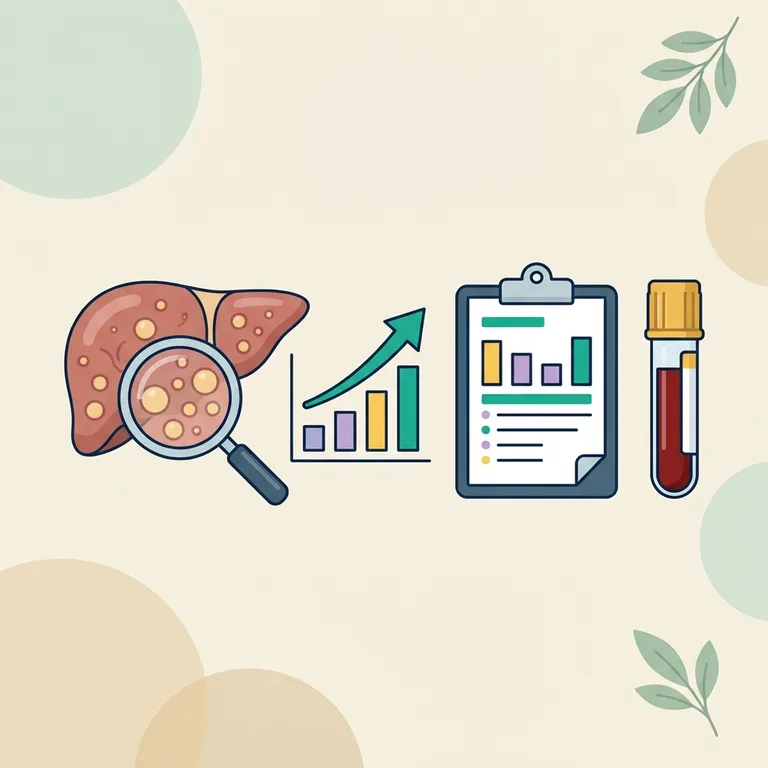
Fatty liver disease, now called MASLD, means too much fat in the liver, usually with excess weight, type 2 diabetes or high blood fats. It affects one US adult in four and rarely causes symptoms. What matters is scarring (fibrosis), estimated by the FIB-4 score from routine blood tests and sometimes a FibroScan. Weight loss can reverse it.
What is fatty liver disease, at a glance?
A liver is called "fatty" (steatotic) when fat fills at least 5% of its cells[3]. In 2023, liver societies renamed non-alcoholic fatty liver disease (NAFLD) MASLD, metabolic dysfunction-associated steatotic liver disease. The inflamed form, NASH, became MASH[1].
| Topic | Key facts |
|---|---|
| Other names | NAFLD (old name), hepatic steatosis |
| How common | About 24% of US adults, 1.5 to 6.5% with MASH, and close to 10% of children aged 2 to 19[11]; about 30% of adults worldwide[4] |
| Stages | Fat alone (steatosis), then inflammation (MASH), fibrosis, cirrhosis, and sometimes liver cancer[2] |
| Key tests | ALT, AST, GGT, platelets, FIB-4 score, ultrasound, elastography (FibroScan) |
What are the symptoms of fatty liver?
MASLD is usually silent, even at the cirrhosis stage[12]; it is often found by chance on an ultrasound or a blood test.
- Common No symptoms at all.
- Possible Tiredness or discomfort under the right ribs[12].
- Rare Signs of advanced cirrhosis: yellow skin or eyes, swollen belly or legs, vomiting blood, confusion.
When should I see a doctor?
When to see a doctor
- Emergency: call 911 if you vomit blood or pass black, tarry stools, become confused or very drowsy, or your belly swells quickly.
- Within 24 to 48 hours if your skin or eyes turn yellow, or you have a fever with pain under the right ribs.
- At your next appointment if a scan mentions "steatosis", your ALT or AST is high, or you have type 2 diabetes or obesity and have never had your liver checked.
What causes fatty liver, and who is at risk?
When energy intake exceeds needs and insulin works poorly (insulin resistance), the liver stores the excess as fat[3]. To be called MASLD, a fatty liver must come with at least one of five cardiometabolic risk factors[1]:
- Overweight (BMI 25 or more, 23 in Asian people) or a large waist.
- High blood sugar: prediabetes, type 2 diabetes or a raised HbA1c.
- High blood pressure.
- High triglycerides.
- Low HDL ("good") cholesterol (each also counts if treated).
Type 2 diabetes is the strongest risk factor[3]. MASLD affects up to 75% of people with overweight and one-third to two-thirds of people with type 2 diabetes[11]. Women with polycystic ovary syndrome have it 2 to 4 times as often[3]. Genes play a part; it is most common among Hispanic Americans[11].
Alcohol: with a metabolic risk factor, drinking 20 to 50 g a day (women) or 30 to 60 g (men) is called MetALD; more is alcohol-related liver disease[1]. Some medicines (such as corticosteroids) and rapid weight loss can also cause fatty liver[12].
How is fatty liver diagnosed, and what do the blood tests show?
An ultrasound shows the fat but misses mild cases[3]. Blood tests rule out other causes and estimate the risk of scarring.
- ALT and AST: often mildly raised, but normal values do not rule out MASLD. Most lab limits are set high: a truly healthy ALT is about 29 to 33 U/L in men and 19 to 25 U/L in women[3].
- GGT: often raised too; alcohol also raises it, so it is read with your drinking history.
- Platelet count: a falling count can be a sign of advanced scarring, which is why it is part of FIB-4[3].
- Metabolic tests: glucose, HbA1c and a lipid panel[3].
- Other causes: hepatitis B and C, ferritin and iron[3].
See also how to read liver function test results together, and the causes of high liver enzymes.
| Test | Result | Reference range | Flag |
|---|---|---|---|
| ALT (SGPT) | 58 U/L | 7-55 U/L | H |
| AST (SGOT) | 41 U/L | 8-40 U/L | H |
| GGT | 72 U/L | 8-61 U/L | H |
| Platelet count | 210 x103/µL | 150-450 x103/µL | |
| Hemoglobin A1c | 6.1% | < 5.7% | H |
| Triglycerides | 212 mg/dL | < 150 mg/dL | H |
- ALT, AST, GGT H: a mild rise, typical of fatty liver.
- HbA1c 6.1%, triglycerides 212 mg/dL: prediabetes and high blood fats, two of the five risk factors that define MASLD[1]. Your own lab's ranges apply.
Fatty liver on a scan and a few H flags on your blood work? BloodSense explains every line of your report, ALT, AST, GGT, platelets, HbA1c and lipids, and shows what to ask your doctor next.
Get my blood results explainedThe FIB-4 score: the key number
FIB-4 combines your age, AST, ALT and platelet count: age × AST ÷ (platelets × √ALT)[5]. It is the first test recommended by both US and European guidelines[2][3]:
| FIB-4 | Risk of advanced scarring | Usual next step |
|---|---|---|
| Below 1.3 | Low | Follow-up with your primary care provider[3] |
| 1.3 to 2.67 | Intermediate | Elastography (FibroScan) or an ELF blood test[3] |
| Above 2.67 | High | Referral to a liver specialist[3] |
In the example above, FIB-4 = 54 × 41 ÷ (210 × √58) ≈ 1.4: intermediate, so a FibroScan comes next.
Elastography (FibroScan) and biopsy
Elastography measures liver stiffness in a few minutes, with a probe on the skin. Below 8 kPa, advanced fibrosis is unlikely; above 12 kPa, it is likely[3]. A liver biopsy is now reserved for doubtful cases[2].
How is fatty liver followed over time?
- Low risk: repeat FIB-4 every 1 to 2 years if you have type 2 diabetes, prediabetes or two or more metabolic risk factors[3]; moving up a FIB-4 category signals progression[3].
- Heart and metabolism: HbA1c, lipids and blood pressure. Heart disease is the leading cause of death in MASLD[11].
- Cirrhosis: regular ultrasound surveillance for liver cancer and for complications, as described in our cirrhosis guide[2].
How is fatty liver treated?
No doses are given here.
- Weight loss, the main treatment: losing 3 to 5% of body weight reduces liver fat; over 10% is usually needed to improve MASH and fibrosis[3]. In one study, losing 10% or more resolved MASH in 90% of people[6].
- Treating risk factors: diabetes, blood pressure and cholesterol. Statins are safe in fatty liver[3]. GLP-1 medicines such as semaglutide or tirzepatide may be used for diabetes or obesity[2].
- Resmetirom (Rezdiffra): a tablet approved by the FDA in March 2024 for adults with MASH and moderate to advanced fibrosis, without cirrhosis, with diet and exercise[9]. In its main trial, MASH resolved in 26 to 30% of treated patients versus 10% on placebo[7].
- Semaglutide (Wegovy): approved by the FDA in August 2025 for the same group[10]. In its trial, MASH resolved in 63% of treated patients versus 34% on placebo[8].
Both are "accelerated" approvals, based on biopsy results; long-term benefit is still being confirmed[9][10]. No MASH-specific drug is recommended once cirrhosis is present[2].
Can fatty liver be prevented or reversed?
- Lose weight steadily; any calorie-reducing diet works, the Mediterranean diet is often advised[3].
- Cut sugary drinks: excess fructose raises the risk of fatty liver and fibrosis[3].
- Move at least 150 minutes a week; exercise helps even without weight loss[3].
- Limit alcohol: its harm adds to metabolic risk[3].
- Coffee, 3 or more cups a day, is linked to less fibrosis in studies[3].
Questions to ask your doctor
- What is my FIB-4 score, and do I need a FibroScan?
- Is this MASLD, MetALD or another liver disease?
- How much weight should I aim to lose, and how fast?
- Which tests will we repeat, and when?
Frequently asked questions
Is fatty liver serious?
Usually not. The risk lies in fibrosis, which FIB-4 and elastography measure[3].
Why was NAFLD renamed MASLD?
The old name defined the disease by what it was not and was felt to be stigmatizing; MASLD names its driver, metabolic dysfunction[1].
How long does it take to reverse fatty liver?
Liver fat drops within months. In the main lifestyle study, MASH and fibrosis improved after a year of sustained weight loss[6].
Can thin people have fatty liver?
Yes, especially people of Hispanic or Asian origin, partly because of genes[3].
Related articles
- Liver function test resultsHow ALT, AST, ALP and GGT are read together
- High liver enzymesCauses of a high ALT or AST and the next tests
- GGT blood testThe most sensitive liver enzyme, and its limits
- TriglyceridesThe blood fat most linked to fatty liver
- CirrhosisWhat happens when scarring becomes advanced
- Rinella ME, Lazarus JV, Ratziu V, et al. A multisociety Delphi consensus statement on new fatty liver disease nomenclature. J Hepatol. 2023;79(6):1542-1556. doi:10.1016/j.jhep.2023.06.003 (accessed November 8, 2026)
- EASL, EASD, EASO. EASL-EASD-EASO Clinical Practice Guidelines on the management of metabolic dysfunction-associated steatotic liver disease (MASLD). J Hepatol. 2024;81(3):492-542. doi:10.1016/j.jhep.2024.04.031 (accessed November 8, 2026)
- Rinella ME, Neuschwander-Tetri BA, Siddiqui MS, et al. AASLD Practice Guidance on the clinical assessment and management of nonalcoholic fatty liver disease. Hepatology. 2023;77(5):1797-1835. doi:10.1097/HEP.0000000000000323. PubMed Central (accessed November 8, 2026)
- Younossi ZM, Golabi P, Paik JM, et al. The global epidemiology of nonalcoholic fatty liver disease (NAFLD) and nonalcoholic steatohepatitis (NASH): a systematic review. Hepatology. 2023;77(4):1335-1347. doi:10.1097/HEP.0000000000000004 (accessed November 8, 2026)
- Sterling RK, Lissen E, Clumeck N, et al. Development of a simple noninvasive index to predict significant fibrosis in patients with HIV/HCV coinfection. Hepatology. 2006;43(6):1317-1325. doi:10.1002/hep.21178 (accessed November 8, 2026)
- Vilar-Gomez E, Martinez-Perez Y, Calzadilla-Bertot L, et al. Weight loss through lifestyle modification significantly reduces features of nonalcoholic steatohepatitis. Gastroenterology. 2015;149(2):367-378. doi:10.1053/j.gastro.2015.04.005 (accessed November 8, 2026)
- Harrison SA, Bedossa P, Guy CD, et al. A phase 3, randomized, controlled trial of resmetirom in NASH with liver fibrosis. N Engl J Med. 2024;390(6):497-509. doi:10.1056/NEJMoa2309000 (accessed November 8, 2026)
- Sanyal AJ, Newsome PN, Kliers I, et al. Phase 3 trial of semaglutide in metabolic dysfunction-associated steatohepatitis. N Engl J Med. 2025;392(21):2089-2099. doi:10.1056/NEJMoa2413258 (accessed November 8, 2026)
- US Food and Drug Administration. FDA approves first treatment for patients with liver scarring due to fatty liver disease. March 14, 2024. fda.gov (accessed November 8, 2026)
- US Food and Drug Administration. FDA approves treatment for serious liver disease known as "MASH". August 15, 2025. fda.gov (accessed November 8, 2026)
- NIDDK. Definition & facts of NAFLD & NASH. National Institutes of Health. niddk.nih.gov (accessed November 8, 2026)
- NIDDK. Symptoms & causes of NAFLD & NASH. National Institutes of Health. niddk.nih.gov (accessed November 8, 2026)
This page is general information. It does not replace the advice of a doctor; blood tests alone can neither confirm nor rule out fatty liver disease or liver scarring.