Muscle Twitching (Fasciculations): Causes, When to Worry and Blood Tests
The essentials
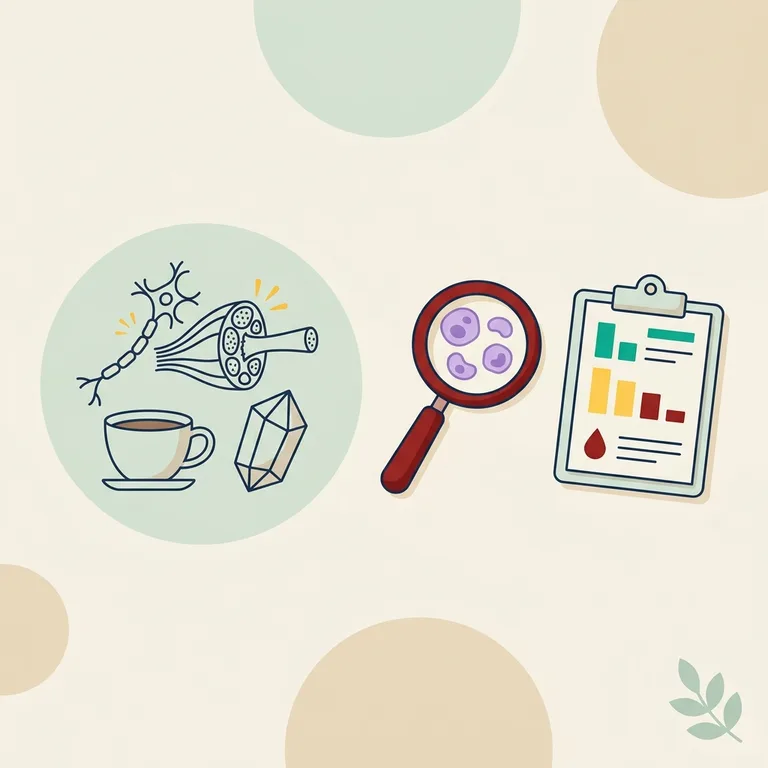
Muscle twitching (fasciculations) is very common and usually harmless: stress, poor sleep, hard exercise and stimulants are the usual triggers. See a doctor when it lasts, spreads, or comes with weakness, muscle loss or numbness. Blood tests such as electrolytes, magnesium, calcium, TSH and vitamin B12 look for causes that are easy to treat.
A twitch is a brief contraction of a few muscle fibers that you feel or see under the skin, often in an eyelid, a calf or a thumb[1]. To read a magnesium result line by line, see our magnesium blood test guide.
When is muscle twitching an emergency?
When to see a doctor
- Emergency: call 911 for twitching with sudden weakness, trouble breathing or swallowing, a seizure, or strong spasms with tingling around the mouth. Very low calcium or potassium can affect breathing or the heart[9][7].
- Within 24 to 48 hours for twitching with new weakness, palpitations, vomiting or diarrhea that will not stop, or dark urine and muscle pain after intense exercise[11].
- At your next appointment if twitches persist for weeks, keep spreading, or come with cramps, numbness, clumsiness or visible muscle loss[1].
Why do my muscles twitch? Harmless causes first
- Common Benign twitches. The most common kind; they usually fade within a few days[1]. On ultrasound, 43% of healthy adults had fasciculations, mostly in the foot, more often with age[4].
- Common Stress, anxiety, poor sleep. The classic triggers[1]; see our guide to anxiety symptoms.
- Common Exercise. Twitches often follow a workout[1]; strenuous effort briefly increases them in the lower legs[4].
- Common Caffeine and stimulants, including amphetamines[1]. The FDA cites 400 mg of caffeine a day, about two to three 12-ounce cups of coffee, as generally safe for healthy adults[12].
- Possible Medicines. Diuretics, corticosteroids and estrogens can cause twitching[1]; diuretics and stomach acid pills (proton pump inhibitors) can lower magnesium[8]. Never stop a medicine without asking.
- Possible Benign fasciculation syndrome (BFS). Twitches for months, with normal strength and a normal nerve test. Of 121 Mayo Clinic patients followed for 2 to 32 years, none developed motor neuron disease[2]. In a 2025 review of 180 patients, twitches persisted in 98% but improved in about half[3].
Which medical conditions cause muscle twitching?
- Possible Low potassium, magnesium or calcium. Low potassium causes weak, twitching muscles[7], low magnesium spasms and cramps[8], low calcium spasms and tingling lips and fingers[9]. Alcohol, diarrhea and some medicines are frequent reasons[8].
- Possible Kidney disease and uremia[1].
- Possible Thyroid or parathyroid problems. Thyroid function is routinely checked[1]; an overactive thyroid also causes tremor. Low parathyroid hormone lowers calcium, and high calcium can cause twitches too[9].
- Possible Nerve damage (neuropathy)[1]. Low vitamin B12 causes numbness, tingling and weakness, and about half of people with diabetes develop nerve damage over the years[10].
- Rare ALS (Lou Gehrig's disease), or rarer nerve and muscle diseases[1]. ALS affects about 7 in 100,000 people worldwide, mostly after 50. It starts with weakness, often in one hand, arm or leg, or in the muscles for speech and swallowing[6]. See our ALS symptoms guide.
Twitching and ALS: which signs matter?
What comes with the twitch matters most:
- Real weakness: tripping, dropping things, trouble with buttons or stairs[6]
- A muscle visibly thinner than on the other side[1]
- Slurred speech, choking or trouble swallowing[6]
- Twitches above the knee or in the tongue, uncommon in healthy people[4][6]
Fear of ALS is common with benign twitches, especially among health workers; treating that anxiety helps[5].
Which blood tests check for causes of muscle twitching?
There is no single twitching test. Blood tests check electrolytes, thyroid and blood chemistry[1]; a basic metabolic panel covers several at once.
| Test | What it answers | Usually when |
|---|---|---|
| Electrolytes, potassium | Is potassium or sodium off? | Cramps, diuretics, vomiting |
| Magnesium | Is magnesium low? | Alcohol, diarrhea, acid pills |
| Calcium (± PTH) | Is calcium low or high? | Tingling, spasms, neck surgery |
| Vitamin D | Does it explain a low calcium? | Low calcium |
| TSH | Is the thyroid off? | Tremor, weight change |
| Vitamin B12 | Is a deficiency harming nerves? | Numbness, poor balance |
| Glucose | Is there diabetes? | Burning feet, thirst |
| Creatinine | Are the kidneys working? | Abnormal electrolytes |
| CK (CPK) | Is muscle damaged? | Weakness, pain, statins |
With weakness or muscle loss, a neurologist adds an electromyogram (EMG) and nerve conduction studies, sometimes an MRI[1]. ALS is diagnosed by exam and EMG; blood tests rule out other causes[6].
Twitching and results you are not sure how to read? BloodSense explains your full report line by line, in plain words, so you know what to ask your doctor.
Explain my resultsHow do I read my results?
| Test | Result | Reference range | Flag |
|---|---|---|---|
| Potassium | 3.9 mEq/L | 3.5-5.1 mEq/L | |
| Magnesium | 1.6 mg/dL | 1.7-2.2 mg/dL | L |
| Calcium, total | 9.3 mg/dL | 8.8-10.3 mg/dL | |
| TSH | 1.6 mIU/L | 0.4-4.5 mIU/L | |
| Vitamin B12 | 420 pg/mL | 299-1054 pg/mL | |
| CK, total | 380 U/L | 30-200 U/L | H |
- Potassium is normal[7].
- L means below this lab's range (often 1.7 to 2.2 mg/dL)[8]. A mild low can cause cramps and spasms; the doctor looks for a reason.
- Calcium is normal; low magnesium can drag it down, so both are read together[9].
- TSH and B12 are normal: these causes are unlikely[10].
- H means above range. A hard workout can raise CK; avoid intense exercise and alcohol for a few days before a repeat test[11].
All normal? That is the most frequent outcome. With normal strength, benign twitches are the usual explanation and tend to improve over time[3]. A normal blood magnesium does not always mean normal body stores, as our magnesium test results page explains. Very high CK with dark urine and sore muscles suggests rhabdomyolysis, which needs urgent care[11].
What should I note before the appointment?
- Start date, how long and how often twitches happen, which muscles[1]; a short video helps
- Cramps, numbness, or any task that has become harder
- Coffee, energy drinks, alcohol, sleep, recent workouts
- Medicines and supplements, recent illness, pregnancy
Questions to ask your doctor
- Is my strength normal on the exam?
- Could a medicine explain this?
- Do I need an EMG, or can we watch and wait?
Frequently asked questions
Is eyelid twitching the same thing?
A flickering eyelid for a few days is a typical benign twitch, often from stress or fatigue[1]. See a doctor if it lasts weeks or spreads to the face.
Can anxiety cause twitching all over the body?
Yes, and twitching can fuel health anxiety about ALS. Cognitive behavioral therapy, sometimes with medication, helped in reported cases[5].
Should I take magnesium for twitching?
It corrects symptoms caused by a true deficiency[8]. Ask first if you have kidney disease or take other medicines.
Can normal blood tests rule out ALS?
They are not meant to: ALS is diagnosed by exam and EMG[6]. With normal strength, twitching alone rarely points to it[2].
Related tests and guides
- Magnesium blood testWhat low, high and normal results mean.
- CPK blood testWhat a high CK says about muscles.
- ALS (Lou Gehrig's disease)The real early signs.
References
- MedlinePlus Medical Encyclopedia. Muscle twitching. medlineplus.gov (accessed November 8, 2026)
- Blexrud MD, Windebank AJ, Daube JR. Long-term follow-up of 121 patients with benign fasciculations. Ann Neurol. 1993;34(4):622-625. doi:10.1002/ana.410340419 (accessed November 8, 2026)
- Mattiuzzi C, Lippi G. Clinical progression of benign fasciculation syndrome: a systematic literature review. Neurol Sci. 2025;46(3):1131-1135. doi:10.1007/s10072-024-07867-0 (accessed November 8, 2026)
- Fermont J, Arts IM, Overeem S, et al. Prevalence and distribution of fasciculations in healthy adults. Amyotroph Lateral Scler. 2010;11(1-2):181-186. doi:10.3109/17482960903062137 (accessed November 8, 2026)
- Blackman G, Cherfi Y, Morrin H, et al. The association between benign fasciculations and health anxiety. Psychosomatics. 2019;60(5):499-507. doi:10.1016/j.psym.2019.04.001 (accessed November 8, 2026)
- MedlinePlus Medical Encyclopedia. Amyotrophic lateral sclerosis. medlineplus.gov (accessed November 8, 2026)
- MedlinePlus. Potassium blood test; Low blood potassium. medlineplus.gov, medlineplus.gov (accessed November 8, 2026)
- MedlinePlus Medical Encyclopedia. Magnesium deficiency; Magnesium blood test. medlineplus.gov, medlineplus.gov (accessed November 8, 2026)
- MedlinePlus. Calcium blood test; Hypoparathyroidism; Hypercalcemia. medlineplus.gov, medlineplus.gov, medlineplus.gov (accessed November 8, 2026)
- MedlinePlus Medical Encyclopedia. Vitamin B12 level; Diabetes and nerve damage. medlineplus.gov, medlineplus.gov (accessed November 8, 2026)
- MedlinePlus Lab Tests. Creatine kinase. medlineplus.gov (accessed November 8, 2026)
- U.S. Food and Drug Administration. Spilling the beans: how much caffeine is too much? fda.gov (accessed November 8, 2026)
This article is general health information. It does not replace a medical examination, diagnosis or treatment. Do not start supplements or stop a medicine without talking to your doctor.