HLA Typing (HLA Test): What It Shows and How to Read Your Results
The essentials
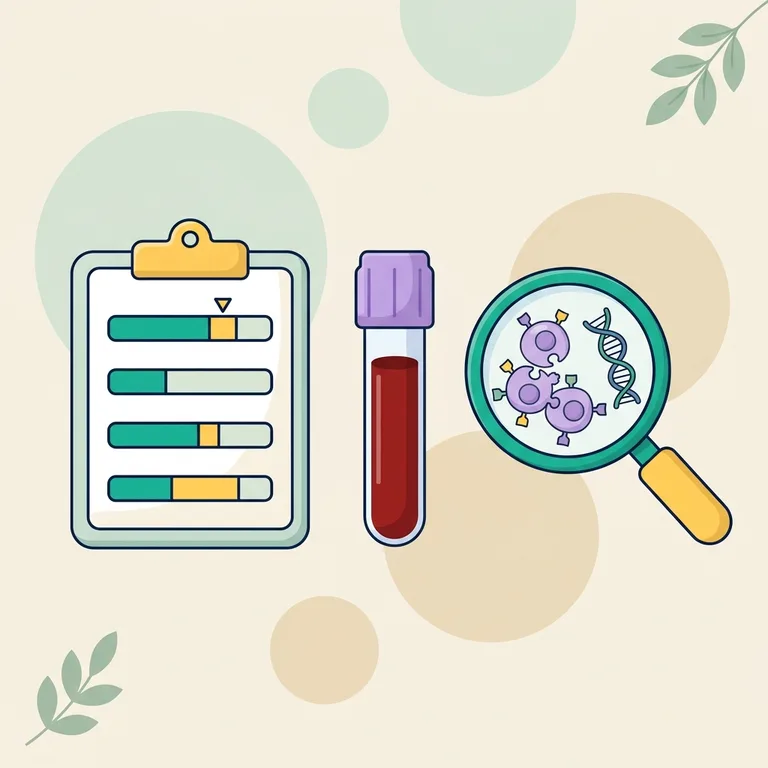
HLA typing reads your human leukocyte antigen genes, the "ID tags" your immune system uses to tell your cells from foreign ones. It is done for three reasons: to match a transplant donor, to check a gene linked to a disease (such as HLA-B27), or to check safety before certain medicines. An HLA result is not high or low: it is a list of gene variants, or a "detected / not detected" answer, and it does not change over your lifetime.
How do I read the HLA results on my lab report?
You inherit one set of HLA genes from each parent[3]. Labs report them in two ways: a simple answer about one variant, or a full typing that lists each gene. Here is a fictitious report, in US format.
| Test | Result | Reference range | Flag |
|---|---|---|---|
| HLA-B27 | Detected | Not detected | - |
| HLA-DQ2 | Not detected | Not detected | - |
| HLA-DQ8 | Not detected | Not detected | - |
| HLA class I typing, high resolution | A*02:01, A*24:02; B*07:02, B*27:05; C*07:02, C*02:02 | No range | - |
- No H or L flag: an HLA gene is either present or absent. "Detected" is not "abnormal"; it only means you carry that variant.
- HLA-B27 detected: about 6.1% of US adults carry it, most of them healthy[5]. It raises the chance of some forms of arthritis but proves nothing on its own[6].
- HLA-DQ2 and DQ8 not detected: celiac disease becomes very unlikely[10].
- Typing line: two results per gene, one from each parent. In "B*27:05", B is the gene, 27 is the allele group (the "B27" family) and 05 the exact protein[2].
An HLA line next to CRP, sed rate or a blood count? BloodSense reads your full report line by line and helps you prepare the questions for your doctor.
Get my lab report explainedWhat is an HLA test used for?
HLA proteins sit on the surface of most of your cells. Your immune system uses them to recognize what belongs to you[3]. That is why the same genes matter in three very different situations.
- Transplant matching. For a stem cell or bone marrow transplant, the closer the HLA match between donor and patient, the better. Each full brother or sister has a 1 in 4 chance of being a full match, and about 7 in 10 patients have no fully matched donor in their family[3]. For a kidney, typing is combined with a crossmatch and a search for donor-specific antibodies[4]. Your ABO blood type is a separate test.
- Disease-linked genes. HLA-B27 for ankylosing spondylitis and related arthritis, HLA-DQ2/DQ8 for celiac disease, HLA-B51 for Behçet's disease, HLA-DQB1*06:02 for narcolepsy.
- Drug safety (pharmacogenetics). A few HLA variants strongly predict a severe allergic reaction to one specific medicine, so the test is done before the first dose[7][8][9].
What are normal HLA results?
There is no normal range. Everyone carries a mix of HLA variants, and thousands exist[1]. What matters is which variant the test looked for, and why. The table shows the main results you may see; your laboratory's report and your doctor's reading apply.
| Result on the report | Main use | What "detected" means | Source |
|---|---|---|---|
| HLA-B27 | Back pain, eye inflammation, arthritis | Higher risk of spondyloarthritis; found in 6.1% of US adults | MedlinePlus[6]; NHANES 2009[5] |
| HLA-DQ2 / HLA-DQ8 | Celiac disease, unclear cases | Celiac disease is possible, not confirmed; "not detected" makes it very unlikely | NIDDK[10] |
| HLA-B*57:01 | Before abacavir (HIV treatment) | Abacavir should not be used | PREDICT-1 trial[7] |
| HLA-B*58:01 | Before allopurinol (gout) | Higher risk of a severe skin reaction | American College of Rheumatology[8] |
| HLA-B*15:02, HLA-A*31:01 | Before carbamazepine (epilepsy, nerve pain) | Carbamazepine is avoided if you have never taken it | CPIC[9] |
| Full typing (A, B, C, DRB1, DQB1…) | Transplant | No "detected": it is compared with a donor's typing | NMDP[3]; review[4] |
Low or high resolution? Low resolution gives the allele group only (for example "B27"). High resolution adds the second field, the exact protein (for example "B*27:05")[2]. A disease test usually needs only the group; transplant and drug-safety tests often need more detail.
What does a positive HLA result mean?
A positive (detected) result is a risk factor or a safety signal, never a diagnosis. Conditions most often discussed with each result:
- Common HLA-B27 in a healthy person. Many carriers are healthy[6]: about 6.1% of US adults carry it[5]. It weighs in only alongside inflammatory back pain, imaging and inflammation tests such as CRP or the sed rate (ESR).
- Common HLA-DQ2 or DQ8 positive. Most people with these variants never get celiac disease; diagnosis relies on antibody blood tests and often a biopsy[10]. See celiac disease and gluten intolerance.
- Possible HLA-B27 with symptoms: ankylosing spondylitis, psoriatic arthritis, reactive arthritis, arthritis linked to Crohn's disease or ulcerative colitis, sacroiliitis or uveitis (eye inflammation)[6]. See also psoriasis.
- Possible A drug-safety variant (B*57:01, B*58:01, B*15:02). In the PREDICT-1 trial of 1,956 people with HIV, 5.6% carried HLA-B*57:01; excluding them from abacavir cut immunologically confirmed hypersensitivity from 2.7% to 0%[7]. HLA-B*58:01 is found in about 7.4% of people of Han Chinese, Korean or Thai descent, 3.8% of African Americans and 0.7% of White and Hispanic people[8]. HLA-B*15:02 is most frequent in East Asian (6.9%), Oceanian and South or Central Asian populations, and below 1% in people of European descent[9].
- Rare HLA-DQB1*06:02 in narcolepsy. Most people with narcolepsy carry it, especially those with cataplexy[11], but it is not a diagnosis: see narcolepsy.
A negative result is reassuring in two cases: celiac disease becomes very unlikely[10], and a negative HLA-B*57:01 screen had a negative predictive value of 100% for confirmed abacavir hypersensitivity[7]. A negative HLA-B27 does not rule out spondyloarthritis.
What should I check before an HLA test?
- No fasting: no special preparation is needed[6]. Some labs use a cheek swab instead of blood[3]. More on fasting before a blood test.
- Is it the right test? "HLA-B27" and "HLA typing" are not the same order. Ask which genes are tested and at what resolution[2].
- Test before the first dose: the safety value of HLA-B*57:01, B*58:01 and B*15:02 testing is before starting the medicine[7][9]. After more than 3 months of carbamazepine without a reaction, the risk is extremely low but not zero[9].
- Transplant candidates: mention pregnancies, blood transfusions and any previous transplant. They can create HLA antibodies that change the crossmatch[4].
- Keep your result: your HLA genes do not change, so an old report stays valid. Show it to any new prescriber.
When should I see a doctor about an HLA result?
When to see a doctor
- Emergency: call 911 for a spreading rash with blisters, peeling skin, mouth or eye sores, or fever after starting a new medicine such as carbamazepine or allopurinol: signs of Stevens-Johnson syndrome[9].
- Within 24 to 48 hours for a painful red eye with blurred vision or light sensitivity if you carry HLA-B27 (possible uveitis)[6], or for fever, rash or feeling unwell in the first weeks of abacavir[7].
- At your next appointment for a positive HLA-B27 with back pain lasting months, a positive DQ2/DQ8 with digestive symptoms, or questions about a donor match.
Questions to ask your doctor
- Why is this HLA test being ordered: transplant, a disease, or a medicine?
- Which genes does it look for, and at what resolution?
- What will we do if it is positive, and if it is negative?
- Do my other results (CRP, antibodies, imaging) support the diagnosis?
- Should my family members be tested?
Frequently asked questions
Do I need to repeat an HLA test?
Usually not. HLA genes are inherited and fixed for life[3]. Transplant teams may still retest to confirm a match, and antibody screening is repeated.
Can my parents or children be my donor?
Yes, as half-matched (haploidentical) donors: you share half of your HLA with each parent and each child[3].
Is HLA typing the same as a blood type?
No. Blood type (ABO, Rh) concerns red blood cells; HLA concerns markers on most other cells and is matched mainly for transplants.
Can a home DNA kit replace an HLA test?
Not for medical decisions. Transplant and drug-safety choices rely on a validated test ordered by your care team, at the resolution they need.
Related tests and guides
- Ankylosing spondylitisThe disease most linked to HLA-B27, and how it is diagnosed.
- Behçet's diseaseWhy HLA-B51 supports but never confirms the diagnosis.
- Celiac diseaseAntibody tests, biopsy and the role of DQ2/DQ8.
- Gout and allopurinolWhen HLA-B*58:01 testing comes before treatment.
- HIV test resultsThe tests around starting HIV treatment.
- All blood markersEvery blood test explained, line by line.
References
- Marsh SGE, Albert ED, Bodmer WF, et al. Nomenclature for factors of the HLA system, 2010. Tissue Antigens. 2010;75(4):291-455. doi:10.1111/j.1399-0039.2010.01466.x (accessed November 8, 2026)
- WHO Nomenclature Committee for Factors of the HLA System. Naming of HLA alleles. hla.alleles.org (accessed November 8, 2026)
- NMDP. What is HLA? HLA basics, typing and matching. nmdp.org (accessed November 8, 2026)
- Althaf MM, El Kossi M, Jin JK, et al. Human leukocyte antigen typing and crossmatch: a comprehensive review. World J Transplant. 2017;7(6):339-48. doi:10.5500/wjt.v7.i6.339 (accessed November 8, 2026)
- Reveille JD, Hirsch R, Dillon CF, et al. The prevalence of HLA-B27 in the US: data from the US National Health and Nutrition Examination Survey, 2009. Arthritis Rheum. 2012;64(5):1407-11. doi:10.1002/art.33503 (accessed November 8, 2026)
- MedlinePlus. HLA-B27 antigen. US National Library of Medicine. medlineplus.gov (accessed November 8, 2026)
- Mallal S, Phillips E, Carosi G, et al. HLA-B*5701 screening for hypersensitivity to abacavir. N Engl J Med. 2008;358(6):568-79. doi:10.1056/NEJMoa0706135 (accessed November 8, 2026)
- FitzGerald JD, Dalbeth N, Mikuls T, et al. 2020 American College of Rheumatology guideline for the management of gout. Arthritis Care Res (Hoboken). 2020;72(6):744-60. doi:10.1002/acr.24180 (accessed November 8, 2026)
- Phillips EJ, Sukasem C, Whirl-Carrillo M, et al. Clinical Pharmacogenetics Implementation Consortium guideline for HLA genotype and use of carbamazepine and oxcarbazepine: 2017 update. Clin Pharmacol Ther. 2018;103(4):574-81. doi:10.1002/cpt.1004 (accessed November 8, 2026)
- National Institute of Diabetes and Digestive and Kidney Diseases (NIDDK). Diagnosis of celiac disease. niddk.nih.gov (accessed November 8, 2026)
- MedlinePlus Genetics. Narcolepsy. US National Library of Medicine. medlineplus.gov (accessed November 8, 2026)
- Medicare.gov. Diagnostic laboratory tests. medicare.gov (accessed November 8, 2026)
This article is general health information. It does not replace a medical examination, diagnosis or treatment. Never start, stop or change a medicine because of an HLA result without your provider's advice.