Behçet's Disease: Symptoms, Diagnosis and the Blood Tests Doctors Use
The essentials
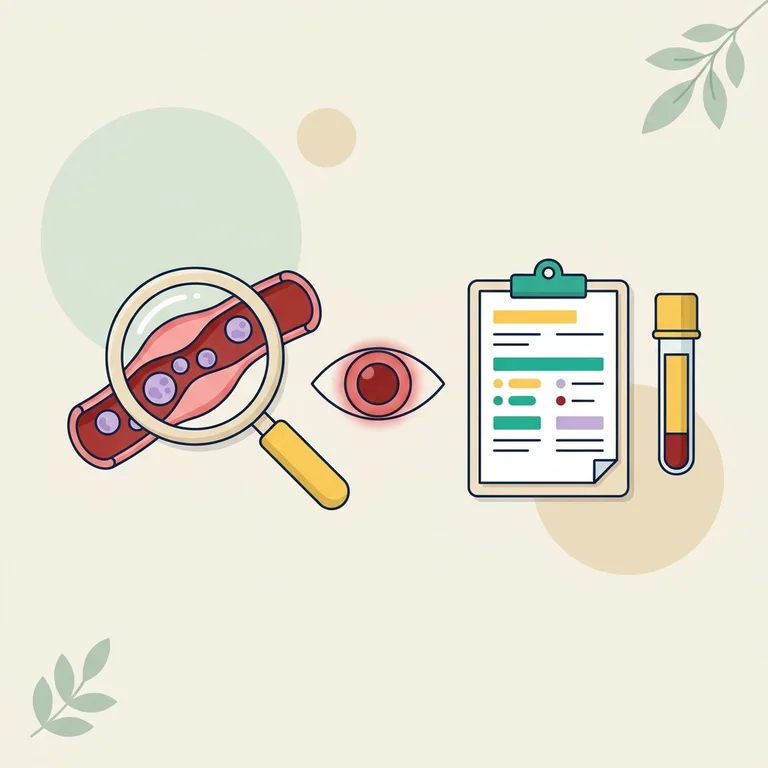
Behçet's disease is a rare, long-lasting inflammation of blood vessels that causes mouth ulcers that keep coming back, often with genital ulcers, eye inflammation and skin spots. No blood test can confirm it on its own: doctors make the diagnosis from your symptoms, using a points score. Blood tests such as CRP, ESR or HLA-B51 only support the picture or rule out other causes. Sudden eye pain or blurred vision needs urgent care.
What is Behçet's disease, at a glance?
Behçet's disease (also called Behçet's syndrome) is a chronic inflammation of the blood vessels, a form of vasculitis, that can affect arteries and veins of any size. It comes in flares followed by calmer periods[7]. It is not contagious and it is not an infection.
| Topic | Key facts |
|---|---|
| Other names | Behçet's syndrome, Adamantiades-Behçet disease, "Silk Road disease" |
| How common | About 10 per 100,000 people worldwide, 120 per 100,000 in Turkey, 32 per 100,000 in the Middle East and 3 per 100,000 in Europe[3]; fewer than 1 in 100,000 in the United States[6] |
| Usual age | Symptoms usually start in the 20s or 30s[6]; a first diagnosis before 15 or after 50 is unusual[5] |
| Key tests | A clinical score (ICBD), sometimes a skin prick test (pathergy test); CRP, ESR, blood count and urine tests to assess inflammation and exclude other diseases |
| Main specialist | Rheumatologist or internist, working with eye, skin and other specialists[2] |
What are the symptoms of Behçet's disease?
Symptoms vary from one person to another and rarely appear all at once.
- Common Mouth ulcers that look like large canker sores and keep returning; they are usually the first sign[6]. Doctors look for at least 3 episodes in 12 months[7].
- Common Genital ulcers, in about 75% of people, on the scrotum or vulva; they can leave scars[6].
- Common Skin lesions: acne-like spots and red, tender lumps on the legs (erythema nodosum), which affect about one person in three[5][6].
- Possible Eye inflammation (uveitis) in more than half of people, more often in men: red, painful eyes, blurred vision, sensitivity to light[6].
- Possible Painful, stiff, swollen joints, and headaches[7].
- Rare Blood clots in veins, artery aneurysms, inflammation of the brain or nerves (neuro-Behçet), or ulcers in the bowel[5]. These forms are serious and need specialist care.
Is it a canker sore or Behçet's disease?
Most people with repeated mouth ulcers do not have Behçet's disease. Ordinary canker sores are far more common and have simpler causes, such as minor injury, stress or a lack of iron or vitamin B12: see our guide to canker sores and their blood tests. Behçet's disease becomes a question when mouth ulcers come with genital ulcers, eye inflammation or skin lesions. A genital ulcer can also come from herpes, which is a different, contagious infection; read our page on herpes symptoms and tests.
When should I see a doctor?
When to see a doctor
- Emergency: call 911 for sudden loss of vision, a sudden severe headache, weakness of an arm or leg, confusion, chest pain, coughing up blood, or a swollen, painful leg with shortness of breath. These can signal eye, brain or blood vessel involvement, which can be life-threatening[5][7].
- Within 24 to 48 hours for a red, painful eye or blurred vision (see an eye doctor quickly), a painful genital ulcer, or a fever with ulcers while you take medicines that weaken immunity.
- At your next appointment if you have had mouth ulcers 3 times or more in a year, especially with skin spots or joint pain, or if you already have Behçet's disease and notice a new symptom.
What causes Behçet's disease, and who gets it?
The exact cause is unknown. Doctors think an overactive immune response, possibly triggered by an infection or another environmental factor, inflames blood vessels in people who are genetically predisposed[6].
- Genes: carrying the HLA-B51 gene variant raises the risk about six times[4][6]. Yet most HLA-B51 carriers never develop the disease, and many patients do not carry it[6].
- Origin: the disease is most frequent along the old Silk Road, from Turkey and the Middle East to Japan, China and Korea. The higher risk persists in families who have moved to countries where it is rare[5].
- Sex: men and women are affected about equally overall, but young men tend to have more severe eye and blood vessel involvement[5].
Behçet's disease belongs to the large family of immune-mediated diseases described in our guide to autoimmune diseases and their blood tests.
How is Behçet's disease diagnosed, and is there a blood test?
There is no specific test for Behçet's disease[1][7]. The diagnosis is clinical: a doctor puts together the symptoms, ideally seen during a flare, and rules out other diseases[5]. Many specialists use the International Criteria for Behçet's Disease (ICBD, 2014)[1]:
| Sign | Points |
|---|---|
| Mouth ulcers (oral aphthosis) | 2 |
| Genital ulcers | 2 |
| Eye inflammation | 2 |
| Skin lesions | 1 |
| Brain or nerve involvement | 1 |
| Blood vessel involvement (clots, aneurysms) | 1 |
| Positive pathergy test (if done) | 1 |
In the study that created this score, it identified about 95% of patients[1]. It is a guide, not a verdict[5].
The pathergy test
A small needle prick is made in the skin of the forearm. The test is positive if a red bump or a small pustule appears 24 to 48 hours later[5]. Modern disposable needles and skin disinfection make it less sensitive, so a negative result does not rule out the disease[5]. The score counts it as one point only[1].
What do blood tests show in Behçet's disease?
- CRP and ESR (sed rate): measure inflammation. They are often normal and rise mostly with joint or blood vessel involvement[5]. A high CRP says there is inflammation, not where it comes from[8].
- HLA-B51 typing: found in about 30 to 60% of patients but also in 10 to 20% of healthy people. It should not be used to confirm or exclude the diagnosis[5].
- Complete blood count, kidney and liver tests, urinalysis: to check your general state and look for other causes.
- Tests that should come back negative: autoantibodies such as ANA or ANCA point to other diseases (lupus, other vasculitis). Doctors also exclude infections: genital ulcers must be told apart from other causes such as herpes, and tuberculosis or listeria must be ruled out before brain inflammation is blamed on Behçet's disease[5].
| Test | Result | Reference range | Flag |
|---|---|---|---|
| C-reactive protein (CRP) | 2.6 mg/dL | < 1.0 mg/dL | H |
| Sed rate (ESR), Westergren | 34 mm/hr | < 20 mm/hr | H |
| WBC | 8.9 x10³/µL | 4.5-11.0 x10³/µL | |
| HLA-B51 | Detected | Not detected | |
| ANA screen | Negative | Negative |
- CRP and ESR: high, meaning active inflammation. Healthy CRP is about 1.0 mg/dL or lower[8]; for women under 50, ESR is usually below 20 mm/hr[9]. These values do not say which disease is responsible.
- WBC (white blood cells): normal. It is also checked regularly if you later take immune-suppressing medicines[5].
- HLA-B51 "Detected": there is no H or L flag, because this is a gene variant, not a level. It slightly raises the probability of Behçet's disease but proves nothing on its own[5].
- ANA negative: makes lupus less likely, which helps the doctor narrow down the cause.
Inflammation markers high and no clear answer yet? BloodSense explains every line of your report, from CRP to HLA typing, so you can discuss it calmly with your doctor.
Get my blood results explainedDepending on symptoms, doctors may also order an eye examination with a slit lamp, a skin biopsy, a brain MRI, imaging of the veins or a colonoscopy[5][7].
Which tests are used to follow Behçet's disease?
There is no reliable blood marker of disease activity: a CRP can stay normal while the disease smolders[5]. Follow-up therefore relies mostly on symptoms and examinations:
- Visits: usually every 3 to 6 months, and at least once a year when the disease is quiet; more often in severe forms[5].
- Eye checks: regular examinations by an eye doctor if you have, or have had, uveitis.
- Medicine safety tests: with azathioprine or methotrexate, a blood count and liver enzymes (ALT or AST) every week for the first month, then monthly for 3 months, then every 3 months[5]. See what to do if your liver enzymes are high.
- Before steroids or biologic medicines: screening for latent tuberculosis, and updating vaccines, because these treatments lower immunity[5].
How is Behçet's disease treated?
There is no cure, but treatment controls symptoms in most people and protects the eyes, brain and blood vessels[7]. The choice depends on the organs involved[2]. No doses are given here.
- Mouth and genital ulcers: corticosteroid gels or mouthwashes; colchicine to prevent new ulcers and skin lesions; apremilast for persistent mouth ulcers[2].
- Joints: colchicine first, then other medicines if arthritis persists[2].
- Eyes: uveitis at the back of the eye needs immune-suppressing medicines such as azathioprine or ciclosporin, or a biologic (anti-TNF or interferon-alpha)[2].
- Blood clots, brain or bowel involvement: corticosteroids with immune-suppressing medicines. In Behçet's disease, clots come from inflamed vein walls, so blood thinners alone are not enough; doctors decide case by case whether to add them[2]. See our guide to blood clots and their tests.
How can I live well with Behçet's disease?
- Keep a symptom diary (ulcers, eyes, joints, skin) with dates and photos: flares are easier to prove when the doctor sees them.
- Never stop a treatment on your own, even when you feel well; relapses can affect the eyes without warning.
- Have your eyes checked as planned, even without symptoms.
- Ask about vaccines before starting immune-suppressing medicines[5].
Questions to ask your doctor
- How many ICBD points do my symptoms add up to?
- Could my ulcers have another cause, such as herpes, a deficiency or bowel disease?
- Should I have an eye examination, even without eye symptoms?
- Which blood tests will check the safety of my treatment, and how often?
- Which symptoms mean I should come back or go to the emergency room?
Frequently asked questions
Is Behçet's disease contagious?
No. It cannot be passed on by kissing, sex or sharing objects. It is an inflammatory disease, not an infection[7].
I am HLA-B51 positive. Do I have Behçet's disease?
Not necessarily. 10 to 20% of healthy people carry HLA-B51, and most of them never get the disease[5][6]. Only symptoms make the diagnosis.
Can children get Behçet's disease?
Yes, but it is rare: symptoms can start in childhood[7], and a diagnosis before age 15 is unusual[5]. Pediatric rheumatologists handle these cases.
Is Behçet's disease serious?
Most people mainly have ulcers, skin and joint symptoms that treatment controls. Eye, brain and blood vessel forms can be serious, especially in young men, which is why regular follow-up matters[5][7].
Related articles
- Canker soresThe common causes of mouth ulcers and the tests to ask for
- CRP blood testHow to read a high inflammation marker
- Sed rate (ESR)What a high or normal ESR means
- Autoimmune diseasesSymptoms and blood tests of immune-mediated diseases
- Crohn's diseaseAnother cause of mouth ulcers with bowel symptoms
- International Team for the Revision of the International Criteria for Behçet's Disease (ITR-ICBD). The International Criteria for Behçet's Disease (ICBD): a collaborative study of 27 countries on the sensitivity and specificity of the new criteria. J Eur Acad Dermatol Venereol. 2014;28(3):338-347. doi:10.1111/jdv.12107 (accessed November 6, 2026)
- Hatemi G, Christensen R, Bang D, et al. 2018 update of the EULAR recommendations for the management of Behçet's syndrome. Ann Rheum Dis. 2018;77(6):808-818. doi:10.1136/annrheumdis-2018-213225 (accessed November 6, 2026)
- Maldini C, Druce K, Basu N, LaValley MP, Mahr A. Exploring the variability in Behçet's disease prevalence: a meta-analytical approach. Rheumatology (Oxford). 2018;57(1):185-195. doi:10.1093/rheumatology/kew486 (accessed November 6, 2026)
- de Menthon M, Lavalley MP, Maldini C, Guillevin L, Mahr A. HLA-B51/B5 and the risk of Behçet's disease: a systematic review and meta-analysis of case-control genetic association studies. Arthritis Rheum. 2009;61(10):1287-1296. doi:10.1002/art.24642 (accessed November 6, 2026)
- Haute Autorité de Santé (France). Protocole national de diagnostic et de soins (PNDS) : maladie de Behçet. December 2019. has-sante.fr (in French; accessed November 6, 2026)
- MedlinePlus Genetics. Behçet disease. US National Library of Medicine. medlineplus.gov (accessed November 6, 2026)
- NHS. Behçet's disease. nhs.uk (accessed November 6, 2026)
- MedlinePlus. C-Reactive Protein (CRP) Test. US National Library of Medicine. medlineplus.gov (accessed November 6, 2026)
- MedlinePlus Medical Encyclopedia. Sed rate (erythrocyte sedimentation rate). US National Library of Medicine. medlineplus.gov (accessed November 6, 2026)
This page is general information. It does not replace the advice of a doctor, who makes the diagnosis from your symptoms, examination and history; no blood test alone can confirm or rule out Behçet's disease.