










Antidiuretic Hormone (ADH, Vasopressin): Blood Test, Levels and Copeptin
The essentials
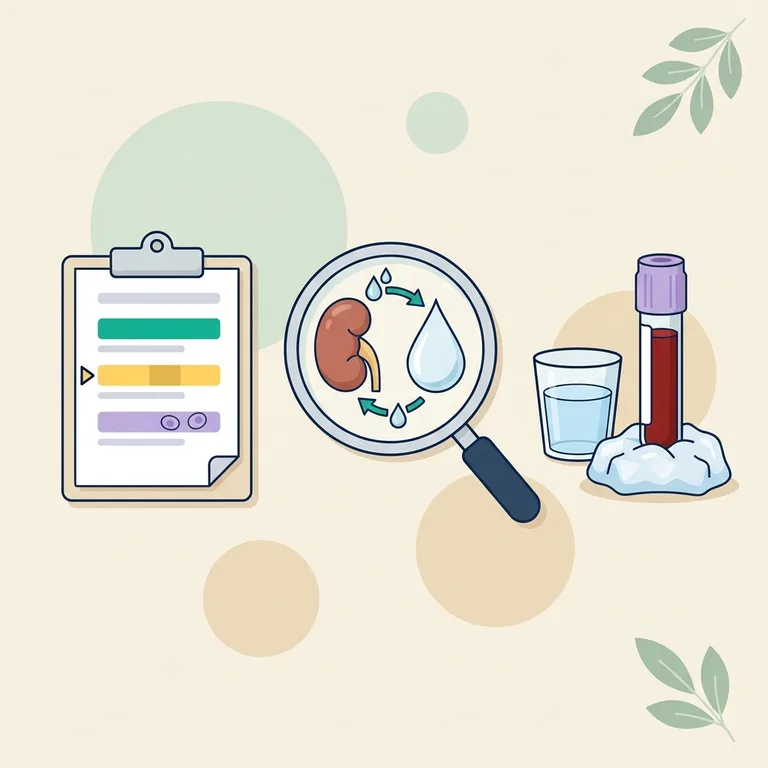
Antidiuretic hormone (ADH), also called vasopressin, tells your kidneys to keep water when your blood becomes too concentrated. An ADH level means little on its own: it is read against your blood sodium, blood osmolality and urine concentration. Because ADH is hard to measure, many labs now test copeptin, a stable fragment released with it.
How do I read an ADH result on my lab report?
An ADH result alone does not point to a diagnosis. It usually arrives with a sodium level, a blood osmolality and urine tests, and is read next to how diluted your blood is[3]. Below is a fictitious report for a 67-year-old man whose routine blood test showed low sodium.
| Test | Result | Reference range | Flag |
|---|---|---|---|
| Sodium, serum | 128 mmol/L | 135-145 mmol/L | L |
| Osmolality, serum | 266 mOsm/kg | 275-295 mOsm/kg | L |
| Antidiuretic hormone (ADH), plasma | 3.8 pg/mL | 0-5.9 pg/mL | - |
| Osmolality, urine (random) | 460 mOsm/kg | Interpret with serum osmolality | - |
| Sodium, urine (random) | 58 mmol/L | Interpret with intake | - |
- Sodium and serum osmolality: both are low, so the blood holds too much water for its salt. Hyponatremia means a sodium below 135 mmol/L[9].
- ADH: 3.8 pg/mL sits inside the printed range, yet it is not normal here. With dilute blood, ADH should be switched off; a level still detectable is what doctors call "inappropriate"[4].
- Urine osmolality: above 100 mOsm/kg while the blood is dilute shows the kidneys are still holding water, one of the criteria for the syndrome of inappropriate antidiuresis (SIADH)[4].
- Urine sodium: above 30 mmol/L with normal salt intake fits the same picture, once diuretics, thyroid and adrenal problems are ruled out[4].
- No flag does not mean no problem: the reference range describes healthy people with normal blood concentration, not someone with low sodium.
An ADH result only makes sense next to your sodium and osmolality. BloodSense reads your whole lab report together and explains it in plain language.
Read my lab reportWhat does antidiuretic hormone do, and why test it?
ADH is made in the hypothalamus, stored in the posterior pituitary gland and released when your blood becomes more concentrated or when your blood volume or pressure falls[4]. In the kidney, it opens water channels in the collecting ducts so less water leaves in the urine; it also narrows blood vessels[4]. Our page on serum osmolality results explains the concentration side of this balance.
A doctor may order an ADH or copeptin test:
- when blood sodium is low without a clear cause[3];
- when you pass large amounts of dilute urine and feel very thirsty, to look for diabetes insipidus[3];
- during a water deprivation test or a stimulation test run by a hormone specialist[3].
Diabetes insipidus has nothing to do with blood sugar or diabetes mellitus. In 2022, international endocrine societies proposed new names: arginine vasopressin deficiency (AVP-D) for the central form and arginine vasopressin resistance (AVP-R) for the kidney form[5].
What are normal ADH and copeptin levels?
| Test | Usual adult value | Source |
|---|---|---|
| ADH (vasopressin), plasma | 0-5.9 pg/mL (0-5.4 pmol/L) | MedlinePlus[1] |
| Copeptin, baseline, healthy adults | About 1.0-13.8 pmol/L (median 4.2), higher on average in men | Copeptin review[6] |
| Serum sodium | Below 135 mmol/L = hyponatremia | European guideline[9] |
| Serum osmolality | Below 275 mOsm/kg = low (one SIADH criterion) | SIADH review[4] |
| Urine osmolality with low serum osmolality | Above 100 mOsm/kg = kidneys still concentrating | SIADH review[4] |
To convert ADH, 1 pg/mL is about 0.92 pmol/L. Ranges vary slightly between labs, and most labs cannot run ADH themselves, which is why copeptin is now often used in its place[1].
For suspected diabetes insipidus, copeptin is often read after a stimulus rather than at rest. These cutoffs come from specialist studies and are applied only within a supervised protocol:
| Situation | Cutoff | What it suggests |
|---|---|---|
| Baseline copeptin, no prior thirsting | Above 21.4 pmol/L | Kidney resistance to ADH (AVP-R), with 100% sensitivity and specificity in one study of 55 patients[8] |
| After hypertonic saline, sodium at least 150 mmol/L | Above 4.9 pmol/L | Primary polydipsia rather than AVP-D: 96.5% correct diagnoses, versus 76.6% for the classic water deprivation test[7] |
| 60 minutes after an arginine infusion | Above 3.8 pmol/L | Primary polydipsia rather than AVP-D, with 93% accuracy[10] |
What causes high or low ADH?
Higher ADH or copeptin
- Common A normal response to dehydration, blood loss or low blood pressure: here, a high level is appropriate[4].
- Common Short-lived triggers: nausea, pain, stress, general anesthesia or surgery[4].
- Common Medicines, including some antidepressants (SSRIs, SNRIs), seizure drugs such as carbamazepine, some cancer, opioid, heart, diabetes and blood pressure drugs[1][4].
- Possible SIADH linked to lung disease such as pneumonia, brain injury, infection or stroke, or tuberculosis[2]. Small cell lung cancer makes its own vasopressin in about 10 to 15% of cases[4].
- Possible Heart failure, liver failure such as cirrhosis, or some kidney diseases[1].
- Rare Arginine vasopressin resistance: the hormone is high because the kidneys do not respond to it[3][8].
In an international registry of 1,524 people with SIADH, the cause stayed undetermined in about 35%; cancer, medicines, lung and brain disease made up most of the rest[4].
Lower ADH or copeptin
- Common Drinking large amounts of fluid (primary polydipsia) or fluid overload: the body appropriately switches ADH off[1].
- Possible Arginine vasopressin deficiency from damage to the hypothalamus or pituitary, for example after pituitary surgery[1][6].
- Rare Nephrogenic SIADH, an inherited kidney variant: low sodium with copeptin below about 2.0 pmol/L can prompt genetic testing[4].
For low sodium, measuring ADH or copeptin has not proven useful: both are raised in SIADH and also when blood volume is low[4][6]. Doctors rely instead on blood and urine osmolality, urine sodium, a basic metabolic panel, and checks of the thyroid (TSH) and adrenal glands (cortisol)[2][4].
What can affect an ADH or copeptin test?
No preparation is usually needed for a single ADH test; a water deprivation or stimulation test comes with its own instructions[3]. Check these points:
- Your team has your full list of medicines, including alcohol, nicotine, diuretics, blood pressure drugs, insulin, steroids and psychiatric medicines, which can all change ADH levels[1].
- You avoided hard exercise and arrived calm if you can: physical and emotional stress raise copeptin[6].
- Sodium and osmolality were drawn at the same time as ADH, since the hormone cannot be read without them[3].
- You know what you drank beforehand: a lot of water switches ADH off, thirst switches it on[4].
- The sample is handled quickly: ADH breaks down fast once drawn, and copeptin stays stable for at least 7 days at room temperature[4][6].
- You expect a delay: direct ADH results can take up to two weeks[2].
Urine tests are read alongside: urine specific gravity and urine electrolytes show whether the kidneys are concentrating urine.
When to see a doctor
- Emergency: call 911 for confusion, a seizure, severe vomiting, drowsiness or a fall with known low sodium: severe hyponatremia is a medical emergency[2].
- Within 24 to 48 hours for new nausea, headache or unsteadiness with low sodium[2], or for sudden large volumes of urine and intense thirst, especially after brain or pituitary surgery[6].
- At your next appointment to review an ADH or copeptin result together with your sodium, osmolality and medicines.
Questions to ask your doctor
- Was my ADH or copeptin measured at the same time as my sodium and osmolality?
- Could one of my medicines explain this result?
- Do I need a stimulation test, and how is it supervised?
- How much should I drink until we know more?
Frequently asked questions
Is ADH on my report the same as alcohol dehydrogenase?
Not on a hormone test. ADH also abbreviates alcohol dehydrogenase, an enzyme, and it is easily confused with ADHD. On an endocrine or kidney report, ADH means antidiuretic hormone (vasopressin).
Why did my lab measure copeptin instead of ADH?
Copeptin is released in equal amounts with ADH but is far easier to measure: a small sample, no special processing, and results in hours[6][8]. Many labs now use it as a substitute[1].
Does alcohol affect antidiuretic hormone?
Yes. Alcohol is one of the substances listed as changing ADH levels[1], so tell the team if you drank before the test.
Related tests and pages
- Serum osmolality resultsThe concentration value ADH responds to.
- Sodium blood testLow sodium is the usual reason ADH is checked.
- Urine sodium testA key test when SIADH is suspected.
- Addison's diseaseAn adrenal cause of low sodium to rule out.
- Blood markersAll our guides to blood test results.
References
- MedlinePlus. ADH blood test. Medical Encyclopedia. US National Library of Medicine; reviewed April 24, 2025. medlineplus.gov (accessed November 18, 2026)
- MedlinePlus. Syndrome of inappropriate antidiuretic hormone secretion. Medical Encyclopedia. US National Library of Medicine; reviewed April 24, 2025. medlineplus.gov (accessed November 18, 2026)
- Testing.com. Antidiuretic Hormone (ADH) test. Updated November 5, 2026. testing.com (accessed November 18, 2026)
- Warren AM, Grossmann M, Christ-Crain M, Russell N. Syndrome of inappropriate antidiuresis: from pathophysiology to management. Endocr Rev. 2023;44(5):819-861. doi:10.1210/endrev/bnad010 (accessed November 18, 2026)
- Arima H, Cheetham T, Christ-Crain M, et al. Changing the name of diabetes insipidus: a position statement of the Working Group for Renaming Diabetes Insipidus. J Clin Endocrinol Metab. 2022;108(1):1-3. doi:10.1210/clinem/dgac547 (accessed November 18, 2026)
- Refardt J, Winzeler B, Christ-Crain M. Copeptin and its role in the diagnosis of diabetes insipidus and the syndrome of inappropriate antidiuresis. Clin Endocrinol (Oxf). 2019;91(1):22-32. doi:10.1111/cen.13991 (accessed November 18, 2026)
- Fenske W, Refardt J, Chifu I, et al. A copeptin-based approach in the diagnosis of diabetes insipidus. N Engl J Med. 2018;379(5):428-439. doi:10.1056/NEJMoa1803760 (accessed November 18, 2026)
- Timper K, Fenske W, Kühn F, et al. Diagnostic accuracy of copeptin in the differential diagnosis of the polyuria-polydipsia syndrome: a prospective multicenter study. J Clin Endocrinol Metab. 2015;100(6):2268-2274. doi:10.1210/jc.2014-4507 (accessed November 18, 2026)
- Spasovski G, Vanholder R, Allolio B, et al. Clinical practice guideline on diagnosis and treatment of hyponatraemia. Eur J Endocrinol. 2014;170(3):G1-G47. doi:10.1530/EJE-13-1020 (accessed November 18, 2026)
- Winzeler B, Cesana-Nigro N, Refardt J, et al. Arginine-stimulated copeptin measurements in the differential diagnosis of diabetes insipidus: a prospective diagnostic study. Lancet. 2019;394(10198):587-595. doi:10.1016/S0140-6736(19)31255-3 (accessed November 18, 2026)
This page gives general information about the antidiuretic hormone and copeptin tests. It does not replace the advice of the medical team that knows your symptoms, your medicines and your full results.