










Cardiac Enzymes Test: What the Panel Includes and How to Read It
The essentials
"Cardiac enzymes" is the everyday name for a group of blood tests that look for heart muscle injury. Today the key test is troponin, measured twice a few hours apart; CK, CK-MB, myoglobin and LDH are older markers that labs may still report. The pattern over time, read with your symptoms and ECG, matters more than any single number.
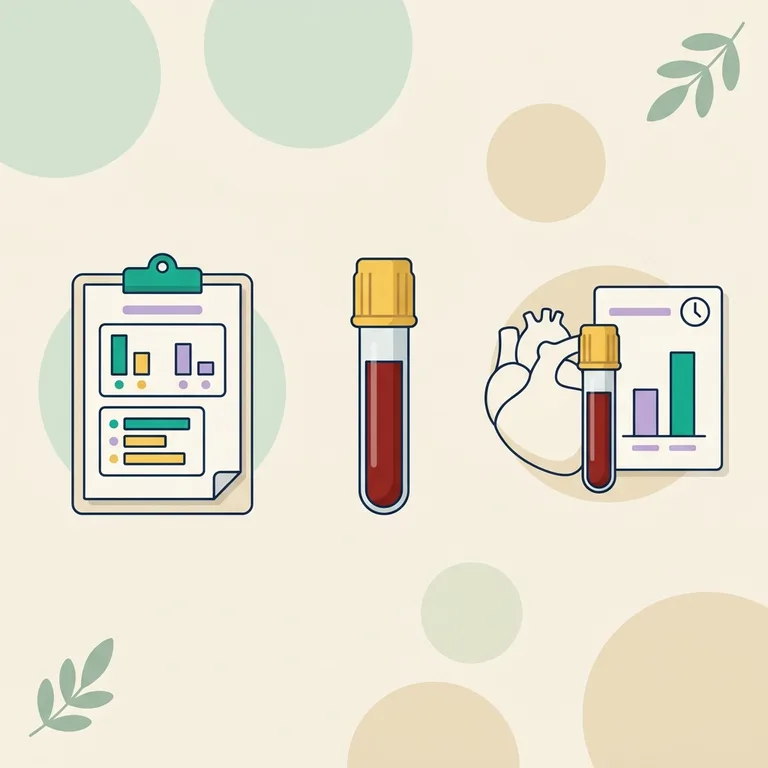
This guide shows an annotated cardiac enzyme panel, what each marker can and cannot tell you, when each one rises, and how to read the common combinations.
What does a cardiac enzymes test show? A panel, annotated
A typical example: a 61-year-old man arrives at the emergency department with chest pressure that started about two hours earlier. Blood is drawn on arrival and again two hours later, as US guidelines recommend a second high-sensitivity troponin one to three hours after the first[4].
| Test | Result | Reference range | Flag |
|---|---|---|---|
| Troponin T, high sensitivity (0 h) | 31 ng/L | <14 ng/L | H |
| Troponin T, high sensitivity (2 h) | 74 ng/L | <14 ng/L | H |
| Creatine kinase (CK), total | 165 U/L | 39-308 U/L | |
| CK-MB, mass | 3.1 ng/mL | 0.0-6.6 ng/mL | |
| Myoglobin | 85 ng/mL | 0-72 ng/mL | H |
- Two troponin lines, not one: the 99th percentile of a healthy population is the decision limit, and it depends on the assay (14 ng/L for one high-sensitivity troponin T test)[5]. Here troponin is above it and more than doubles in two hours. A clear rise or fall points to acute heart muscle injury[5].
- Normal CK and CK-MB do not reassure this early: creatine kinase typically rises 6 to 12 hours after presentation, later than troponin[6].
- Myoglobin flagged H: it rises within 1 to 2 hours but is not specific to the heart[6]; US guidelines consider it not useful for diagnosing heart injury[4].
- LDH and AST are absent: these older markers are not specific to heart muscle[5], so most panels now leave them out.
- The verdict is clinical: a rising troponin plus symptoms and the ECG is how the care team decides whether this is a heart attack or another kind of heart injury.
Got cardiac enzyme results with several flags, two time points and different units? BloodSense reads your whole report with you, line by line, and lists the questions worth asking your care team.
Explain my heart test resultsWhich tests are in a cardiac enzyme panel? Summary table
Troponin is not technically an enzyme: "cardiac biomarkers" is the more exact term for these enzymes and proteins released when heart muscle is injured or under strain[6]. Ranges depend on the method, so the range printed on your report comes first.
| Marker | What it shows | Usual adult value | Full guide |
|---|---|---|---|
| Troponin I or T (often high-sensitivity) | Heart muscle injury; the most accurate and earliest marker[4] | Below the assay's 99th percentile, for example 14 ng/L (one troponin T test) or 16 ng/L (one troponin I test)[5] | Troponin levels |
| Creatine kinase (CK, CPK), total | Mostly skeletal muscle, some heart and brain[7] | Lab-specific; one reference gives 10-120 mcg/L[8] | CPK blood test |
| CK-MB | The CK form richer in heart muscle (25-30% of its CK, against about 1% in skeletal muscle)[5] | Lab-specific | CK-MB blood test |
| Myoglobin | Early but not heart-specific muscle protein[6] | 0-72 ng/mL (men), 0-58 ng/mL (women)[9] | Myoglobin test |
| Lactate dehydrogenase (LDH) | Tissue damage anywhere: blood, liver, lungs, muscle, heart[10] | 125-220 IU/L[11] | LDH blood test |
| BNP or NT-proBNP (sometimes added) | Heart strain, mainly to confirm or rule out heart failure; not an injury marker | BNP under 100 pg/mL suggests no heart failure[12]; NT-proBNP limits depend on age | BNP test, NT-proBNP |
Older troponin tests report in ng/mL, high-sensitivity tests in ng/L: 0.04 ng/mL equals 40 ng/L. AST was the first marker used for heart attacks, in the 1960s, but it is not specific to the heart[5].
When do cardiac enzymes rise after a heart attack?
Each marker follows its own clock, which is why a single early result can be misleading.
| Marker | Starts to rise | How long it stays high |
|---|---|---|
| Myoglobin | Within 1 to 2 hours[6] | Short; not heart-specific |
| Troponin | Usually 2 to 3 hours after the start; raised within 6 hours in most patients, within 12 hours in almost all[1][2] | Can keep rising for about 24 hours[1] and stay high for 1 to 2 weeks[2] |
| CK and CK-MB | About 6 to 12 hours after presentation[6] | Shorter than troponin |
A troponin that is still normal 12 hours after symptoms began makes a heart attack unlikely[1]. With high-sensitivity tests, a normal result on arrival already excludes a heart attack in more than 95% of cases, and nearly 100% when repeated at 3 hours[5].
How do you read cardiac enzyme results together?
Troponin high and rising (or falling)
This is the pattern of acute heart muscle injury: a heart attack, but also myocarditis, shock, a pulmonary embolism or stress cardiomyopathy[5]. The higher the troponin, the more likely a heart attack; values just above the limit have a low predictive value[5].
Troponin slightly high but stable over hours
A raised troponin without a significant rise or fall is common in structural heart disease and heart failure[5]. In chronic kidney disease, a persistent elevation is frequent and still carries meaning: it should not be dismissed as poor kidney clearance alone[5].
CK high, troponin normal
The muscle signal comes from skeletal muscle: heavy exercise, an injury, intramuscular injections, recent surgery or medicines such as statins[7][8]. Very high CK with muscle pain and dark urine raises the question of rhabdomyolysis[7].
CK-MB high, troponin normal
CK-MB is less specific than troponin. Besides heart injury, it can rise with a blood clot in the lung, heart surgery, heart failure, an underactive thyroid or kidney failure[7]. A normal troponin usually carries more weight.
Myoglobin or LDH high on their own
Myoglobin also rises with skeletal muscle injury, myositis or muscular dystrophy[9]. LDH rises with liver disease, anemia caused by red cell destruction, infections and some cancers, and a sample in which red cells broke open during collection can falsely raise it[10][11].
BNP high, troponin normal
This points to a heart under strain rather than injured muscle; BNP is mainly used to confirm or rule out heart failure, and kidney failure, pulmonary embolism or sepsis can also raise it[12].
How should you prepare for a cardiac enzyme test?
In an emergency there is nothing to prepare: go first, explain later. For a planned test:
- No fasting is needed for troponin, myoglobin or LDH[1][9][10]. See fasting before a blood test for other tests drawn the same day.
- Biotin (vitamin B7, common in hair and nail supplements) can make troponin look lower than it really is: tell the person ordering the test[1].
- Avoid intense exercise and alcohol for a few days before a planned CK test, if your clinician asks[7]. A marathon can raise troponin too[1].
- Mention recent procedures and medicines: heart catheterization, surgery, intramuscular injections, statins, fibrates or steroids can raise CK[8].
- Compare like with like: troponin cutoffs are specific to each assay[5], so a result from another lab is read against its own range.
When should you see a doctor about cardiac enzyme results?
When to see a doctor
- Emergency: call 911 for chest pain, pressure or heaviness, pain spreading to the arms, back, neck or jaw, trouble breathing, or nausea with unusual tiredness[1]. Do not wait for a blood test, and do not drive yourself.
- Within 24 to 48 hours if a lab or clinic calls about a high troponin from an outpatient test, or if you have muscle pain with dark urine after exertion.
- At your next appointment for a mildly high CK after exercise, or a stable, already known troponin elevation with kidney or heart disease.
Questions to ask your doctor
- Was my troponin above the limit for this assay, and did it rise or fall between the two draws?
- If this was not a heart attack, what else could have injured or strained my heart?
- Why were CK, CK-MB or myoglobin measured, and do they change anything?
- Could my kidneys, a recent workout or a supplement such as biotin have affected the results?
- Do I need further tests for my arteries, such as a stress test or a CT scan?
Frequently asked questions
Is a troponin level of 12 normal?
It depends on the unit. 12 ng/L is below the 14 ng/L limit of one common high-sensitivity troponin T test[5]; 12 ng/mL on an older test would be very high. Always check the unit and the range on your report.
Are cardiac enzymes part of routine blood work?
No. They are ordered when heart injury is suspected, mostly for symptoms of a heart attack[1]. A standard checkup is described in our guide to routine blood work.
Do normal cardiac enzymes mean my heart is healthy?
They mean no recent heart muscle injury was detected. They do not show narrowed arteries: angina and coronary disease are assessed with other tests, such as stress testing or CT coronary angiography[4].
Why is CK-MB still on some reports?
Habit and older lab menus. CK-MB and myoglobin were key markers for two decades[5], but the 2021 US chest pain guideline considers them not useful for diagnosis when high-sensitivity troponin is available[3][4].
Related tests and guides
- Troponin levelsThe key marker of the panel, with high-sensitivity ranges.
- Heart attack: symptoms and testsWhat happens after a rising troponin, from ECG to treatment.
- CK-MB blood testHow the heart fraction of CK is reported and compared with troponin.
- CPK blood testWhen a high CK comes from muscles rather than the heart.
- Reading lab resultsRanges, flags and units on any blood test report.
References
- MedlinePlus. Troponin test. medlineplus.gov (accessed November 16, 2026)
- MedlinePlus Medical Encyclopedia. Troponin test. medlineplus.gov (accessed November 16, 2026)
- Gulati M, Levy PD, Mukherjee D, et al. 2021 AHA/ACC/ASE/CHEST/SAEM/SCCT/SCMR guideline for the evaluation and diagnosis of chest pain. Circulation. 2021;144(22):e368-e454. doi:10.1161/CIR.0000000000001029 (accessed November 16, 2026)
- Buelt A, Kennady J, Arnold M. Chest pain evaluation: updated guidelines from the AHA/ACC. Am Fam Physician. 2023;107(2):204-206. aafp.org (accessed November 16, 2026)
- Garg P, Morris P, Fazlanie AL, et al. Cardiac biomarkers of acute coronary syndrome: from history to high-sensitivity cardiac troponin. Intern Emerg Med. 2017;12(2):147-155. doi:10.1007/s11739-017-1612-1 (accessed November 16, 2026)
- Zubair M, Alsayouri K. Cardiac biomarkers. StatPearls. Treasure Island (FL): StatPearls Publishing; 2026. ncbi.nlm.nih.gov (accessed November 16, 2026)
- MedlinePlus. Creatine kinase (CK). medlineplus.gov (accessed November 16, 2026)
- MedlinePlus Medical Encyclopedia. Creatine phosphokinase test. medlineplus.gov (accessed November 16, 2026)
- MedlinePlus Medical Encyclopedia. Myoglobin blood test. medlineplus.gov (accessed November 16, 2026)
- MedlinePlus. Lactate dehydrogenase (LDH) test. medlineplus.gov (accessed November 16, 2026)
- MedlinePlus Medical Encyclopedia. Lactate dehydrogenase test. medlineplus.gov (accessed November 16, 2026)
- MedlinePlus Medical Encyclopedia. Brain natriuretic peptide test. medlineplus.gov (accessed November 16, 2026)
This article is general health information. It does not replace a medical examination, diagnosis or treatment. Chest pain is an emergency: call 911 rather than waiting for a test result.