Routine Blood Work: Which Tests a Full Checkup Includes and How to Read Them
The essentials
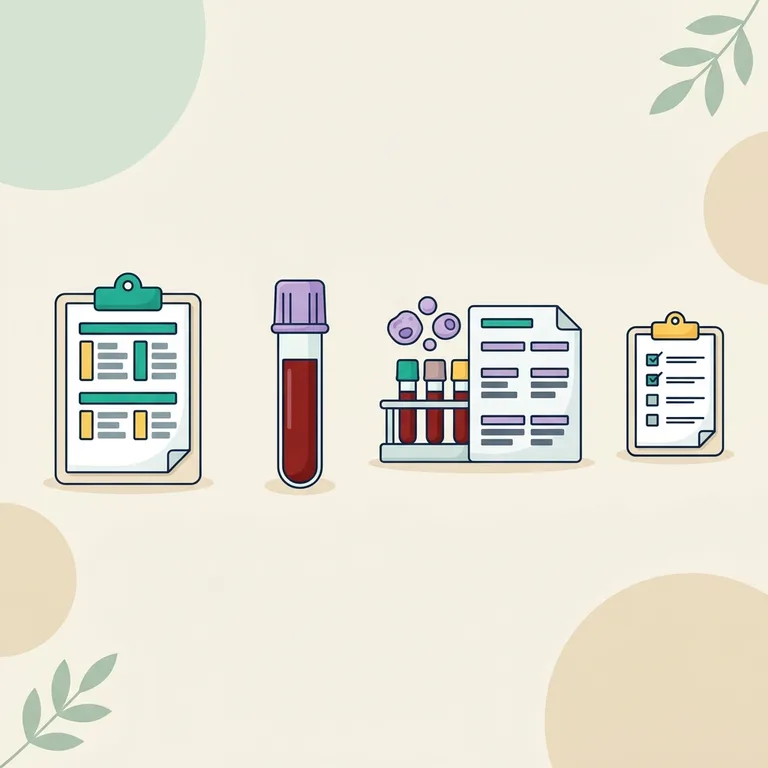
Routine blood work is not one test but a small set chosen for your age and risks: usually a complete blood count, a metabolic panel, cholesterol and blood sugar. A full checkup report is easiest to read block by block, then as a whole. One value slightly outside the range is common in healthy people.
People say "routine blood work", "a full blood panel" or "checkup labs", but there is no single standard list. Your clinician picks the tests from your age, sex, family history, medicines and habits. This guide shows what a typical adult checkup report contains, what each block checks, which tests are added with age or risk, and how to read the results together. For the basics of any lab report (columns, units, flags), see how to read blood test results.
What does routine blood work include? A checkup report, annotated
A complete blood count (CBC) and a comprehensive metabolic panel (CMP) are both commonly used as part of a routine checkup[1][2]. A lipid panel and a blood sugar test are often added for adults. Here is what such a report can look like.
| Test | Result | Reference range | Flag |
|---|---|---|---|
| Hemoglobin | 13.8 g/dL | 12.0-15.5 g/dL | |
| White blood cells | 6.2 x10³/µL | 4.5-11.0 x10³/µL | |
| Platelets | 254 x10³/µL | 150-400 x10³/µL | |
| Glucose, fasting | 106 mg/dL | 70-99 mg/dL | H |
| Hemoglobin A1c | 5.9 % | < 5.7 % | H |
| Creatinine | 0.84 mg/dL | 0.59-1.04 mg/dL | |
| eGFR | 88 mL/min/1.73 m² | ≥ 60 | |
| ALT | 24 U/L | 7-35 U/L | |
| Total cholesterol | 214 mg/dL | < 200 mg/dL | H |
| LDL cholesterol | 136 mg/dL | < 100 mg/dL | H |
| HDL cholesterol | 54 mg/dL | ≥ 50 mg/dL | |
| Triglycerides | 118 mg/dL | < 150 mg/dL |
- Read by block: blood cells first (CBC), then chemistry (sugar, kidneys, liver), then fats (lipid panel). Each block answers a different question.
- The blood cell block is normal: no sign of anemia, infection or a platelet problem in this sample.
- Two sugar results point the same way: a fasting glucose of 100 to 125 mg/dL and an A1c of 5.7 to 6.4% are both in the prediabetes range[5]. When two tests agree, the finding is more solid than one alone.
- Cholesterol: the LDL target printed here (under 100 mg/dL) is the healthy level for adults[6]; what to do about it depends on your overall heart risk, not only this number.
- H means high, L low: the flag only compares one number with one range. It is not a diagnosis.
Got a checkup report with a dozen lines and a few flags? BloodSense reads the whole report with you, block by block, and lists the questions worth asking your doctor.
Explain my checkup resultsWhich blood tests are in a full checkup? Summary table
The table lists the tests most often found in an adult checkup. The "usual value" column gives a common reference point with its source; your lab's printed range always wins.
| Test | What it checks | Usual adult value | Full guide |
|---|---|---|---|
| Complete blood count (CBC) | Red cells, white cells, platelets, hemoglobin, hematocrit, MCV[1] | Within the lab's range | Complete blood count |
| Fasting glucose | Blood sugar after an overnight fast | 99 mg/dL or below[5] | Fasting blood sugar |
| Hemoglobin A1c | Average blood sugar over 2 to 3 months | Below 5.7%[5] | HbA1c |
| Lipid panel | Total, LDL and HDL cholesterol, triglycerides | Total under 200, LDL under 100, non-HDL under 130 mg/dL; HDL 60 or more is best[6] | Lipid panel |
| Metabolic panel (CMP or BMP) | Glucose, electrolytes, calcium, kidney and liver markers; the CMP has 14 tests[2] | Within the lab's range | Comprehensive metabolic panel |
| Creatinine and eGFR | How well the kidneys filter | eGFR 60 or more[7] | eGFR blood test |
| ALT, AST | Liver cells | Within the lab's range | ALT blood test |
| Urine albumin (UACR) | Early kidney damage, mainly with diabetes or high blood pressure | 30 mg/g or less[7] | Albumin creatinine ratio |
| Hepatitis B, hepatitis C, HIV | Silent infections, tested once or by risk | Negative or nonreactive | HIV test results |
Which tests are added depending on age and risk?
US recommendations add some tests at certain ages and leave others for people with symptoms or risk factors.
- Common Cholesterol: adults 21 to 65 are generally tested every 5 years; men 45 to 65 and women 55 to 65 every 1 to 2 years; adults over 65 every year[6].
- Common Blood sugar: screening for prediabetes and type 2 diabetes is recommended for adults 35 to 70 who have overweight or obesity[8], and anyone with risk factors should ask about it[5].
- Possible Kidneys: people with diabetes should have kidney tests every year; people with high blood pressure, heart disease or a family history of kidney failure should ask how often[7].
- Possible Infections, at least once: hepatitis C for adults 18 to 79[9], hepatitis B for all adults 18 and older with a three-part test[10], HIV from 15 to 65[11].
- Rare Not routine without a reason: for adults without symptoms, the evidence is insufficient to recommend screening for thyroid problems[12] or vitamin D deficiency[13]. These tests make sense when you have symptoms or a condition that calls for them; see TSH and vitamin D.
Is "testing everything" better? A Cochrane review of 17 trials found that general health checks in adults have little or no effect on total, cancer or cardiovascular deaths[14]. Targeted tests, chosen for your age and risks, are what the recommendations support.
How do you read routine blood test results together?
A checkup report is more than a list of lines. These are the combinations that matter most.
One value just outside the range, everything else normal
Reference ranges usually cover the middle 95% of healthy people: the limits are set at the 2.5th and 97.5th percentiles[4]. So it is common for healthy people to sometimes have results outside the range[3], and the more tests on a report, the more likely one is flagged. Food, medicines, supplements, hard exercise or a menstrual period can shift a result[3]. Your clinician may simply repeat it. Our page on abnormal results when you feel fine explains this in detail.
Fasting glucose and A1c
Both tests answer the same question in different ways. A fasting glucose of 126 mg/dL or more, or an A1c of 6.5% or more, is in the diabetes range; 100 to 125 mg/dL and 5.7 to 6.4% are in the prediabetes range[5]. When both agree, as in the example above, the picture is clear. When only one is high, ask whether a repeat test is needed. Read more in our guide to diabetes blood tests.
Cholesterol numbers and your heart risk
LDL, HDL, total and non-HDL cholesterol are read together[6]. The same LDL does not mean the same thing for a 30-year-old non-smoker and for a 60-year-old with diabetes and high blood pressure, so bring your blood pressure readings to the visit. For a fasting or non-fasting lipid panel, see the LDL cholesterol guide.
Creatinine, eGFR and urine albumin
An eGFR of 60 or more is in the normal range; below 60 may mean kidney disease[7]. A urine albumin-to-creatinine ratio above 30 mg/g may also be a sign of kidney disease, and an abnormal result is often repeated one or two more times to confirm it[7]. The two tests complete each other: one shows filtering, the other leakage.
Liver enzymes with high sugar or fats
A slightly raised ALT on a report that also shows high triglycerides or glucose is a frequent checkup pattern; our guide to high liver enzymes explains the usual causes and the next tests.
Low hemoglobin with small red cells
The CBC reports hemoglobin and the average size of red cells (MCV)[1]. Low values in both lead most often to an iron check: see iron deficiency blood tests and ferritin.
How should you prepare for routine blood work?
Preparation depends on which tests are ordered. Check each point with the clinic, and never stop a medicine without asking.
- Fasting only if asked: a CBC needs no preparation, but you may have to fast for several hours when other tests are run on the same sample[1]; a metabolic panel may require several hours of fasting[2]. Our page on fasting before a blood test lists which tests need it.
- Cholesterol: fasting is not routinely required for a lipid profile[15]; fasting glucose, by definition, is measured after an overnight fast[5].
- Water is fine unless you are told otherwise; it also makes the blood draw easier.
- Tell the clinic about medicines and supplements, hard exercise the day before and your menstrual period: all can shift some results[3].
- Same lab, same time of day when you can: ranges and methods differ between labs, so trends are easier to follow.
- Bring your previous results so changes over time can be compared, not only today's flags.
When should you see a doctor about your checkup results?
When to see a doctor
- Emergency: call 911 if you have chest pain, severe shortness of breath, fainting or confusion, whatever your last results said.
- Within 24 to 48 hours if the lab or clinic calls you about an urgent result, or if a high blood sugar comes with strong thirst, frequent urination and weight loss.
- At your next appointment for results in the prediabetes range, a high LDL, an eGFR under 60, a raised urine albumin or a value slightly outside the range.
Questions to ask your doctor
- Which tests are in my checkup, and why these ones for my age and history?
- Do I need to fast, and for which test?
- Which of my flagged results matter, and which can wait for a repeat?
- How does my cholesterol fit with my overall heart risk?
- When should these tests be repeated?
- Should I be tested once for hepatitis B, hepatitis C or HIV?
Frequently asked questions
Does routine blood work show everything, including cancer?
No. Normal routine results do not rule out every disease, and there is no checkup blood panel for cancer. Cancer screening uses specific tests chosen by age, for example stool tests or colonoscopy for colorectal cancer from age 45[18].
Can a complete blood count detect diabetes?
No. A CBC counts blood cells[1]. Diabetes is found with blood sugar tests: fasting glucose, A1c or a glucose tolerance test[5].
Can I ask for a "full blood panel" without symptoms?
You can ask, and your clinician will explain what is useful for you. Extra tests beyond the recommended ones raise the chance of a borderline flag that leads to more tests, while general health checks have not been shown to reduce deaths[14].
Is a urine test part of a checkup?
Often, especially with diabetes or high blood pressure, when a urine albumin test checks the kidneys[7]. A routine urinalysis is explained in our guide to urinalysis results.
Related tests and guides
- Complete blood count with differentialEvery line of the CBC, with normal ranges and patterns.
- Comprehensive metabolic panelThe 14 chemistry results of the CMP, one by one.
- Lipid panelHow to read cholesterol and triglyceride numbers.
- HbA1c testWhat your average blood sugar says about diabetes risk.
- How to read blood test resultsReference ranges, flags and abbreviations on any report.
References
- MedlinePlus. Complete blood count (CBC). medlineplus.gov (accessed October 30, 2026)
- MedlinePlus. Comprehensive metabolic panel (CMP). medlineplus.gov (accessed October 30, 2026)
- MedlinePlus. How to understand your lab results. medlineplus.gov (accessed October 30, 2026)
- Ozarda Y. Reference intervals: current status, recent developments and future considerations. Biochem Med (Zagreb). 2016;26(1):5-16. doi:10.11613/BM.2016.001 (accessed October 30, 2026)
- Centers for Disease Control and Prevention. Diabetes testing. cdc.gov (accessed October 30, 2026)
- MedlinePlus. Cholesterol levels: what you need to know. medlineplus.gov (accessed October 30, 2026)
- National Institute of Diabetes and Digestive and Kidney Diseases. Chronic kidney disease tests and diagnosis. niddk.nih.gov (accessed October 30, 2026)
- US Preventive Services Task Force. Screening for prediabetes and type 2 diabetes: recommendation statement. JAMA. 2021;326(8):736-743. doi:10.1001/jama.2021.12531 (accessed October 30, 2026)
- US Preventive Services Task Force. Screening for hepatitis C virus infection in adolescents and adults: recommendation statement. JAMA. 2020;323(10):970-975. doi:10.1001/jama.2020.1123 (accessed October 30, 2026)
- Centers for Disease Control and Prevention. Hepatitis B: diagnosis and testing (clinical guidance). cdc.gov (accessed October 30, 2026)
- US Preventive Services Task Force. Screening for HIV infection: recommendation statement. JAMA. 2019;321(23):2326-2336. doi:10.1001/jama.2019.6587 (accessed October 30, 2026)
- LeFevre ML; US Preventive Services Task Force. Screening for thyroid dysfunction: recommendation statement. Ann Intern Med. 2015;162(9):641-650. doi:10.7326/M15-0483 (accessed October 30, 2026)
- US Preventive Services Task Force. Screening for vitamin D deficiency in adults: recommendation statement. JAMA. 2021;325(14):1436-1442. doi:10.1001/jama.2021.3069 (accessed October 30, 2026)
- Krogsbøll LT, Jørgensen KJ, Gøtzsche PC. General health checks in adults for reducing morbidity and mortality from disease. Cochrane Database Syst Rev. 2019;1:CD009009. doi:10.1002/14651858.CD009009.pub3 (accessed October 30, 2026)
- Nordestgaard BG, Langsted A, Mora S, et al. Fasting is not routinely required for determination of a lipid profile: a joint consensus statement from the EAS and EFLM. Eur Heart J. 2016;37(25):1944-1958. doi:10.1093/eurheartj/ehw152 (accessed October 30, 2026)
- US Departments of Labor, Health and Human Services, and the Treasury. FAQs about Affordable Care Act implementation, Part 51. dol.gov (accessed October 30, 2026)
- Medicare.gov. Cardiovascular disease screenings. medicare.gov (accessed October 30, 2026)
- Centers for Disease Control and Prevention. Screening for colorectal cancer. cdc.gov (accessed October 30, 2026)
This article is general health information. It does not replace a medical examination, diagnosis or treatment. With chest pain, severe shortness of breath or fainting, seek emergency care without waiting.