








Blood Draw: What to Expect, How to Prepare and What Affects Results
The essentials
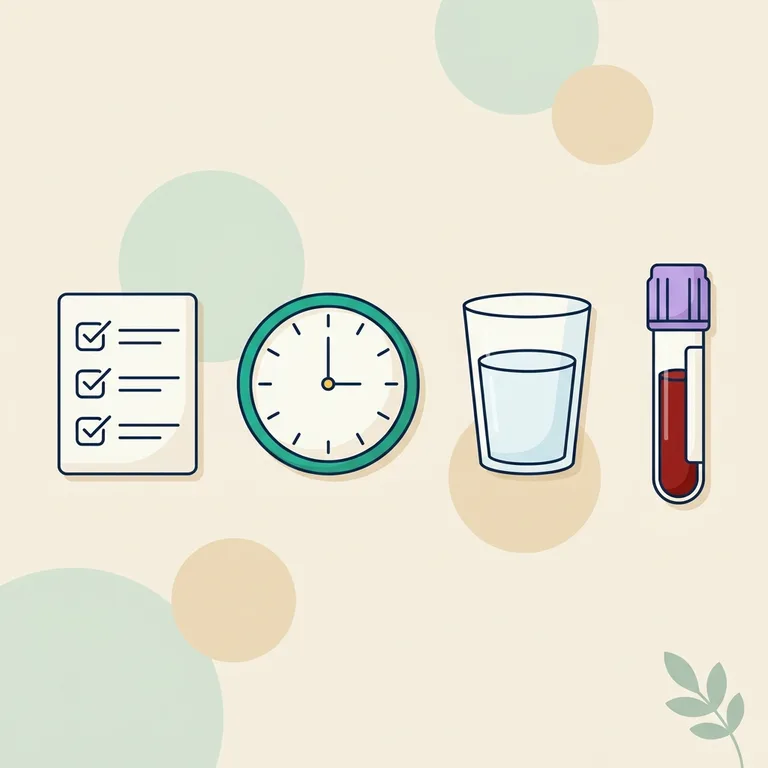
A blood draw takes about ten minutes, and the needle itself only a few seconds. A clinician cleans the skin, ties a strap around your upper arm, takes blood from a vein at the inside of the elbow and covers the spot. Most people feel a brief sting and, at worst, a small bruise. Ask whether your tests need fasting, keep drinking water, and tell the person drawing your blood if needles make you nervous.
What happens during a blood draw, step by step?
The procedure is called venipuncture. Blood is usually taken from the inside of the elbow or the back of the hand[1]. The whole visit typically takes about 10 minutes[2].
- Identity check. The phlebotomist (the person trained to draw blood) confirms your name and labels the tubes.
- Strap. An elastic band goes around your upper arm so the veins fill with blood[1].
- Cleaning. The skin is wiped with an antiseptic[1].
- Needle and tubes. A needle enters the vein and blood runs into one or several tubes. You may feel a slight pain or a sting[1].
- Release and cover. The strap comes off, the needle is withdrawn and the spot is covered with a bandage or cotton[1][2].
In babies and young children, a small lancet prick may replace the needle in the arm[1].
How do I prepare for a blood draw?
Preparation depends on the test, and many tests need none[1].
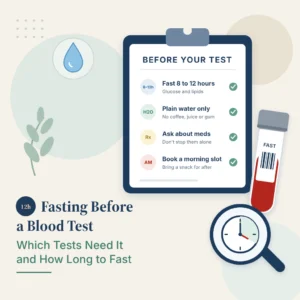
- Ask whether your tests need fasting, and for how long. Some require you to eat or drink nothing but water for a short time[2]. Our guide to fasting before a blood test explains which tests are concerned.
- Keep drinking water if you are fasting. Water is allowed[2].
- Do not stop or change your medicines without talking to your provider first[1]. You may be told to pause a few, such as blood thinners[2].
- Bring your test request, insurance card and a photo ID[8].
- If you are anxious, tell the person who will draw your blood[2], and consider bringing someone for support[2].
Already have the results of a previous draw? BloodSense reads every line of your report with you and helps you prepare questions for your doctor.
Get my blood test explainedDoes a blood draw hurt, and what happens afterward?
Expect a quick sting as the needle goes in and some throbbing at the site afterward[1]. Bruising or swelling is possible and should settle within a few days[2].
When to see a doctor
- Emergency: call 911 if you faint and do not wake up quickly, or if you have chest pain or trouble breathing after the draw.
- Within 24 to 48 hours if the arm becomes increasingly swollen, hot, red or very painful, if you have numbness or tingling down the arm or hand, or if you develop a fever.
- At your next appointment if a bruise is still visible after a few days[2] or you want to discuss your worries about needles.
What if I am afraid of needles or tend to faint?
Fear of blood draws is common. In people with blood-injection-injury phobia, 75% report a history of fainting when they face what they fear[6]. Fainting happens because blood pressure or heart rate drops after an initial stress reaction[7].
- Common Tell the staff first. They can help you feel more at ease[2]. You can ask to lie down for the draw.
- Possible Tense your muscles. Tensing the muscles of the arms, legs and trunk (applied tension) is a technique proposed to counter the drop in blood pressure[7].
- Possible Slow, steady breathing. Breathing-focused coping is also studied[7].
Can the way blood is drawn change my results?
Yes. Hemolysis, the breakdown of red cells in the tube, is a leading cause of laboratory errors before the sample is even analyzed[3]. Reviews link it to a strap left on for more than one minute, tubes filled less than halfway, and draws that are not from the elbow crease[3]. In a simulation, tying the strap before finding the vein and leaving it on until the tubes are full could multiply hemolysis tenfold[4].
If a result looks odd, ask whether the sample was hemolyzed. See lab errors versus real emergencies.
Fasting also matters less than many people think for some tests. European experts recommend non-fasting samples for routine cholesterol tests, with fasting considered when triglycerides are very high (above 5 mmol/L, or 440 mg/dL)[5]. See lipid panel results.
Which tests are usually done on the same draw?
One draw can fill several tubes. Common ones are the complete blood count, the basic metabolic panel and the comprehensive metabolic panel. Results often come within a few days and usually within a few weeks[2]. Our guide on how to understand lab results shows how to read them.
Frequently asked questions
How long does a blood draw take?
The whole visit typically takes about 10 minutes[2].
Can I drink water before a blood test?
Yes. Even when you must fast, plain water is allowed[2].
Why do they tie a strap around my arm?
It makes the blood easier to draw[2]. More than one minute raises the risk of hemolysis[3].
Can I take my usual medicines the morning of the test?
Do not stop or change your medicines without talking to your provider[1]. Some, such as blood thinners, may need to be paused for certain tests[2].
Related tests and guides
- Fasting for a blood testWhich tests need it, how long, and what you can drink.
- Complete blood countThe most common test on a blood draw.
- HemoglobinThe result most often looked at first.
- Lab errors versus real emergenciesWhen a strange result is a sampling problem.
- How to understand lab resultsRead your report line by line once it arrives.
References
- MedlinePlus Medical Encyclopedia. Venipuncture. medlineplus.gov (accessed October 22, 2026)
- NHS. Blood tests. nhs.uk (accessed October 22, 2026)
- McCaughey EJ, et al. Key factors influencing the incidence of hemolysis: a critical appraisal of current evidence. Crit Rev Clin Lab Sci. 2017;54(1):59-72. doi:10.1080/10408363.2016.1250247 (accessed October 22, 2026)
- Reed S, Remenyte-Prescott R, Rees B. Effect of venepuncture process design on efficiency and failure rates: a simulation model study for secondary care. Int J Nurs Stud. 2017;68:73-82. doi:10.1016/j.ijnurstu.2016.12.010 (accessed October 22, 2026)
- Nordestgaard BG, et al. Fasting is not routinely required for determination of a lipid profile (EAS and EFLM joint consensus statement). Eur Heart J. 2016;37(25):1944-58. doi:10.1093/eurheartj/ehw152 (accessed October 22, 2026)
- Ducasse D, et al. Blood-injection-injury phobia: psychophysiological and therapeutic specificities. Encephale. 2013;39(5):326-31. doi:10.1016/j.encep.2012.06.031 (accessed October 22, 2026)
- Ritz T, Meuret AE, Ayala ES. The psychophysiology of blood-injection-injury phobia: looking beyond the diphasic response paradigm. Int J Psychophysiol. 2010;78(1):50-67. doi:10.1016/j.ijpsycho.2010.05.007 (accessed October 22, 2026)
- Labcorp. What to expect when visiting a Labcorp patient service center. labcorp.com (accessed October 22, 2026)
This article is general health information. It does not replace a medical examination, diagnosis or treatment. If you faint, have severe pain or notice signs of infection after a blood draw, seek care without waiting.