










Inflammatory Bowel Disease (IBD): Symptoms, Tests and Treatment
The essentials
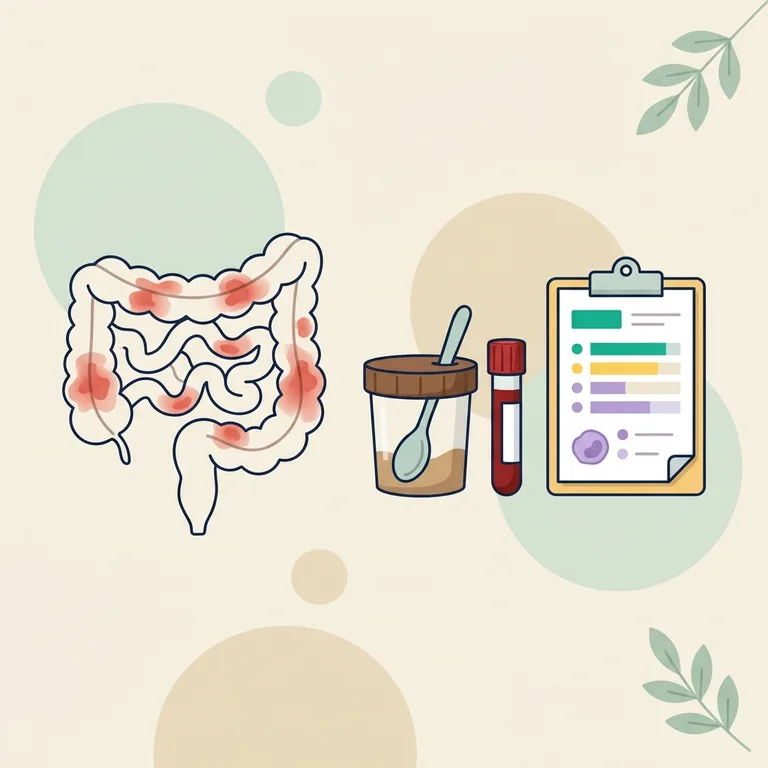
Inflammatory bowel disease (IBD) is the name for long-lasting inflammation of the gut, mainly Crohn's disease and ulcerative colitis. It causes diarrhea, belly pain, blood in the stool, tiredness and weight loss, in flares. Blood tests (blood count, CRP, ferritin) and stool calprotectin show inflammation; a colonoscopy with biopsies confirms it, and the same tests then check that treatment works.
What is inflammatory bowel disease (IBD)?
In IBD, the immune system keeps the gut lining inflamed. The condition is lifelong, with flares and remissions[1]. It has two main forms[1][11]:
- Crohn's disease: can affect any part of the digestive tract, from mouth to anus, often in patches and through the whole bowel wall.
- Ulcerative colitis: affects only the inner lining of the colon, starting at the rectum.
If the type is still unclear, the report may say "IBD unclassified". IBD is not irritable bowel syndrome (IBS), which causes real symptoms but no gut inflammation[1].
| Topic | Key facts |
|---|---|
| Other names | IBD; Crohn's disease and ulcerative colitis (UC); "IBD unclassified" when the type is unclear |
| How common | About 2.39 million people in the United States, more than 0.7% of Americans[2]; 6.8 million worldwide in 2017[3] |
| Usual age at diagnosis | Most often between 15 and 30, but any age[11]; new cases peak in the third decade of life[2] |
| Key tests | Complete blood count, CRP, ferritin, albumin, stool calprotectin, stool tests for infection, then colonoscopy with biopsies and imaging[4] |
What are the symptoms of IBD?
Symptoms depend on where the inflammation sits and how active it is[1][11]:
- Gut symptoms: diarrhea lasting weeks, belly pain or cramps, an urgent need to go, blood or mucus in the stool (more typical of ulcerative colitis).
- Whole-body symptoms: tiredness, weight loss, fever during flares; slowed growth in some children.
- Outside the gut: joint pain, red or painful eyes, skin lesions, mouth ulcers, liver or bile duct problems[11].
Over time, IBD can cause anemia, weaker bones, poor absorption of nutrients and a higher risk of colorectal cancer[1]. A third of people with active IBD have iron deficiency anemia[5].
When to see a doctor
- Emergency: call 911 for heavy rectal bleeding, fainting, severe belly pain with a swollen or hard abdomen, or vomiting that does not stop.
- Within 24 to 48 hours for more than 6 bloody stools a day with fever above 100°F (37.8°C) or a fast pulse: doctors call this acute severe colitis and treat it in hospital[5]. Also for signs of dehydration.
- At your next appointment for diarrhea lasting more than a few weeks, blood in the stool, unexplained weight loss or tiredness, or a high calprotectin or low hemoglobin on a recent report.
What causes IBD, and who is at risk?
The cause is unknown: probably an abnormal immune reaction to gut bacteria in people with a genetic tendency[11].
- Common Family history: parents, brothers, sisters and children of people with IBD have a 4- to 20-fold higher risk, more so for Crohn's disease[11].
- Common Smoking: raises the risk of Crohn's disease[10], and smokers with Crohn's have more flares and surgery[5].
- Possible Other links found in studies: city living, antibiotic use, oral contraceptives, low vitamin D, appendix removal (Crohn's). Physical activity and breastfeeding were linked to a lower risk[10].
Which tests diagnose IBD, and how do I read the results?
No blood test proves IBD. European guidelines advise, at diagnosis, a blood count, inflammatory markers such as CRP, kidney and liver tests, iron status, and stool tests for infection, including C. difficile toxin[4]. Here is a fictitious report for a 26-year-old woman with two months of bloody diarrhea.
| Test | Result | Reference range | Flag |
|---|---|---|---|
| Hemoglobin | 10.9 g/dL | 12.0-15.5 g/dL | L |
| Platelets | 468 x10³/µL | 150-400 x10³/µL | H |
| C-reactive protein (CRP) | 2.4 mg/dL | < 0.8 mg/dL | H |
| Ferritin | 21 ng/mL | 15-150 ng/mL | - |
| Albumin | 3.2 g/dL | 3.5-5.0 g/dL | L |
| Calprotectin, stool | 640 µg/g | < 50 µg/g | H |
| C. difficile toxin / stool culture | Not detected / no pathogens | Not detected | - |
- Hemoglobin and platelets: mild anemia and raised platelets often go with inflammation and blood loss. See our complete blood count guide.
- CRP: confirms inflammation somewhere in the body, but it is not specific to IBD and can be normal in active disease[4].
- Ferritin: "normal" for the lab, yet in IBD a ferritin below 30 ng/mL without inflammation means iron deficiency[4], and up to 100 ng/mL can still mean iron deficiency when inflammation is present[5].
- Calprotectin: a white blood cell protein; 640 µg/g points to bowel inflammation and calls for a colonoscopy.
- Stool tests: infection can mimic IBD and is ruled out first[4].
Have your blood and stool results in hand? BloodSense explains each value of your full lab report in plain words, so you can prepare your questions for the gastroenterologist.
Explain my lab reportFecal calprotectin: IBD or IBS?
Many labs define a normal fecal calprotectin as below 50 µg/g[5]. In adults with IBS-like symptoms, a value of 40 µg/g or less, or a CRP of 0.5 mg/dL or less, means a 1% chance or less of IBD[6]. Because assays differ, British guidelines let each area set its own cut-off for referral to colonoscopy, usually between 100 and 250 µg/g[5]. Infection also raises calprotectin, and bloody diarrhea needs a scope whatever the result[5]. See also our IBS guide.
What confirms the diagnosis?
An ileocolonoscopy with biopsies is the reference test; CT, MRI or capsule endoscopy check the small bowel[4]. Antibody (ASCA, pANCA) and genetic tests are not recommended for routine diagnosis[4]. Before biologic treatment, the team also screens for tuberculosis, hepatitis B and C, HIV and chickenpox immunity[5].
Which tests are used to monitor IBD, and how often?
Guidelines aim to calm the inflammation itself, not only symptoms. Short-term goals are fewer symptoms and a return to normal of CRP and calprotectin; long-term goals are a healed bowel lining, normal quality of life and normal growth in children[9].
| Test | Why | Usual timing |
|---|---|---|
| Calprotectin, CRP, symptoms | Check inflammation without a scope; calprotectin can rise before a relapse | Every 3 to 6 months in remission[4] |
| Calprotectin or colonoscopy | Check that a new treatment heals the lining (ulcerative colitis) | 3 to 6 months after starting[4] |
| Blood count, kidney and liver tests | Side effects of azathioprine or mercaptopurine | Weeks 2, 4, 8 and 12, then at least every 3 months[5] |
| TPMT (enzyme test) | Choose a safe thiopurine dose | Before the first dose[5] |
| Ferritin, transferrin saturation, B12, folate, vitamin D | Iron deficiency and nutrition | When anemic, malnourished or at risk[5] |
| Surveillance colonoscopy | Look for early cancer changes when the colon is involved | From 8 years after symptoms began; from diagnosis with primary sclerosing cholangitis[5] |
For ulcerative colitis in remission, American guidelines suggest that calprotectin below 150 µg/g, a normal fecal lactoferrin or a normal CRP can rule out active inflammation and spare a routine colonoscopy; with moderate to severe symptoms, a value above 150 µg/g can guide treatment[8]. In a review of 2,499 patients, calprotectin detected 88% of endoscopic flares, CRP only 49%[7]: a normal CRP does not exclude a flare.
Low albumin, low vitamin B12 (after ileal Crohn's or surgery) and low ferritin are frequent and treatable findings.
How is IBD treated?
Treatment depends on the type, extent and severity of the disease[5]. Main options:
- Aminosalicylates (5-ASA, mesalamine): mainly for mild to moderate ulcerative colitis.
- Corticosteroids: to calm a flare quickly, not for long-term use. Courses of 3 months or more call for checks of blood count, blood sugar or HbA1c, lipids and blood pressure, plus calcium and vitamin D[5].
- Immunomodulators: azathioprine, mercaptopurine, methotrexate, with the blood monitoring above.
- Biologics and small molecules: anti-TNF drugs (infliximab, adalimumab), vedolizumab, ustekinumab, JAK inhibitor tablets. Blood drug levels can explain a loss of response[5].
- Surgery and nutrition: surgery for narrowing, fistula, abscess or colitis that resists drugs; diet support and iron.
Can IBD be prevented, and how do you live with it?
IBD cannot be prevented, but its course can be improved:
- Stop smoking: it worsens Crohn's disease[5]. People with ulcerative colitis should stop too, knowing that a flare may follow and treatment may need adjusting[5].
- Keep your tests on schedule in remission: calprotectin can warn before symptoms return[4].
- Bring a stool sample when a flare starts: infection must be ruled out before treatment is stepped up[4].
- Update your vaccines before immunosuppressive treatment[5], and ask about bone health, mood and fatigue[1].
Most people with IBD lead active lives with long periods of remission[1].
Questions to ask your doctor
- Do I have Crohn's disease or ulcerative colitis, and which part of the bowel is affected?
- Which result will tell us that my treatment works: symptoms, calprotectin, CRP or a scope?
- Is my ferritin low for someone with IBD, and do I need iron?
- When should my first surveillance colonoscopy be?
Frequently asked questions
Is IBD an autoimmune disease?
It is called immune-mediated: the immune system reacts wrongly to gut bacteria, but no single autoantibody causes it, so antibody tests do not diagnose it[4][11]. See our page on autoimmune diseases.
Can a blood test alone diagnose IBD?
No. A normal blood test does not rule it out, and a high CRP has many causes. Calprotectin is the most sensitive non-invasive marker, but diagnosis needs a colonoscopy with biopsies[4].
Does IBD increase the risk of colon cancer?
Yes, when the colon has been inflamed for many years, which is why surveillance colonoscopy starts 8 years after symptoms began[5]. Proctitis alone carries a risk close to the general population[5]. See colorectal cancer.
Related articles
- Crohn's diseaseSymptoms, causes and the lab markers that track it.
- Ulcerative colitisThe form of IBD limited to the colon.
- Fecal calprotectin testHow to read the key stool marker of IBD.
- CRP blood testWhat a raised C-reactive protein means.
- Diarrhea: causes and testsWhen diarrhea needs stool and blood tests.
References
- Centers for Disease Control and Prevention. About Inflammatory Bowel Disease. cdc.gov (accessed November 16, 2026)
- Lewis JD, Parlett LE, Jonsson Funk ML, et al. Incidence, Prevalence, and Racial and Ethnic Distribution of Inflammatory Bowel Disease in the United States. Gastroenterology. 2023;165(5):1197-1205. doi:10.1053/j.gastro.2023.07.003 (accessed November 16, 2026)
- GBD 2017 Inflammatory Bowel Disease Collaborators. The global, regional, and national burden of inflammatory bowel disease in 195 countries and territories, 1990-2017. Lancet Gastroenterol Hepatol. 2020;5(1):17-30. doi:10.1016/S2468-1253(19)30333-4 (accessed November 16, 2026)
- Maaser C, Sturm A, Vavricka SR, et al. ECCO-ESGAR Guideline for Diagnostic Assessment in IBD Part 1: Initial diagnosis, monitoring of known IBD, detection of complications. J Crohns Colitis. 2019;13(2):144-164. doi:10.1093/ecco-jcc/jjy113 (accessed November 16, 2026)
- Lamb CA, Kennedy NA, Raine T, et al. British Society of Gastroenterology consensus guidelines on the management of inflammatory bowel disease in adults. Gut. 2019;68(Suppl 3):s1-s106. doi:10.1136/gutjnl-2019-318484 (accessed November 16, 2026)
- Menees SB, Powell C, Kurlander J, et al. A meta-analysis of the utility of C-reactive protein, erythrocyte sedimentation rate, fecal calprotectin, and fecal lactoferrin to exclude inflammatory bowel disease in adults with IBS. Am J Gastroenterol. 2015;110(3):444-454. doi:10.1038/ajg.2015.6 (accessed November 16, 2026)
- Mosli MH, Zou G, Garg SK, et al. C-Reactive Protein, Fecal Calprotectin, and Stool Lactoferrin for Detection of Endoscopic Activity in Symptomatic Inflammatory Bowel Disease Patients: A Systematic Review and Meta-Analysis. Am J Gastroenterol. 2015;110(6):802-819. doi:10.1038/ajg.2015.120 (accessed November 16, 2026)
- Singh S, Ananthakrishnan AN, Nguyen NH, et al. AGA Clinical Practice Guideline on the Role of Biomarkers for the Management of Ulcerative Colitis. Gastroenterology. 2023;164(3):344-372. doi:10.1053/j.gastro.2022.12.007 (accessed November 16, 2026)
- Turner D, Ricciuto A, Lewis A, et al. STRIDE-II: An Update on the Selecting Therapeutic Targets in Inflammatory Bowel Disease (STRIDE) Initiative of the IOIBD. Gastroenterology. 2021;160(5):1570-1583. doi:10.1053/j.gastro.2020.12.031 (accessed November 16, 2026)
- Piovani D, Danese S, Peyrin-Biroulet L, et al. Environmental Risk Factors for Inflammatory Bowel Diseases: An Umbrella Review of Meta-analyses. Gastroenterology. 2019;157(3):647-659. doi:10.1053/j.gastro.2019.04.016 (accessed November 16, 2026)
- MSD Manual Consumer Version. Overview of Inflammatory Bowel Disease (IBD). msdmanuals.com (accessed November 16, 2026)
This page gives general information about inflammatory bowel disease. It does not replace the advice of the doctor who knows your health and your full results.