











Peripheral Artery Disease (PAD): Poor Circulation in the Legs, ABI and Blood Tests
The essentials
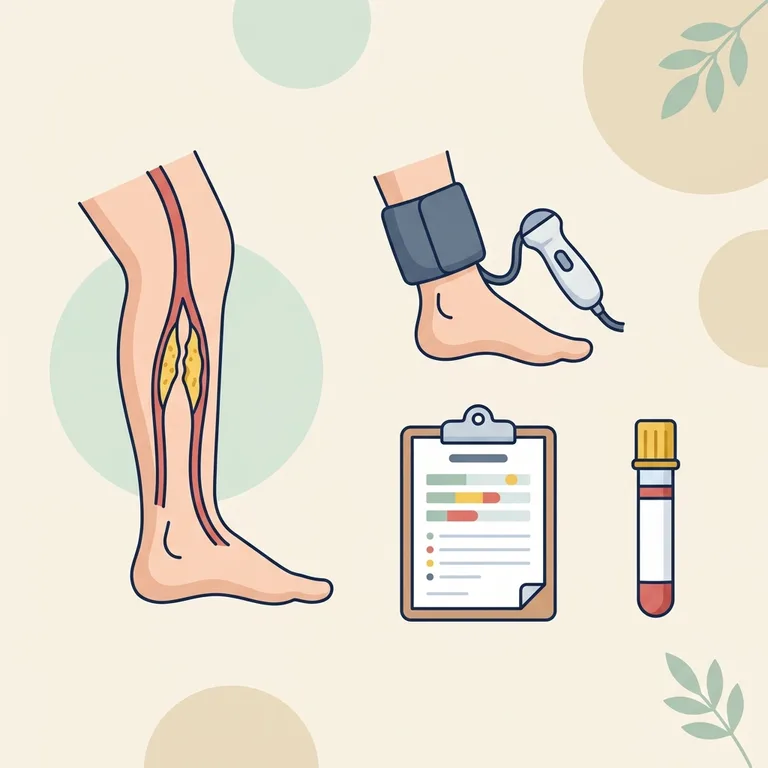
Peripheral artery disease (PAD) is poor circulation in the legs caused by narrowed arteries, usually from plaque. Its classic sign is calf pain when walking that eases within minutes of rest. A simple ankle-brachial index (ABI) test confirms it, blood tests look for the risk factors behind it, and regular walking plus medicines protect both the legs and the heart.
What is peripheral artery disease, at a glance?
- What it is: narrowing of the arteries that carry blood to the legs, almost always from atherosclerosis[1]. Other names: PAD, peripheral arterial disease, lower extremity arterial disease. "Peripheral vascular disease" (PVD) is a broader term that also includes veins.
- How common: an estimated 10 to 12 million Americans over 40, and at least 113 million people worldwide[1].
- Key test: the ankle-brachial index (ABI), a blood pressure measurement at the ankles and arms[1].
- Key blood tests: a lipid panel, glucose and HbA1c, kidney function[2]: they find what drives PAD.
What are the symptoms of poor circulation in the legs?
The typical symptom is intermittent claudication: pain, aching, heaviness or cramping in the calf, thigh or buttock that starts after a certain walking distance or on stairs and goes away after a few minutes of standing still[3].
Only about 1 person in 4 with PAD has this pattern; more than half have atypical symptoms, and 1 in 5 none[3]. Women more often have PAD without symptoms[4] and tend to show it 10 to 20 years later than men[1].
Other signs: one foot colder or paler than the other, toenails and leg hair that stop growing, sores on the feet that heal slowly, numbness or pins and needles, and in severe disease, foot pain at rest[3].
Is it PAD, varicose veins, restless legs or cramps?
"Bad circulation" can mean arteries or veins, and other leg complaints look alike. The timing of the pain is the best clue.
| Condition | Typical feeling | When it comes and what helps |
|---|---|---|
| PAD (arteries) | Cramp or ache in calf, thigh or buttock | Comes with walking at a similar distance; stops after a few minutes of rest, standing is enough[3] |
| Venous insufficiency, varicose veins (veins) | Dull ache, heaviness, swollen ankles | Worse after standing; better with legs raised; skin changes and ulcers near the ankle[11] |
| Spinal stenosis (nerves) | Pain and weakness in both buttocks and legs | Comes with standing as well as walking; eased by sitting or bending forward[1] |
| Restless legs syndrome | Urge to move, crawling feeling | At rest in the evening; relieved by moving, not by stopping |
| Night leg cramps | Sudden, hard, painful muscle knot | At night in bed; eased by stretching |
A suddenly swollen, painful calf can be a blood clot in a vein. Chest pain on effort is the heart's version of claudication: see coronary artery disease.
When is a cold, painful leg an emergency?
When to see a doctor
- Emergency: call 911 if a leg or foot suddenly becomes painful, pale or bluish, cold, numb, weak or hard to move, especially if you cannot feel a pulse. This is acute limb ischemia: a blocked artery that needs treatment within hours to save the limb[1]. Also for chest pain or stroke signs.
- Within 24 to 48 hours for foot pain at rest, a foot wound not healing after 2 weeks, or a dark toe. These signal chronic limb-threatening ischemia, which needs urgent referral to a vascular specialist[8].
- At your next appointment for leg pain on walking that eases with rest, or if you are 65 or older, or 50 or older with diabetes, smoking, high cholesterol, high blood pressure or kidney disease, to discuss an ABI[1].
What causes PAD, and who is at risk?
Plaque builds up in the artery wall. When you walk, the muscles need more blood than the narrowed artery can deliver, which causes the pain[1]. Risk factors[4][1]:
- Common Smoking, now or in the past, including regular secondhand smoke.
- Common Diabetes, which also dulls pain and slows wound healing.
- Common Age: most Americans with PAD are 65 or older.
- Possible High cholesterol, high triglycerides and high blood pressure.
- Possible Chronic kidney disease, family history of PAD, heart disease or stroke; African American people have a higher risk.
- Rare Causes other than plaque, such as a clot traveling from the heart or an injury[8].
How is PAD diagnosed? The ABI test and what the numbers mean
The doctor asks about walking pain and checks your feet and pulses[1]. The first test is the ankle-brachial index: you lie down, and blood pressure is measured with a cuff and a small Doppler probe at both arms and both ankles. Each ankle's highest pressure is divided by the highest arm pressure[6]. It does not hurt.
| Resting ABI | Meaning |
|---|---|
| 1.00 to 1.40 | Normal[1] |
| 0.91 to 0.99 | Borderline; an ABI after exercise can help[1] |
| 0.90 or less | Abnormal: confirms PAD[1] |
| Below 0.40 | Severe PAD[5] |
| Above 1.40 | Noncompressible: stiff, calcified arteries (diabetes, kidney disease); a toe-brachial index is done instead, abnormal at 0.70 or less[1][2] |
If your symptoms suggest PAD but the resting ABI is normal or borderline, the test is repeated after walking on a treadmill: a drop of 20% or more is abnormal[5]. Ultrasound, CT or MR angiography then locate the narrowing, mainly before a procedure[5].
A fictitious report for a 67-year-old former smoker with calf pain after two blocks:
| Test | Result | Reference range | Flag |
|---|---|---|---|
| ABI, right | 0.68 | 1.00-1.40 | L |
| ABI, left | 0.95 | 1.00-1.40 | L |
| LDL cholesterol | 138 mg/dL | <100 mg/dL | H |
| Hemoglobin A1c | 6.9 % | <5.7 % | H |
| Creatinine | 1.2 mg/dL | 0.7-1.3 mg/dL | |
| eGFR | 56 mL/min/1.73m² | >59 | L |
- ABI right 0.68: below 0.90, so PAD is confirmed on the right. The left leg at 0.95 is borderline[1].
- LDL 138 mg/dL: the "<100" range is for the general population. With PAD, guidelines aim for a cut of at least 50% and an LDL below 70 mg/dL[1]. See LDL cholesterol.
- HbA1c 6.9%: in the diabetes range (6.5% or more); in PAD, each 1% rise went with about 14% more heart attacks and strokes in one trial[1]. See HbA1c results.
- Creatinine normal, eGFR 56: an eGFR under 60 counts as chronic kidney disease, which raises PAD risk and matters before a dye scan[1]. See eGFR.
An ABI, a lipid panel, an HbA1c and kidney tests, each with its own units and flags? BloodSense explains every line of your full report in plain words, so you know what to ask at your next visit.
Explain my blood test resultsWhich blood tests are done for PAD, and how do I read them?
No blood test shows PAD itself. The 2024 European guideline lists tests that look for its causes and risks[2]:
- Lipid panel: LDL, HDL, triglycerides, plus lipoprotein(a) at least once in a lifetime.
- Blood sugar: fasting glucose and HbA1c.
- Kidney function: creatinine and eGFR.
- Complete blood count, clotting, liver tests, electrolytes, CRP, and thyroid tests if needed.
The result that most often changes treatment is LDL: with PAD, your target is far stricter than the range printed on the report[1].
What are the stages of PAD, and what is critical limb ischemia?
Doctors describe PAD by how it affects you[1]:
- Without symptoms, then claudication: pain on walking, eased by rest.
- Chronic limb-threatening ischemia (CLTI, formerly "critical limb ischemia"): pain at rest, a wound that has not healed for more than 2 weeks, or gangrene[8]. In one review, about 22% of untreated people needed a major amputation within a year[1].
- Acute limb ischemia: a sudden blockage with pain, pallor, no pulse, coldness, pins and needles, then paralysis. Muscle tolerates it for only about 4 to 6 hours[1].
The bigger danger is elsewhere: plaque in the legs often means plaque in the heart and brain arteries, so heart attack and stroke are the main risks[3].
How is peripheral artery disease treated?
Two goals: protect the heart and brain, and help you walk farther. An overview, without doses[1]:
- Stop smoking, with counseling and medicines if needed.
- A high-intensity statin to lower LDL by at least half, and an antiplatelet medicine, sometimes with a low-dose blood thinner.
- Blood pressure control, usually aiming below 130/80 mm Hg.
- Diabetes care, with medicines that also protect the heart.
- A medicine for walking distance in some people with claudication; it is not suitable for people with heart failure.
- Foot care: daily self-checks and proper footwear.
- Opening the artery (balloon, stent or bypass): needed for CLTI, an option for claudication that still limits daily life despite exercise and medicines[1].
Does walking help peripheral artery disease?
Yes, and it is the first treatment for claudication. The best-studied form is supervised exercise therapy: walking on a treadmill until the pain is mild to moderate, resting, then walking again, at least 3 times a week for 30 to 45 minutes, over at least 12 weeks[1]. In a Cochrane review of 21 trials, supervised programs added about 210 meters of walking at 3 months compared with walking advice alone, and 120 meters compared with home exercise[7]. For many people, exercise works at least as well as opening the artery, and the two combined give the biggest gain[1].
Walking to moderate pain is what drives the benefit. If supervised sessions are not available, a structured home program is the next option[1].
What follow-up is needed with PAD?
- Lipid panel a few weeks after starting or changing a statin, then about once a year, to check the LDL target.
- HbA1c every 3 to 6 months if you have diabetes.
- Creatinine and eGFR regularly.
- Feet checked at every visit, and a full foot exam at least once a year[1].
- Walking distance: note it; a sudden drop is a reason to call.
Questions to ask your doctor
- What is my ABI on each leg, and is a test after exercise or a toe pressure needed?
- What LDL level should I aim for, and when will you recheck it?
- Can I join a supervised exercise program, and is it covered by my plan?
- Should my heart, carotid arteries or aorta also be checked?
- Which foot problems should make me call you right away?
Frequently asked questions
Can you live a long life with peripheral artery disease?
Yes, many people do, especially when they stop smoking, take their medicines and keep walking. The main threat is to the heart and brain rather than the leg[1].
Can PAD be reversed?
Plaque rarely disappears, but symptoms often improve a lot: supervised walking increases walking distance within 3 months[7], and lowering LDL and stopping smoking slow the disease and cut the risk of heart attack and stroke[1].
Why is my ABI normal when my doctor still suspects PAD?
An ABI above 1.40 can hide PAD because stiff, calcified arteries do not compress; a toe pressure test is then used. With typical symptoms and a normal resting ABI, an ABI after exercise may unmask the narrowing[1][2].
Related articles
- AtherosclerosisThe plaque process behind PAD, heart attack and stroke
- Lipid panel resultsLDL, HDL and triglycerides, line by line
- HbA1cThe diabetes test that matters for leg wounds
- Coronary artery diseaseThe same plaque in the heart arteries
- Leg cramps at nightWhen the pain comes in bed, not on walking
- Restless legs syndromeAn urge to move at rest, not a circulation problem
- Gornik HL, Aronow HD, Goodney PP, et al. 2024 ACC/AHA/AACVPR/APMA/ABC/SCAI/SVM/SVN/SVS/SIR/VESS Guideline for the Management of Lower Extremity Peripheral Artery Disease. Circulation. 2024;149(24):e1313-e1410. doi:10.1161/CIR.0000000000001251 (accessed November 15, 2026)
- Mazzolai L, Teixido-Tura G, Lanzi S, et al. 2024 ESC Guidelines for the management of peripheral arterial and aortic diseases. Eur Heart J. 2024;45(36):3538-3700. doi:10.1093/eurheartj/ehae179 (accessed November 15, 2026)
- National Heart, Lung, and Blood Institute. Peripheral Artery Disease: Symptoms. nhlbi.nih.gov (accessed November 15, 2026)
- National Heart, Lung, and Blood Institute. Peripheral Artery Disease: Causes and Risk Factors. nhlbi.nih.gov (accessed November 15, 2026)
- National Heart, Lung, and Blood Institute. Peripheral Artery Disease: Diagnosis. nhlbi.nih.gov (accessed November 15, 2026)
- Aboyans V, Criqui MH, Abraham P, et al. Measurement and interpretation of the ankle-brachial index: a scientific statement from the American Heart Association. Circulation. 2012;126(24):2890-2909. doi:10.1161/CIR.0b013e318276fbcb (accessed November 15, 2026)
- Hageman D, Fokkenrood HJ, Gommans LN, van den Houten MM, Teijink JA. Supervised exercise therapy versus home-based exercise therapy versus walking advice for intermittent claudication. Cochrane Database Syst Rev. 2018;4(4):CD005263. doi:10.1002/14651858.CD005263.pub4 (accessed November 15, 2026)
- Conte MS, Bradbury AW, Kolh P, et al. Global vascular guidelines on the management of chronic limb-threatening ischemia. J Vasc Surg. 2019;69(6S):3S-125S.e40. doi:10.1016/j.jvs.2019.02.016 (accessed November 15, 2026)
- Centers for Medicare & Medicaid Services. National Coverage Determination 20.35: Supervised Exercise Therapy (SET) for Symptomatic Peripheral Artery Disease (PAD). cms.gov (accessed November 15, 2026)
- US Preventive Services Task Force; Curry SJ, Krist AH, Owens DK, et al. Screening for peripheral artery disease and cardiovascular disease risk assessment with the ankle-brachial index: US Preventive Services Task Force recommendation statement. JAMA. 2018;320(2):177-183. doi:10.1001/jama.2018.8357 (accessed November 15, 2026)
- MedlinePlus Medical Encyclopedia. Venous insufficiency. Reviewed June 4, 2026. US National Library of Medicine. medlineplus.gov (accessed November 15, 2026)
This page is general information. It does not replace the advice of a doctor, who interprets your results with your symptoms, your examination and your medical history.