










Hemochromatosis: Symptoms, Iron Blood Tests and Treatment
The essentials
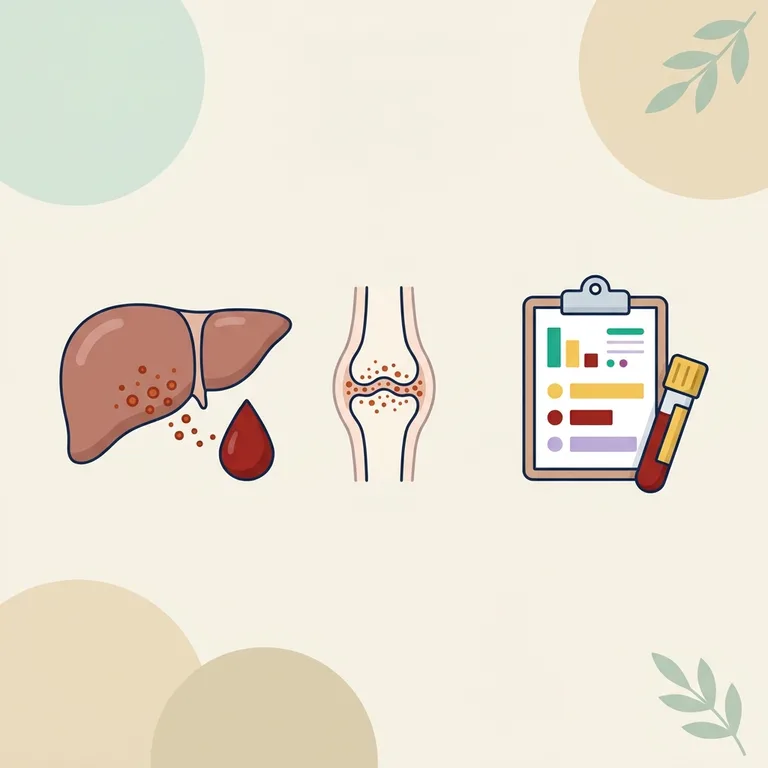
Hemochromatosis makes the body absorb too much iron from food. The excess builds up over years in the liver, pancreas, heart and joints. It is usually inherited (two copies of the C282Y change in the HFE gene). Blood tests find it early: high transferrin saturation, then high ferritin. Regular blood removal (phlebotomy) brings iron down and prevents most damage.
What is hemochromatosis, at a glance?
In hemochromatosis, the hormone that limits iron absorption (hepcidin) is made in too small amounts, so the gut keeps taking in iron the body does not need[3]. The body has no natural way to get rid of it, so iron accumulates in the organs[1].
| Topic | Key facts |
|---|---|
| Other names | Hereditary hemochromatosis, HFE hemochromatosis, iron overload disease |
| How common | About 1 million people in the United States have the most common type[8]; two C282Y copies in 0.44% of non-Hispanic white Americans, much fewer in other groups[4] |
| Usual onset | Men between 40 and 60; women mostly after menopause[8] |
| Key tests | Transferrin saturation, ferritin, HFE gene test, liver tests, sometimes liver MRI[1][2] |
| Main treatment | Therapeutic phlebotomy, about a pint of blood at a time[7] |
What are the symptoms of hemochromatosis?
Many people have no symptoms for years, and iron is found on a routine blood test. When symptoms appear, they are vague and come on slowly[7][9]:
- Common Tiredness and weakness that rest does not fix.
- Common Joint pain, especially in the knees and the hands; the knuckles of the index and middle fingers are a typical spot[5][7].
- Possible Low sex drive or erectile dysfunction; irregular or missed periods in women[9].
- Possible Pain in the upper right belly, over the liver, and weight loss[7][8].
- Possible Brain fog, mood swings, low mood or anxiety[9].
- Rare Gray, metallic or bronze skin, and signs of complications: cirrhosis, diabetes, heart failure or liver cancer[3][7].
When to see a doctor
- Emergency: call 911 for vomiting blood, black tarry stools, sudden confusion or drowsiness, chest pain or severe shortness of breath: possible signs of advanced liver or heart damage.
- Within 24 to 48 hours if you have yellow skin or eyes, a swelling belly, swollen legs, or new breathlessness or palpitations.
- At your next appointment if a parent, brother or sister has hemochromatosis, even if you feel well[9], or if your transferrin saturation or ferritin came back high; a ferritin above 1,000 ng/mL calls for a liver assessment[2].
What causes hemochromatosis, and who gets it?
Hereditary hemochromatosis is by far the most frequent form. It is caused mainly by two copies of the C282Y variant of the HFE gene, one inherited from each parent[1][8]. People with a single copy are carriers and usually have no problem[8]. Rarer types involve other genes (HJV, HAMP, TFR2, SLC40A1), and one juvenile form can damage the heart before age 30[3][8].
- Ancestry: most common with northern European, especially Irish, Scottish or Welsh, roots[9]. In a UK cohort, 1 person of European descent in 156 carried two C282Y copies[6].
- Sex: periods and pregnancies remove iron, so women are affected later and less often. In an Australian cohort, iron-related disease developed in 28.4% of men with two C282Y copies but in 1.2% of women[5].
- Alcohol and the liver: drinking adds to liver damage, and alcohol, diet and infections can change how severe the disease is[7][8].
Secondary iron overload is a different situation: it comes mostly from repeated blood transfusions for severe anemias such as thalassemia or sickle cell disease, and sometimes from advanced liver disease[7].
How is hemochromatosis diagnosed, and how do you read the blood tests?
The first clue is almost always an iron panel. Transferrin saturation rises first: it shows how much of the iron transport protein is loaded. Ferritin reflects the iron stored in the body and rises as iron builds up[1]. Here is a fictitious report for a 48-year-old man.
| Test | Result | Reference range | Flag |
|---|---|---|---|
| Iron, serum | 212 µg/dL | 60-170 µg/dL | H |
| TIBC | 258 µg/dL | 250-450 µg/dL | |
| Transferrin saturation | 82% | 20-50% | H |
| Ferritin | 640 ng/mL | 24-336 ng/mL | H |
| ALT | 61 U/L | 7-56 U/L | H |
- Iron and TIBC: serum iron swings during the day, so it is never read alone; TIBC is normal or low here.
- Transferrin saturation 82%: above the 50% threshold used in men and postmenopausal women (45% in women before menopause)[1].
- Ferritin 640 ng/mL: above 300 ng/mL in men (200 ng/mL in women), so stores are high; below 1,000 ng/mL, the risk of advanced liver scarring is low[1][2].
- ALT slightly high: the liver is under strain; see high liver enzymes.
- Reference range: each lab sets its own; the one printed on your report is the one that applies.
Got an iron panel with H flags? BloodSense reads your whole report, line by line, and shows how saturation, ferritin and liver tests fit together before you see your doctor.
Analyze my blood testHigh iron numbers are a signal, not a diagnosis. The next step is the HFE gene test, a simple blood sample[1][7]:
| HFE result | What it usually means | Source |
|---|---|---|
| C282Y / C282Y (two copies) | Hemochromatosis confirmed when saturation and ferritin are high; no biopsy needed | EASL 2022[1] |
| C282Y / H63D | Iron overload possible but usually mild; other causes of high ferritin are looked for | ACG 2019[2], UK Biobank[6] |
| One copy only (carrier) | Usually no iron overload; high ferritin has another cause | MedlinePlus[8], ACG 2019[2] |
| Other genotype, high iron | Liver MRI (or rarely a biopsy) to measure liver iron; rare genes tested in a specialist center | EASL 2022[1] |
A high ferritin is much more often due to something else. In people without two C282Y copies, fatty liver disease and alcohol-related liver disease are more common causes than hemochromatosis[2]. That is why a high ferritin with a normal transferrin saturation rarely points to hemochromatosis. Liver MRI has largely replaced biopsy to measure liver iron[2].
How is hemochromatosis monitored?
- Ferritin during every phase of treatment, to adjust the rhythm of phlebotomies[7]. The targets are below 50 ng/mL while iron is being removed, then below 100 ng/mL for life[1].
- Hemoglobin before each session, so the blood removal does not cause anemia.
- Liver tests (ALT, AST) and an assessment of liver scarring at diagnosis, because the stage of fibrosis guides follow-up[1].
- Regular liver cancer screening (usually by ultrasound) if fibrosis is advanced or cirrhosis is present[1]; see liver cancer.
- Blood sugar (fasting glucose or A1c), since diabetes is a known complication[3][6].
How is hemochromatosis treated?
Treatment works best before organs are damaged: started early, it can prevent cirrhosis, liver cancer, diabetes and joint disease[1].
- Therapeutic phlebotomy: about a pint of blood is removed, like a blood donation. It is done once or twice a week for several months, then every 1 to 3 months, and finally 2 to 4 times a year for life[7][9]. Each session pulls iron out of the stores to make new red blood cells.
- Iron chelation: medicines that bind iron so it leaves in the urine; used when phlebotomy is not possible, mostly in transfusion-related iron overload. They remove iron less efficiently[7].
- Treating complications: diabetes, joint disease such as osteoarthritis, or liver disease are cared for in parallel; both are more frequent with two C282Y copies[6].
In the United States, the American Red Cross accepts people with hereditary hemochromatosis as blood donors if they meet the usual eligibility rules and intervals[10]. Ask your care team whether your maintenance sessions can be done this way.
Can you prevent complications, and how do you live with it?
The gene cannot be changed, but iron damage can be prevented. Most people with treated hemochromatosis do not need a special low-iron diet: diet has a small effect compared with phlebotomy[7].
- Avoid supplements that contain iron or vitamin C, which increases iron absorption[7].
- Check labels for iron-fortified breakfast cereals[9].
- Avoid raw or undercooked shellfish, which can cause a serious infection when the liver is damaged[7].
- Limit alcohol; stop completely if you have cirrhosis[7].
- Tell your parents, brothers, sisters and adult children: they can be tested even without symptoms[9]. When both parents are carriers, each sibling has a 1 in 4 chance of two copies[8].
Do not follow advice to eat more iron-rich foods meant for iron deficiency: it is the opposite problem.
Questions to ask your doctor
- Is my transferrin saturation high, or only my ferritin?
- Do I need the HFE gene test, and what does my genotype mean?
- Is my liver scarred, and do I need an MRI or regular ultrasounds?
- How often will I have phlebotomy, and what ferritin are we aiming for?
- Which relatives should be tested?
Frequently asked questions
Is hemochromatosis serious?
It can be if it goes unnoticed for decades, but many people with two C282Y copies never develop organ damage, especially women[5][6]. Found early and treated, most complications can be prevented[1].
Can women get hemochromatosis?
Yes. Menstruation and pregnancy delay iron buildup, so symptoms tend to appear after menopause. In a UK study, 9.8% of women with two C282Y copies had been diagnosed by the end of follow-up, versus 21.7% of men[6].
Is hemochromatosis the same as high ferritin?
No. Ferritin also rises with fatty liver, alcohol, inflammation and other conditions. Hemochromatosis needs a high transferrin saturation too, and usually two C282Y copies[1][2].
Does a carrier need treatment?
Usually not. A single C282Y or H63D copy rarely causes iron overload; if ferritin is high, doctors look for another cause[2][8].
Related articles
- Transferrin saturationThe first marker to rise in hemochromatosis.
- Ferritin blood testIron stores, and the many other reasons it rises.
- Iron panelIron, TIBC, saturation and ferritin read together.
- CirrhosisThe main liver complication to prevent.
- DiseasesAll our disease guides.
References
- European Association for the Study of the Liver. EASL Clinical Practice Guidelines on haemochromatosis. J Hepatol. 2022;77(2):479-502. doi:10.1016/j.jhep.2022.03.033 (accessed November 18, 2026)
- Kowdley KV, Brown KE, Ahn J, Sundaram V. ACG Clinical Guideline: Hereditary Hemochromatosis. Am J Gastroenterol. 2019;114(8):1202-1218. doi:10.14309/ajg.0000000000000315 (accessed November 18, 2026)
- Girelli D, Busti F, Brissot P, et al. Hemochromatosis classification: update and recommendations by the BIOIRON Society. Blood. 2022;139(20):3018-3029. doi:10.1182/blood.2021011338 (accessed November 18, 2026)
- Adams PC, Reboussin DM, Barton JC, et al. Hemochromatosis and iron-overload screening in a racially diverse population. N Engl J Med. 2005;352(17):1769-1778. doi:10.1056/NEJMoa041534 (accessed November 18, 2026)
- Allen KJ, Gurrin LC, Constantine CC, et al. Iron-overload-related disease in HFE hereditary hemochromatosis. N Engl J Med. 2008;358(3):221-230. doi:10.1056/NEJMoa073286 (accessed November 18, 2026)
- Pilling LC, Tamosauskaite J, Jones G, et al. Common conditions associated with hereditary haemochromatosis genetic variants: cohort study in UK Biobank. BMJ. 2019;364:k5222. doi:10.1136/bmj.k5222 (accessed November 18, 2026)
- National Institute of Diabetes and Digestive and Kidney Diseases (NIDDK). Hemochromatosis (symptoms and causes, diagnosis, treatment, eating and diet). Reviewed January 2020. niddk.nih.gov (accessed November 18, 2026)
- MedlinePlus Genetics. Hereditary hemochromatosis. National Library of Medicine. medlineplus.gov (accessed November 18, 2026)
- NHS. Haemochromatosis. Reviewed March 29, 2023. nhs.uk (accessed November 18, 2026)
- American Red Cross. Eligibility criteria: alphabetical, "Hemochromatosis (Hereditary)". redcrossblood.org (accessed November 18, 2026)
- National Human Genome Research Institute. Genetic Discrimination (GINA). genome.gov (accessed November 18, 2026)
General information only: it does not replace the advice of a doctor who examines you and knows your full results.