Chorionic Villus Sampling (CVS): Preparation, Procedure and Results
The essentials
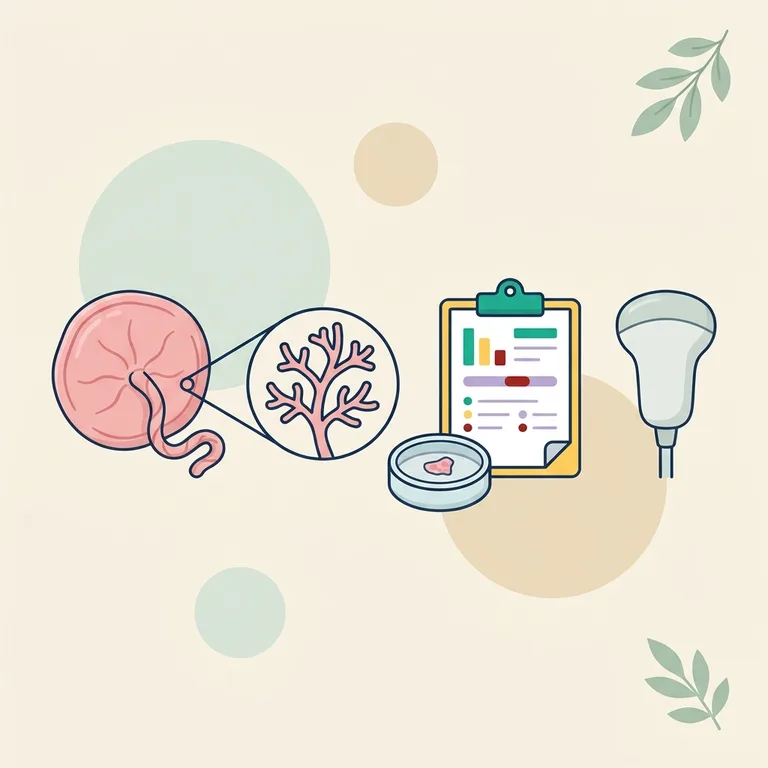
Chorionic villus sampling (CVS) takes a tiny piece of the placenta, usually between 10 and 14 weeks of pregnancy, to check the baby's chromosomes or a specific genetic condition. No fasting is needed. The sampling takes minutes, cramps are common for a few hours, and a first result often comes in about 3 days, the full report in about 2 weeks.
What is chorionic villus sampling and why is it offered?
Chorionic villi are tiny projections of the placenta that usually carry the same genetic material as the baby[1]. CVS is a diagnostic test: it gives an answer, while a screening blood test only estimates a chance[3].
It is usually discussed after a high-chance screening result, a previous affected pregnancy, or a family history such as sickle cell disease, thalassemia or cystic fibrosis[2]. In the United States it is offered to everyone who is pregnant, and choosing it is your decision[3]. Our page on trisomy 21 (Down syndrome) explains how screening and diagnosis fit together.
How do I prepare for chorionic villus sampling?
- Genetic counseling first. It is recommended so you can decide without pressure[1]. Ask which tests will be run on the sample.
- Your Rh status. If you are Rh negative, you may receive Rho(D) immune globulin afterward[1]. Your blood type result shows it, and the indirect Coombs test checks for antibodies.
- Bladder instructions. You may be asked to drink fluids and not urinate, because a full bladder helps guide the needle[1].
- Allergies, especially to iodine or shellfish[1].
- Recent bleeding or infection. Vaginal bleeding during the pregnancy or an infection may lead your team to advise against CVS[4].
- A quiet afternoon. Many people rest for several hours afterward[4]; bring someone with you if you feel anxious.
What happens during the CVS procedure?
- Ultrasound. A painless scan locates the placenta; the gel feels cold[1]. You sign a consent form first.
- Sampling. Most often a thin needle goes through the belly into the placenta (transabdominal CVS), sometimes with local anesthesia. Less often a thin tube or small forceps pass through the cervix (transcervical CVS)[2][4].
- Timing. The sampling takes about 5 to 10 minutes; the visit about 30 minutes[1][2].
What should I expect after CVS?
Period-like cramps for a few hours and light spotting are common; the belly may feel sore after the needle route[2][4]. Most people resume normal activities the next day, avoiding sex, exercise and strenuous effort for 48 to 72 hours if advised[4]. A follow-up ultrasound is often done 2 to 4 days later[1].
When to see a doctor
- Emergency: call 911 for heavy vaginal bleeding, severe belly pain or fainting.
- The same day for fever or chills, fluid leaking from the vagina, contractions, or cramps or bleeding that get worse[4].
- At your next appointment to go over the results, especially one described as mosaic.
How long do CVS results take and how do I read them?
A rapid result (FISH or similar, for chromosomes 13, 18, 21, X and Y) usually comes in 2 to 3 days, a chromosomal microarray in about 7 days and a full karyotype in 1 to 2 weeks[2][3]. If the rapid result and the earlier scan are both normal, waiting for the detailed result before any major decision is recommended[2].
| Test | Result | Expected | Flag |
|---|---|---|---|
| Rapid aneuploidy test (FISH: 13, 18, 21, X, Y) | Normal pattern, female | Two copies of 13, 18, 21 | Normal |
| Karyotype, cultured villi | mos 47,XX,+16[4]/46,XX[16] | 46,XX or 46,XY | A |
| Comment | Mosaic trisomy 16, possibly confined to the placenta. Amniocentesis and growth scans suggested. | ||
- Rapid test: checks only a few chromosomes, so the full analysis confirms it[3].
- "mos" and brackets: two cell lines were seen; the bracketed numbers are how many cells showed each pattern.
- A flag: abnormal, but a finding limited to the placenta occurs in about 1 to 2% of CVS results and does not necessarily affect the baby[4].
Have other prenatal lab results to understand? BloodSense explains each line of your blood test report in plain language and helps you prepare your questions.
Get my lab results explainedA negative result means the baby does not have the conditions tested for; it does not rule out every condition[3].
Which special situations change the plan?
- Twins. If each baby has its own placenta, two samples may be needed[4]; the chance of miscarriage is around 1 in 100[2].
- Before 10 weeks. Very early CVS has rarely been linked to limb differences, one reason it is scheduled later[4].
- Known family variant. For conditions such as spinal muscular atrophy, a specific gene test is done on request[3]: bring the family's genetic result.
What can make a CVS result unclear?
- Placental mosaicism. The placenta can carry a chromosome change the baby does not have; amniocentesis may be offered to check[4]. When it is confirmed as confined to the placenta, small-for-gestational-age babies are more frequent, so growth scans are often added[6].
- Limits of the test. CVS does not detect neural tube defects such as spina bifida, nor most birth defects without a genetic cause[1].
Is CVS riskier than amniocentesis?
CVS is done earlier, at about 10 to 13 weeks; amniocentesis usually from 15 weeks[3]. The NHS quotes a miscarriage chance below 1 in 200 after CVS in most pregnancies[2]. A 2019 meta-analysis of 13,011 procedures put the extra risk due to CVS at 0.2%, and found none measurable against pregnancies of similar background risk[5]. The cell-free DNA test behind the fetal sex blood test carries no procedure risk, but it remains screening.
Questions to ask your doctor
- Which tests will be run on my sample?
- Do I need Rho(D) immune globulin?
- If the result is mosaic, what are the next steps?
Frequently asked questions
Does CVS hurt?
It is usually described as uncomfortable rather than painful[2]. The cervical route feels more like a Pap test[1].
Can CVS tell the baby's sex?
Yes, the chromosome analysis shows XX or XY. If you prefer not to know, say so before results are shared.
Can I go back to work the next day?
Usually yes; most people resume normal activities the next day[4].
Related tests and guides
- Trisomy 21The condition CVS most often confirms or rules out.
- Fetal sex blood testHow cell-free DNA screening works.
- Blood typeKnow your Rh status before the procedure.
References
- MedlinePlus Medical Encyclopedia. Chorionic villus sampling. US National Library of Medicine. Reviewed October 15, 2024. medlineplus.gov (accessed November 18, 2026)
- NHS. Chorionic villus sampling. Reviewed January 3, 2023. nhs.uk (accessed November 18, 2026)
- American College of Obstetricians and Gynecologists. Prenatal Genetic Diagnostic Tests (FAQ). acog.org (accessed November 18, 2026)
- Cleveland Clinic. Chorionic Villus Sampling (CVS). Reviewed August 8, 2024. clevelandclinic.org (accessed November 18, 2026)
- Salomon LJ, Sotiriadis A, Wulff CB, Odibo A, Akolekar R. Risk of miscarriage following amniocentesis or chorionic villus sampling: systematic review of literature and updated meta-analysis. Ultrasound Obstet Gynecol. 2019;54(4):442-451. doi:10.1002/uog.20353 (accessed November 18, 2026)
- Spinillo SL, Farina A, Sotiriadis A, et al. Pregnancy outcome of confined placental mosaicism: meta-analysis of cohort studies. Am J Obstet Gynecol. 2022;227(5):714-727.e1. doi:10.1016/j.ajog.2022.07.034 (accessed November 18, 2026)
General health information only: it does not replace advice from your obstetric team or genetic counselor, who know your pregnancy and full results.