Coughing Up Blood (Hemoptysis): Causes, When to Worry and Tests
The essentials
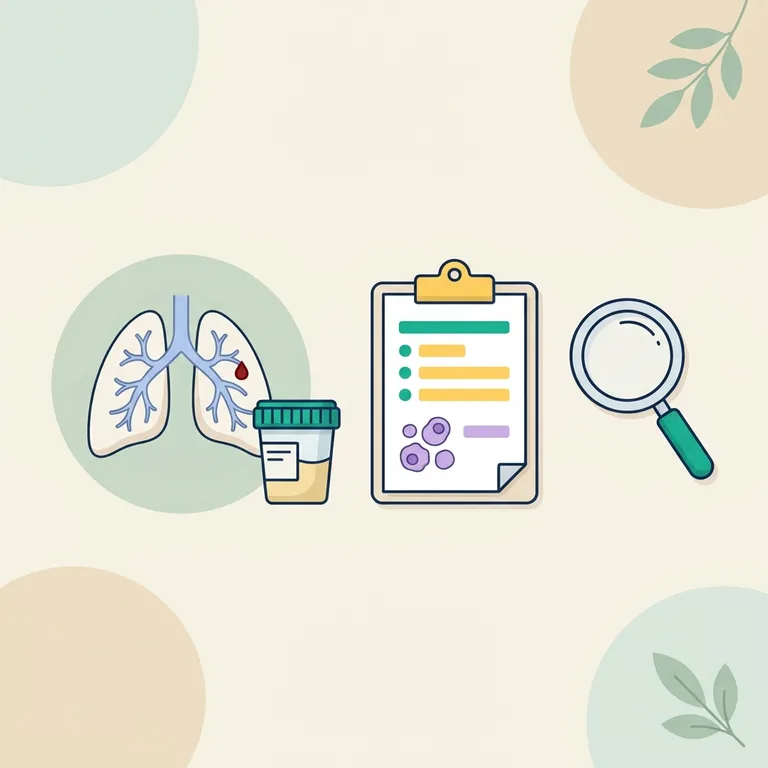
Coughing up blood (hemoptysis) means blood comes from the airways or lungs, usually as streaks in phlegm. Most cases are small and come from a chest infection or bronchitis, but any amount deserves a medical check, and more than a few teaspoons is an emergency. A chest X-ray or CT scan, a blood count and clotting tests are the usual first steps.
When is coughing up blood an emergency?
More than 90% of episodes are mild and stop on their own[1][3]. Heavy bleeding is rare but dangerous: the airways hold only 150 to 200 mL, so blood can block breathing before much is lost[3][5].
When to see a doctor
- Emergency: call 911 if you cough up more than a few spots or a few teaspoons of blood, or any blood with trouble breathing, a very fast heartbeat, chest or upper back pain, or dizziness[6][8]. Do not drive yourself[8].
- Within 24 to 48 hours for small spots or streaks of blood in phlegm, even if you feel well, and sooner with fever, night sweats, weight loss or a blood thinner[6][7][8].
- At your next appointment if a cause was already found, the streaks have stopped and you want to review your results.
Is the blood really coming from the lungs?
Doctors first check where the blood comes from, because blood from the nose or stomach is handled differently[1][2].
- From the lungs: bright red or rust-colored, frothy, mixed with phlegm, brought up by a cough[1][6].
- From the nose or throat: blood dripping down the back of the throat after a nosebleed, with little or no cough[2][9].
- From the stomach: dark, like coffee grounds, brought up with nausea and retching[1]. That is a different problem: see vomiting blood (hematemesis).
What can cause coughing up blood that is not serious?
In a UK study of 4,812 people seen by family doctors, the causes were[2]:
- Common Chest infections (64%): acute bronchitis or pneumonia. Hard coughing breaks tiny vessels and streaks the phlegm.
- Common Asthma (10%) and COPD (8%), often during a flare.
- Possible No cause found (8%). In hospital series this reaches 20% to 50%[1]; these episodes usually settle within 6 months[9].
In children, the usual causes are a lower airway infection or an inhaled object[9].
What serious conditions cause coughing up blood?
- Possible Lung cancer: 6% in primary care[2], 17% in hospital series[3]. The risk is highest from age 40 with 30 or more pack-years of smoking; among smokers with a normal chest X-ray, 9.6% were found to have cancer within 3 years[2].
- Possible Bronchiectasis and cystic fibrosis, widened airways that stay infected[3].
- Possible Tuberculosis: a cough lasting weeks, sometimes with blood, plus fever, night sweats and weight loss[10]. It is the leading cause worldwide[1]; in the US it is rare (0.4% of cases), but more frequent in people born abroad or who have been homeless[2]. It is curable[10].
- Possible Blood thinners, mostly when the blood is thinner than intended[6].
- Rare Pulmonary embolism, a clot in the lung, with sudden breathlessness or chest pain (1% to 3% of cases)[2][3].
- Rare Heart failure or a narrowed mitral valve, when fluid backs up into the lungs (about 4% of cases)[3][7].
- Rare Vasculitis and lupus, which can inflame the lungs and the kidneys at the same time[6][9]; cocaine use[7].
What tests will the doctor order for coughing up blood?
The first goals are to measure blood loss, check clotting and see the lungs. A chest X-ray comes first; a CT scan with contrast is the preferred next step, even after a normal X-ray when cancer risk is high[1][2][4].
| Test | Question it answers | Read more |
|---|---|---|
| Complete blood count | Anemia from blood loss; low platelets; signs of infection | Complete blood count |
| PT/INR and PTT | Blood that clots too slowly, for example on warfarin | Prothrombin time and INR |
| Metabolic panel (creatinine) | Kidney function, before contrast and when vasculitis is suspected | Checked with the blood count |
| Urinalysis | Blood or protein in urine pointing to kidney inflammation | Urinalysis results |
| Sputum tests (culture, AFB smear) | Bacteria, tuberculosis, fungi, abnormal cells | QuantiFERON or a TB skin test if TB is suspected |
| Oxygen level | Whether breathing is affected | Oxygen saturation |
| D-dimer, CT angiography | A clot in the lung | D-dimer test |
| ANCA, anti-GBM, lupus antibodies | Vasculitis or lupus, only when suspected | ANCA test |
| Bronchoscopy | Looks inside the airways and can stop bleeding | Finds the bleeding site in 73% to 93%[3] |
Sources: [1][2][7][9]. A blood type and crossmatch is added when bleeding is heavy[1].
How do I read my results after coughing up blood?
| Test | Result | Reference range | Flag |
|---|---|---|---|
| Hemoglobin | 12.6 g/dL | 13.2-16.6 | L |
| White blood cells | 12.4 x10³/µL | 3.4-9.6 | H |
| Platelet count | 268 x103/µL | 135-317 | |
| INR | 1.0 | 0.9-1.1 | |
| PTT | 29 s | 25-37 | |
| Creatinine | 0.9 mg/dL | 0.7-1.3 | |
| Urinalysis, blood | Negative | Negative | |
| Sputum AFB smear | Negative (1 of 3) | Negative |
- Flag: L is below this lab's range, H above it; ranges vary between labs.
- Hemoglobin 12.6: mildly low. Below 8 g/dL, with low oxygen or low blood pressure, admission is advised[2].
- White cells 12.4: fits an infection, but does not rule out another cause.
- Normal platelets, INR and PTT: clotting is not the problem.
- Normal creatinine and urine: no sign of kidney involvement; contrast for a CT is possible.
- AFB smear 1 of 3: TB testing uses several samples; wait for all of them and the culture.
Got your blood count, clotting tests or sputum results after coughing up blood? BloodSense explains each line of your report in plain words before your follow-up visit.
Explain my lab reportIn this example, the age and smoking history mean a chest CT is still advised even if the X-ray is clear[2][4]. For heavy bleeding, an artery embolization through a catheter stops it in 75% to 98% of cases[3].
What should I note before seeing the doctor?
- When it started, how often, and roughly how much: streaks, a teaspoon, more (a photo helps)
- Color: bright red, pink and frothy, rust, or dark like coffee grounds
- Whether it came with a cough, a nosebleed or vomiting
- Fever, night sweats, weight loss, breathlessness or chest pain
- Smoking (pack-years), past lung disease, recent travel or contact with TB
- Blood thinners, aspirin and anti-inflammatory painkillers, with the last dose
Questions to ask your doctor
- Do I need a CT scan even if my X-ray is normal?
- Should I be tested for tuberculosis?
- What amount of blood should make me go to the emergency room?
Frequently asked questions
Is a little blood in phlegm during a cold normal?
It is common with a hard cough, and usually comes from an airway infection[2]. Still, see a doctor for any blood in phlegm, and go back if it lasts more than a week[7][8].
Why is there blood in my phlegm in the morning?
Blood from the nose or the back of the throat, for example after a small nosebleed, can drip down and be coughed up later[9]. If it keeps happening, the doctor will still check the lungs.
Is coughing up blood always a sign of lung cancer?
No. Infections are by far the most frequent cause[2]. Cancer is looked for mainly from age 40, in smokers, or when the blood keeps coming back[2][9].
Should I stop my blood thinner if I cough up blood?
Not on your own: call the doctor who prescribed it the same day, or 911 if the bleeding is heavy. A clotting test (INR or anti-Xa) shows if the dose is too strong[6][9].
Related tests and guides
- Tuberculosis symptoms and testsA long cough with blood, fever and night sweats.
- Vomiting bloodWhen the blood comes from the stomach instead.
- Hemoglobin blood testHow much blood loss your count shows.
- D-dimer testThe first blood test when a lung clot is suspected.
- DiseasesAll our disease and symptom guides.
References
- O'Gurek D, Choi HYJ. Hemoptysis: evaluation and management. Am Fam Physician. 2022;105(2):144-151. aafp.org (accessed November 18, 2026)
- Earwood JS, Thompson TD. Hemoptysis: evaluation and management. Am Fam Physician. 2015;91(4):243-249. aafp.org (accessed November 18, 2026)
- Ittrich H, Bockhorn M, Klose H, Simon M. The diagnosis and treatment of hemoptysis. Dtsch Arztebl Int. 2017;114(21):371-381. doi:10.3238/arztebl.2017.0371 (accessed November 18, 2026)
- Expert Panel on Thoracic Imaging; Olsen KM, Manouchehr-Pour S, Donnelly EF, et al. ACR Appropriateness Criteria® Hemoptysis. J Am Coll Radiol. 2020;17(5S):S148-S159. doi:10.1016/j.jacr.2020.01.043 (accessed November 18, 2026)
- Davidson K, Shojaee S. Managing massive hemoptysis. Chest. 2020;157(1):77-88. doi:10.1016/j.chest.2019.07.012 (accessed November 18, 2026)
- MedlinePlus Medical Encyclopedia. Coughing up blood. Reviewed April 1, 2025. medlineplus.gov (accessed November 18, 2026)
- Cleveland Clinic. Coughing up blood (hemoptysis). Reviewed October 10, 2022. clevelandclinic.org (accessed November 18, 2026)
- NHS. Coughing up blood. Reviewed June 13, 2024. nhs.uk (accessed November 18, 2026)
- Merck Manual Professional Version. Hemoptysis. Reviewed November 2025. merckmanuals.com (accessed November 18, 2026)
- World Health Organization. Tuberculosis: fact sheet. November 12, 2026. who.int (accessed November 18, 2026)
- Centers for Medicare & Medicaid Services. Emergency Medical Treatment & Labor Act (EMTALA). cms.gov (accessed November 18, 2026)
This article is general health information. It does not replace a medical examination, diagnosis or treatment. If you are coughing up more than a little blood, seek care without waiting.