









TB Skin Test (PPD) Results: What Positive and Negative Mean
The essentials
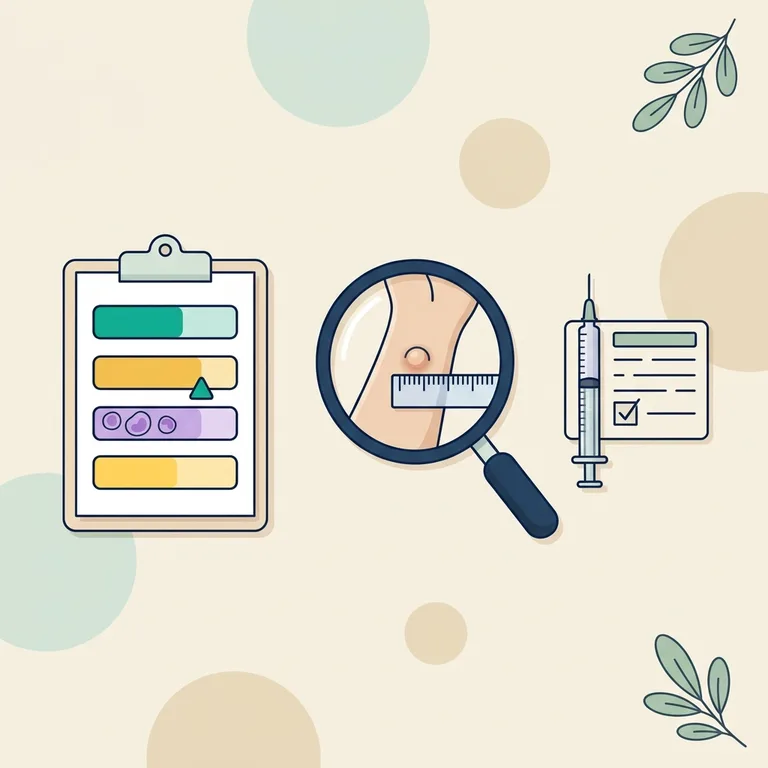
A TB skin test (PPD or Mantoux test) is read 48 to 72 hours after the injection by measuring the firm bump, not the redness, in millimeters. Whether 5, 10 or 15 mm counts as positive depends on your own risk. A positive result shows past contact with TB germs: it does not mean you are sick or contagious.
How do I read my TB skin test result?
The result is a size in millimeters, then a verdict: positive or negative. The same size can be positive for one person and negative for another, because the cut-off depends on your risk[1]. Here is a fictitious record for a 29-year-old nurse starting a hospital job.
| Item | Result | Reference | Flag |
|---|---|---|---|
| Test | Mantoux TST, 0.1 mL PPD tuberculin, left forearm | - | - |
| Time from placement to reading | 60 hours | 48-72 hours | - |
| Redness (erythema) | Present, not measured | Not used | - |
| Induration (firm swelling) | 12 mm | Positive if ≥ 10 mm for this risk group | POS |
| Previous test (12 months ago) | 0 mm | - | - |
| Interpretation | Positive, new since last test | Negative | A |
- Test: tuberculin, a purified protein derivative (PPD) of the TB germ, is injected just under the skin of the forearm[1]. It cannot give you TB[4].
- Timing: after 72 hours, the reading is not valid and a new test is placed[1].
- Redness: ignored. Only the hard, raised area counts[1].
- Induration: 12 mm is above the 10 mm cut-off for health care workers, but would be negative for a person with no risk factor (cut-off 15 mm)[1].
- Previous test: after a negative test in the past 2 years, 10 mm or more counts as positive: a change like this suggests a recent infection, which weighs in favor of preventive treatment.[3].
Skin test done with blood work? BloodSense explains every value of your full report in plain words, before your appointment.
Explain my lab reportWhat is the PPD test used for?
The test answers one question: has your immune system ever met the bacteria that cause tuberculosis? About a quarter of the world's population has been infected; most feel well and cannot spread it[8]. That silent stage is called latent TB infection. Our guide to tuberculosis symptoms and treatment explains the difference with active disease.
You may need it[4]:
- after close contact with someone who has active TB;
- for work in health care, a shelter, a prison or a nursing home;
- if you were born in, or often travel to, a country where TB is common;
- before an organ transplant or treatments that weaken the immune system, such as those used for rheumatoid arthritis, Crohn's disease or psoriasis;
- with HIV or diabetes, which make a sleeping infection more likely to wake up.
The skin test needs two visits; the blood alternative (IGRA, such as QuantiFERON) needs one. US guidelines prefer the blood test from age 5 after a BCG vaccine or when a return visit is unlikely, and suggest the skin test for healthy children under 5[5]; the World Health Organization accepts both[9]. For the blood version, see QuantiFERON test results.
What size of TB skin test is positive?
There is no single normal value: the higher your risk, the lower the cut-off. "0 mm" means no firm bump.
| Positive if induration is | For whom | Source |
|---|---|---|
| 5 mm or more | HIV; recent contact with infectious TB; chest X-ray suggesting old TB; organ transplant; weakened immunity (prednisone 15 mg a day or more, TNF-blocking drugs) | CDC[1] |
| 10 mm or more | Born in a country where TB is common; drug use; TB lab staff; residents and staff of high-risk group settings; diabetes, severe kidney disease, silicosis, some cancers; low body weight; children under 5 | CDC[1] |
| 10 mm or more | Health care workers; anyone whose test was negative within the past 2 years | MedlinePlus[3] |
| 15 mm or more | People with no known risk factor for TB | CDC[1] |
Other countries, especially where BCG is given at birth, use their own cut-offs. Your clinic's interpretation takes priority over this table.
What does a positive TB skin test mean?
You have probably met TB germs at some point, but the test cannot tell a sleeping infection from an active one. A chest X-ray, sometimes a sputum (phlegm) test, comes next[2]. If they are normal and you have no symptoms, it is latent TB infection.
Keep perspective: more than 95% of people with a positive skin or blood test did not develop TB disease during follow-up[7]; over a lifetime, about 5 to 10% of infected people become ill[8]. Short preventive treatments of 3 or 4 months lower that risk[1]; your doctor may check your liver enzymes during treatment.
Why it can be positive:
- Common A true infection, often years old.
- Possible The BCG vaccine. Given in infancy, it rarely explains a positive test 10 years later (1% of people in a review of 24 studies); given after age 1, it causes more frequent, longer-lasting reactions (21% at 10 years)[6].
- Possible A "booster" effect: in older adults infected long ago, a first test can wake up the immune memory so that the next one reads positive. A second test placed shortly after a first negative one, at the start of regular screening (two-step testing), avoids mistaking this for a new infection[1].
- Rare Other mycobacteria found in soil and water (0.1 to 2.3% of people depending on the region)[6], a measuring error or the wrong product[1].
When infection was unlikely to begin with, US guidelines suggest a second test; you count as infected only if both are positive[5].
What does a negative TB skin test mean?
Infection is unlikely[2]: without BCG, the test reads negative in about 97% of people who are not infected[7]. It can still miss an infection[1]:
- Common Infection within the past 8 to 10 weeks, too recent to show; after a contact, a second test is often planned.
- Possible A weakened immune system ("anergy"): HIV, steroids, cancer treatment. A very low lymphocyte count is a clue.
- Possible A live vaccine, such as measles, given in the previous month.
- Rare Babies under 6 months, an injection placed too deep, or a reading error.
With symptoms, HIV or a recent exposure, more tests may follow a negative result[2].
What can affect a TB skin test result?
No fasting is needed[4]. Before the injection, check that:
- You can come back 2 to 3 days later; a reading after 72 hours does not count[1].
- You mentioned any previous positive test or strong reaction (blisters, open sore, severe allergy): the test is then not repeated[1][3].
- You mentioned a BCG vaccine and when you got it[3].
- No live vaccine (MMR, chickenpox, yellow fever, oral typhoid) in the past month; the same day is fine[1]. See measles and the MMR vaccine.
- You listed medicines that lower immunity, such as steroids[3].
- Afterwards, leave the spot uncovered and do not scratch it; water is fine, a cold cloth eases itching[4].
Pregnancy and HIV are not reasons to avoid the test[1].
When to see a doctor
- Emergency: call 911 if you cough up more than streaks of blood, have trouble breathing, or have a severe allergic reaction (swelling of the face or throat) after the injection.
- Within 24 to 48 hours if your arm blisters or ulcerates, or if the test is positive with a cough over 3 weeks, fever, night sweats or weight loss[4].
- At your next appointment for a positive test without symptoms, or one never read.
Questions to ask your doctor
- Which cut-off (5, 10 or 15 mm) applies to me, and why?
- Could my BCG vaccine explain this result, and would a blood test help?
- Do I need a chest X-ray, and when will I get the result?
- If it is latent TB, which preventive treatment do you suggest, and for how long?
Frequently asked questions
Can I read my own TB skin test at home?
No. A trained health care worker must measure it; redness can make a negative test look positive to an untrained eye[1]. Missed the 72-hour window? A new test is placed[2].
Am I contagious if my PPD test is positive?
Not if the infection is latent: infected people who are not sick do not spread it[8]. Only active TB of the lungs or throat is contagious, hence the chest X-ray.
Will my skin test stay positive after treatment?
Often, yes: a positive reaction can persist after TB medicine[2], so later screening relies on symptoms or a chest X-ray rather than a new skin test[3].
Related tests and pages
- Tuberculosis symptoms and treatmentLatent versus active TB, symptoms and how it is treated.
- QuantiFERON TB blood testThe one-visit alternative, unaffected by BCG.
- HIV test resultsHIV lowers the positive cut-off to 5 mm.
- Chronic kidney diseaseOne of the conditions that raise TB risk.
- Diseases and conditionsAll our guides to diseases and their tests.
References
- Centers for Disease Control and Prevention. Tuberculin Skin Testing: Information for Health Care Providers (CS 320275-C). September 2020. cdc.gov (accessed November 14, 2026)
- Centers for Disease Control and Prevention. Testing for Tuberculosis: Skin Test. cdc.gov (accessed November 14, 2026)
- MedlinePlus. PPD skin test. Medical Encyclopedia. US National Library of Medicine. medlineplus.gov (accessed November 14, 2026)
- MedlinePlus. Tuberculosis Screening. Medical Tests. US National Library of Medicine. medlineplus.gov (accessed November 14, 2026)
- Lewinsohn DM, Leonard MK, LoBue PA, et al. Official American Thoracic Society/Infectious Diseases Society of America/Centers for Disease Control and Prevention Clinical Practice Guidelines: Diagnosis of Tuberculosis in Adults and Children. Clin Infect Dis. 2017;64(2):111-115. doi:10.1093/cid/ciw778 (accessed November 14, 2026)
- Farhat M, Greenaway C, Pai M, Menzies D. False-positive tuberculin skin tests: what is the absolute effect of BCG and non-tuberculous mycobacteria? Int J Tuberc Lung Dis. 2006;10(11):1192-1204. PMID 17131776 (accessed November 14, 2026)
- Pai M, Denkinger CM, Kik SV, et al. Gamma interferon release assays for detection of Mycobacterium tuberculosis infection. Clin Microbiol Rev. 2014;27(1):3-20. doi:10.1128/CMR.00034-13 (accessed November 14, 2026)
- World Health Organization. Tuberculosis: fact sheet. November 2026. who.int (accessed November 14, 2026)
- World Health Organization. WHO consolidated guidelines on tuberculosis: module 3: diagnosis: tests for TB infection. Geneva: WHO; 2022. who.int (accessed November 14, 2026)
This page gives general information about the tuberculin skin test. It does not replace the advice of a doctor or nurse who knows your health and your exposure history.