










Polymyalgia Rheumatica (PMR): Symptoms, Blood Tests and Treatment
The essentials
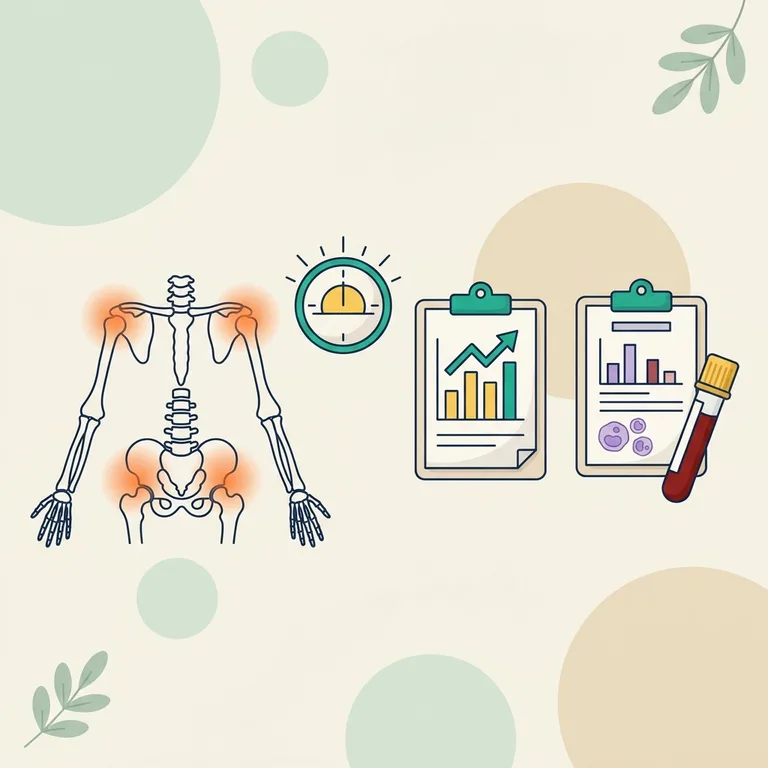
Polymyalgia rheumatica (PMR) causes pain and marked morning stiffness in both shoulders, often the neck and hips too, in people over 50. No single test proves it: doctors combine the symptoms, a raised sed rate or CRP, normal results for tests that point to other diseases, and a fast response to steroids. A new headache, jaw pain when chewing or any change in vision can mean giant cell arteritis and needs care the same day.
What is polymyalgia rheumatica (PMR)?
PMR is an inflammatory rheumatic disease. The inflammation sits around the shoulder and hip joints, in tendons, joint capsules and the small fluid sacs called bursae, rather than in the muscles themselves[5][11].
| Topic | Key facts |
|---|---|
| Other names | PMR; "pseudo-polyarthrite rhizomélique" in French |
| Who gets it | Almost only people over 50, peak at 70 to 79; women 2 to 3 times as often as men; most common in Scandinavia and in North Americans of Scandinavian descent[6] |
| How common | About 64 new cases per 100,000 people aged 50 or more each year in Minnesota, mean age 74[8]; lifetime risk 2.4% for women, 1.7% for men[5] |
| Key tests | Sed rate (ESR), CRP, blood count, rheumatoid factor, anti-CCP, CK, TSH |
What are the symptoms of polymyalgia rheumatica?
Symptoms build up over days to weeks and affect both sides of the body[5].
- Common Aching and stiffness in both shoulders and upper arms, often the neck: combing your hair or putting on a coat becomes hard[5].
- Common Morning stiffness lasting more than 45 minutes, easing by the afternoon[2][5].
- Common Hip and thigh pain: getting out of bed, rising from a chair or climbing stairs is difficult[5].
- Common Fatigue, sometimes low mood[11].
- Possible Low fever, loss of appetite, weight loss[6].
- Rare Signs of giant cell arteritis: new headache, tender scalp, jaw pain when chewing, vision problems.
Muscle strength is kept: real weakness points to another disease[6]. Widespread pain with normal inflammation tests suggests fibromyalgia; pain in one shoulder only is more often a tendon problem or bursitis.
When should I see a doctor?
When to see a doctor
- Emergency: call 911 if you suddenly lose sight, see double, notice a shadow over one eye or have signs of a stroke. With PMR, this can be giant cell arteritis reaching the arteries of the eye or brain[5].
- The same day for a new headache, a tender scalp, jaw pain when chewing or a high fever. European recommendations ask for a specialist review within 24 hours when giant cell arteritis is suspected[4].
- At your next appointment, within a week or two for aching and morning stiffness in both shoulders or hips that lasts more than a few days.
What causes polymyalgia rheumatica, and who is at risk?
The cause is unknown[11]. An inflammatory messenger, interleukin-6, is involved: drugs that block its receptor calm the disease[9][10]. The main risk factors are age over 50, female sex and Northern European origin. A PMR-like illness can also follow cancer treatment with immune checkpoint inhibitors[6]. Unlike many autoimmune diseases, PMR has no specific antibody.
The link with giant cell arteritis
About 5 to 10% of people with PMR later develop giant cell arteritis (temporal arteritis)[5]. When scans are done systematically, about one person in four with new PMR and no headache already has silent inflammation of large arteries (23% overall, 29% with PET scans)[7].
How is polymyalgia rheumatica diagnosed, and what do the blood tests show?
No blood test alone confirms or excludes PMR[11]. The diagnosis rests on typical symptoms, raised inflammation markers, the exclusion of look-alike diseases and a quick response to steroids[1][6]. A basic panel is drawn before treatment to rule out mimics[3][6].
| Test | Usual result in PMR | If different |
|---|---|---|
| Sed rate (ESR) and CRP | Raised above the person's usual level[5] | Normal values do not exclude PMR if your baseline is low[5] |
| Complete blood count | Often mild anemia with normal-sized red cells[5] | High platelets: more often hidden artery inflammation[7] |
| Rheumatoid factor, anti-CCP | Negative[2] | Positive: late-onset rheumatoid arthritis[6] |
| CK | Normal | High with weakness: muscle inflammation[6] |
| TSH, calcium, vitamin D | Normal | Thyroid or bone disorders that cause aching[6] |
| Protein electrophoresis | No abnormal band | A monoclonal band can point to myeloma[6] |
| Glucose, HbA1c, creatinine, liver tests | Usually normal | Baseline before steroids, which can raise blood sugar[6] |
| Test | Result | Reference range | Flag |
|---|---|---|---|
| Sed rate (ESR), Westergren | 58 mm/hr | 0-30 mm/hr | H |
| C-reactive protein (CRP) | 3.9 mg/dL | < 1.0 mg/dL | H |
| Hemoglobin | 11.6 g/dL | 12.0-15.5 g/dL | L |
| Rheumatoid factor | < 10 IU/mL | < 14 IU/mL | Negative |
| CCP antibody, IgG | < 16 units | < 20 units | Negative |
| Creatine kinase (CK), total | 71 U/L | 26-192 U/L | |
| TSH | 1.8 mIU/L | 0.45-4.50 mIU/L |
- Flag: H means above the laboratory's range, L below it. The range is the lab's own; yours may differ.
- ESR 58, CRP 3.9 mg/dL (39 mg/L): clear inflammation. It fits PMR, but an infection or a cancer can give the same numbers[1].
- Hemoglobin L: mild anemia is common in PMR[5].
- Negative RF and anti-CCP, normal CK and TSH: they make rheumatoid arthritis, muscle and thyroid disease less likely[2][6].
Stiff shoulders and a report full of H and L flags? BloodSense reads your whole report, sed rate, CRP, blood count and antibodies, and explains each line before you see your doctor.
Get my blood test explainedThe 2012 EULAR/ACR score
For people aged 50 or more with aching in both shoulders and a raised CRP or ESR, this research score adds: morning stiffness over 45 minutes (2 points), hip pain or stiffness (1), negative rheumatoid factor and anti-CCP (2), no pain in other joints (1). A total of 4 or more classifies PMR, with 68% sensitivity and 78% specificity; shoulder and hip ultrasound can add points[2]. It is not a diagnostic test[5].
Shoulder and hip ultrasound is the first imaging test when needed[6]. Symptoms usually improve dramatically within days of starting steroids, and no clear improvement after a week should prompt a rethink[5]. Unlike giant cell arteritis, treatment can usually wait until the work-up is done[4]. Atypical features (age under 50, swollen joints, marked weight loss, low ESR and CRP) call for a rheumatologist[6].
Which tests are used to monitor PMR, and how often?
A common schedule is a visit at 2 to 4 weeks, then at 3, 6, 9 and 12 months, with extra visits during a relapse[6].
| Check | Why | When |
|---|---|---|
| CRP and ESR | Inflammation control, suspected relapse | At visits and when symptoms return[5] |
| HbA1c | Steroid-related diabetes | At diagnosis, yearly, and 3 months after a dose increase[5] |
| Blood pressure, lipid panel | Heart risk | At diagnosis, then yearly[5] |
| Bone density (DEXA) | Steroid-related osteoporosis | At diagnosis, then at least every 3 years[5] |
| Eye check | Cataract, glaucoma | About 2 months after starting steroids, then yearly[5] |
| Blood count, liver tests, lipids | Side effects of methotrexate or interleukin-6 blockers | As the prescriber plans[5][12] |
Two traps. Steroids lower CRP and ESR, so a relapse may move them only a little; a normal CRP with returning pain can also mean steroid withdrawal or low cortisol production[5]. And interleukin-6 blockers lower CRP directly: in the sarilumab label, CRP fell to normal within 2 weeks[12]. On these drugs, symptoms count more than the CRP line.
How is polymyalgia rheumatica treated?
Steroids. A moderate daily dose of prednisone or prednisolone usually brings relief within days, then the dose is lowered step by step over 9 to 12 months. About half of people finish without a relapse; 51% still take steroids after 2 years and 25% after 5 years[5]. After a few weeks of steroids the body can make less cortisol, sometimes for a year after stopping: never stop them abruptly, and follow your "sick day rules"[5].
Bone protection. British guidance recommends a bisphosphonate for everyone starting steroids for PMR, unless it is unsuitable; 9.5% of people with PMR had a fracture within 5 years in one study[5].
Methotrexate can be added early or after a relapse to stop steroids sooner[4][5].
Interleukin-6 receptor blockers. Sarilumab is FDA-approved for PMR that responds poorly to steroids or flares when the dose is lowered[12]. In relapsing PMR, sustained remission at one year reached 28% with sarilumab versus 10% with placebo, with less than half the total steroid intake[9]. Tocilizumab, used off-label, let 49% of steroid-dependent patients stop prednisone at 24 weeks, versus 20% with placebo[10].
How can I live well with polymyalgia rheumatica?
- Keep moving: aerobic exercise for blood sugar and blood pressure, strength and balance work against muscle loss and falls, stretching for the shoulders[5].
- Carry your steroid card; ask about vaccinations and report fever early[5].
- Calcium and vitamin D are usually advised while on steroids[6]; no diet cures PMR.
Questions to ask your doctor
- Should another disease be ruled out before we call this PMR?
- Do I need a scan to look for artery inflammation?
- What is my tapering plan, and what do I do if the pain returns?
- Do I need bone protection, or a drug to use less steroid?
Frequently asked questions
Does polymyalgia rheumatica shorten life expectancy?
No. In a population study over 45 years, people with PMR lived at least as long as others of the same age[8].
Can PMR go away?
Untreated, it rarely improves[11]. Treated, most people reach remission and stop steroids, often after 1 to 2 years. After 6 months without a steroid prescription, restarting is unlikely[5].
Does polymyalgia rheumatica affect the legs?
The hips and thighs, yes. Pain in the feet or hands, or swollen joints, is less typical and points to another cause[2][6].
Why does the pain come back when the steroid dose goes down?
Up to two thirds of people relapse, usually during the taper. The usual step is to go back to the last dose that worked for 2 to 4 weeks, then taper more slowly. Withdrawal aches can mimic a relapse[5].
Related articles
- Sed rate (ESR)How the sedimentation rate is measured and read
- Giant cell arteritisThe artery disease that can accompany PMR
- CRP blood testThe fast inflammation marker checked at visits
- Rheumatoid arthritisThe main disease to rule out after 60
References
- Dejaco C, Matteson EL. Polymyalgia rheumatica. N Engl J Med. 2026;394(11):1097-1109. doi:10.1056/NEJMcp2506817. PubMed (accessed November 10, 2026)
- Dasgupta B, Cimmino MA, Maradit-Kremers H, et al. 2012 provisional classification criteria for polymyalgia rheumatica: a European League Against Rheumatism/American College of Rheumatology collaborative initiative. Ann Rheum Dis. 2012;71(4):484-492. doi:10.1136/annrheumdis-2011-200329 (accessed November 10, 2026)
- Dejaco C, Singh YP, Perel P, et al. 2015 recommendations for the management of polymyalgia rheumatica: a European League Against Rheumatism/American College of Rheumatology collaborative initiative. Ann Rheum Dis. 2015;74(10):1799-1807. doi:10.1136/annrheumdis-2015-207492 (accessed November 10, 2026)
- Mukhtyar CB, Nikiphorou E, Bartoletti A, et al. 2025 EULAR recommendations for the management of polymyalgia rheumatica and primary large vessel vasculitis. Ann Rheum Dis. 2026 (online July 21, 2026). doi:10.1016/j.ard.2026.06.009 (accessed November 10, 2026)
- Toyoda T, Bhide S, Boland C, et al. The 2026 British Society for Rheumatology guideline for the treatment of polymyalgia rheumatica. Rheumatology (Oxford). 2026;65(10). doi:10.1093/rheumatology/keag502. Full text (PMC) (accessed November 10, 2026)
- Tengesdal S, Diamantopoulos AP, Brekke LK, et al. Norwegian society of rheumatology recommendations on diagnosis and treatment of patients with polymyalgia rheumatica: a narrative review. BMC Rheumatol. 2024;8(1):58. doi:10.1186/s41927-024-00422-6 (accessed November 10, 2026)
- Hemmig AK, Gozzoli D, Werlen L, et al. Subclinical giant cell arteritis in new onset polymyalgia rheumatica: a systematic review and meta-analysis of individual patient data. Semin Arthritis Rheum. 2022;55:152017. doi:10.1016/j.semarthrit.2022.152017 (accessed November 10, 2026)
- Raheel S, Shbeeb I, Crowson CS, Matteson EL. Epidemiology of polymyalgia rheumatica 2000-2014 and examination of incidence and survival trends over 45 years: a population-based study. Arthritis Care Res (Hoboken). 2017;69(8):1282-1285. doi:10.1002/acr.23132. PubMed (accessed November 10, 2026)
- Spiera RF, Unizony S, Warrington KJ, et al. Sarilumab for relapse of polymyalgia rheumatica during glucocorticoid taper. N Engl J Med. 2023;389(14):1263-1272. doi:10.1056/NEJMoa2303452. PubMed (accessed November 10, 2026)
- Devauchelle-Pensec V, Carvajal-Alegria G, Dernis E, et al. Effect of tocilizumab on disease activity in patients with active polymyalgia rheumatica receiving glucocorticoid therapy: a randomized clinical trial. JAMA. 2022;328(11):1053-1062. doi:10.1001/jama.2022.15459. Full text (PMC) (accessed November 10, 2026)
- MedlinePlus Medical Encyclopedia. Polymyalgia rheumatica. US National Library of Medicine. medlineplus.gov (accessed November 10, 2026)
- Kevzara (sarilumab) injection, prescribing information. DailyMed, US National Library of Medicine. dailymed.nlm.nih.gov (accessed November 10, 2026)
This page is general information and does not replace a doctor's advice. Blood tests alone cannot confirm or rule out polymyalgia rheumatica. Do not start, change or stop steroids without medical advice, and seek emergency care for any sudden change in vision.